Recorded 23 July 2026 · 92 min
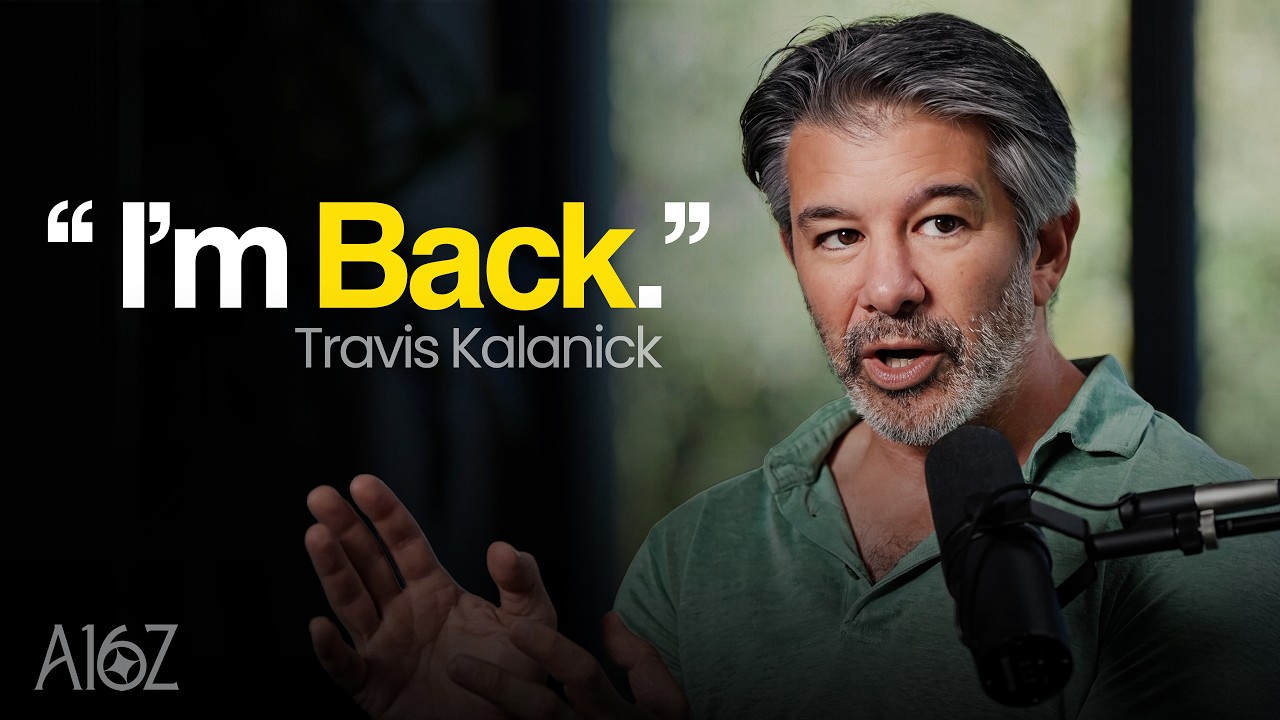
Travis Kalanick argues that the physical economy can be run like a computer: manufacturing is the CPU, real estate is storage, and transport is the network. Uber digitized the network, he says, and his new company Atoms, which merges his food, mining and autonomy businesses, is a bet on the other two layers. He makes the case to Ben Horowitz, who wanted a stake in all of it.
The tension lies between an elegant framework and the capacity to execute it. Kalanick says the limit is whether he can solve problems as fast as he creates them, a rule now tested as Atoms leaves eight years of stealth. The talk also revisits a 2011 funding round that Kalanick and Horowitz remember differently.
Uncapped anchor auction — ▶ 3:03
Kalanick ran Uber's 2011 Series B as a winner-takes-all auction in which one lead sets the price and the rest follow. His tactic, which he calls the uncapped anchor, was to tell each investor the price was at least a stated number with no ceiling, starting low. Each new conversation raised the floor, from at least 2x the previous round to at least 3x, and he called earlier bidders with the new figure. The process reached a $375 million pre-money price, with another investor nearly bidding 400. He calls it a little crass and attributes it to a pre-Uber mindset of acting as if he would not eat tomorrow.
Two memories of 2011 — ▶ 5:34
In Kalanick's account, Marc Andreessen invited him to a sushi dinner and said the partnership would not do 375, only 210. He then had to restart the auction at the lower number, lost credibility, and rebuilt the round, which is how Shervin became involved in Uber. Horowitz remembers an impressive solo pitch, then handing the deal to colleagues because he held around 16 board seats. He heard second-hand about something involving the employee option pool and then found Shervin had the deal. Both concede the other side may differ, and Horowitz says he regretted it for years.
Pirate becomes navy — ▶ 18:19
Tactics that suit an upstart become unacceptable once a company is dominant, Kalanick says; viewers judge a leader by different rules and vibes. His example is an internal program to recruit Lyft drivers, called shoplifting. Board member David Drummond told him the name was untenable, and antitrust counsel said project names must suit a 10-year-old basketball team, so it became the North American Championship Series. Kalanick says he stands by every decision but concedes he got too close to the line. Horowitz says he applied the lesson at his own firm, telling colleagues to stop talking like pirates once they were no longer upstarts.
Acquiring a six-person startup — ▶ 21:14
Kalanick saw the first dark kitchens, commercial kitchens on Uber Eats that were not restaurants, in Melbourne around late 2015 or early 2016. A friend with real-estate expertise proposed a multi-tenant model: 30 kitchens of about 200 square feet per property, leased as delivery-only locations. About 3 months after Kalanick left Uber, the friend planned a few more sites; Kalanick asked whether he meant a few thousand, then acquired the company. It had six people, so he went from addressing 20,000 to addressing 6. He says he is drawn to complexity that looks unglamorous but is bigger than others realize, and he distinguishes this from being a professional CEO.
Grocery-store-cost meals — ▶ 27:15
The prize, Kalanick says, is making a quality prepared meal so efficient that it approaches the cost of a grocery trip, which would do to the kitchen what Uber did to the car. That requires manufacturing and logistics in the same real estate, food robots, and robotic couriers. His estimate: courier cost falls from $12 a drop to $0.50-$1, saving roughly $10-11, plus about $6 on labor and $2-3 on occupancy, yielding a delivered meal of $8-10. He says production would be 50% cheaper once a robot manufacturing line starts in Q4. These are projections, and he admits Cloud Kitchens was a bit early.
Stealth as strategy — ▶ 32:06
After 2017, Kalanick says, there were 150 negative articles a day, and he wanted to build without that noise and without the team worrying about the next New York Times story. The price was hard-mode hiring through recruiters with stealth in their signatures, selling to customers under the deliberately boring name City Storage Systems, and using different local brands across countries. He argues stealth becomes self-reinforcing: a multi-year gap in the narrative makes the story too hard for media to cover, so leaks go nowhere. He does not recommend it generally and calls it a special case.
Atoms-based computer — ▶ 35:06
Kalanick maps computing onto the physical world: manufacturing manipulates atoms like a CPU, real estate stores them, and transport and logistics move them. Uber digitized the network layer and is nearly done because it is almost fully software, leaving digitized manufacturing and real estate. He pushes the analogy operationally: a 10,000-square-foot facility is a 30-core processor, corridors are a bus, cold storage is edge servers, and a courier is a packet. TCP is used to manage how much demand goes to each kitchen by capacity and reliability. Because physical systems have more stochastic variables, he says they must be understood empirically, not solved with a single algorithm.
Autonomy as pure play — ▶ 41:20
Kalanick argues that anyone in specialized robotics needs their own autonomy rather than depending on a single company with an existence proof, referring to Tesla, whose timeline he calls uncertain. After he surveyed autonomy players in China and the US, several parties, including Uber, showed interest. He created a separate company near the end of last year because funding autonomy through a core food company would not work: real estate and heavy software are different profiles, and the partners wanted a pure play. He compares it to a computer company trying to build a networking business on the side. The former head of Uber's Advanced Technology Group now runs food robotics.
Mining passes humans — ▶ 42:56
Pronto, an off-road autonomy company Kalanick acquired after being its biggest investor, has worked on mining for 7-8 years. He says it is now passing human productivity, which in autonomy is the point when enterprise pilots turn into scale. The pitch to a gold mine CEO is 20% more gold per year. Customers are pushing for speed, which requires manufacturing kits, installing them on machines in remote locations and managing change at every mine. He also cites a safety upside. He calls growth super exponential and nearly deterministic if the company professionalizes, but provides no revenue or deployment figures.
Founder, not idea — ▶ 49:37
Horowitz argues that company-building narratives are mistold: many people had the idea for an electric car or an online bookstore, yet there is one Tesla and one Amazon because only a rare founder could execute. Uber surviving as a valuable company without its founder is, in his view, almost unheard of, so his firm wanted to back the person across all Atoms businesses, not one of them. Kalanick adds that the only limit on a founder's imagination is management capacity, citing Bezos, whose AWS drew on knowledge of running infrastructure at scale. The claim is difficult to test, since it is defined by survivors.
External validation trap — ▶ 57:52
A stealth company, Kalanick argues, gives employees fulfillment from their work and colleagues, not from fame, so decisions track internal correctness rather than external validation. Once a company starts seeking outside approval, it becomes volatile and loses its true north. A speaker applies this to big AI labs, claiming employees want to be seen as good researchers and so voice predictions, such as taking all jobs, they cannot know are true. Kalanick concedes stealth starved the normal human pride in one's work, though he says it forced a valuable emotional intelligence. Leaving stealth, he says, will be a cultural case study.
Empowerment before acquisition — ▶ 1:06:26
Kalanick says scaling across 24 time zones requires empowerment with alignment on goals, strategy and culture up front and accountability afterward, summarized as letting builders build. Horowitz notes Uber's leaders looked like founders themselves. A single point of failure cannot scale. Kalanick also argues against buying expansion: an acquisition imports another culture and reputation, products reflect culture, and fusing products takes years. This is why Uber expanded city by city and, he jokes, why he did not buy Lyft. Atoms now holds a single equity structure at the top-company level, which he says benefits employees and spares him management complexity.
The meta problem — ▶ 1:11:38
Kalanick calls himself a problem creator and offers a rule: the rate of problem creation must be less than or equal to the rate of problem solving. Creating a problem means guessing 6, 12 or 18 months ahead at one's capacity to solve it, with limited understanding of the problem itself. If the guess is badly wrong, all problem creation must stop until the company is back above water. Horowitz adds that the capacity at stake is Kalanick's personal attention, not only the team's. The rule explains why he says he is focused on food, mining and transport, and why new industries wait for a solved beachhead.
Computers raise storage value — ▶ 1:15:47
In conventional computing, storage becomes obsolete; in the atoms version, a computer that optimizes storage makes the storage more valuable. Kalanick says the food computer multiplies the value of the real estate it runs in, particularly before OEMs make such systems widely available. He compares data centers: far more computation now happens in them than 20 years ago, so their value to society keeps rising. He also says the same infrastructure vision would have applied to Uber Eats, and that an OEM need not make every part. The implication, an editorial inference, is that owning the physical asset and its optimizing software is a combined advantage.
Resistance to industrial change — ▶ 1:21:17
Kalanick defines industrial AI as a stack of software, sensors, robotics and machinery that automates one industry at a time, non-humanoid and non-military. He argues that once bits control atoms, regulators arrive, and finds parallels in the second industrial revolution. He cites a book, Freedom's Forge, in which Bill Knudsen faced attacks over cost-plus 7% contracts when carmaking employed 20% of America. Today's analogue, he suggests, is resistance to data centers, including a New York ban he says he thinks occurred. He adds that the US has largely forgotten how to manufacture, and that data centers are among the first relearning efforts.
Travis Kalanick's central claim is that the physical economy can be run like a computer, and that Uber was only its first component. In his framework, a CPU manipulates bits while manufacturing manipulates atoms. Storage holds bits while real estate holds atoms. A network moves bits while transport and logistics move atoms. Uber, he says, digitized the network layer and is "almost done" because ride-hailing is now nearly all software, with Waymo vehicles already on the road. What remains is digitized manufacturing and digitized real estate. Atoms, formed by merging his food, mining and autonomy businesses, is the attempt to build those two layers. The framework's practical value, he says, is that it tells him where the interesting work will be.
The analogy is more than decoration, at least in how Kalanick uses it. A 10,000-square-foot Cloud Kitchens facility is a 30-core processor, with 30 kitchens as the cores, corridors as the bus, cold storage as pre-computed items at the edge, and the courier as a packet. He says the company uses TCP to manage how much demand goes to each kitchen, based on capacity and reliability. He also draws a limit. The physical world has many more stochastic variables, so it will not be solved by an algorithm but by empirically understanding how it works. The implication, an editorial inference, is that the advantage lies in operating knowledge rather than in the metaphor.
Food is the beachhead where the framework gets tested. Kalanick saw the first dark kitchens on Uber Eats in Melbourne around late 2015 or early 2016. A friend with a real-estate background proposed leasing 200-square-foot delivery-only kitchens, 30 to a property. About 3 months after Kalanick left Uber, he acquired the company, which had six people. He frames the prize as bringing a quality prepared meal near the cost of a grocery trip. That requires manufacturing and logistics in the same real estate, food robots and robotic couriers. By his estimates, courier cost falls from $12 a drop to $0.50-$1, with about $6 saved on labor and $2-3 on occupancy, giving a delivered meal of $8-10.
His method for judging timing is distinctive. He asks whether in 20 years people will still cook regularly and whether autonomous delivery boxes will roam the streets. Everyone says yes, so the question becomes when and who, and he compresses the horizon to 10, 7 or 5 years, which he calls bending reality toward now. He admits Cloud Kitchens was a bit early. The evidence he offers is operational: hundreds of facilities in 30 countries, restaurant churn falling as delivery volume grows, and a robot manufacturing line due in Q4. What is missing is any profitability figure. The $12-to-$1 courier cost also depends on couriers that, by his own phrasing, do not yet exist at scale. The economics are a projection, and he presents them as one.
A less obvious claim concerns real estate. In a conventional computer, storage becomes obsolete over time. In the atoms version, Kalanick says, a computer that optimizes the storage makes the storage more valuable. The food computer multiplies the value of the facility it runs in, particularly before OEMs make such systems widely available. The data center is his comparison: far more computation happens in one today than 20 years ago, and its value to society has risen dramatically. If the claim holds, it explains why a tenant business and a software stack are being built together. Whoever owns the asset and the software that optimizes it captures the multiplication, though the transcript does not test this against actual facility returns.
The same logic explains why autonomy sits inside Atoms. Kalanick argues that anyone in specialized robotics needs their own autonomy rather than depending on one company with an existence proof, an allusion to Tesla, whose timing he calls uncertain. Autonomy was funded as a separate company because a food company could not carry heavy-duty software and the partners wanted a pure play. Pronto, an off-road autonomy company he acquired after being its biggest investor, is his proof point. He says it is now passing human productivity at mines, which he treats as the moment enterprise software moves from pilots to scale. Customers are pushing for speed, which means building kits, installing them in remote places and managing change at every mine. He calls the growth super exponential, though he gives no figures.
Ben Horowitz supplies the investor's reading of why this is fundable. Ideas are plentiful, he argues, and many people had the idea for an electric car or an online bookstore. There is one Tesla and one Amazon because only one rare person could execute. Uber surviving without its founder almost never happens, in his view, so his firm wanted to back the person rather than a single business. That is why Kalanick, who describes showing him many businesses like watches in a trench coat, ended up unifying them. Kalanick adds the Bezos corollary: the only constraint on imagination is management capacity. The claim is persuasive but hard to falsify, because it is defined by survivors, and the conversation is between a founder and an investor who wanted the whole company.
The 2011 Series B shows what that founder profile looks like, including its costs. Kalanick ran an auction with what he calls the uncapped anchor, raising the floor with each investor, and reached a $375 million pre-money price before, in his account, Andreessen reported the partnership would only do $210 million. Horowitz recalls an impressive solo pitch, then handing the deal to colleagues because he held around 16 board seats, and learning second-hand of some dispute over the option pool. The accounts differ on detail, and Kalanick says there may be another side. Both agree on the aftermath: Horowitz's years of regret, and, in Kalanick's telling, damaged credibility that he had to rebuild.
The same aggression connects to the lessons of 2017. Kalanick says an upstart can use tactics that a market leader cannot, because when the pirate becomes the navy, the rules and the vibes change. His example is an internal program to recruit Lyft drivers, called shoplifting, which David Drummond and antitrust counsel pushed him to rename the North American Championship Series. He says he stands by every decision but concedes he got too close to the line. Horowitz says he absorbed the lesson at his own firm. The relevance for Atoms is direct: Kalanick says he is hiring a general counsel to keep him a few inches off the line, which suggests the trait has been managed rather than removed.
Stealth was Kalanick's answer to 2017. He says there were 150 negative articles a day and he wanted the team to build without worrying about the next New York Times story. The cost was cold recruiting through recruiters with stealth in their signatures, a deliberately boring company name, City Storage Systems, and different local brands in different countries. He argues stealth becomes self-reinforcing, because a gap in the narrative makes the story too hard for media to cover. The benefit he claims is cultural: employees draw fulfillment from work rather than fame, so decisions follow internal correctness rather than external validation. A speaker contrasts this with big AI labs. Kalanick concedes that stealth starved ordinary human pride, and whether the culture survives public attention is untested.
Where Kalanick is most original is on the limit to all of this. He calls himself a problem creator and offers a rule: the rate at which you create problems must not exceed the rate at which you solve them. Creating a problem means guessing 6, 12 or 18 months ahead at your capacity to solve it, with only partial understanding of the problem. If you guess badly, he says, you must stop creating problems until you are back above water. Horowitz adds that the capacity at stake is Kalanick's personal attention, not only the team's. The rule explains his claim that he is heavily constrained with food, mining and transport, and implies new industries wait until a beachhead is solved.
His scaling answer is organizational. At Uber, Horowitz says, Kalanick had leaders who looked like founders, and he managed them through empowerment, with alignment on goals, strategy and culture up front and accountability afterward. A single point of failure, Kalanick says, cannot scale across 24 time zones. He also opposes buying expansion. An acquisition imports another culture and reputation, products reflect culture, and fusing two products takes years, which he gives as the reason Uber grew city by city and he did not buy Lyft. Atoms now sits under a single equity structure, which he says benefits employees and spares him the complexity of managing several. That model has not yet been tested across three industries, each of which he describes as a multi-trillion-dollar opportunity.
The next test may come from outside the company. Kalanick says that once bits start controlling atoms, regulators enter in force, because regulation has always concerned the physical world. He and Horowitz see a parallel in the second industrial revolution, citing Bill Knudsen's fight over cost-plus 7% contracts when carmaking employed 20% of America, and today's resistance to data centers. One speaker believes New York banned them, a claim the transcript does not substantiate. This puts Kalanick's own inequality under pressure. Regulators multiply problems at the same time he is multiplying industries, and he is still hiring a general counsel, a head of corporate development and a CEO for mining. Whether his problem-solving rate keeps pace will only be visible once he is underwater.
The open question. The delivered meal at $8-10 depends on food robots and robotic couriers cutting distribution cost from $12 a drop to $0.50-$1. Kalanick says the courier piece arrives only once the couriers exist, and offers no margin or profitability figures for Cloud Kitchens. If that cost curve slips, does the atoms-based computer still compound the way the framework implies, or does it remain a real-estate business with promising software?
Watch the full video at https://www.youtube.com/watch?v=z6gH_v0buUc.
Comments ()