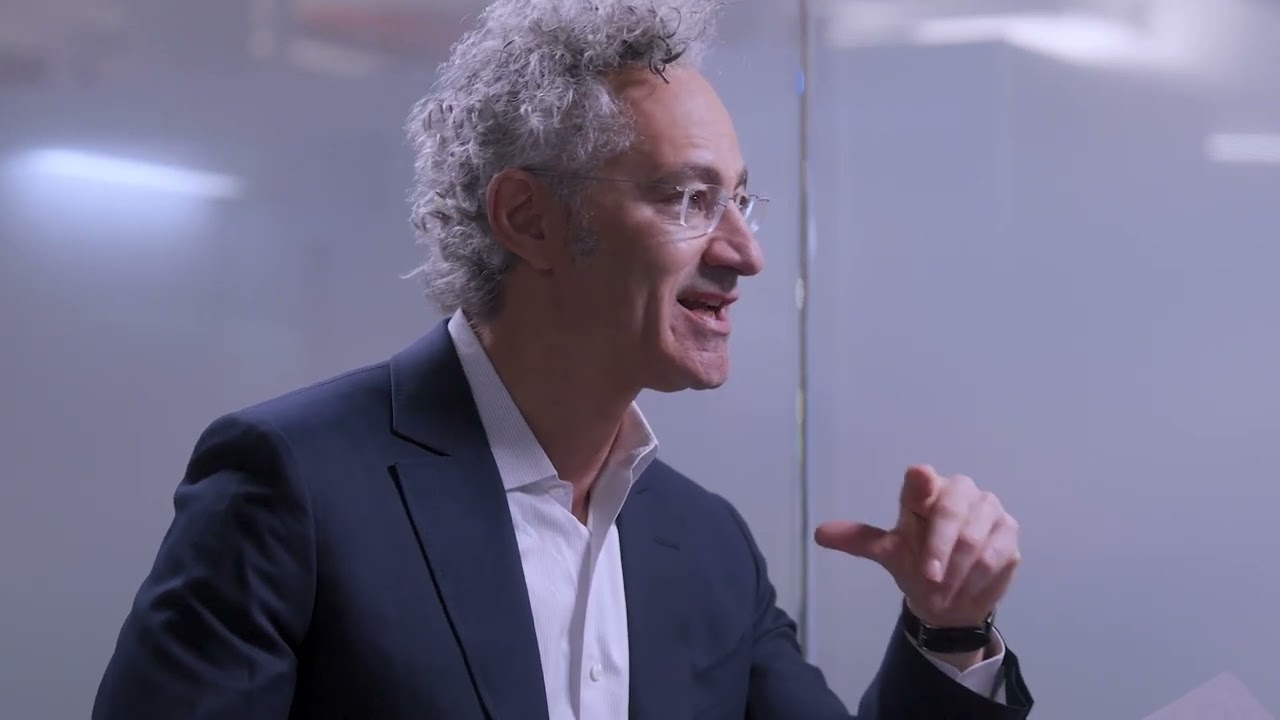
Recorded 23 October 2026 · 36 min
Alex Karp, co-founder and CEO of Palantir, argues that the scarce asset in AI is not the model but the ability to deploy it inside established institutions without those institutions giving up their intellectual property. In his telling, this is a craft that depends on outlier talent, on changing clients' sense of what good looks like, and on sovereign architectures that keep proprietary knowledge in-house.
The conversation turns on whether that craft can scale and whether the political environment will let it. Karp warns that AI wealth creation is politically unexplainable, that a wealth tax would be a surveillance-heavy overreaction, and that the US lead over China is measured in months. He does not claim to have a clean answer to the wealth question.
Dyslexia as distribution edge — ▶ 3:23
Karp discloses that he is severely dyslexic, something he hid for most of his life until recently. He credits it with letting him work faster, more creatively and more honestly with himself, and with processing ideas that sit outside the distribution, to use his term. His broader claim is that the value of things correlates with how far outside the distribution they are and whether they can be brought into it. This is self-assessment rather than evidence, but it frames how he thinks about talent.
Jagged talent, flat hierarchy — ▶ 4:48
Karp says Palantir has had the highest bar for talent over 20 years, and that former employees have shaped defense tech and the AI movement. The company seeks unusually jagged people and tries to raise their intelligence where it is already unusual, which makes the environment hard to manage. A flat hierarchy contains the friction. When an individual's rare talent converges on an important problem with a societal hook, he argues, Palantir can build what no one else can, citing anti-terror, institutional AI integration and battlefield work.
Why institutions expel outliers — ▶ 6:37
In Karp's generalization, the person who sticks out, who may be better at something, gets fired, especially when telling the truth. He applies this beyond business to universities and to Europe's struggle to produce even a taxi. The mechanism is psychological: people find it hard to accept a colleague so much better at something that they barely understand it, and there is inherent humiliation in it. Palantir trains people to treat that discomfort as a sign of progress. He calls the ability to harness such talent the West's sole advantage, cultivated for a thousand years.
The olive and the transfer mechanism — ▶ 10:40
Moving from an artist colony to enterprises set in their ways is a second problem. Karp says the two worlds are initially uncorrelated, but a transfer mechanism is essential because without it Palantir would not know what to build, so it shapes the product. It produced forward-deployed engineers and Karp's own time with clients. A titan of industry asked him how he got the first olive out of the jar; his answer is that adoption means changing the client's taste so it values the right olive. He admits he does not know exactly how this is done.
From data integration to sovereignty — ▶ 12:02
Karp describes three stages of Palantir's enterprise offer. Foundry integrates all a company's data sets, which he says was the main work around 2017. Later work helped enterprises run their ideas on top of that data. The current frontier is a sovereign architecture: companies power models they create and own, selectively share or white-label them, and embed their tribal knowledge in the enterprise one-to-one so it is not lost. The right offer, he says, depends on the enterprise. He says the next version could let clients white-label the platform to expand into other verticals.
Cost means what you lose — ▶ 13:18
Karp redefines cost as two questions: what you paid and what you lost. A token has a price, but using a model that transfers your information to a competitor carries a second one, the portion of IP surrendered. His example: no one cares about marketing in Argentina, but supply-chain organization and vendor judgments must stay inside the enterprise. He says CEOs are livid about tokens that create no value while IP migrates, and less so now that sovereign platforms exist. These are his characterizations; no figures are given. Value, he adds, is the delta between operating with and without the platform.
Patching faster than exploitation — ▶ 16:59
Karp says new models already expose security flaws at a scale organizations are not equipped to handle, and find attack vectors humans would miss. He expects this to become a societal issue for every organization, a guerrilla war in which speed of mitigation decides outcomes. Palantir's distinct contribution, he says, is patching unknown penetration vectors faster than they can be exploited; because one breach could be so dangerous, 100% safety is the company's objective. Societally, he says, there is no 100% protection, and different places will need different security levels.
Wealth creation as political risk — ▶ 18:47
Asked whether AI is really a contest over energy and compute, and about a figure of $150 billion in data centers blocked by local groups (the interviewer's hedged recollection), Karp says the primary American risk is political. AI is a wealth-creation mechanism, and his own becoming 20 times wealthier is a societal problem, since the reply that everyone else's wealth will rise 4% a year is not explainable to voters. Deferral feeds extremists whose answer is a wealth tax he says would crush startups. He dismisses public benefit corporations because even he and a counterpart he calls Dario would not agree on what public benefit means.
Substance versus political problems — ▶ 22:24
Karp argues the West treats political problems as substantive and substantive ones as political, though the two rarely correlate and are not solvable the same way. On poverty, he says education is the only thing that has worked. On migration, he has told senior Germans for roughly 10 years that, even if he is wrong on the first-order substance, he is right about the political second derivative: neglect transfers power to people who want to create problems. He says most of his tech friends disagree. He adds that giving all one's money away no longer works as a response.
Wealth tax as surveillance — ▶ 25:53
Karp predicts a wealth tax whose reach would eventually extend to people with a $1 million net worth. His objection is civil-liberties: assessing net worth at fine granularity would require valuing all of someone's assets in real time and knowing when they are sold, which he says Palantir's products could probably do but he does not want to be involved in. He asks whether gifts, a watch or hotel payments would count, and warns of a Pandora's box, one that would override First and Fourth Amendment protections. These are predictions about unenacted policy, supported by reasoning rather than evidence.
Creativity versus scale race — ▶ 28:40
Karp argues that winners of technology battles historically win more broadly, citing Japanese-Chinese and German history, and says the AI race is effectively between the US and China, with Israel a minor exception. He describes the US lead as roughly six months, and not durable: Chinese ability to refactor models for less compute, undercut pricing and distill is not going away. America's edge is creativity and China's is scale, but he says the caricature of creative Americans and uncreative Chinese is not playing out. He says Europe will have to buy a full stack from one of the two, and that US safety framing fails because it ignores the competitive frame.
Karp's central claim is that the model is not where AI's value accrues. The scarce asset, in his account, is the ability to put models to work inside institutions that have operated one way for decades, without those institutions surrendering what makes them distinctive. He says it is what you do with the model that matters, and he concedes the obvious caveat: the model companies do not produce the application layers, forward-deployed engineers, ontology or Foundry that Palantir sells. The conflict of interest is real, and no figures were offered to test the claim. But the mechanism he describes is specific enough to examine, and it begins with people rather than software.
Palantir, Karp says, is an artist colony, and he means it as a hiring and management doctrine. The company looks for unusually jagged people, tries to raise their intelligence where it is already unusual, and absorbs the resulting friction with a flat hierarchy. When such a person converges on a problem with a societal hook, he argues, the company can build what no one else can, citing anti-terror work, institutional AI integration and the battlefield. He offers his own severe dyslexia, hidden for most of his life, as a source of this orientation: it lets him process ideas outside the distribution, and value, he says, correlates with how far outside something is and whether it can be brought in. This is self-assessment, not evidence, but it explains the selection logic.
The harder claim concerns why most organizations cannot do this. Karp's generalization is that the person who sticks out, who may be better at something, gets fired, especially when telling the truth. He extends it from companies to universities and to Europe's struggle to produce even a taxi. The root, he suggests, is psychological: it is difficult to accept a colleague so much better at something that you can barely understand it, and the humiliation is inherent. Palantir trains people to read discomfort as a sign that something is working, since all medicine is somewhat poisonous. Citing Wittgenstein, he notes that believing you are following a rule is not the same as following it. Everyone endorses the principle; few live it.
Importing that culture into a client is a second problem. The interviewer pressed the point: an artist colony may create value, but an enterprise set in its ways must still adopt something new on its own terms. Karp describes a transfer mechanism between two worlds that are initially uncorrelated. It matters beyond sales, because without it Palantir would not know what to build, so it shapes the product. It produced the forward-deployed engineers and Karp's own time on the front line with clients. When a titan of industry asked how he got the first olive out of the jar, Karp's answer was that adoption means changing the client's taste so it values the right olive. He called this complete artistry and admitted he does not know exactly how it is done. That candor is notable. An editorial inference: the absence of a repeatable description bears directly on scale.
The commercial expression is what Karp calls the sovereign architecture. Foundry integrated enterprise data, which he says was the main work around 2017. Later layers helped companies run their ideas on the enterprise. Now the offer is to power models that a company creates and owns, selectively shares or white-labels, with its tribal knowledge embedded so it is not lost. The argument rests on redefining cost as two questions: what you paid and what you lost. A token has a price, but a model that transfers your information to a competitor carries another. His example is stark. Marketing in Argentina is low-stakes; supply-chain organization and vendor judgments are not. He says CEOs are livid about paying for tokens that create no value while IP migrates, and less so now. That is his characterization of customers, unquantified. He also claims Palantir's ontology is currently the only application platform of this kind available at scale.
The same logic of control extends to security, where Karp is blunt about asymmetry. Models, he says, already expose security flaws at a scale organizations are not equipped to handle, and they are adept at finding attack vectors a human would miss. Palantir's contribution is to patch previously unknown penetration vectors faster than they can be exploited; for the company, one breach is dangerous enough that 100% safety is the objective. Societally, he says, 100% protection does not exist. Institutions will need different security levels and must focus on how quickly they identify and fix vectors, a condition he likens to guerrilla war. An editorial inference: defensive speed becomes a competitive variable alongside model quality.
Asked whether AI competition is really about energy, chips and data centers, Karp redirects to politics. The interviewer recalled, with a hedge, that $150 billion of US data centers had been blocked by local groups. Karp says the primary American risk is that AI is a wealth-creation mechanism whose gains few can explain. Him becoming 20 times wealthier is a societal problem, he argues, and the reply that everyone else's wealth will rise 4% a year is not explainable to voters. Deferral, he says, feeds extremists, whose answer is a wealth tax that would shut off innovation and crush the startups that compete with people like him, who could pay it. He dismisses public benefit corporations: even he and a counterpart he calls Dario, whom he respects, would not agree on what public benefit means.
His broader analytic move is to separate substance from politics. The West, he says, solves political problems as if they were substantive and substantive ones as if they were political, though the two rarely correlate. Poverty is substantive, and education is the only remedy that has worked. The political problem must still be handled, or power shifts to people who want to create problems. His example is migration in Germany: even if he is wrong on the first-order substance, he says, he is right about the political second derivative, which he claims has held over 10 to 15 years in Europe. He acknowledges most of his tech friends disagree. The argument is deliberately agnostic about the underlying policy, which makes it hard to rebut and hard to test.
His objection to a wealth tax goes beyond economics. Assessing net worth at fine granularity would require valuing every asset in real time and knowing when each is sold. He says Palantir's products could probably do that, but he does not want to be involved. He frames it as a deep intrusion into the most personal parts of life, one that raises questions about gifts, watches and hotel payments and opens a Pandora's box with no civil-liberties protection, overriding First and Fourth Amendment protections. He predicts the tax would eventually reach people with a net worth of $1 million. These are forecasts about unenacted policy. An editorial observation: he is warning about capabilities his own company says it could supply.
On the US-China race, Karp is categorical about the stakes. Winners of technology battles, he argues, have historically won the world, drawing on Japanese-Chinese and German history. He says the AI race is effectively between the two countries, with a minor exception in Israel. He puts the American lead at roughly six months and does not consider it durable: China's ability to refactor models for less compute, undercut pricing and distill is not going to disappear. America's advantage is creativity and China's is scale, but he says the caricature of creative Americans and uncreative Chinese is not playing out, since China's reaction to American models has been creative. Europe, he says, will have to buy a full stack from one of the two, because everyone else is a weak derivative.
The unresolved tension sits inside his own case. If China's edge is scale and Palantir's is deployment craft, that craft depends on rare people and on clients willing to have their taste changed, which Karp says he cannot fully describe. Whether it can be reproduced without outliers, or without Karp, would determine whether sovereign deployment is a durable advantage or a bespoke service. And the political threat he identifies, wealth that cannot be explained to voters, comes with no remedy he is willing to endorse.
The open question. Karp says the West must sit down and come up with ideas about how to handle AI-generated wealth, yet he rejects philanthropy, public benefit corporations and a wealth tax without proposing an alternative. If the political risk is, as he claims, the primary threat to American AI leadership, what would a policy that satisfies voters without choking startups actually look like?
Watch the full video at https://www.youtube.com/watch?v=NDHeUx7nUbs.
Comments ()