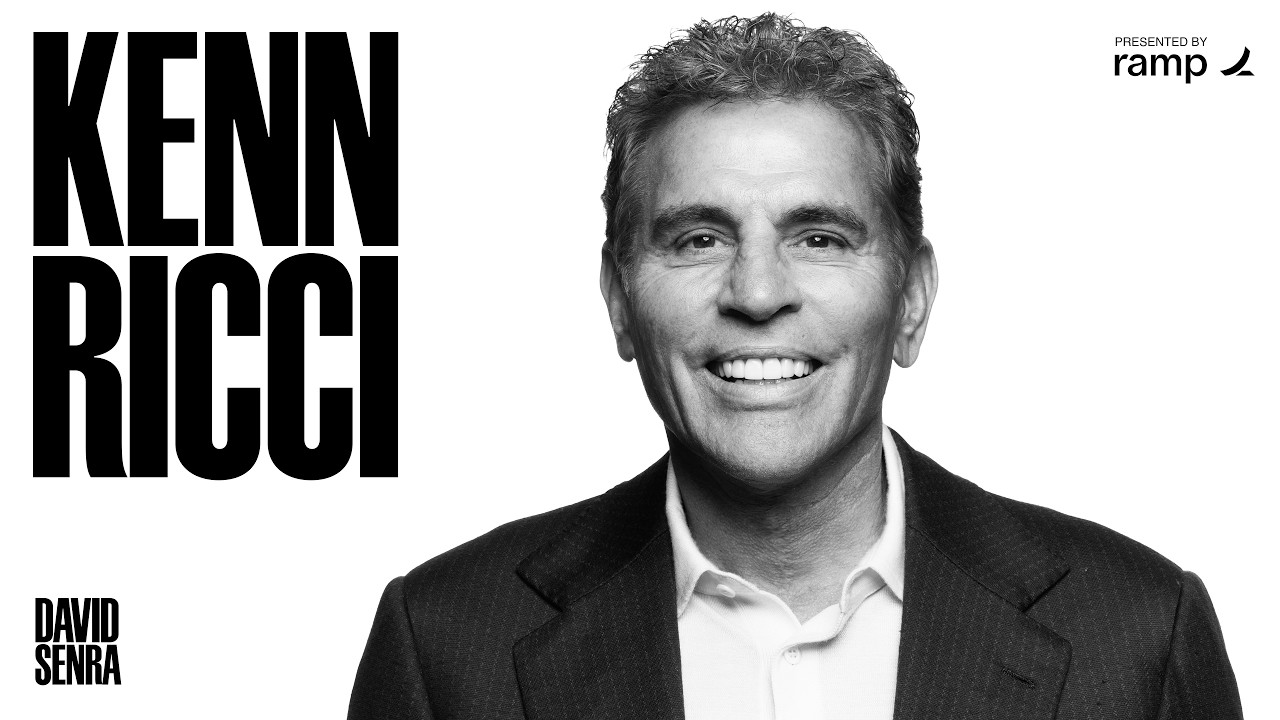
Recorded 28 October 2026 · 71 min
Ken Ricci, who owns Flexjet, argues that wealth should pass to children while the giver is alive, because trusts and staged payouts signal distrust and forfeit the chance to guide. He acted on this at home by gifting shares of a family limited partnership at his children's births. He applies the same instinct at work, where front-line staff can comp trips without approval.
The tension is between that deliberate philosophy and Ricci's description of himself as "accidentally wealthy." His account of founding, losing and repurchasing his company turns on timing, bank skepticism, Warren Buffett's NetJets purchase and a blocked aircraft order. Interviewer David Senra pushes on both threads, leaving open how much was design and how much was luck.
Trust over control — ▶ 2:45
Ricci holds that parents should transfer wealth early and tell children about it, because withholding financial information says you do not trust them. He gives three reasons families do otherwise. A trust industry of trustees, law firms and banks profits from control. Entrepreneurial 'lions' want influence after death, so they pay out at 25, 35 and 45. And parents fear money will make children lazy, which he says implies they parented poorly. These are his interpretations of motive, not demonstrated facts.
Munger's give-it-now logic — ▶ 6:58
Senra recalls asking Charlie Munger what a successful founder should do about wealthy children. Munger's answer was to give them the money, because otherwise they will hate you and the relationship was the point. Munger acknowledged it makes them less ambitious, with some children holding $250 million, and treated that as an acceptable cost. Ricci frames the same trade-off differently: if money alone ruins a child, that is a parenting failure, and the better response is to be alive to guide them through it.
Gift before appreciation — ▶ 9:03
Ricci started a family limited partnership in 1990, five years before his first child was born, and gifted shares at each birth. Because he is general partner, he keeps full flexibility over distributions. Senra compares it to Sam Walton, who gave his four children shares when the company was small, which Senra recalls as about $5,000 each. Ricci says he did not borrow the idea. The mechanism is simple: assets transferred before they appreciate grow outside the giver's estate, while control over distributions stays with the parent.
Children set the rules — ▶ 14:39
After teaching giving at ages 5 and 6 and running personality tests, Ricci walked his children through the full estate when the youngest was about 16. The children then designed their own rules. Spouses are excluded from meetings, each sibling decides how to share information at home, and a sibling who invests may put in 60% but must offer 20% to each of the other two. Ricci says the aim is to remove jealousy, and he opens each meeting by telling them they are not equal.
Luck of timing — ▶ 23:05
Ricci says he never set out to build a business or become wealthy. He loved flying, and part of his luck was entering private aviation in 1985, when he says there were 5,000 jets worldwide. Today there are 35,000, with the US holding 85% of the market. That concentration is why he needs no Asia strategy: he cites three flights a day there against 800 in the US. He chose private over airline flying for its freedom and for conversations with passengers.
Bootstrapping with others' capital — ▶ 25:36
At 26 Ricci bought J&J Aviation, a charter firm whose previous head had faked leases, for $27,500, using the $27,000 in its bank account plus $500 from his father. He wanted to keep flying. To build a charter niche, he flew celebrities and persuaded owners to buy large jets by leasing them out three months a year, which he said paid for the aircraft for the whole year. That let him build a managed fleet with no capital of his own.
Why fractional works — ▶ 32:28
In Ricci's telling, NetJets's founder saw that a typical corporate plane flies about 300 hours a year though it can fly 1,200, and that planes degrade when idle. Selling quarter shares of 200 hours let four owners share one aircraft, which is why NetJets tail numbers still end in QS. The founder also took manufacturers' unsold 'white tail' planes on consignment, risking no capital. A floating dispatch let a plane drop a client and serve the next without a paid return flight, and that drew customers away from charter operators like Ricci.
Buffett unlocks the banks — ▶ 34:34
Ricci's plan was to copy NetJets with used aircraft at roughly half the buy-in. Unlike NetJets, he could not take planes on consignment and needed $30-40 million of debt. Over 12 to 15 months, 35 to 40 banks balked at the idea of collateral in a quarter of a plane, leaving about $7 million of opportunities. In June 1998 Warren Buffett bought NetJets for $750 million, and that summer Ricci raised almost $300 million. He attributes the change to Buffett's move, and launched Flight Options on October 13, 1998.
Balance sheet is the game — ▶ 39:38
Flight Options booked $100 million in sales in its first three months and $400 million the next year, with customers mailing $800,000 buy-in checks before seeing paperwork. Ricci says he had a tiger by the tail. Rapid growth strained cash flow, and he learned that in capital-intensive industries like aviation the balance sheet, free cash flow rather than income or EBITDA, drives the business. He also keeps a core fleet that is never sold, so that peak-day demand can be met. Today about 70 of Flexjet's 365 aircraft serve that role.
Against mergers — ▶ 41:28
Ricci calls mergers a sign of weakness. He says the buyer should ask why it cannot win the market share itself, since 90% of the time it probably could, and warns that paying multiples of cash flow is often an overpayment. Culture is the second cost: he says a company can absorb an acquisition that adds 10% to its workforce, but not 30-40%. He concedes his views postdate his own 50/50 merger of Flight Options and Travel Air, which was done out of financial trouble in 2000-2001 when he had not worked this out.
Shareholders' roulette backfires — ▶ 44:00
In the Travel Air merger, a Raytheon division losing $30 million a year was combined 50/50 with Flight Options under a buy-or-sell mechanism at a single price. Warburg Pincus valued the business at $360 million. Ricci arrived at Raytheon believing he had financed his $180 million side, and Raytheon instead bought him out. He held 16% and calls the day in 2002, at age 42, the worst of his life. The lesson he draws is not explicit, but the structure let a stronger party decide who stayed.
Domain depth beats outside capital — ▶ 49:01
After the ouster, Warburg Pincus offered $250,000 a year as an executive in residence. Ricci declined, reasoning that finding deals before choosing capital kept his veto intact. His firm, Directional Capital, invested only in aviation. With Allied Capital he bought Mercury Air Centers, an FBO chain, for $80 million, then bought small operators at about 6 times EBITDA. He sold in 2007 for $615 million and kept 20%. Such businesses now trade at 15-20 times, and he blames private equity for a duopoly and invented event fees.
Buying it back — ▶ 52:19
Raytheon had lost $600 million on Flight Options and called Ricci to take it back. He bought it in December, just after the September financial crisis. The headline price was $135 million, but he says the real outlay after liabilities was about $42 million: a $27 million three-year seller note, personally guaranteed, and $15 million in cash. He wanted the company back regardless of its condition. It was damaged by unionization, torn seats and lost customers, and fixing its Hawker-based fleet meant buying planes.
Blocked order becomes Gulfstream — ▶ 55:00
Ricci wanted Bombardier's Challenger 300s, but they were exclusive to Flexjet, which Bombardier owned. Rather than lose a $300 million order, Bombardier sold him Flexjet in 2014 for $180 million, with orders worth about $1 billion including 15 Globals at $40 million each that he had no plan to fund. NetJets's contract barred Bombardier from selling them, which he first took as a blow. It cleared the way for a Gulfstream deal, and the 2017 purchase made Flexjet the largest operator, with 85 aircraft, more than the US government.
Purpose and the 1992 giveaway — ▶ 1:03:04
Ricci asked the priest who led Notre Dame for 35 years whether capitalism was compatible with his faith. He was told his gift for balance sheets was something to use for others. The priest said a significant life needs three things: be true to your God, be as good as your parents, and champion underdogs. After reading about a chief who gave away all possessions, Ricci gave away his own assets in 1992 to prove wealth did not run him, then rebuilt. He says his purpose became clear in 2018 but does not state what it is.
Ken Ricci's central claim is that controlling a child's inheritance is a parenting failure disguised as prudence. Withholding financial information, in his view, tells children that their parents do not trust them, and trust, rather than hours logged, is what children need. He rejects the helicopter model of raising children and its financial equivalent: tell them early, transfer assets early, and stay alive to coach them through good and bad decisions. The conviction is unusually concrete in his case. It shaped his legal structures, a yearly family meeting about wealth and, by his telling, the way his three adult children now treat one another.
He offers three explanations for why other wealthy families behave differently. A cottage industry of trustees, law firms and banks profits from the idea that wealth must be controlled. Entrepreneurs are lions, and lions control things; he cites the Chinese saying that the son of a lion is a lamb, and describes payouts at 25, 35 and 45 as a way for a patriarch to keep influence from the grave. Finally, the fear that money makes children lazy strikes him as an indictment of the parent, since a child undone by that one factor was not parented well. These are interpretations of motive rather than demonstrated facts, but they are internally coherent.
The practical case rests partly on Charlie Munger. David Senra recalls asking him the question and getting a blunt answer: give children the money, because they will hate you if you do not. Munger conceded it could make them less ambitious, and in Senra's recollection treated that as a minor cost. Ricci's mechanism is a family limited partnership he started in 1990, five years before his first child was born. He gifted shares at birth, before the assets appreciated, while keeping flexibility over distributions as general partner. He says he did not borrow the idea from Sam Walton, whom Senra notes gave his four children shares worth about $5,000 each.
Ricci reports no downside, and the family's behavior is his evidence. He began with giving: at 5 and 6, his children chose recipients, and the youngest wanted Disney, which was not a nonprofit. Personality tests came before any spreadsheets, and he walked them through the full estate when the youngest was around 16. He opens each annual meeting by telling the children they are not equal, since the eldest began inheriting 12 years earlier. The children then devised their own rules. Spouses are excluded from the meetings, each sibling decides how to share information with his or her family, and an investor may put in 60% of a deal but must offer 20% to each sibling. Ricci says the idea was theirs.
The evidence is thin by design. It comes from one family, reported by the father, after 10 to 12 years of practice. Ricci himself says the third generation of wealth is the hard one, and the children reached the same conclusion after reading about families that failed. Their decision to keep spouses out is telling. By Ricci's account, the group trusts one another because of a decade or more of grooming that newcomers lack. That implies trust of this kind is built rather than declared, and may not transfer automatically. This is an editorial inference, but it sits awkwardly with the suggestion that early disclosure alone solves the problem.
The same logic appears in how Ricci runs Flexjet. Customer service, he argues, is defined by what happens when things go wrong, so nobody on the phone needs approval to fix a problem. An employee earning $80,000 a year can comp a $300,000 trip. Ricci presents this as institutional trust, extended downward in the same way he extends it to his children. Senra reports that friends who use Flexjet praise its service, though that is secondhand and anecdotal. What the policy reveals is a consistent preference: replace control mechanisms with delegated authority and accept the occasional expensive mistake. Whether that preference holds as the fleet grows is not addressed.
Against this deliberate philosophy stands Ricci's description of himself as "accidentally wealthy." He says he never set out to build a business, and credits timing first. When he entered private aviation in 1985, he says, there were 5,000 jets in the world; today there are 35,000, with the US accounting for 85% of the market. That concentration is why he says he needs no Asia strategy: three flights a day there against 800 in the US. His first company was an accident of another kind. At 26 he bought a charter firm left behind by a fraud for $27,500, using the $27,000 the company held in the bank plus $500 from his father, so that he could keep flying.
Behind the luck is a pattern of using other people's capital until the model proved itself. Ricci flew celebrities, persuaded owners to buy large jets by leasing them out three months a year to pay for the whole year, and built a managed fleet with none of his own money. Fractional ownership then gave him scale. The NetJets founder's insight, as Ricci tells it, was that a corporate plane flies about 300 hours a year though it can fly 1,200, so four owners could share it. Ricci copied the model with used aircraft at roughly half the buy-in. Unlike NetJets, however, he could not take planes on consignment, so he had to borrow.
Banks refused. Over 12 to 15 months, 35 to 40 lenders asked what collateral they would hold in a quarter of a plane, and Ricci left with perhaps $7 million of opportunities against the $30-40 million he sought. Then in June 1998 Warren Buffett bought NetJets for $750 million, and that summer Ricci raised almost $300 million of debt. In his telling, lenders were persuaded by Buffett's move rather than by any change in his plan. Flight Options went active on October 13, 1998, booked $100 million in three months and $400 million the next year, and exposed a lesson Ricci says he lacked: in capital-intensive industries the balance sheet, not income, is the whole game.
The consequences arrived after the 2000 dotcom bust. Cash flow was strained, though volume was not, and Ricci merged Flight Options 50/50 with Travel Air, a Raytheon division losing $30 million a year. The deal included a shareholders' roulette mechanism: either party could be forced to buy or sell at one price. Warburg Pincus valued the business at $360 million. Ricci believed he had found the money to buy Raytheon's half, and Raytheon instead bought him out. He held 16%. It was, he says, the worst day of his life, in 2002 at age 42. The episode complicates his stated hatred of mergers, which he says usually signal weakness and risk culture when an acquisition adds 30-40% to a workforce. He notes that his views postdate that deal.
Exile became the foundation of his next fortune. Ricci moved to Phoenix in 2003 and declined Warburg Pincus's offer of $250,000 a year as an executive in residence, reasoning that finding deals first and capital second preserved his freedom to choose. His vehicle, Directional Capital, invested only in aviation, where sellers did not need to explain cost per hour or dispatch availability. With Allied Capital he bought Mercury Air Centers for $80 million, bought small operators at about 6 times EBITDA, and sold in 2007 for $615 million, keeping 20%. Such businesses now trade at 15-20 times, and he blames private equity for a duopoly and invented event fees.
The comeback sharpened his habit of committing first and financing later. After the financial crisis he bought Flight Options back from Raytheon, which he says had lost $600 million on it. The headline price was $135 million, but the real outlay after liabilities, he says, was about $42 million: a $27 million personal note and $15 million in cash. Wanting Bombardier's Challenger 300s, he ended up buying Flexjet in 2014 for $180 million, with orders for about $1 billion of aircraft, including 15 Globals he had no way to pay for. NetJets's contract blocked that sale. The block pushed him toward Gulfstream, and Flexjet now operates 85, more than the US government.
The narrative is selective. Buffett's purchase, Bombardier's contract clause and a financial-crisis discount were not things Ricci controlled, so luck is a fair part of the story. But each setback is recounted from the vantage of its payoff, and sector knowledge, willingness to guarantee debt personally and a sales executive who found him a path look less accidental than he suggests. The transcript does not settle how much was judgment. Ricci offers an account of purpose instead: a priest who led Notre Dame for 35 years told him to be true to his God, be as good as his parents and champion underdogs. Ricci gave away his assets in 1992 to prove wealth did not run him.
The unresolved issue is whether the trust he describes can outlast its architect. His children decided that generational transfer is hardest at the third stage, and they responded by narrowing the circle rather than widening it. Spouses are out, and each sibling controls disclosure in his or her own household. Ricci's own philosophy holds that trust beats control, yet his children's solution treats trust as the product of a decade of shared history, not a policy. That is the real test of early gifting: not whether the first generation behaves well, but whether the third inherits the habit without the history.
The open question. Can the trust Ricci describes outlast the people who built it? His children concluded that the third generation is where family wealth usually breaks down. Their response was to exclude spouses and let each sibling decide how much to share, which suggests the bond depends on a decade or more of shared history. The evidence is one family, reported by the father. Whether early disclosure and early gifting hold up once the next generation has no such history is untested.
Watch the full video at https://www.youtube.com/watch?v=D76BdIPTfGw.
Comments ()