
Recorded 6 October 2026 · 44 min
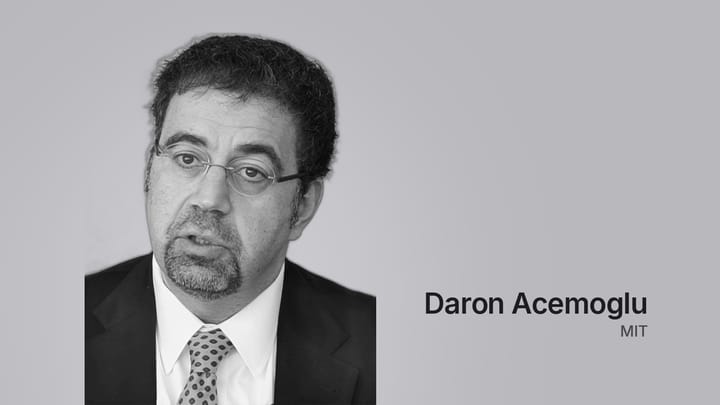
The bottleneck for AI's economic payoff is not stronger models but applications. Daron Acemoglu, MIT economist and 2024 Nobel laureate, argues that even last year's models could already power much better tools for nurses, electricians and teachers. He says Silicon Valley is sinking its engineering talent into foundation models instead. When he pitches "pro-worker AI," CEOs say it is exactly what they need. Tech companies tell him: "You live in a different world."
The conversation runs from productivity forecasts to schooling, investing and risk. The tension is between a technology he calls transformative and a deployment path he thinks is too narrow. He still thinks the discussion exaggerates how fast automation will arrive, because integration and diffusion are slow. He wants automation balanced with new tasks for humans. He rejects "inevitabilism," worries more about society losing control than about existential risk, and sees little money in foundation models themselves.
Higher forecast, still slow — ▶ 1:01
In 2024 he projected AI adding about 1% to US GDP over 10 years, with 5% of tasks fully automatable. Agentic AI this year means he would now put the task share "a little higher than 5%." But the discussion still exaggerates speed. Automation is hard, integrating it into organizations is hard, and diffusion of technologies needing complementary investments is "hard and slow." Erik Brynjolfsson is more optimistic about 2034-35. Acemoglu agrees the effects will come but thinks them slower, and rates Brynjolfsson likelier to be right than overly optimistic industry voices.
Ground truth explains coding — ▶ 3:03
Coding advances fastest for three reasons. It happens in offices with no real-world interaction, its supervisors are fluent in AI, and it has rules. Code either runs or it doesn't, so reinforcement learning gets a ground truth that most occupations lack. Customer service, which most expected to be automated first, is "very slow and very difficult." Requests change over time, are person-specific, use different language and sit in gray areas and edge cases. Humans will need to oversee it or work with it, and that choice drives displacement, productivity and who benefits.
Applications over foundation models — ▶ 5:39
His one-word answer to weak productivity gains: "We just need much better and more applications." He allows he may be wrong, having no view inside Anthropic or OpenAI. But he argues Silicon Valley puts too much emphasis on foundation models and too little on integrating applications into organizations. The US leads in large language models, and Chinese models catch up partly by distilling. Yet Chinese firms push robotics and AI onto the production line with a huge supply of engineers, while the scarcer US engineering talent all goes into foundation models.
Against inevitabilism — ▶ 7:39
The worst thing for the AI industry, in his view, is "inevitabilism." That is the belief that whatever it is doing is the only way, and that anyone questioning it is an idiot. He rejects this. AI is a general purpose technology like electricity or the printing press, and history shows many ways to develop such technologies. Those ways "are not neutral." They bring different benefits and different costs. Assuming the current path is the only one, or by far the best, is a mistake.
Easy wins for workers — ▶ 13:06
Existing models are already capable foundations, and "even last year's models would have been good enough" for most of what could be done. Examples: quality control, teachers, electricians, and nurses taking a bigger role in diagnosis, prescription and care decisions in a system spending almost $1 of every $5 on healthcare. Nurses need some retraining, but the constraint is elsewhere: "The bottleneck is the tech industry not doing it." Healthcare and education involve government money. Electricians, customer service and scientists are mostly a private-sector job.
Pro-worker AI has no supplier — ▶ 16:00
CEOs hear "pro-worker AI" and say it is exactly what they need. Acemoglu can't test whether they mean it, because tech companies aren't supplying the tools. Tech people nod and turn away, or say they are going to create AGI. He calls that "pie in the sky," with no agreed definition. He also sees an inconsistency: if AGI or ASI means machines doing everything better, there can't be many things left for humans, not even for the best physicists. You cannot promise AGI soon and plenty of human work.
Schools as unguarded experiment — ▶ 20:16
He uses AI for background research and for criticism of his writing, and tells students to use it as support, never as a replacement. He still does math by hand. His biggest worry is delegating so much that we stop flexing our mental muscles. AI in K-12 has been "pretty disastrous," rolled out blindly without guardrails. In 2024 he called it a "dangerous huge social experiment," and his worst fears have come "pretty close." The calculator analogy fails: calculators took over a tiny part of math, and no school stopped teaching multiplication.
Balance automation with new tasks — ▶ 24:25
He is not against automation: "We don't want to go back to the days where we carry heavy things on our backs." But automation alone yields less productivity, because not everything is easy to automate, and no shared prosperity, because too many jobs vanish. His calculus: with 100 employees, automating 5% of jobs and halving their cost pays far less than making all workers 5% more productive. Companies remembered, such as Ford, GM, GE, IBM and Microsoft, imagined new markets and tasks. None made history by cutting costs 5%.
Study foundations, stay flexible — ▶ 31:26
Because true AGI is not around the corner, human creativity matters more, and "human creativity without strong foundations is an oxymoron." His advice: study math, physics, economics or engineering, and don't be put off by AI solving hard math problems. Learn flexibility, since tasks change within occupations. Add civic responsibility, taught from elementary school. He adds that not everyone should go to college, that much of elite universities is signal, and that high schools are further behind than universities in adapting.
Loss of control beats doom — ▶ 34:59
On Dario's 25% chance that things go very badly, he applauds the courage to speak. But he worries more about the public, workers, students and parents losing control of their own agency, through how companies roll out AI, not through super-intelligence. Dangers have grown since 2024-25, but so has clarity on what AI can do well. It is too important to be left to a few people. He blames the media: for 10 years Elon Musk could do no wrong, or AI was "stochastic parrots or killer robots," with no middle ground.
Money is in data and applications — ▶ 40:41
He doesn't see how foundation models make trillions, given bottlenecks in development or diffusion and increasingly good open source models. He expects some failed IPOs, though not right away, since the enthusiasm is still there. The edge is in high-quality data and in applications, which creative niche products make hard for open source to replicate. Firms should cultivate their data and compensate the workers who generate it. Tacit knowledge sits with those workers, so builders must "get your hands dirty and talk to workers."
Automation alone cannot deliver what the industry promises. Daron Acemoglu is not against it. He says it cannot be stopped and should not be, because nobody wants to go back to carrying heavy loads on their backs. His objection is to a strategy of automation and nothing else. That strategy fails twice. It yields less productivity than expected, because not everything is easy to automate. And it removes too many jobs without creating high-paying, high-productivity ones to replace them. The result is neither a big productivity gain nor shared prosperity.
The case is as much about business logic as about fairness. Take a firm with 100 employees. It can automate 5% of the jobs and halve the cost of those tasks. Or it can make every worker 5% more productive. Acemoglu says the second path pays much more. Workers carry experience and commitment, and a firm that makes them better at problem solving builds something competitors cannot copy. Look at the companies people remember: Ford, General Motors, General Electric, IBM, Microsoft. They imagined new markets, new technologies and new tasks. None earned a place in the history books by cutting costs 5%.
Automation is also slower than the hype assumes. In 2024 Acemoglu projected about 1% added to US GDP over 10 years, with 5% of tasks fully automatable. After a year of fast agentic progress he would put the task share a little higher. He would not go to double digits. Integrating technology into organizations is hard. Diffusion of anything that needs complementary investments is slow. He has watched firms take the automation plunge because they thought it would be easy or felt pressure, and then fail to make it work. He reads "jagged frontier" as a code word for having overestimated AI.
Coding shows what the fast case looks like. It happens in offices, its supervisors are fluent in AI, and it has rules. Code runs or it doesn't, so reinforcement learning has a ground truth. Customer service has none. Requests change over time, differ by person and live in gray areas. Where that ground truth is missing, humans stay in the loop. Which form that takes decides how many jobs go and who gains.
So what should be built instead? Tools that make workers more capable. Acemoglu argues that existing models are already enough. Even last year's would do for most of it. Nurses given better quality control and information could take on more diagnosis, prescription and care decisions in a system that spends almost $1 of every $5 on healthcare. Electricians, teachers and many blue-collar tasks could get far better tools. Nurses would need some retraining. That is not the constraint. "The bottleneck is the tech industry not doing it."
Why isn't it happening? Part of the answer is a mindset he calls "inevitabilism." The belief that the current path is the only path, held by people who treat questioners as fools, narrows what gets built. He says general purpose technologies can be developed in many ways, and those ways are not neutral. Talent follows the belief. US engineers go into foundation models. Chinese companies such as Foxconn and BYD put engineers onto production lines to fold in robotics and AI. The incentives point the same way. He doesn't see how foundation models earn trillions, given development and diffusion bottlenecks and strong open source models. He expects failed IPOs eventually. The edge, he says, is in high-quality data and in creative niche applications that open source cannot easily copy. Building them means talking to workers, because the tacit knowledge is theirs.
The human side follows the same logic. Delegating too much to AI weakens the skills that make people valuable. He calls AI in K-12 schools "pretty disastrous" because it arrived without guardrails. His advice is to study math, physics, economics or engineering, stay flexible and learn civic responsibility. Creativity needs foundations. His own risk ranking is unusual. He worries less about a super-intelligent AI than about the public, workers, students and parents losing control of their own agency to the way AI is rolled out. He blames a media that swung between worship and "killer robots."
The strongest objection comes from his own evidence. He calls applications for nurses and electricians easy low-hanging fruit. He also says Chinese manufacturers find integration slow and need more engineers than they expected, and that firms fail when they automate assuming it will be easy. Those claims pull against each other. He also admits he has no view inside the frontier labs. He cannot tell whether the CEOs who praise pro-worker AI mean it, because nobody is selling them the product. Erik Brynjolfsson, whom he respects, is more optimistic about how soon the gains arrive. The claim that today's models suffice rests on Acemoglu's judgment, and the people best placed to test it are not trying.
Asked what a knowledge worker's day looks like in 2035, he says he doesn't know. He can see fewer hours at high productivity. He can see office and home work blended around genuinely complementary AI. He can also see a "very scary future" where many people have no meaningful work. Nothing in the technology picks among them. His complaint is that the choice is being made by a handful of labs. It is too important for that.
The open question. Acemoglu calls tools for nurses and electricians "easy low-hanging fruit," yet says Chinese manufacturers find integration slow and need more engineers than they expect, and that firms fail when they automate assuming it will be easy. Both cannot hold. He also concedes he has no view inside Anthropic or OpenAI, and he cannot test whether the CEOs who praise pro-worker AI mean it. The claim that existing models already suffice rests on his judgment alone.
Watch the full video at https://www.youtube.com/watch?v=0lsasYuzhL4.
Comments ()