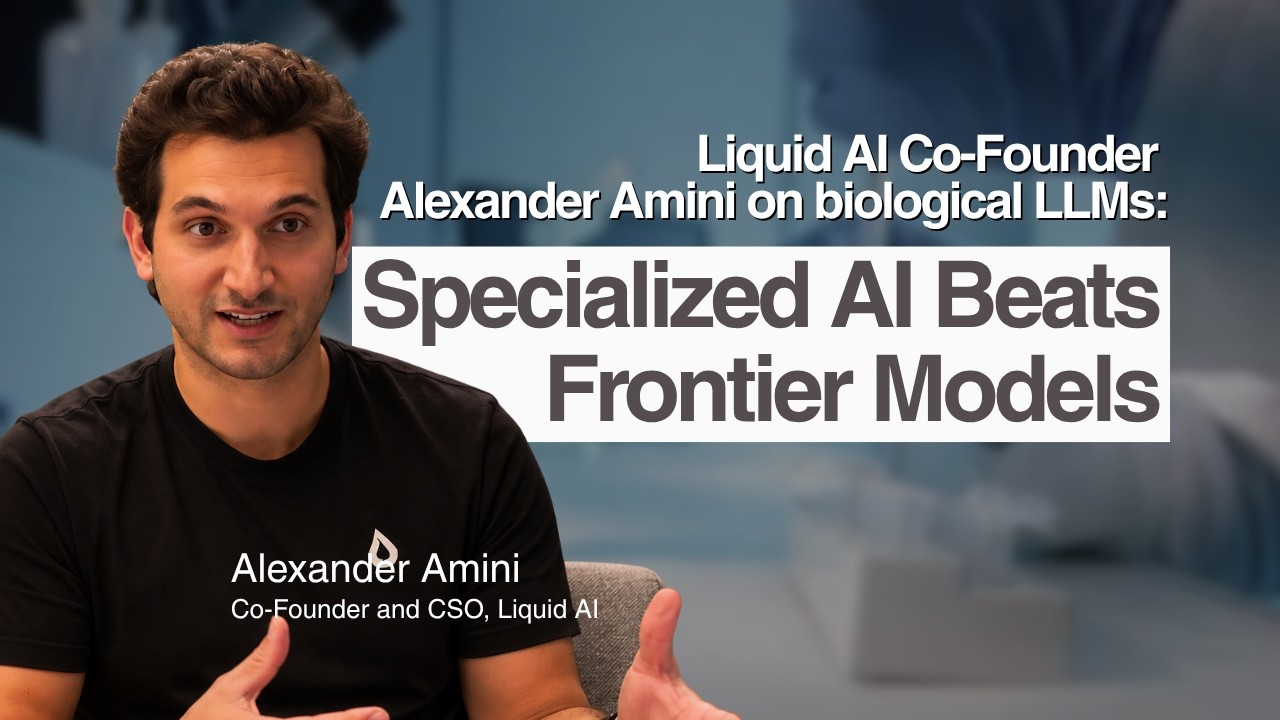
Recorded 14 October 2026 · 16 min
Alexander Amini, co-founder and chief science officer of Liquid AI and an AI scientist at MIT, argues that frontier cloud models are generalists and therefore poor specialists, and that smaller models trained for a narrow job can beat them. He makes the case in an interview with host Sophia on the day Liquid launched LFM 2.5 24B MoE, pointing to aging biology, agentic tool use and robotics.
The tension is between breadth and depth. Amini frames it as exploration versus exploitation, and says connectivity constraints push intelligence out of data centers and into phones, cars and eventually robots. The interview offers few benchmarks, so the strength of the claim rests mostly on assertion and on one collaboration with Insilico Medicine.
Mixture-of-experts for laptops — ▶ 0:53
LFM 2.5 24B MoE, the last model in Liquid's LFM 2.5 series, has 24 billion parameters in total but only 2 billion active at a time. Amini says it runs at the speed of a 2 billion parameter model while retaining a much higher learning capacity. It fits in about 16 GB of RAM, which he notes many laptops have, and is aimed at AI PCs and tool-calling agentic work. He calls it very intelligent on agentic traces, but no benchmark figures were offered.
Generalists make poor specialists — ▶ 2:05
Frontier cloud models are broad generalists, Amini argues, and because they are trained to do many things well, they do no single thing exceptionally. Liquid optimizes the opposite end of what he calls an exploration-versus-exploitation trade-off. His claim is that models trained as specialists can outperform the big cloud models on their target tasks. The mechanism is the training objective rather than scale. The claim is stated generally, but no comparative numbers were given beyond the aging-biology example.
Prototype in cloud, specialize locally — ▶ 3:54
Amini names distinct reasons teams adopt local models. Many prototype on big cloud models, then go local once they know the task, narrowing a frontier model into something he says can exceed frontier capability. Others want disconnected operation and ownership of their own intelligence. Devices such as phones, laptops and cars must either stay reliably connected or carry the model. Editorial inference: local deployment appears to be a second stage in a workflow that begins in the cloud, not a wholesale replacement for it.
Returning the robot's brain — ▶ 6:10
Liquid AI was born out of robotics use cases, Amini says. His argument is that a robot's body and brain must be co-developed, yet today's frontier intelligence needs massive GPU clusters in the cloud, so robots suffer on latency and connectivity. Liquid wants to bring the brain back into the body while still reaching frontier-level intelligence. The host adds that latency is also a safety issue in robotics. Whether on-device models can actually reach that level is asserted, not demonstrated, in the interview.
Frontier models struggle with biology — ▶ 8:31
With collaborator Insilico Medicine, Liquid trained a foundation model on biological data to understand aging. Given a person's blood work and other biological signals, the model predicts biological age, which can differ from calendar age, or the relative age of two individuals. Amini says ChatGPT, Claude, Gemini and other frontier models struggle at this, because biological language differs from natural language. He gives no accuracy figures or evaluation details. The stated payoff is interventions and therapeutics that reduce aging.
Two languages in one model — ▶ 11:15
Liquid's aging model understands both English and biological data, and Amini says that combination is its most important property. Researchers can pose questions about a person's biology in natural language: how old the model thinks they are, why they are not younger, what to change in their blood work, and how to design drugs to overcome blockers. The design implies a specialist can keep a conversational interface. Amini does not say how reliable the model's explanations are.
Multimodal sensing at the edge — ▶ 12:32
Amini says Liquid's future combines two goals: putting intelligence on every edge device, and building models that perceive many modalities. His premise is that the real world is not only text or vision but also time series and other physical modalities. The company already builds foundation models over text, images, video, audio, biology and time series. He gave no timeline, products or evidence on how well a single model handles this range of sensing.
Alexander Amini's central claim is that breadth and depth trade against each other, and that the cloud's frontier models sit on the breadth side. In his telling, big models are "amazing generalists," but because they are trained to do many things well, they do not do any single thing exceptionally well. Liquid AI's wager is that a model trained as a specialist can beat them on its own task. Amini frames this as a trade-off between exploration across a broad landscape and exploitation of a single type of task. It is a claim about training objectives rather than raw model size, and it is the thread connecting almost everything else he says.
The strongest example he offers is aging biology. Working with Insilico Medicine, Liquid trained a foundation model on biological data to predict aging dynamics, such as whether a person's blood work implies a biological age older or younger than their calendar age. Amini says models can be trained to predict someone's age, or the relative age of two people. ChatGPT, Claude, Gemini and other frontier models, he says, struggle with the task because biological language differs from the natural language they were built around. A plausible reading, and it is an editorial inference, is that nothing in a general training objective rewards fluency in this data.
The more interesting design choice is that the specialist is not narrow in its interface. Liquid's model understands both English and biological data, and Amini says the pairing is what makes it useful to researchers. They can give it a person's biological data and ask how old it thinks they are, why they are not younger, what to change in their blood work, and how to design drugs that overcome the blockers. Specialization, in this framing, means depth in a domain while language remains the way humans query the model. Amini does not say how reliable those explanations are.
The same logic underlies Liquid's newest product. LFM 2.5 24B MoE has 24 billion parameters in total but only 2 billion active, which Amini says lets it run at the speed of a 2 billion parameter model with a much higher learning capacity. It fits in about 16 GB of RAM and is built for tool calling and agentic work. The host raises the common objection that local models are not effective enough. Amini does not claim parity with the cloud everywhere. He argues that a model optimized for a defined job need not be.
He also describes where that argument leads in practice. Many teams prototype on large cloud models, then go local once they know the task, to specialize and narrow a frontier model into something he says can exceed frontier capability. Others want to run in disconnected environments and own their intelligence. For phones, cars and eventually robots, he says the choice is stark: a very stable connection or a model on the device. Robotics sharpens it. Liquid was born from robotics use cases, and Amini wants to put the brain back into the body instead of relying on GPU clusters whose latency and connectivity limits the robot inherits.
The evidence, however, is thinner than the confidence. The interview contains no benchmark scores for the aging task, no figures comparing the new 24B model with cloud models, and no definition of what "near frontier" means on a laptop. Nor does Amini say how the frontier models were prompted or whether they were tuned for the biological task. By his own logic, a general model tested on an unfamiliar specialized task should be expected to lose, so the result is consistent with his thesis but does not by itself measure how large the gap is.
There is also a tension in his closing vision. Amini says the real world is massively multimodal, spanning text, vision, time series and other physical signals, and that Liquid wants models that perceive across all of them on every edge device. That is a case for breadth, even if breadth in sensing rather than in tasks. If specialists win because focus beats generality, it is unclear whether a model spanning many modalities keeps the advantage. The interview leaves open whether the future is many narrow models or a few multimodal ones.
The open question. Does the specialist advantage survive a fair comparison? Amini says frontier models struggle on the biological-age task and that specialized local models can exceed them, but he gives no scores, no account of how the frontier models were prompted or tuned, and no benchmark for the new 24B model's agentic performance. His vision of massively multimodal models also sits uneasily with his critique of generalists. Whether breadth across sensing modalities erodes the depth that specialization is supposed to deliver remains unanswered.
Watch the full video at https://www.youtube.com/watch?v=B_GH2qiKboU.
Comments ()