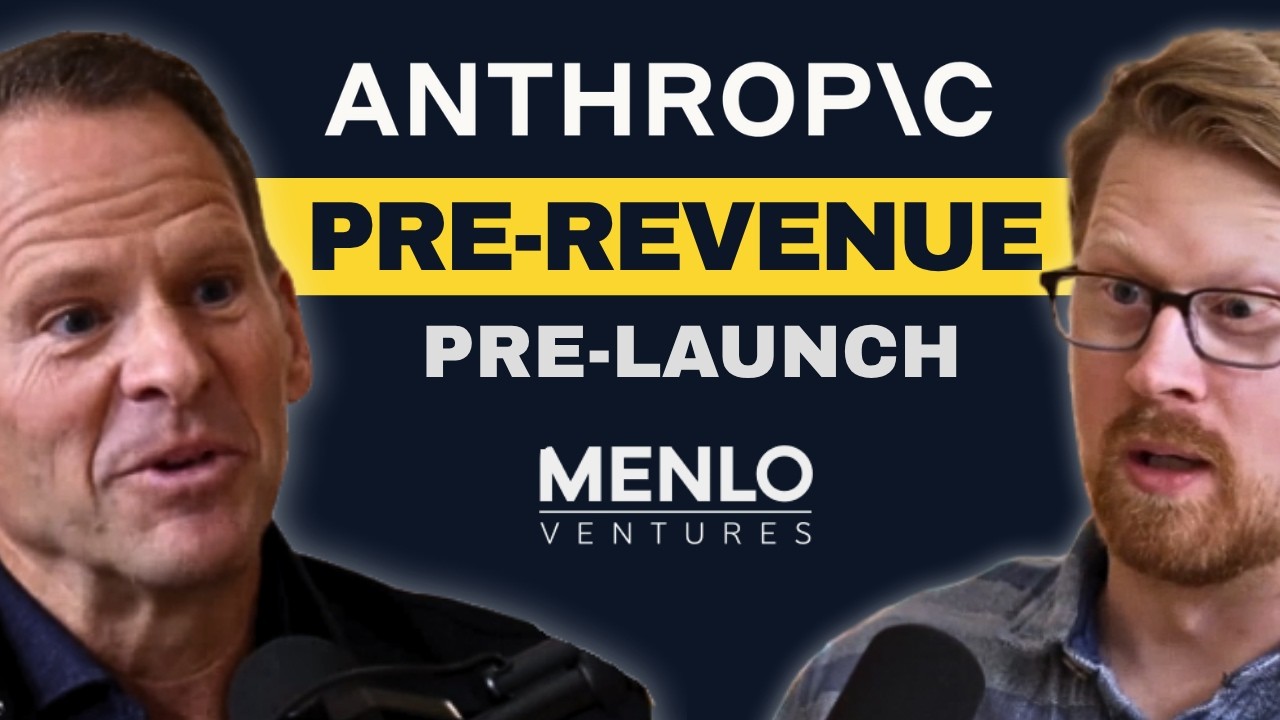
Recorded 26 October 2026 · 72 min
Matt Murphy of Menlo Ventures argues that Anthropic's growth has outrun every precedent venture investors use, and that backing it required abandoning conventional discipline on fund fit and ownership targets. Menlo entered a pre-revenue, pre-launch company valued at more than $4 billion, then led a $500 million-plus SPV, its first, at roughly $18 billion.
The tension is between exceptions and discipline. Murphy says the bet was possible only because Menlo spent years rebuilding its team, technical depth and thesis work, yet he concedes the entry looked unfundable under standard math. Whether that flexibility can be repeated across 70-plus neolabs and an expensive, uncertain middle stage is left open.
Reading the S-1 correctly — ▶ 0:17
Constrained by Anthropic's quiet period, Murphy says the widely circulated negative figure of around 42 million is neither a burn number nor a cash number. In his reading it reflects non-cash GAAP charges such as warrants and convertible notes. He points readers instead to operating cash flow, gross margin and growth rate as better indicators of health, and says the filing shows Anthropic operating-cash-flow positive and expecting to stay so. This is his interpretation of the filing, not an independently verified figure.
Faster than Google — ▶ 2:21
Murphy attended Google's board meetings from Kleiner Perkins' investment through the IPO, and says Google is probably still regarded as the fastest-growing business ever. The figures recited in the exchange: $0 to $1 billion in 5 years, $0 to $10 billion in 8-11 years, then $10 billion to $100 billion in another 11, about 19 years in total. Anthropic, he says, is doing comparable growth in a third or less of the time, which he offers as perspective on how different AI is.
Enterprise by accident — ▶ 3:24
Murphy sees a parallel with Google, whose founders did not want an advertising business and were pushed into it. Anthropic knew it would sell models but did not expect to be an enterprise company. It began with an API and a strong model while OpenAI dominated consumer interfaces. Partnerships with Amazon and Google, for compute and also distribution, pulled it toward enterprise, which proved faster and more lucrative. He says this uncertainty over monetization is common among technical founders.
Small check, then the lead — ▶ 5:21
At the Series C, Anthropic was pre-revenue and pre-launch at a valuation of $4 billion-plus, which fit neither Menlo's venture fund nor its growth fund. Menlo bent its rules to participate, intending to lead the next round. Inside the company it watched the AWS and Google deals, forward-deployed engineering work with a large telecom, and a long tail of developers. Revenue reportedly went from zero at an April launch to about $85 million by year-end, and Menlo led the Series D. Murphy says the first check bought the relationship and trust.
Why 10x was believable — ▶ 10:20
Internally, a roughly $4.5 billion entry meant that even a doubling would not matter to the fund. It needed a 10x, and a $45 billion outcome sounded crazy. Murphy's counter: earlier technology waves were constrained by devices, high-speed internet or comfort with cloud data, whereas AI was immediately available to everyone. Anthropic also had Amazon and Google as partners, a better model, and top researchers joining. Capital cycles that once took 2 to 2.5 years compressed into under 6 months, and by the second investment at around $18 billion the decision felt more obvious.
First SPV under pressure — ▶ 15:58
Menlo had never run an SPV before an Anthropic executive impressed its LPs at a November meeting. Co-investment interest of roughly $300 million exceeded what its $750 million fund could carry. Anthropic barred financial disclosure, so Menlo could cite only last year's revenue, with no forward projections, while asking for an $18 billion valuation. Some state pension funds declined. Murphy recalls 30-45 days of fear that Menlo had over-committed. The term sheet was signed mid-December and the raise closed in 2 tranches by early April. He called it a potentially existential moment for the firm.
Rebuilding Menlo brick by brick — ▶ 24:47
Murphy says Menlo's generational handoff was done well, followed by a reset to a single $400 million early-stage fund, then an early growth fund, plus talent and business-development teams. After ChatGPT's launch the firm published an AI infrastructure market map and hired technical investors, including Tim Tully, former Splunk CTO, because it judged SaaS-era investors insufficiently technical for products with heavy technology underneath. Tully spent time with Anthropic's Tom Brown on its compute multiplier, which let it build powerful models at lower cost. Without that, Murphy says, he would have been making an intuitive people decision.
How firms decay — ▶ 38:40
From 25 years of watching firms fade, Murphy identifies three causes, based on observation rather than data. First, poor generational transitions: senior partners linger and younger talent partners leave, taking the next hot founder with them. Second, weak alignment, where an unusual bet is rejected as not what the firm does, creating false guardrails. Third, missing a technology wave. If a firm was late to AI and not already top-tier, he says, he does not see how it recovers, while a top firm can recover only by playing catch-up.
Exception slots and stubs — ▶ 41:31
Exceptions began serendipitously and are now institutionalized as exception slots, or stub investments, small starting positions meant to grow. The Anthology fund, a $100 million vehicle set up with Anthropic after Menlo led the round, wrote checks of roughly $100,000 to $1 million. It yielded OpenRouter, a $100,000 first check subject to a rumored $8 billion Stripe acquisition, along with a dictation leader and Goodfire. Murphy sets limits: a fund of only exceptions has no board seats and no reputation, and without proven performance a firm will not win later rounds.
Why 1999 differs — ▶ 45:41
Murphy lived through 1999 and argues the crash had 3 causes: a small share of the population had PCs, broadband and comfort using credit cards online; business models, including ad swapping, were weak; and the next 98% arrived too slowly for scale to repair economics. AI, by contrast, was immediately available to every consumer and enterprise, and sells into sticky enterprise applications. He says never before had he invested in a company that, 14 months later, was being acquired for a rumored $8 billion. Some companies still need to fix gross margins.
Frontier versus open weights — ▶ 48:12
Murphy says the narrative that open-weight models would replace frontier models overcorrected. Companies first make a product excellent regardless of cost, then fix gross margin by testing how much of the application needs frontier intelligence, such as 70% versus 20%. He guesses, while saying he does not know, that main foundation models like Anthropic hold over 50% and open-weight models 20-30%. Caching, alternative architectures and hardware routing, including choosing among Nvidia, AMD and TPUs by per-token cost, also reduce spend. Inferior intelligence, he argues, cannot win against a good product.
Barbell and messy middle — ▶ 51:29
Menlo now runs a barbell: early technology bets, including real seeds and researcher-founders from places like Stanford, and later leaders such as Lovable, Lora, Suno, Higgsfield, OpenRouter and Anthropic. The theory is that first-wave leaders compound, as Uber, Airbnb, Spotify, Square and AWS did. It does less of the messy middle between seed or Series A and later growth, once Menlo's sweet spot, because companies launch fast, grow fast and produce false positives. Lovable had many rivals, and legal has 2 leaders. Paying high prices without knowing the leader is the risk.
Tells of a category leader — ▶ 55:23
Murphy looks for customer diversity rather than a few large contracts, plus short sales cycles. Legal software, once terrible to sell, now shows ridiculously short cycles and high usage. Another sign is enterprise reps closing roughly $3-5 million, against a normal quota of about $1.2-1.8 million, or pull through product-led growth. His inference is that adding $1 million-quota reps one at a time is slow by comparison. He also notes that penetration of the Fortune 5000 is almost nil, with almost no one having replatformed their application stack.
Complementary neolabs — ▶ 59:18
With around 77 neolabs by the host's count, many raising $1 billion at Series A and $2-3 billion at B, Murphy says that clearly won't end well, and expects spectacular acquisitions alongside big craters. Menlo has stakes in 10, chosen as complements rather than Anthropic rivals: robotics, drug-discovery antibodies, math, audio, diffusion for text, and continual learning. The logic is that those models serve use cases foundation models don't, and that frontier intelligence is currently valuable to any company lacking it.
Where the capital goes — ▶ 1:02:15
For model companies, Murphy says capital funds training, scarce researchers, and renting or buying GPUs before revenue, plus building surfaces like Claude Code that guide customers in. The model is table stakes, he says, not the whole product. Application companies consume capital because growth does: forward-deployed engineers, salespeople and customer support. Phase 2 shifts from just getting a model working to optimizing the stack. AI-written code makes the software development lifecycle a bottleneck for merging, testing and security, and shaving cents off per-token cost matters enormously.
Matt Murphy's account of Menlo Ventures' Anthropic investment is, at its core, an argument that the old arithmetic of venture no longer fits the technology it is applied to. Roll the clocks back to 2022 or 2023, and a pre-revenue, pre-launch company valued at more than $4 billion belonged in neither an early-stage fund nor a growth fund. At a $4.5 billion entry, even a doubling would not have mattered to the fund, so the partners needed to believe in a 10x. Murphy says the case rested on two things: a growth curve with no precedent, and a firm that had spent years preparing to recognize it. The first made the bet rational. The second made it possible.
Murphy's evidence for the growth claim is comparative. He sat in Google's board meetings from Kleiner Perkins' investment through its IPO, and the figures recited in the conversation describe a company that went from $0 to $1 billion in 5 years and from $10 billion to $100 billion in another 11, roughly 19 years in all. Anthropic, in his telling, is covering similar ground in a third or less of the time. His explanation is structural rather than merely statistical. Earlier waves were throttled by devices, broadband access or comfort with data in the cloud. AI was available to every consumer and enterprise at once, so the ceiling on adoption was far higher from the start.
The same logic is how he separates this moment from 1999, which he lived through. In his reading, the dot-com boom reached only a small share of the population, those with PCs, broadband and willingness to use a credit card online. It never reached the next 98% quickly enough for businesses to scale into their economics. Add ad swapping and weak business models, and the wall appeared. Today, he argues, models sell to enterprise customers whose applications are sticky and hard to replace. He concedes that some companies still need to repair gross margins. The contrast is an interpretation, resting on his recollection and on the revenue trajectories he cites, not a demonstration.
The path into the round shows how Menlo turned an awkward fit into an advantage. Rather than lead the Series C, the firm participated with a smaller stake, intending to lead the next round. That stake bought proximity: recruiting help, customer introductions, and a view of the AWS and Google deals, including forward-deployed engineering projects with a large telecom alongside a long tail of developers. Murphy says he watched revenue go from zero at an April launch to a reported figure of about $85 million by year-end, and Menlo moved in September or October to lead the Series D. His claim is that without the first check, Menlo would have lacked both the information and the trust to win the second.
The SPV shows the cost of conviction. After an Anthropic executive impressed Menlo's LPs at a meeting in early November, co-investment interest reached around $300 million, more than the firm's $750 million fund could absorb alongside a lead position. Menlo had never run an SPV. Anthropic supported the raise but barred financial information, so Menlo could share last year's revenue but no forward projections while asking investors to underwrite an $18 billion valuation. Murphy describes 30 to 45 frightening days, state pension funds that said they could not responsibly participate, and a term sheet signed in mid-December that closed in 2 tranches by early April. He says the 3 that did invest have, by his account, made well over $1 billion at the last round valuation.
Murphy insists the bet was not a flash of individual courage. Menlo had reset under new leadership with a single $400 million early-stage fund, then added an early growth fund, talent and business-development functions, and published an AI infrastructure market map after ChatGPT's launch. Its central thesis was that SaaS-era investors were not technical enough for a wave in which products carry heavy technology under the hood. So it hired people such as Tim Tully, formerly CTO of Splunk. It was Tully, Murphy says, who spent time with Anthropic's Tom Brown to understand the compute multiplier that let the company build powerful models at lower cost. Otherwise, Murphy says, he would have been making an intuitive people decision.
The same culture explains Menlo's willingness to depart from ownership targets. Murphy ties it to how he has seen firms fail: poor generational transitions, low alignment that turns every unusual bet into a violation of what the firm does, and missing a technology wave. Menlo's exceptions began serendipitously and are now institutionalized as exception slots, or stub investments, small starting positions meant to grow. The Anthology fund, a $100 million vehicle formed with Anthropic, wrote checks of roughly $100,000 to $1 million and produced OpenRouter, subject to a rumored $8 billion Stripe acquisition. Murphy sets limits, though. A fund of only exceptions has no board seats and no reputation, and without proven performance a firm cannot lead later rounds.
Applied to the current market, this philosophy yields a barbell. Menlo wants early technology bets, including real seeds and researcher-founders, and later leaders such as Lovable, Lora, Suno, Higgsfield, OpenRouter and Anthropic, on the theory that first-wave leaders compound, as Uber, Airbnb, Spotify, Square and AWS did. What it does less of is the messy middle between seed or Series A and later growth, once its sweet spot. Companies launch quickly, grow fast initially and generate false positives. Lovable had many competitors, and in legal 2 leaders, Lora and Harvey, took the oxygen. Paying a high valuation without knowing which company leads is the risk Murphy wants to avoid.
He offers practical tells that a company has become the leader. Customer diversity matters more than 2 or 3 large contracts. Sales cycles are short, as in legal, once a notoriously hard software market. Enterprise reps closing roughly $3-5 million, against a normal quota of about $1.2-1.8 million, or pull through product-led growth, point the same way. His inference is that a company adding one $1 million-quota rep at a time is structurally slow by comparison. He adds that penetration of the Fortune 5000 is still almost nil, with almost no one having replatformed an application stack, which suggests the next leg of the wave has barely begun.
Murphy's view of the model layer is that the open-weight narrative overcorrected. Companies first make a product excellent regardless of cost, then fix gross margin by testing how much of an application really needs frontier intelligence, 70% or 20%. Open-weight models serve some tasks, but an inferior product loses customers. His guess, offered with an admission that he does not know, is over 50% for main foundation models such as Anthropic and 20-30% for open-weight models. Caching, alternative architectures and hardware routing among Nvidia, AMD and TPUs trim cost per token. In this second phase, he says, AI-written code makes the software development lifecycle a bottleneck for testing, merging, deploying and securing.
He is more guarded about neolabs. By the host's count there are around 77, many raising $1 billion at Series A and $2-3 billion at B, and Murphy says that clearly will not end well, yet Menlo is in 10. His distinction is that these are complements rather than rivals: models for robotics, drug discovery, math, audio, diffusion-based text and continual learning. Model companies need capital for training, scarce talent and GPUs before revenue, and the model is only half the battle, since Anthropic built surfaces such as Claude Code around it. He expects spectacular acquisitions and plenty of craters, because frontier intelligence is currently so valuable to any company lacking it.
The strongest caution is the gap between hindsight and the decisions Murphy describes. The Anthropic outcome validates his thesis, and he acknowledges that at the time the opportunity looked unclear to LPs. Yet much of the evidence comes from one company and a firm still restricted by a quiet period on the numbers. His open-weight shares are admitted guesses. The signals he offers for spotting leaders, such as short sales cycles and customer diversity, are consistent with winning but do not guarantee it, as his own account of false positives shows. The tension is visible in the neolab strategy: he predicts many will crater while Menlo holds 10, and a complementary-model thesis does not reveal which will be acquired. Strong M&A has, he says, eased pressure so far.
The consequence is a market in which the rule of owning a meaningful percentage or skipping the deal is being traded for access. Murphy says it is better to hold a small piece of the best entrepreneurs than nothing, and that no one can say when the next Anthropic will arrive. He expects public listings of the 2 top labs to turn attention to the next 10 companies. One inference is that the Series C worked partly because the company fit awkwardly in most funds and few were looking hard. If everyone is looking at the next wave, the question becomes whether an early-relationship edge survives.
The open question. Murphy's Anthropic return validates the exception-driven approach, but the conversation offers no test for repeating it. He expects many billion-dollar neolabs to end badly while Menlo holds 10 of them, justified by the claim that they are complementary to foundation models. What distinguishes a complementary model that gets acquired from one that merely burns capital remains unanswered, as does whether his guess of more than 50% frontier-model share holds once companies optimize.
Watch the full video at https://www.youtube.com/watch?v=kQcX4sOaW90.
Comments ()