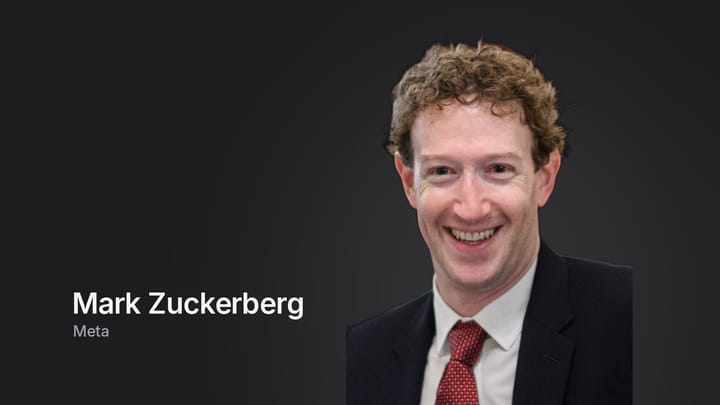

Recorded 13 October 2026 · 134 min
Building a frontier model removes the feedback loop. Meta planned Muse Wonder from August, sized its data centers years earlier, and at the end of last year was ready to commit $100-200 billion to compute without having seen the models. Zuckerberg's defence is a backstop: for the bet to fail, AI overall has to fail.
The conversation is with Zuckerberg and Alex Wang, who leads Meta Superintelligence Labs (MSL), and a Stripe host. They launch Muse Wonder, a much larger pre-train aimed at personal and professional agents. They explain how a research team of fewer than 200 people got there a little over a year after the Llama 4 launch disappointed.
The tension is between convergence and divergence. The host argues that winning AI products collapse onto the same simple shape. Meta replies that the model is the product, coding is not the only lane, and the frontier will not be winner-take-all. The economics still have to be proven.
MMA coach as eval — ▶ 1:21
Zuckerberg put cameras in his gym. Muse watches him spar and gives feedback in the 1 minute between rounds. The agent pulls stills from video and writes its own video-processing pipeline. When it took 30 seconds against a 60-second break, he told it to "optimize yourself." The use case predates Muse, since he first ran it on OpenClaw, and is now an internal eval for the product. His prediction: everyone will soon write tons of code without knowing they are writing code.
Multimodal over coding — ▶ 4:44
Meta trains its models end-to-end to be personal agents and bets that multimodal perception matters disproportionately for that. Earlier this year the industry consensus was that only coding mattered. Meta disagrees because most people experience the world through voice, video and images and "don't actually like reading that much." The glasses will become a pure multimodal product. Zuckerberg doubts they will even need an app store, and imagines generated interfaces painted into your vision instead. Meta's image and video data helps, but focus matters more.
The model is the product — ▶ 8:54
The host argues winning AI products collapse onto a postcard-simple shape. Meta disagrees. The differences sit in decisions that never appear in a product spec: how the model behaves, its personality, how it handles tools. The internal line is that the model is the product. The product work is the privacy and security model and a dedicated VM per agent, and the rest is trained in. Muse has no model or effort selector, because industry model naming is "so egregious" that non-technical users cannot choose.
Wonder climbs the ladder — ▶ 14:45
Muse Wonder is a new class of model, significantly bigger than Muse Spark. Pre-training climbs a ladder, with each rung roughly 4-5x bigger than the last. Spark came from a pre-train finished at the end of last year and surprised the team with its capability for a model that is "frankly not that big." The gap between classes should now compress. Two models ship: Wonder and Wonder Full. Wonder starts in paid subscriptions because it costs more to serve, and the aim is Wonder-level quality in Spark's form factor for hundreds of millions of users.
Memory inside the model — ▶ 18:14
Active memory lives in the model, not a harness. The model treats memory as a core system and knows how to compact it, aimed at the buggy long-term memory people hit in OpenClaw. Active focus means persistence over very long horizons and finding alternatives after setbacks. Wonder is claimed state of the art on DeepSWE and SWE-Marathon and on finance and legal evals, though coders will be a minority of users. Meta says it is the best model in the world for personal and professional agents, by its own measurement.
Internal evals beat benchmarks — ▶ 25:03
Each release, a larger share of what Meta tracks is internal. Public benchmarks are signs of life for a ramping lab, and relying on them outsources product thinking to the PhD student who made a viral benchmark. Meta quantifies big model smell as the gap between in-distribution and out-of-distribution performance and reports a large improvement from Spark to Wonder. It also tests discretion: disclosing as little as possible, like not telling a restaurant about a pregnancy. Each capability in its spreadsheet may matter 2%, but together they make a model feel magical.
Talent density over headcount — ▶ 32:24
Wang's plan, sent 2 days after a 44-minute call: you don't need many people, talent density matters. The research team is under 200, closer to 100 plus infrastructure staff, and each training stage is tens of people against hundreds elsewhere. Compute is not "peanut buttered" across competing efforts. It goes to a few key people, with a lot of compute per researcher. The pitch to recruits was a startup's feel with a large company's stability and resources.
RL does the heavy lifting — ▶ 43:14
From Spark 1 to 1.3, pre-training did not change. Gains came from more RL and feel "night and day." Early versions of a model class have a lower RL-to-pre-train ratio, which is what point releases mean at Meta. In RL, less but higher-quality data is often more, close to the reverse of pre-training. The rule is to scale everything together: pre-training, RL recipes and the agent harness. Scaling one axis alone technically works but yields much worse performance.
Alignment means obedience — ▶ 47:23
Alignment is not a bolt-on RL step. It has to run through the whole process. Heavy RL pressure on tasks where the only way to win is misaligned behaviour teaches that behaviour, so Meta curated its environments to reward aligned conduct. Zuckerberg defines alignment as instruction and values alignment with the person served: high confidence it does what you ask, no moralizing lecture, and a graceful refusal only for catastrophic requests. He says this differs from how some other labs frame it.
The all-in bet — ▶ 48:42
Wonder was planned from August, and the clusters were planned in 2023-2024: Prometheus in Ohio, scaling past 1 gigawatt, and Hyperion in Louisiana, scaling to 5 gigawatts. At the end of last year, with no models seen, Zuckerberg asked Wang whether a $100-200 billion check would work. Operating a gigawatt costs about $15 billion a year. Building one costs $50-60 billion upfront. Training a frontier model costs tens of billions. Wang calls it "entrepreneurship on hard mode," the opposite of Lean Startup.
The backstop argument — ▶ 57:56
Zuckerberg thinks the risk is smaller than the numbers imply. If AI works, plenty of others want Meta's compute at about $15 billion per gigawatt. For the bet to fail, AI overall has to fail, and even then Meta has other uses for it. Inference capacity was built before the product existed. The median expectation for Muse was a few iterations to find product-market fit. Instead it was a home run, and the growth tooling wasn't ready, so it could have grown faster.
Agents hold accounts — ▶ 1:07:21
Muse is trained for strong browser use so no business has to integrate, but that is a stopgap. Key partners get direct API access, which is faster and cheaper than agent crawling. Zuckerberg expects every business to have agents the way it has websites and email, and says far more companies are calling to integrate deeply than are blocking. He opened an Instacart account for Muse and now orders once or twice a week, against about twice a year before. The open question is whether agents holding accounts expands the market.
Funding the buildout — ▶ 1:27:00
The free tier stays excellent to reach scale and network effects. Revenue comes from subscriptions, a small cut of what Muse saves or earns people, a business-in-a-box for small firms, the API, and a Meta Enterprise Platform built with CJ Desai. The core business, hundreds of billions and still growing, funds the rest, and growing it a few percent faster with these models helps. Owned data centers can be depreciated over years, while labs renting cloud pay an annual rate. An H100 is worth more than last year.
No runaway winner — ▶ 1:34:08
Wonder, Fable and Astra are starting to focus in different directions, so benchmarks hide real texture, which is the pitch for OpenRouter's "sommelier" view. Three forces prevent a runaway. Execution at every lab averages out. Distillation is anti-hegemonic, packing capability into smaller models. And many people and companies want a pluralistic outcome. Zuckerberg adds that diversity and checks and balances are a safer configuration than a couple of models in a couple of companies' hands.
Rebooting after Llama 4 — ▶ 1:40:46
Llama 4 launched on April 4, 2025. Around April 20, Zuckerberg began calling people for advice. He cleared his calendar for 1-2 months and bet on Wang, who had never trained a frontier model. Wang's first meeting turned up a lead asking whether anyone needed a reasoning model, and he feared he had joined the wrong company. The fix was more AI-pilled leadership, a flat structure and technical managers. MSL got no deadlines, and its team of "insecure overachievers" always predicts it will be awful in 3 months.
At Meta, the model is the product. The line is internal, and it explains how the company thinks about everything else. The app wrapped around Muse is thin. The heavy product work is the privacy and security model, including a dedicated VM for each agent, so people trust it with their data. The rest is trained into the weights: the personality, the proactivity, the judgment about when to speak up. Nobody can put that on a postcard. A full spec of how the model should behave in every situation would be an extremely long document. It gets flattened into "it's just AI" or "it's just an agent," the way early mobile got flattened into "it's just an app." Meta's answer to the claim that winning AI products converge is that the convergence is an illusion of vocabulary. The real differences sit in post-training methods, data and evals, where no product spec reaches.
That reframes the strategic question. If the model is the product, the decision that matters is what you train it for. Meta trained Muse end-to-end as a personal agent, and that drove choices the rest of the industry had not made. Earlier this year the consensus said coding was all that mattered. Meta bet that multimodal perception matters disproportionately, because most people do not like reading much and experience the world through voice, video and images. Mark Zuckerberg's own use case shows the logic. He put cameras in his gym. Muse watches him spar, pulls stills, writes its own video pipeline and delivers coaching inside the 1 minute between rounds. When the first version took 30 seconds, he told it to optimize itself. He now treats that task as an eval for the product. It also supports his prediction that people will write tons of code and never know it.
Training for a lane means grading for a lane. Public benchmarks are, in Alex Wang's framing, signs of life for a lab that is ramping up. They are not a destination. Leaning on them means "outsourcing all of your product thinking to that PhD student" who happened to build a viral benchmark. So each release, a larger share of what Meta watches is internal. Some of it measures things coding leaderboards ignore. Discretion is one. A personal agent must know a lot about you and disclose as little as possible, so it can book a table for a pregnant user without announcing it. A coding agent in a shared context never faces that. Meta also quantifies big model smell, the gap between performance on tasks inside its RL distribution and tasks outside it, and reports a large improvement from Spark to Wonder. Each small capability in its spreadsheet might matter 2%. The bet is that the sum feels magical.
Wonder is the first output of that approach at scale. Pre-training climbs a ladder, each rung roughly 4-5x bigger than the last. Spark came from a pre-train finished at the end of last year, and the team was surprised by how much capability it got out of a model that is not that big. Wonder is the next rung, significantly bigger. Spark's own history shows how much sits on top of a fixed base. From Spark 1 to 1.3, nothing changed in pre-training. The gains came from more reinforcement learning, and they feel night and day. In RL, less data of higher quality often beats more, which is close to the reverse of pre-training. The rule underneath is to scale everything together. A bigger pre-train, a better RL recipe and a better agent harness compound. Any one alone pays much worse. Wang expects the gap between classes to compress now that the lab is at the frontier.
The surprise is who does this work. The research team is under 200 people, closer to 100 plus infrastructure staff, and each stage of training is tens of people against hundreds at other labs. That was the core of Wang's plan, sent to Zuckerberg 2 days after a 44-minute call: talent density beats headcount. Compute follows the same rule. It is concentrated on a few key people instead of spread across competing efforts. The reboot followed the Llama 4 launch in April 2025. Wang's first meeting turned up a lead asking whether consumers even needed a reasoning model, and he feared he had joined the wrong company. Zuckerberg's reading was that leadership had to become far more AI-pilled and that managers must stay technical. Hence a very flat structure and no layer of non-technical managers.
None of it is cheap, and none of it can be validated early. Wang calls frontier training "entrepreneurship on hard mode," the opposite of Lean Startup. Wonder was planned from August. The clusters behind it were planned in 2023 and 2024: Prometheus in Ohio, scaling past 1 gigawatt, and Hyperion in Louisiana, scaling to 5 gigawatts. At the end of last year Zuckerberg asked Wang whether he was sure about a check of $100-200 billion, with no model yet seen. Operating a gigawatt for a year costs about $15 billion. Building one runs $50-60 billion upfront. Research costs roughly as much again, because every change is tested up the ladder, and a frontier model lands in the tens of billions. Susan Li pulled Wang aside repeatedly to say a bad outcome would be very bad in financial terms. Data centers were being sized for a product that did not yet exist.
Zuckerberg's defence is that the risk is smaller than the sticker. If AI works, plenty of others will pay for Meta's compute. For the bet to fail, AI overall has to fail, and even then Meta has other uses for it. The revenue case sits on top. The free tier stays strong to reach scale and network effects. Subscriptions come first, starting with Wonder. Beyond that sit a small cut of what Muse saves or earns people, a business-in-a-box for small firms, an API and an enterprise platform. The core business, already hundreds of billions in revenue and still growing, funds the rest, and growing it a few percent faster with these models helps. There is an accounting edge too. Owned data centers depreciate over years, while labs renting cloud pay an annual rate.
The upside case leans hardest on commerce. Muse can use any website through trained-in browser use, so no business has to integrate. That is a stopgap. Key partners get direct API access, which is faster and cheaper than an agent crawling a site. Zuckerberg expects every business to have agents the way it has websites and email today, and says far more companies are calling to integrate than are trying to block. Blockers will probably regret it. The deeper claim is about market size. He opened an Instacart account for Muse and now orders once or twice a week, against about twice a year before. His point is that agents holding accounts could expand the addressable market, not just shift it. Delegated purchasing is already happening. The pitch is less friction plus personalization across a person's family, coworkers and friends, which siloed recommendation systems never saw.
The strongest objection is that much of this is self-graded. Wonder is state of the art by Meta's own measurement, and the claim that it is the best model in the world for personal and professional agents is made against evals Meta wrote for a lane Meta defined. That is not dishonest. It is how a lane gets defined. But outsiders cannot yet tell a better model from a better-chosen test, and Meta itself says there is plenty of room to improve on memory. The same caution applies to the funding story. The backstop assumes demand for compute holds up at roughly $15 billion per gigawatt-year, which is exactly what is in doubt if AI disappoints. Asked how the buildout gets funded, Zuckerberg offered a list of revenue lines, none of them sized, and the line "The answer better be yes." The supporting evidence was that every year people are surprised by the upside. That is a record, not a mechanism.
The winner-take-all question gets similar treatment. Distillation, uneven execution at every lab and employees who want a pluralistic outcome all pull leaders back toward the pack. Zuckerberg adds that many models in many hands is safer than a few in a few. That is a coherent view. It is also a convenient one for a lab arriving a year after Llama 4. The host's own prediction cuts against Meta here: if future agent products are Muse-shaped, differentiation shrinks to the model itself, and Meta's edge depends on the evals it grades itself against.
What stays open is timing. Wonder-level quality in a form cheap enough for hundreds of millions of free users is a hope, not a product. Wonder itself starts behind a paywall because it is expensive to serve. The next class is already in planning on the same terms as the last, a commitment made more than a year before anyone knows if it works. Meanwhile the researchers keep predicting that they will be awful in 3 months. Wang records the predictions.
The open question. Meta's claim that Wonder is the best model for personal and professional agents rests on evals it built for a lane it chose, and no outside test is offered. The funding argument is just as thin. The backstop holds only if others will pay roughly $15 billion per gigawatt-year for compute, and the only numbers given are costs, not revenues. Watch whether developers on OpenRouter pick Wonder for non-coding agent work, and whether a Spark-sized model reaches Wonder quality.
Watch the full video at https://www.youtube.com/watch?v=XfdIhd1g6EI.
Comments ()