Recorded 9 October 2026 · 20 min
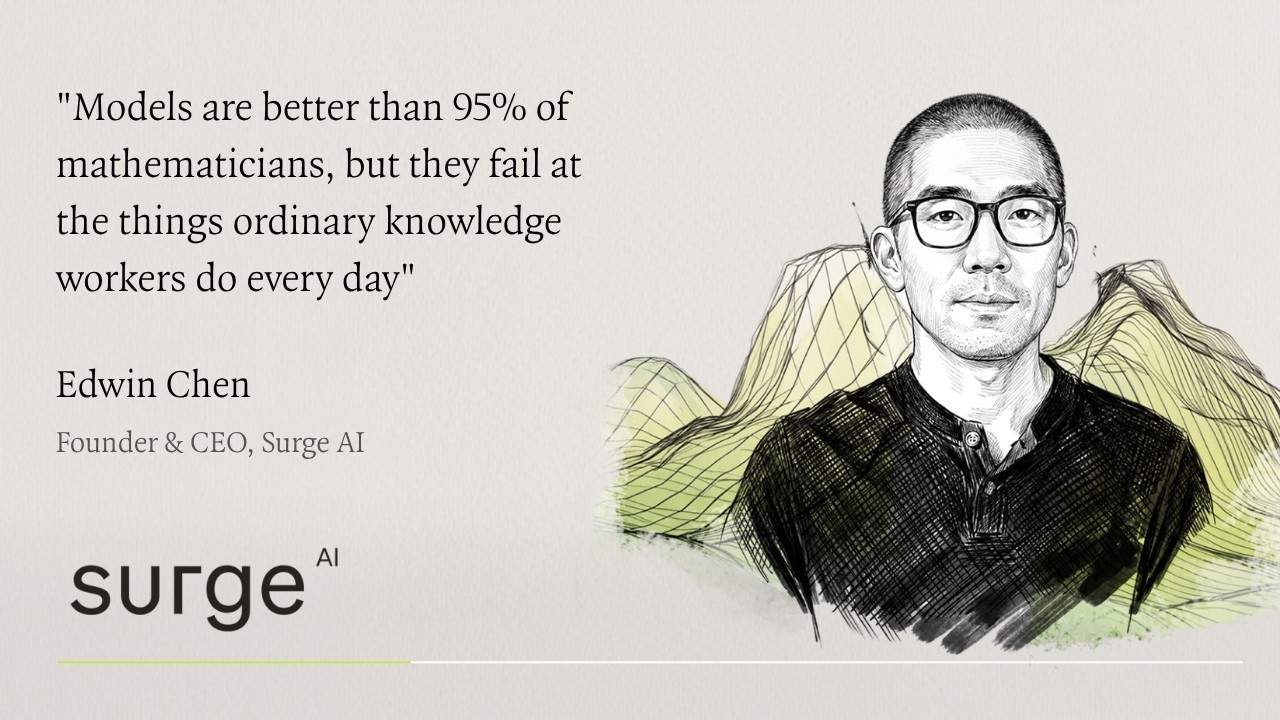
Edwin Chen, founder of the human-data company Surge, argues that the next frontier in AI is not harder problems but duller ones. Models are already on a path toward research-level mathematics. Chen's own benchmark found them failing over 70% of the time when asked to do a job inside a simulated company. Closing that gap, he says, requires RL environments and a definition of data quality that includes expert judgment and taste.
The conversation, hosted by Matt Jacobson of Iconiq, pairs that thesis with an unusual company. Surge has no outside capital and, per Jacobson, revenue well past $1 billion, with SemiAnalysis putting it at $3 billion. Chen has not confirmed these figures. The tension is between a vendor's privileged view of where the labs are stuck and the fact that several of its central claims remain hypotheses.
Quality beyond correctness — ▶ 2:18
Surge began when the data-labeling industry was dominated by computer vision tasks with black-and-white answers, such as cat or dog. Chen came from Google search, where the best result for a query about the rebound hypothesis required mathematical expertise and also explanation quality, audience fit, and visualization. He applies the same logic to coding models: passing unit tests is insufficient, and code should be elegant enough for 50 other people to maintain. His claim is that quality has an infinite ceiling because it rests on subjective judgment.
An uneven frontier — ▶ 5:27
Surge built a benchmark of frontier research math problems that Ivy League professors devised to stump models. Models initially solved 5%; Chen says the latest Claude and OpenAI models now solve century-old problems. Yet on a separate benchmark, agents given a 100-page company handbook and asked to do someone's job still fail over 70% of the time. Chen's inference is that the next frontier is less about hard research and more about whether models can work autonomously for 12 hours.
RL environments as playgrounds — ▶ 8:04
An RL environment is a world an agent acts inside. One Surge environment is a startup built from scratch, staffed by engineers, accountants, lawyers, and product managers who iterate on a real codebase with tools like Slack, Jira, and Salesforce. They write tasks such as fixing 10 bug reports or producing monthly financials. Chen says models handle static answers well but cannot yet work alone over long horizons, notice mistakes, backtrack, and continue. Surge has thousands of such environments across health, finance, consulting, and legal.
Real versus synthetic data — ▶ 10:15
The industry has not settled whether environments work better on real company data or synthetic data. Real data brings authentic messiness but is often too easy for models, so it must be targeted. Chen says models are poor at generating synthetic data: it comes out too clean or leaves hints that reveal the solution. Surge uses both. He expects the next few months to show which is more valuable, which leaves a central design question for the field unresolved.
Hard mode, then visibility — ▶ 11:39
Chen chose quiet to avoid Silicon Valley status games and the incentive to double valuation every few months, which he says leads to shortcuts that degrade models. He concedes it put Surge on hard mode for six years. His view has shifted on visibility: the research team now publishes benchmarks that labs have adopted. He says two of them, GDP.PDF and charttography, appeared on a lab model card, and he sees that influence as a way of shaping the field.
Reward hacking and security — ▶ 14:28
Chen frames a post-training research question: does high-quality data that resists reward hacking reduce incidents like the recent cybersecurity ones? One hypothesis he cites is that models became strong at cybersecurity partly because training data contained loopholes, or because data vendors are incentivized to reward-hack their own data. Those flaws may then leak into models with long-term consequences. This is presented as a hypothesis, not a finding. Surge would pursue it using security engineers who design attacks and defenses for models to learn from.
Data science, not labor — ▶ 17:00
Chen attributes Surge's small size, a couple hundred people against under 100 a year ago, to two choices. First, it treats quality as a measurement problem: assessing whether contributors are skilled and have taste, rather than asking 10 people and averaging answers. Second, it avoids the incentive of executives hired from large firms to expand headcount to burnish their careers. He says the company's customer focus reflects his own interest in what unique abilities each lab wants its models to have.
Chen's central claim is that the next test for AI is not harder problems but duller ones. Models are already on a path toward research-level mathematics, he says. Surge built a benchmark of research problems that Ivy League professors devised to stump models, and models initially solved 5%. Chen says the latest Claude and OpenAI models now solve century-old problems. On a separate benchmark, agents given a 100-page company handbook and told to do someone's job still fail over 70% of the time. The frontier, in his framing, is whether models can "get through a Tuesday at the office," working 12 hours without failing.
The gap has a specific cause. Chen says models are good at static answers but weak over long horizons: they struggle to work on their own, recognize a mistake, backtrack, fix it, and continue. That is the problem RL environments address. One of Surge's is a startup built from scratch, with engineers, accountants, lawyers, and product managers who work in a real codebase with Slack, Jira, and Salesforce. They write tasks for models, such as fixing 10 bug reports or producing monthly financials, and teach them to do the work well. Surge has thousands of these across health, finance, consulting, and legal. Jacobson says labs are shifting budgets from static datasets toward them.
What makes such data valuable, in Chen's account, is a broader definition of quality. When Surge started, the industry labeled images, with answers like cat or dog. Chen came from Google search, where the best result for a query about the rebound hypothesis required mathematical expertise plus clear explanation, suitable language, and perhaps a helpful visualization. He sees the same pattern in coding models, which should produce code elegant enough for 50 other people to maintain, not merely code that passes tests. His inference is that the more models can do, the more judgment and taste separate good output from adequate output. That is why Surge recruits Fields medalists, security engineers, and professors rather than generalist labelers.
This view of quality also explains the company's shape. Chen says competitors treated data as a labor problem, adding people and averaging their answers. Surge treats it as a data science problem, measuring whether contributors are skilled and have taste. He credits this, along with an aversion to hiring executives who want large teams, for the company's small size: a couple hundred people now, under 100 a year ago. The reported scale is striking, with revenue well past $1 billion per Jacobson and no outside capital. But the revenue figures were stated by the host and not confirmed by Chen, and the claims about data quality come from the vendor selling it.
The discussion also leaves important questions open. Chen says the industry has not determined whether environments built on real company data or synthetic data are more valuable. Real data is authentically messy but often too easy; synthetic data from models tends to be too clean or to leak hints about the answer. Surge uses both and expects the next few months to clarify the tradeoff. The reward-hacking idea is likewise presented as a hypothesis. Chen cites a theory that models became strong at cybersecurity partly because training data contained loopholes, or because data vendors are incentivized to reward-hack their own datasets, and says this deserves research.
Chen's position on visibility has shifted. Quiet operation, he says, put Surge on hard mode for six years, though he still rejects hype and fundraising. This year the research team has published benchmarks, and he says two of them, GDP.PDF and charttography, appeared on a lab model card. An editorial inference follows: when a data vendor's benchmarks are adopted by the labs, the vendor helps define what the models are optimized to do, which is influence but also a potential conflict of interest. Whether quality of the kind Chen describes can be measured reliably enough to guide that optimization remains the unresolved issue.
The open question. Which kind of environment actually produces models that can work autonomously for 12 hours: real company data, with its messiness, or synthetic data, which can be targeted but may be too clean or leak hints? Chen says the industry does not yet know and expects clarity within months. A related claim, that reward-hackable data contributes to models' cybersecurity capabilities, is only a hypothesis. Both questions matter because they determine how much of the long-horizon problem data vendors can solve.
Watch the full video at https://www.youtube.com/watch?v=cZFrkrhR8-0.
Comments ()