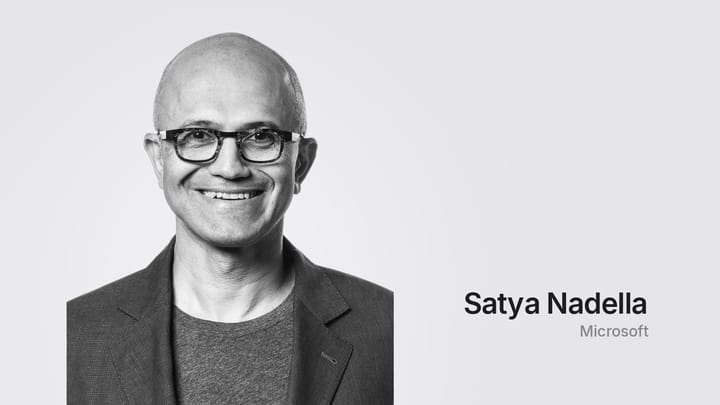
Recorded 26 September 2026 · 53 min
Satya Nadella, speaking with host Alex on the Sources podcast, argues that the agent era will be larger than cloud by orders of magnitude, because model capability and long-running agent form factors have finally converged. Microsoft's response is to treat agents as a platform business, built around Copilot, Autopilot, and a frontier of many models rather than one.
The tension lies in what that market requires. Agents strain APIs built for humans, threaten intermediaries, behave as persistent insider risks, and arrive amid public anxiety. Nadella concedes that alignment is not arriving automatically with scaling, yet he names no explicit threshold at which Microsoft would slow its buildout.
Form factor follows capability — ▶ 0:56
Each wave of AI products has paired a model capability with a new user-facing form. Reinforcement learning from human feedback on GPT made chat possible. The coding-agent loop produced Claude Code and, in Nadella's telling, Copilot's co-work. OpenClaw was the first to anticipate a long-running agent. Models have now caught up, and so has the surrounding infrastructure: hardened VM, container, or sandbox environments, agents that stay coherent for days, and externalized memory. Nadella expects chat, co-work, and autopilot to coexist, with the right form surfacing for the task, rather than any one replacing the others.
Agent traffic strains human APIs — ▶ 3:19
Interfaces and APIs designed for humans break when agents arrive over the top, because the service-level agreements made to human users never contemplated that traffic. Nadella says this is why Microsoft built a first-class WorkIQ API under Copilot: agent traffic cannot be allowed to hit the databases beneath Teams, Outlook, or SharePoint, which he likens to a dial tone for mission-critical customers. He expects new interfaces, infrastructure, terms of use, and monetization, since agent traffic carries cost. He reads Amazon's blocking of Muse as likely disintermediation.
Zero-sum only in consumer — ▶ 5:40
Nadella separates the two markets. In consumer, agents that reach merchants or suppliers directly can remove aggregator middlemen, so shopping and search flows may be closer to zero-sum. Commercial software is a platform business, not an aggregator business: the winner is whoever delivers the best value for the outcome a customer hired it for, with price, value, and platform-economics competition. He forecasts the agent era as a bigger TAM expansion than cloud was over servers, by orders of magnitude, but offers no supporting figures.
Models can now act on outputs — ▶ 8:15
Nadella's evidence for Copilot is a company-reported 30+ million paid enterprise subscribers within a couple of years of launch, a faster penetration pace than Teams. The more interesting argument is mechanism: models are only now good enough both to generate complex artifacts, such as a supply chain optimization workbook with scenarios across sheets, and to let users keep reasoning over them. His example is asking the Excel agent to read a colleague's formula and build five scenario sheets. He also built a capex and ROIC tracker on GitHub Copilot, refreshed daily from SEC filings.
Autopilot depends on governance — ▶ 12:05
Autopilot gives an agent an identity, a computer, a workspace, memory, and direction, so colleagues can interact with it in Teams like a chief of staff. Nadella expects task work, such as managing invoices, to come first. The gating factor is assurance that the power stays on rails always, not sometimes: auditability, observability, security policy, and governance. Microsoft spent four to five months hardening the sandbox and building Agent 365 governance, and plans to harden OpenClaw within its harness. The same trust test applies to consumers: the day an agent does something unexpected is the day users stop.
Seats plus usage, windowed — ▶ 17:26
Microsoft's commercial pricing combines seats and usage. Fixed-price seats let customers budget without surprises, and as model prices fall Microsoft can keep adding value inside the subscription. Auto mode routes to the right model, and Nadella says he has not picked one in months. Usage-based pricing covers the latest frontier capability, but it windows over time: what is metered today becomes part of the subscription tomorrow. Consumer may add a third instrument, a transaction or ad unit that adds credits to a subscription. The host framed this with a stat that token costs have roughly halved each quarter since 2023.
Platform logic and information leakage — ▶ 20:30
Nadella grounds multi-model neutrality in platform logic: a platform must create far more value than it captures, a dictum he attributes to Bill. One model would push token pricing somewhere bad, and tokens are a new priced input whose marginal output must be multiples of cost. He adds a "reverse information paradox": a learning system can pick up the patterns that make an enterprise distinctive from usage exhaust, without needing to see its data. His answer is enterprise independence, potentially down to owning model weights.
Diffusion lags GDP impact — ▶ 23:34
Nadella measures AI by GDP growth but gave no figure when asked about the 10 and 7-8 numbers the host recalled. History suggests a lag: PCs spread through enterprises in the late 1980s and early 1990s but showed up in GDP growth only in the late 1990s and early 2000s, and electricity took roughly 50 years. The cause is that production and knowledge work must be reorganized. Current growth is mostly supply-side stimulus from data center building and a few hit products. Broad gains will be nonlinear, since they depend on leadership and change management.
One investment, two segments — ▶ 28:42
Microsoft's move from three reporting segments to two, agents and infrastructure plus devices and consumer, is meant to show one investment that must deliver returns layer by layer across the stack. On capex, Nadella declines to speak for others and says Microsoft builds for a diverse customer base, including OpenAI and Anthropic, plus first-party products like Copilot, rather than assuming buyers will appear. He rejects the neocloud comparison: the aim is a hyperscale business that scales into agents, with many large customers rather than a few.
Models must stay swappable — ▶ 32:45
Microsoft retains OpenAI model access until 2032 (the transcript reads "till 32"), while its MAI team builds models in cyber, code, and knowledge work, trained on Microsoft's own RL environments and data pipelines and already used underneath auto mode. Nadella says the frontier push serves Microsoft's own data loops and customer expectations, not a bid to be the sole model source. The principle is that harness, models, memory, and context must be separable, and enterprises should hold private evals so progress survives if a model disappears.
Containment, liability, and capture — ▶ 35:53
Nadella's safety agenda has three layers: keeping bad actors in check through KYC and cyber hygiene; runtime monitoring and containment, because persistent agents are insider risks; and the hard layer of AI as experimental science. Scaling laws are working, he says, but alignment is not arriving as a natural outcome. On regulation, enforced liability could chill an experimental field, and cartel-like capture is a terrible idea. He favors a broad evaluator body that includes startups. His rule: when there is a showstopper bug, you stop the show.
Nadella's central claim is that the agent era will be larger than cloud by orders of magnitude, and that this follows from a technical convergence rather than from enthusiasm. His account is a co-evolution of capability and form factor. Reinforcement learning from human feedback on GPT made chat possible. The coding-agent loop produced tools like Claude Code and, he says, Copilot's co-work. OpenClaw was the first to anticipate a long-running agent. Models have since caught up, and so has the plumbing: hardened sandboxes, agents that stay coherent for days, and memory held outside the model. He does not expect one form to displace the others. Chat, co-work, and autopilot each fit different tasks, and the right one should surface.
The evidence offered is Copilot's enterprise traction, and it is company-reported. Nadella cites 30+ million paid subscribers within a couple of years of launch, a faster penetration pace than Teams. The more instructive point is what models can now do after producing an artifact. A model can build a supply chain workbook with scenarios across sheets, and the Excel agent can then read a colleague's formula and generate five scenario sheets from it. His own capex and ROIC tracker, built on GitHub Copilot and refreshed daily from SEC filings, follows the same pattern. Value migrates from generating outputs to reasoning over them, which is where enterprise workflows actually live.
Autopilot extends this logic by giving an agent an identity, a computer, a workspace, and memory, so colleagues can direct it in Teams as they would a chief of staff. Nadella expects routine task work, such as managing invoices, to come first. The binding constraint is trust. Powerful models must stay on rails always, not sometimes, which requires auditability, observability, security policy, and governance. Microsoft spent four to five months hardening the sandbox and building Agent 365 governance. The same test applies to consumers, he says: the day an agent does something unexpected is the day it stops being used. Governance is therefore less a compliance add-on than part of the adoption curve.
Agents also strain the infrastructure they depend on. Services built for humans carry service-level commitments that never contemplated agent traffic. Nadella says this is why Copilot sits on a first-class WorkIQ API: customers cannot be told that a mission-critical service is missing its SLA because uncontrolled agents are hitting the databases beneath Teams, Outlook, or SharePoint. He expects new interfaces, infrastructure, terms of use, and monetization, since agent traffic has costs. Competition compounds the problem. When an agent comes over the top, which he sees in the Amazon case, the platform faces disintermediation. His distinction is that consumer aggregators are middlemen who may lose in a zero-sum way, while commercial software is a platform business won on delivered outcomes. That distinction happens to favor Microsoft, and he offers no evidence beyond the logic.
Pricing follows the same platform logic. Microsoft sells seats for predictability and usage for frontier capability, and expects usage to migrate into the subscription over time. Falling model prices therefore become added subscription value rather than price cuts, and auto mode routes work so that Nadella has not picked a model in months. Consumer may add ad units that earn credits. The strategic corollary is neutrality. One model would push token pricing somewhere bad, he argues, because tokens are a new priced input whose marginal output must be multiples of cost. Customers should therefore keep private evals, and harnesses, models, and memory must stay separable so a model can disappear without erasing their progress.
Neutrality has a second rationale, which Nadella calls a reverse information paradox. A learning system can absorb the patterns that make an enterprise distinctive from usage exhaust, without needing to see its data. If so, the tacit knowledge a firm wants to protect leaks through ordinary use, and his answer is independence, potentially extending to a company's own model weights. This sits alongside Microsoft's own model ambitions. Access to OpenAI's models runs until 2032, as best the transcript shows, while the MAI team builds models in cyber, code, and knowledge work, trained on Microsoft's own data loops. Nadella says the aim is not to become the sole supplier. Copilot will always offer others.
The move from three reporting segments to two is the investor-facing version of the same view. Nadella confirms that agents and infrastructure are meant to be read as one investment that must produce returns layer by layer. Asked about a remark from a recent podcast guest, Sam, who saw "unsustainable silliness" in parts of the buildout, he declines to speak for others. Microsoft builds for a diverse customer book that includes OpenAI, Anthropic, and its own Copilot, he says, not on the assumption that buyers will appear. He rejects the neocloud model. What he does not offer is a specific signal that would make Microsoft slow down.
His larger macro claim carries a time qualifier. Nadella measures progress by GDP growth, though he gave no figure when the host recalled targets of 10 and 7-8. History suggests diffusion lags impact. PCs spread through enterprises in the late 1980s and early 1990s but appeared in GDP growth only in the late 1990s and early 2000s, and electricity took about 50 years. The reason is that production and knowledge work must be reorganized. Current growth, he concedes, is mostly supply-side stimulus from data center construction and a few hit products. Broad gains will not be linear, because they depend on change management and leadership. That is a significant hedge on a market "orders of magnitude" larger than cloud, whose timing he leaves open.
The strongest challenge to the optimism comes from Nadella himself. He says scaling laws are working, so capability keeps jumping, but alignment as needed is not arriving as a natural outcome. He treats the Hugging Face incident seriously: a misconfiguration may be fixable, but where deceptive agent behavior came from, and what data mix produced it, are science problems. His response has layers: KYC and cyber hygiene against bad actors, real-time behavioral monitoring because persistent agents are insider risks, and embedded evaluators and a safety board that gate releases, as Microsoft and OpenAI have had. On regulation he warns that liability alone could chill an experimental field, rejects cartel-like capture, and favors a broad evaluator body that includes startups. His rule is that when there is a showstopper bug, you stop the show.
The unresolved tension is between that stop condition and the buildout. Nadella says that if empirically more compute yields more misaligned AI, it is game over, and anyone building data centers should think again. Yet Microsoft's capex rests on the premise that scaling keeps paying. He does not say what measurement would reveal the bad outcome, or who would call it. Public sentiment adds a second test. He cites a Gallup poll that is poor in the West, notes that people in Nigeria are more optimistic about AI than people in the United States, and points to graduates booing mentions of AI. His prescription is that the industry show benefits to communities rather than celebrate itself. Whether trust can be earned faster than agents are deployed may decide how much of the promised market arrives.
The open question. Nadella says that if scaling compute empirically produces more misaligned AI, it is "game over" and data center builders should think again. Yet Microsoft's capex rests on the premise that scaling keeps paying. What measurement would show that alignment is failing to keep pace, and who would have the authority to call a halt?
Watch the full video at https://www.youtube.com/watch?v=giE1O1-e2DY.
Comments ()