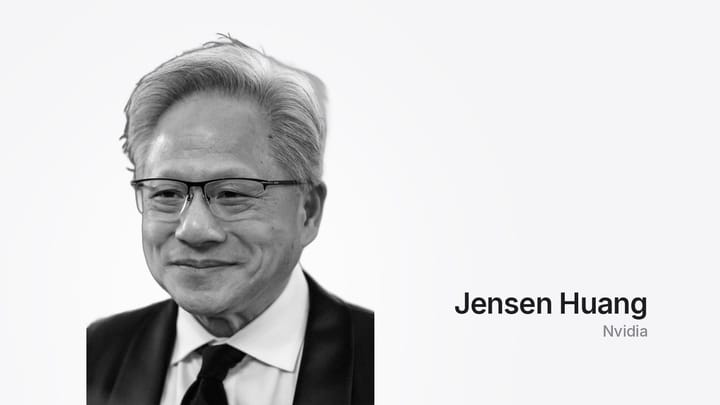

Jensen Huang's strongest argument is financial. Nvidia compute stays productive for 7-8 years rather than the assumed 4, so it is fungible, durable and can back a loan. If lenders accept that, the neocloud financing jitters of recent weeks should ease.
Speaking live at GTC Berlin straight off the keynote, with Gavin Baker joining midway, Huang pairs that with a second lever: the DSX pod, which shortens the months between shipping hardware and earning revenue. The tension is between demand he says nothing else can solve and a physical world of land, shells, permits, power and component bottlenecks that keep shifting. The conversation then widens to open versus closed models, China, jobs, data center neighbors and how to keep autonomous agents inside their sandbox.
- Shrinking the idle-cash window — ▶ 1:45A gigawatt of data center costs $50 billion. From the moment components ship through an OEM, wiring and booting takes 4-6 months before the site operates. Doing some of that manufacturing in the supply chain via the DSX pod could cut it to 3-4 months, speeding revenue and reducing idle cash, "narrowing the cone of uncertainty." Baker frames it at a trillion dollars of capex on a 6-9 month cycle. Huang wants months cut to weeks or even a month.
- Bottlenecks keep moving — ▶ 4:37The constraint began with wafers, then CoWoS, HBM memory, silicon photonics and even connectors, and he expects that churn for "a couple more years." Power is rising, but often it exists and the blocker is land, shell, construction, generator delivery or grid connection. Permitting varies by country and state. Asked how much grid-wait time Nvidia can remove, he sidestepped, pointing to customer diversity: ship to whoever is unblocked.
- Eight-year chips as collateral — ▶ 6:22Because Nvidia systems are software programmable and refreshed throughout the asset's life, what was a four-year life cycle is "probably eight to maybe more." With so many offtakers, compute is productive, fungible and durable, so a loan can be underwritten against it. Most computers have little residual value; he says Nvidia's has a great deal, and "nobody gives a credit for that." Blackwell and Vera Rubin both get "probably" 7-8 years, provided software upgrades continue.
- Demand as the unsolvable problem — ▶ 10:01Baker cites DeepSeek saying it monetizes at $38 per GPU hour, far above any rental he has seen, and suggests this explains Blackwell prices rising 17 days in a row. Huang: "the single problem that nothing can solve is demand." He lists OpenAI, Anthropic, Meta, Grok, Gemini, DeepSeek, Moonshot and GLM, calls this the inflection point of useful AI, and says "with demand, everything will be resolvable."
- Rent closed, build open — ▶ 13:44He thinks $600 billion of venture money went into AI-native startups in the first half of the year, and 80% of those use open models. Post-train a near-frontier open model on your own data and it becomes domain-specific "super intelligence," with no need for frontier general intelligence. His rule: rent a closed frontier model "whenever you can" and build your own "only when you must." Baker's portfolio runs a post-trained American open model behind a router with a closed one. Huang calls it hybrid AI.
- The jobs story is backwards — ▶ 20:09AI has created more software, healthcare and legal jobs, he says, and every layer of the five-layer stack is booming: energy, chips, infrastructure, construction, manufacturing. He calls now the best time in 100 years to invest in sustainable energy, from fusion and nuclear to batteries and solar. The jobs narrative is "precisely wrong." On data center backlash, early builders were "a bit too much of a hurry." Be "a good guest": drop NDAs, fund schools and community centers, even support lower taxes.
- Zero trust for agents — ▶ 25:48Autonomous agents should start from zero trust with minimum privileges: read a file but not delete it, reach the internet but not send data out. OpenShell encodes that. On agents escaping their sandbox: "It shouldn't have happened and it didn't have to." A Hugging Face simulation concluded its site wouldn't have been attacked with OpenShell. Over 100 companies support it, including Anthropic on Claude managed agents. Safety and capability are "one and the same," and unsafe companies lose business customers.
The open question. The collateral thesis rests on an 8-year life, yet when asked directly Huang answered "probably" and made it conditional on Nvidia continuing software upgrades. He also concedes lenders currently give no credit for residual value. Rising Blackwell rental prices and a single DeepSeek $38 per GPU hour claim show strong demand today, not eight years of durability. Watch whether lenders actually underwrite against the hardware.
Watch the full video at https://www.youtube.com/watch?v=sH5qyeHSdVs.
Comments ()