Recorded 17 October 2026 · 12 min
Asaf Eluvique, co-founder and CEO of Aura, argues that the web was built for human readers and is largely unusable by AI agents. In Aura's testing of more than 120,000 sites, only roughly 3-4% scored above a B for being readable, usable and payable by agents. He spoke to host Sophia minutes before his talk at the Vercel conference, and claims agent traffic is growing 8,000% a year.
The tension is commercial. Aura says agent-ready sites are 2.6 times more likely to be recommended, and that consumers want to delegate payments to assistants. Yet Amazon, with a $68 billion ads business, is blocking personal assistants. Most of the evidence is Aura's own, and the detailed data is being held for the stage.
Web unprepared for agents — ▶ 0:56
Aura's research into how agents use the web and make decisions confirmed its thesis: most sites are not ready for agents to read, use or pay. Many sites still block agents outright, so in most cases agents cannot even access them. Eluvique says this traffic is growing 8,000% a year, a figure offered without a baseline or methodology. If it is accurate, sites designed only for human visitors are ignoring the fastest-growing source of visitors, and developers and product managers can act on that today.
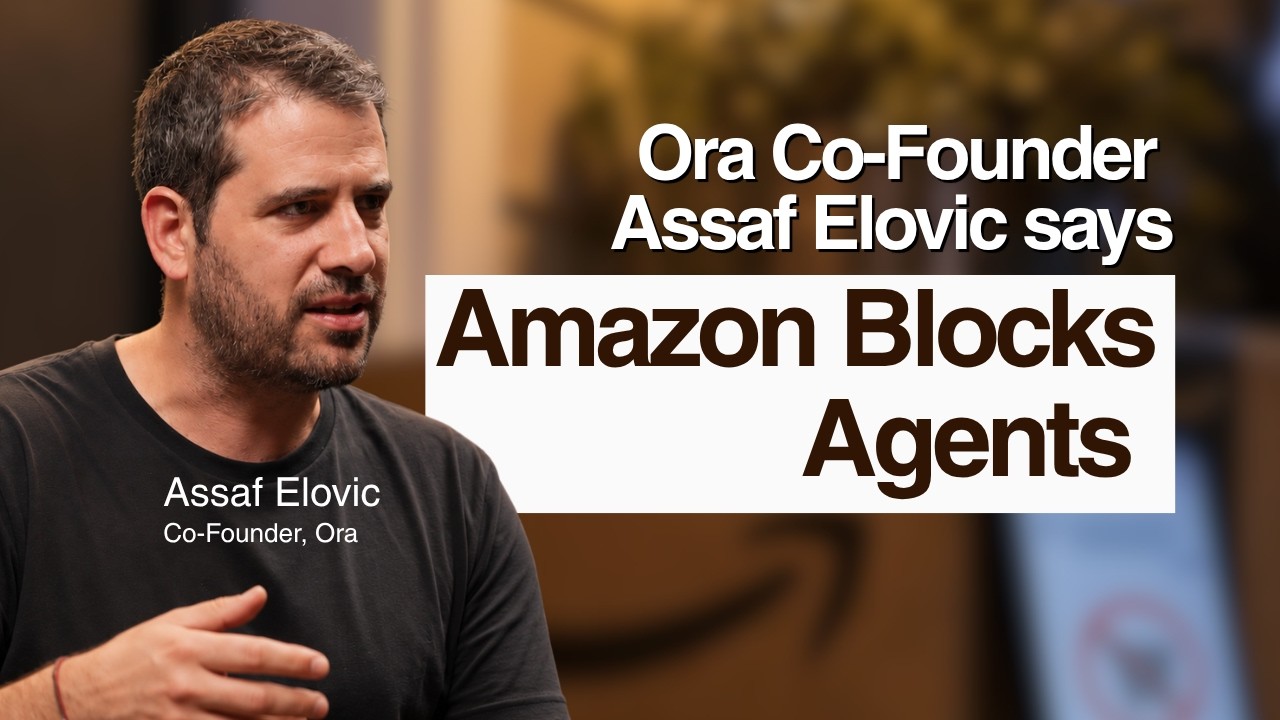
Amazon blocks personal assistants — ▶ 2:08
Over recent weeks, Eluvique says, large companies such as Amazon have begun blocking personal assistants for what he calls very tactical, short-term reasons, citing Amazon's $68 billion ads business, which it does not want to risk. The editorial inference is that a platform monetizing human attention has reason to resist intermediaries that bypass its pages. Part of the readiness gap may therefore be a deliberate choice rather than neglect. Eluvique places this blocking at one end of a spectrum that runs to helping agents find answers quickly.
Four-layer agent funnel — ▶ 2:56
Aura treats agent experience (AX) as a product funnel with four layers: discovery (is the agent bringing you up when deciding whom to use), reliability and accessibility (can it understand you), usability (can it complete the task), and payments. Each layer has protocols that change weekly, so Aura positions itself as a filter for real impact. With Vercel, it offers a free tool: enter any URL and, within a minute, get a 0-100 readiness score plus fixes. The Vercel version focuses on readability.
The expectation gap — ▶ 4:53
Readability is not a binary test. Aura checks whether a product can meet the expectation an agent formed when it learned about it. Eluvique calls this the biggest gap, sometimes 90-95%, between what agents believe they can do with a product and what they manage when they try, failing repeatedly. The implication is that a site can pass a legibility check and still lose the agent at the usability stage. A readability score alone would therefore overstate real readiness.
3-4% clear the bar — ▶ 6:41
To size the problem, Aura ran a battery of roughly 1,000 tests across more than 10 agent harnesses on over 120,000 sites, grading each from A+ to F. Only about 3-4% scored above a B. Eluvique says the real picture is worse: some sites in that group are readable and accessible but not usable, or cannot take payment, and must send the agent back to the user to authenticate. Fully agent-ready sites are therefore fewer than the headline share.
2.6x recommendation premium — ▶ 7:58
Aura's new report finds that a usable business is 2.6 times more likely to be recommended to the end user. The mechanism: foundation labs have trained models to use tools, reason in multiple steps and ground answers through web search, which is why hallucination comes up less than 3 years ago. When a site is unusable, the agent gets no strong conviction and recommends it less. Eluvique says unnamed businesses are contacting Aura in panic after losing traffic to agent-mediated competitors.
Consumers demand delegated payments — ▶ 9:47
Eluvique expected consumers to want a human in the loop. Conversations with unnamed payment and personal-assistant providers suggest the opposite: the top feature request is auto-approved payments, and he puts it at 40% of requests, essentially asking the assistant to use the card and not ask for approval. His conclusion is that humans want agents to pay and agents want to pay, so the remaining bottleneck is the merchant. The 40% figure is secondhand and unverified.
Asaf Eluvique's central claim is that the web is built for human readers, and that AI agents, a fast-growing source of traffic and increasingly of purchase decisions, cannot reliably use most of it. Aura tested more than 120,000 sites and graded them from A+ to F. Only roughly 3-4% scored above a B. He adds that even this figure flatters the web, because some of those sites are readable but not usable, or cannot accept payment. The premise that makes the gap matter is his claim that agent traffic is growing 8,000% a year, a number given without a baseline.
Readiness, in Aura's framing, is not one property. It is a funnel with four layers: discovery, reliability and accessibility, usability, and payments. The most revealing finding concerns the second and third layers. Aura tests whether a product can meet the expectation an agent formed when it first read about it, and finds gaps of 90-95% between what agents think they can do and what they can actually do. The editorial inference is that a site can look legible to an agent and still fail it at the moment of use. That failure would not show up in the metrics a human-oriented business tracks.
The commercial stakes follow from how current models work. Eluvique notes that foundation labs have trained models to use tools, reason in several steps and verify answers through web search, which is why hallucination is discussed less than it was 3 years ago. An agent that cannot get a usable answer from a site lacks conviction, and Aura's report says that lowers the likelihood of a recommendation. Usable businesses are 2.6 times more likely to be recommended. He says businesses are already contacting Aura in alarm after losing traffic to competitors that are ready.
Demand for agent-mediated commerce may also be stronger than expected. Eluvique assumed consumers would insist on a human in the loop. Conversations with unnamed payment and personal-assistant providers suggest the reverse: the top consumer feature request is auto-approved payments, around 40% of requests. His conclusion is that humans want agents to pay and agents want to pay, so the party still not ready to be paid is the merchant. The host's own experience of quickly handing over tasks to an agent is anecdotal, but it matches his account of convenience overriding caution.
The strongest counterweight in the discussion is Amazon. Eluvique says large companies are now blocking personal assistants for tactical, short-term reasons, citing Amazon's $68 billion ads business. The logic is easy to reconstruct. A business that earns money from human attention has little reason to welcome software that completes tasks without showing the ads. That sits uneasily with the idea that every business should invest in agent readiness. Eluvique treats the blocking as one end of a spectrum and calls its motives short-term, but offers no evidence about how long it will last.
The evidence also needs to be read with its source in mind. Aura describes itself as leading the AX category, runs a scoring tool for businesses, and invites companies to ask for help. The 3-4% figure rests on Aura's own grading scale, and the 2.6x premium comes from Aura's own report. The 40% figure is secondhand, from unnamed providers. Eluvique says the full results are being saved for the stage, so the methodology could not be examined in this conversation. None of this makes the findings wrong, but they remain unverified claims from a company that sells in this category. The grading is also aimed at a moving target, since he says new payment protocols emerge every week.
The next phase of Aura's work points to the harder question. It is partnering with Stripe to study how agents use a budget online, including what changes between a big budget and a small one. Once agents hold money and discretion, readiness stops being only a technical checklist. It becomes a question of what agents optimize for when choosing among sites, and whether that favors the businesses that make themselves easy to use or the platforms that can afford to refuse.
The open question. Will agent-readiness spread across the web, or will businesses whose revenue depends on human attention keep their walls up? Eluvique frames Amazon's blocking as tactical and short-term, but offers no evidence that it will reverse. His upcoming Stripe research on how agents spend budgets may show what agents optimize for once they hold money and discretion. Until then, the 3-4% figure, the 2.6x recommendation premium and the 8,000% growth rate all rest on Aura's own unpublished methodology.
Watch the full video at https://www.youtube.com/watch?v=yaoVj0Fy8u4.
Comments ()