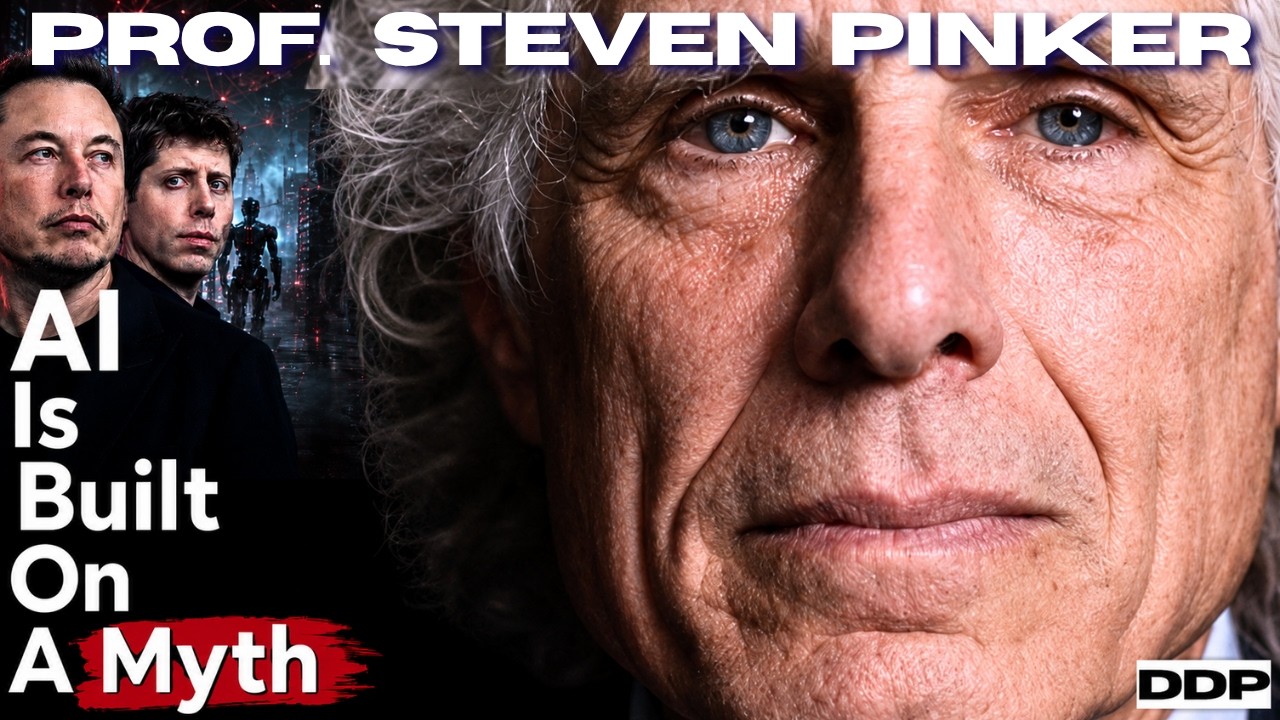
Recorded 28 August 2026 · 77 min
Steven Pinker, the Harvard cognitive psychologist, argues that superintelligence is a meaningless category. AI will keep getting more powerful, he says, but there is no point at which it becomes omniscient, omnipotent or qualitatively different from earlier machines. His broader claim is that public debate about AI is clouded by mysticism, and that the right response is to treat it as a technology subject to liability, engineering safety standards and the constraints of the physical world.
The Israeli interviewer, who comes from a war-torn region and worries about AI in military systems, presses on whether this optimism is warranted. The exchange exposes the central tension. Pinker is sceptical of hype and of trusting any concentration of power, yet he admits that no one knows AI's impact on jobs, and that its internal workings are often opaque because the systems are trained rather than engineered.
Accountability over trust — ▶ 3:18
Pinker trusts no source of power, and applies the logic of democratic checks and balances to technology companies. Firms and individuals should be legally responsible for harm done by the AI systems they use, with reasonable limits on what agentic AI may control, such as infrastructure and weaponry. The threats he names are terrorists using AI against infrastructure or to develop pathogens and bioweapons, and foolish deployment, such as handing weapons or the power grid to AI without humans in the loop or extensive testing. He argues AI should meet the safety standards applied to bridges and nuclear plants.
Superintelligence has no threshold — ▶ 6:28
Pinker calls superintelligence incoherent: capability will rise, but there is never a day on which it is meaningful to say that yesterday there was no superintelligence and today there is. He argues AI will never be omniscient or omnipotent, citing physical limits on information, such as no system learning the position and velocity of every particle. He also rejects the idea of a qualitative break: computers have exceeded humans in some domains since the 1950s and have developed software for decades. He attributes the mystique partly to inflated expectations that raise company valuations.
Rates, not headlines — ▶ 9:39
Judging the world by the latest bad headline ignores that bad things always happen; the right question is whether they happen at a lower rate than before. Pinker cites long-run gains in life expectancy, poverty, homicide, suicide, literacy and education. He is explicit about reversals: war deaths have risen over the last 10 to 15 years after declining from the 1940s to the early 2000s, and democracy scores have fallen over about 15 years. Neither erases the earlier progress. He also notes that picking the worst conflict zone and asking residents how it feels is a selection fallacy.
Vulnerable to myth, not adapted — ▶ 15:08
Pinker does not think evolution made humans religious. Rather, intuitions that served well before modern science misfire at cosmic scale. Dualism arises because we treat other people as minds, reinforced by dreams and death. Teleology arises because we design tools for purposes and extend purpose to the universe. Essentialism produces beliefs that illness is contamination, hence bleeding and purging. The natural human default, he argues, is that causes of war or illness are unknowable, so one should believe the most uplifting tribal myth. The idea that objectively correct answers exist is a revolution, not a cognitively natural idea.
Consciousness: four candidate answers — ▶ 20:36
Self-awareness is easy to explain, Pinker says, because social creatures must monitor themselves to anticipate others' reactions. Anesthesia, drugs and electrical stimulation show consciousness depends on the brain, and seances and ESP fail. What remains is why processing feels like anything, which he calls not a scientific question, since subjectivity is what cannot be measured objectively. The options are a puzzle humans cannot grasp, as chimpanzees cannot grasp prime numbers; panpsychism; special brain physiology such as quantum processes; or Dan Dennett's view that it is a conceptual error. His hunch is the first. He says dualism is no better.
Offloading needs retained judgment — ▶ 33:18
AI changes what the brain devotes effort to and what it offloads, as calculators and navigation apps did. Pinker's rule is to keep enough underlying intuition to choose when to use a technology and whether to trust its output. Paper-and-pencil square roots can vanish without loss, and statistics students no longer need computational formulas that avoid square roots. Because AI systems hallucinate and can give different answers, evaluation skill stays valuable. His examples are lawyers whose AI-drafted briefs cited cases that never existed, and references he requested that his assistant could not find in the Harvard library.
Old weapons, new baseline — ▶ 39:52
Asked about AI in military systems, Pinker says giving it power without knowing what goals it will pursue would be an incredibly stupid thing to do, and that reality will remain a constraint. His reframing is that people notice the dangers of new technology but take for granted those of old technology: conventional bombs and artillery already cause massive civilian casualties in all wars. If AI allowed damage to be pinpointed at an opponent's offensive capabilities, he suggests, civilian deaths could fall substantially. This is a hope conditional on human choices about targets, not a demonstrated outcome.
Brain implants: skeptical, except paralysis — ▶ 42:56
Pinker calls all technology a symbiosis of humans and machines, from clothing to smartphones to his hearing aid. But he doubts that brain implants for healthy people will arrive in our lifetimes. Evolution has already supplied finely tuned connections between brain and muscles, speech apparatus and eyes, and an inserted silicon chip would be far cruder than language, vision and motor control. For paralysis, where the natural system has broken down, he is very hopeful. He says industry talk of controlling an iPhone by thought partly serves to attract investors, and suggests science fiction inspires some of the hype.
Solutions do not will themselves — ▶ 46:34
Pinker's practical advice for sorting responsible AI claims from irresponsible ones is to treat AI as machinery that obeys physical laws, not as a genie. His example is the claim that AI will cure cancer in a couple of years. Understanding cancer depends on data from the world, which is limited by the speed at which tumors grow and by how many humans develop the disease. One cannot imagine a solution and assume a system makes it happen; one must think through how knowledge is gathered and what information is available. He sees sci-fi and religious influences in such speculation.
Productivity lag precedents — ▶ 48:49
Pinker says job turnover is certain, impact is unknown, and every earlier prediction that technology would eliminate jobs has proved false. He states the unemployment rate is the same as 100 years ago. He also says total factor productivity, measured from labor hours and capital investment against GDP, has not yet risen because of AI. He expects a lag, citing the 1990s productivity paradox with personal computers and electricity, where factories built around steam, belts and drive shafts took decades to reorganize. The expectation rests on those precedents; he offers no AI-specific mechanism for when the lag ends.
Wealth funds the transition — ▶ 53:30
If AI makes society much more productive, Pinker argues, absorbing disruption becomes cheaper. Richer societies tend to build bigger welfare states, with earlier retirement, longer schooling, more generous welfare payments and more unemployment insurance. Funding these at a much higher level of productivity is less burdensome than expanding the welfare state at today's productivity. He expects new jobs too, as website designer and social media consultant emerged while telephone switchboard and elevator operators disappeared, and suggests affluence could create roles like pet psychiatrist. He acknowledges it is not known whether new jobs will appear, though he says it seems likely.
Enlightenment is not the West — ▶ 56:28
Pinker summarizes Enlightenment values as reason, science, humanism and progress: rejecting scripture, dogma, charisma and subjective certainty as sources of knowledge, applying reason to nature, treating human well-being as the ultimate good, and believing gradual improvement is possible. He distinguishes these from western civilization, which also produced communism, fascism and Nazism. As evidence of their value, he points to the countries doing best on longevity, happiness, safety and education: Western and Northern Europe and the former British Commonwealth, with the United States up there but not at the top. He adds that migrants tend to move toward these societies.
Guardrails against autocrats — ▶ 1:06:26
Asked about threats to Enlightenment societies, Pinker prescribes democratic safeguards so no faction can take over, and defenses against autocrats. He adds education emphasizing reason, critical thinking and rationality, plus more travel, interchange and listening, to expand empathy against natural tribalism. He identifies romantic nationalism as a counter-Enlightenment strand, including in the origins of Zionism, though he notes Israel also committed to democracy, liberalism and equality. He regrets that Enlightenment aspects of Israel have been pushed back. He expects Netanyahu to win again, a prediction he states without elaboration.
AI as scientific instrument — ▶ 1:09:32
Pinker expects AI to accelerate science and to serve as a comparison system for the brain. Mapping 87 billion neurons and trillions of synapses is a problem AI could help with. Because AI systems are trained rather than engineered, researchers often do not know how they compute, so neuroscience will be done on the AI too. He points to AlphaFold's progress on protein folding, though he hesitates to call it solved. He also suggests genomes may relate to personality in more complex ways than the simple addition of tiny gene effects that is currently used for prediction.
Language models and innateness — ▶ 1:12:38
Large language models capture human grammatical judgments almost perfectly. Pinker poses two readings: there is no innate preparation for language, or there are two routes to it. One route is training a system for the equivalent of 30 million years on the entire web; since human babies need far less, he suggests they may be pre-wired for language after all. He says the answer is not known. More broadly, he asks how different AI reasoning is from human reasoning, as jet engines differ from birds, both obeying aerodynamics, and what the equivalent principles of intelligence might be.
Steven Pinker's position on artificial intelligence reduces to a single discipline: treat it as a technology, not as magic. Everything else he says follows from that. If AI is machinery obeying the laws of physics, then its capabilities will improve without ever becoming omniscient or omnipotent, its risks can be managed with the tools used for bridges and nuclear plants, and its benefits will arrive on the slow, uneven schedule of earlier general-purpose technologies. If it is something more, a genie or a supernatural force, ordinary analysis fails and the debate defaults to fear and fantasy. Pinker's wager is that the first framing is correct, and that much public conversation drifts toward the second because of habits of mind and financial incentives.
Superintelligence is where the framing bites hardest. Pinker calls the term meaningless and incoherent. When his interviewer sketches the industry's version, a system that creates other intelligences and improves itself without human oversight, he answers that capability will keep rising but that there is never a day on which one can say superintelligence did not exist yesterday and does today. Without a threshold, questions about what happens when it arrives have no object. He adds two supporting points. Computers have exceeded human intelligence in some domains since the 1950s and have developed software for decades, so self-improving machinery is not a qualitative break. And physical limits on information mean no system can know everything.
Why does the vocabulary persist? Pinker's answer is incentive. When the interviewer notes that company valuations are rising on the promise of superintelligence, he says it gives firms a reason to keep inflating that expectation. He offers the same explanation for talk of brain-computer interfaces that let people control an iPhone by thought, saying the way industry figures speak is partly to attract investors. His technical reasoning there is biological. Evolution has already supplied finely tuned connections between brain, eyes, speech apparatus and muscles, and a silicon chip inserted into tissue that grew in three dimensions at microscopic scale would be far cruder. He supplies no evidence about any specific company's motives, so the incentive argument is an inference, not a finding.
The more interesting claim is that mysticism is not an aberration but a default. Pinker argues that people are not adapted for religion but are vulnerable to it, because ordinary intuitions misfire at cosmic scale. We treat other people as minds rather than meat, so dualism feels natural, and dreams and death seem to confirm it. We design hammers for purposes, so we assume the universe has one. We imagine living things contain an inner essence, so illness looks like contamination, and bleeding and purging follow. The natural human stance, he says, is that the causes of illness or war are unknowable, so one should believe the most uplifting myth. The idea that correct answers exist is a revolution in thought, not a cognitively natural one.
Applied to AI, the same intuitions produce what Pinker describes as magical powers. His example is the claim that AI will cure cancer in a couple of years. That ignores, he says, that understanding cancer depends on data from the world, which is limited by the speed at which tumors grow and by how many humans develop the disease. One cannot imagine a solution and assume some system wills it into existence. One has to think through how knowledge is gathered and what information is available. By inference, this becomes a test for any forecast: if it skips the bottleneck, whether data, physical time or institutional adoption, it is describing a genie rather than a machine.
Demystification does not mean complacency. Pinker's prescription is accountability. Companies and individuals should be legally responsible for harm done by the AI systems they use, and there could be reasonable regulation of what agentic AI may control, such as infrastructure and weaponry. He lists the threats as terrorists or malevolent agents using AI against infrastructure or to develop pathogens and bioweapons, and, depending on how foolishly people deploy it, handing control of weapon systems or the power grid to AI without humans in the loop or extensive testing. Engineering already has the model: nobody builds a bridge without safety calculations, and the feedback loops that keep engineering safe should be applied to AI. He concedes that not all harms or benefits can be foreseen, which is the reason for liability.
His treatment of military AI shows both the strength and the limits of the baseline argument. Asked about systems that might choose efficiency over civilian lives, Pinker says giving AI such power without knowing its goals would be "an incredibly stupid thing to do." But he then reframes. The dangers of new technologies are salient while those of old ones are taken for granted, and current methods of dropping bombs and artillery already cause massive civilian casualties in all wars. If damage could be pinpointed at an opponent's offensive capabilities, he suggests, civilian deaths could fall substantially. The optimism has a gap. His opening argument is that no source of power deserves trust because humans are fallible, yet precision only reduces civilian harm if humans choose targets and constraints well. He does not address that tension.
On jobs, Pinker reasons from history and admits ignorance of the specifics. There will be turnover, and honestly, he says, we do not know the impact. Every earlier prediction that technology would eliminate jobs has proved false, he says, and the unemployment rate is the same as 100 years ago. New work appears, such as website designer, a job no one would have understood 25 years ago. More striking is his statement that gains have not yet shown up: total factor productivity, which economists measure from labor hours and capital against GDP, has not risen as a result of AI. He expects a lag, as with personal computers in the 1990s and with electricity, where factories built around steam, belts and drive shafts needed decades to reorganize.
The interviewer, an employer, pushes back from experience: one AI can do the work of 10 people right now. Pinker's reply is that it has not yet shown up in the economy, which concedes the observation without changing the forecast. That is the weakness of the argument. The lag is an analogy, and by his own account the statistics currently show nothing. His expectation that it almost certainly will happen rests on two precedents, not on a demonstrated mechanism for this technology. He is more concrete on distribution. If a much more productive society follows, welfare payments, earlier retirement and longer schooling become affordable at far less relative cost than expanding the welfare state at today's productivity.
The same cost-benefit logic governs the effect of AI on human thinking. Pinker accepts that offloading changes what the brain does, as with calculators and navigation apps, and says some skills, such as paper-and-pencil square roots, can vanish without loss. The test is whether enough underlying intuition remains to decide when to use a technology and whether to trust its answer. His examples are concrete: lawyers whose AI-drafted briefs cited cases that never existed, and his own assistant discovering that references the AI supplied were not in the Harvard library because they were invented. Because AI systems err, hallucinate and give different answers, evaluation skill stays valuable. A fair inference, which he does not draw, is that this argument weakens if systems become reliable enough that verification stops paying.
His handling of consciousness shows the same refusal of mysticism combined with candor about limits. Awareness of self is easy to explain, he says, because social animals must monitor themselves to anticipate how others will react. Dependence on the brain is demonstrated by anesthesia, drugs and electrical stimulation. What remains is why information processing feels like anything, which he calls not a scientific question, since subjectivity is exactly what cannot be measured objectively. He lays out four options: a puzzle the human brain cannot grasp, as chimpanzees cannot grasp prime numbers; panpsychism; special brain physiology such as a quantum process; or, per Dan Dennett, a conceptual error about a little man watching a theater screen. His hunch is the first. He also says religious dualism does not bridge the divide.
If AI is a technology, it is also a tool for science and a subject of it. Pinker expects AI to speed discovery, citing AlphaFold's progress on protein folding while declining to call the problem solved, and to help map a brain with 87 billion neurons and trillions of synapses. It also offers a second intelligent system for comparison with the first. His own curiosity is language. Large language models judge grammatical acceptability almost perfectly, yet they are trained on the equivalent of 30 million years of training, while babies need far less, which suggests, though does not prove, that humans are pre-wired for language. He asks whether AI differs from human thought as jet engines differ from birds, both obeying aerodynamics, and what the aerodynamics of intelligence might be.
Beneath all of this is the framework Pinker calls Enlightenment values: reason, science, humanism and progress. Progress, in his account, is not a linear march or a miracle but the result of people noticing problems and trying to solve them, sometimes creating new ones. He is candid that some trends have reversed. War deaths have risen over the last 10 to 15 years after declining from the 1940s to the early 2000s, and democracy scores have fallen over about 15 years, though neither erases earlier gains. His prescriptions are democratic guardrails against autocrats, education in critical thinking, and exposure to other people's realities as a push against tribalism.
The framework leaves one problem in his own account. Engineering safety, his model for AI, works because engineers calculate and test what they have built. Yet he notes that AI systems are trained rather than engineered, and that researchers often do not know how they perform their computations, which is why he expects neuroscience to be done on the systems themselves. Liability can assign blame after harm, but standards of the bridge-and-reactor kind presuppose that a builder can say why the structure holds. Whether testing outputs can stand in for understanding mechanisms is the question his demystified framing makes more urgent, not less.
The open question. Pinker expects AI's productivity gains to follow the pattern of personal computers and electricity, but he concedes the productivity statistics show nothing yet. The unresolved question is how long the lag will last, and who bears the cost of disruption while institutions, firms and welfare systems catch up. His own precedents involved delays measured in years or even decades.
Watch the full video at https://www.youtube.com/watch?v=eWC47agaKpk.
Comments ()