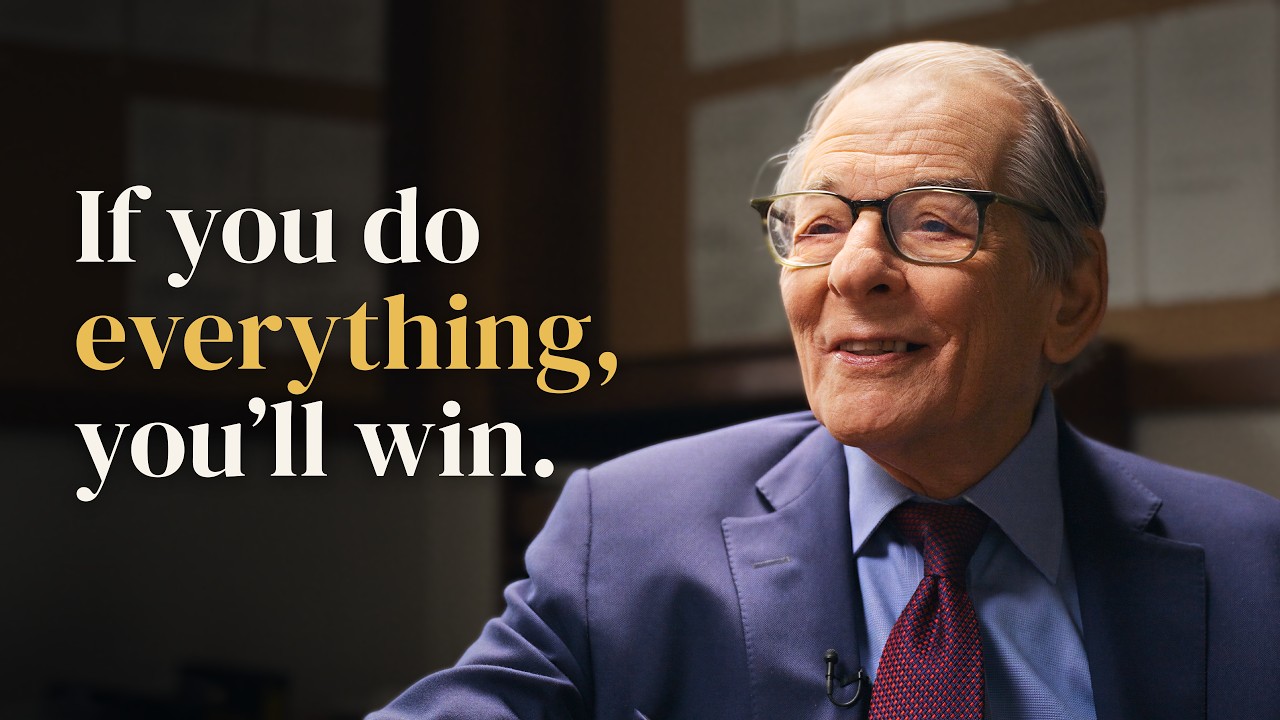
Recorded 30 October 2026 · 61 min
Robert Caro, biographer of Robert Moses and Lyndon Johnson, argues that large public projects get built only when an exceptional political figure appears and refuses to be stopped. In his view, obstacles do not explain stalled eras; the absence of such a person does. After 50 years of research, he ties that capacity to a trait he shares with his subjects: relentlessness.
The tension is what that will costs. Caro traces Moses from reforming idealist to a man who evicted tens of thousands of people without relocation provisions, and says he wants a builder who finds a way, but not one as ruthless as Moses. He cannot yet explain why Johnson escalated in Vietnam, and he is unsure any good spot exists between paralysis and domination.
Refusing to accept no — ▶ 2:39
Caro treats certain interviewees as indispensable, so a refusal cannot end the pursuit. Johnson's first secretary, who rode with him across Texas on campaigns, was the only person who knew what Johnson did during those hours. The method is preparation. Caro knew from the notes that John Connally distributed Johnson's money on his instructions, making him the sole source on how Johnson chose recipients. Johnson's marginal replies ranged from approving $1,500 to granting 500 to refusing, and sometimes read "No, never," which Connally said meant the man would never get Johnson's money. Specific questions about one congressman unlock the real stories.
Builders arrive unpredictably — ▶ 6:12
The complaint that nothing can be built was also made in the 1920s. Roads into Long Island would cross scores of properties whose owners opposed them, and Moses initially lacked eminent domain power. He still opened access to Jones Beach, 27 miles from New York City, by overcoming each obstacle. Caro's claim is that decades may pass with no one able to do this, then someone appears. That is the nature of political genius. Asked about the Second Avenue subway and California rail, he offered no policy fix, only that he is not sure a good spot exists between extremes.
From idealist to hardened builder — ▶ 12:58
Early Moses was a civil service reformer who wanted promotion by merit and beaches open to city people. Caro's central story in The Power Broker is how he became someone who builds because he thinks something should be built, whatever anyone says. The Cross Bronx Expressway evicted tens of thousands of people without relocation provisions, despite warnings beforehand, and Caro says it became the world's longest traffic jam once it opened. Caro avoids the word corrupting. His term is hardening: power made Moses harder toward any opposition.
Weakness as a weapon — ▶ 24:48
Caro's one question for an eighth Moses interview would be whether he realized he was changing. Caro believes he did not: Moses felt from the start that his vision justified any hardship. The Bronx politician Henry Epstein opposed the Cross Bronx route and proposed moving it two blocks south, which would displace a couple of hundred people rather than tens of thousands. Moses destroyed him by making an affair known. Caro's interpretation is that Moses learned to find and exploit people's weaknesses through failing to get things done when young.
Why Moses was unfireable — ▶ 18:54
Moses had threatened to resign to countless mayors and governors. In 1962 Nelson Rockefeller replied that he regretfully accepted, and nothing happened. Earlier officials could technically have fired him, Caro says, but he was too popular, the idol of New York. He also held an interlocking web of posts, including the State Power Authority, Triborough Bridge Authority and several parks commissionerships, with terms ending differently and some beyond anyone's power to remove. Cracks appeared with age. Caro recalls a late interview after which his secretary had no calls to report, and says Moses never grasped that his power was fading.
Depression-era labor advantage — ▶ 28:13
Caro says the Depression played a big role in Moses's early speed. Thousands of out-of-work architects lined up on Fifth Avenue. Wages were low, but more important was availability, and workmen with no other jobs could be hired and fired ruthlessly. Caro makes a related point about beauty: skilled artisans were so cheap that builders paid for carved stonework on rooftops almost no one could see. Editorially, this qualifies a theory built on will, since labor conditions shaped how far will could carry. Caro does not draw that conclusion himself.
Persuasion rested on leverage — ▶ 33:25
Asked whether Johnson's power came from persuasion or leverage, Caro says the power stood behind the persuasion. When Johnson put his arm around a senator, the senator knew Johnson could grant or deny a committee assignment, or the passage of a law he wanted. The force of personality was never the whole of it. The practical lesson is that Johnson's effectiveness depended on holding things others needed before he ever made a request.
Johnson's drive versus Kennedy's — ▶ 36:05
In a counterfactual with Kennedy president and Johnson still majority leader, Caro says the civil rights and anti-poverty laws would not have come earlier. Kennedy was charming and good in foreign policy, but lacked Johnson's overriding desire to change America. Caro traces that desire to Johnson's year teaching poor children in Cotulla, and says we would not have those laws without Johnson. When Johnson's attention turned to Vietnam, Caro says, everything fell apart. Why Johnson kept escalating is something Caro says he is still trying to figure out.
The one-sentence test — ▶ 41:35
Before writing, Caro thinks through the whole book and forces himself to say what it is about in one sentence, or at most a paragraph. He learned this the hard way because he skipped it for The Power Broker. The reason is practical: three years in, he would otherwise be asking what he is trying to do. He then makes everything hang together around that point. He concedes there is no way to be sure you are on the right track after years without public feedback; the device only helps him try to stay on it.
Cuts and the archive — ▶ 46:27
The Power Broker manuscript ran 1,050,000 words, but one volume could hold about 700,000, so 350,000 were cut. Caro says he cannot stop writing what he thinks should be written, even knowing much will go. He estimates 700 interviews for that book alone, with typed notes. He cites Sam Rayburn as a major figure with no good biography. He gave his archive to the New-York Historical Society for much less money than other offers, wanting it accessible in New York rather than at the University of Texas. Digital archives would speed finding documents, but finding is small compared to reading them.
Frontier loneliness as formation — ▶ 54:30
Caro argues America undervalues the heroism of frontier loneliness, apart from the dangers of Indians and raiders. Johnson grew up on a ranch 18 miles beyond Johnson City. His mother could walk up a hill and see nothing but more hills. One elderly woman told Caro to drive 22 miles from Austin to a cattle guard, then 22 more on a dirt road, and he passed no other house. Caro's own work is solitary too: he turns off his phone each morning and does not return calls until the end of the day, which he says affects his whole life.
Caro's most provocative claim is that the difficulty of building is not the variable that matters. In his telling, every era of large-scale construction looks impossible beforehand. What changes is whether a particular person is present. When Robert Moses began, people were already saying that government could not build anything, that the age of the automobile demanded roads, and that property owners would block every route. Moses lacked the power of eminent domain at first, yet he found a way across each obstacle. Caro calls this the nature of political genius: decades may pass with nobody capable of it, and then someone arrives and things get built.
The modern version of the complaint is stark. The host cited the Second Avenue subway, under construction for around 50 years, with a mile and a half opened at a cost of more than $4 billion. He added California's $15 billion over a decade without a new mile of railway, and contrasted China's tens of thousands of miles of track, built at the cost of displacement and recklessness. Caro offered no policy answer. He said he is not sure a good spot exists between the extremes, noted that Moses also faced safeguards, and said he wants someone who finds a way but is not as ruthless as Moses. His position is about people, not institutions.
The argument has a visible gap, which Caro's own answers partly expose. Asked how much of Moses's early success came from the Great Depression, he said it played a big role. Thousands of out-of-work architects lined up on Fifth Avenue. They were cheap, but more important, they were available, and Moses could hire and fire ruthlessly because workmen had no other jobs. Caro makes a related point about beauty: skilled artisans were so cheap that builders paid for carved stonework on rooftops almost nobody could see. It is an editorial inference, not Caro's conclusion, that this sits uneasily with a theory built on will. Genius may be necessary, but labor conditions appear to have determined how far will could carry.
Caro's account of how Moses held power adds a structural layer. Moses was chairman of the State Power Authority and of the Triborough Bridge Authority, Parks Commissioner, Long Island Parks Commissioner and Jones Beach Commissioner. Those terms ended in different ways, and for some no one had the power to fire him. He was also too popular, which Caro compares to firing the idol of New York. So his 1962 threat to resign, a trick he had used on countless mayors and governors, worked until Nelson Rockefeller replied that he regretfully accepted. By then, Caro says, cracks had appeared in the armor, and a leader willing to brave newspaper criticism could have acted.
Johnson supplies the second case, and the mechanism is clearer. Persuasion was not the source of his power; leverage stood behind it. When Johnson put his arm around a senator, the senator knew Johnson could grant or deny a committee assignment or the passage of a law he wanted. What distinguished Johnson, in Caro's view, was an overriding desire to change America, which he says Kennedy lacked. Kennedy was charming and good in foreign policy, but Caro does not think the civil rights and anti-poverty laws would have come earlier under him. Caro traces the drive to Johnson's year teaching poor children in Cotulla. Vietnam, by contrast, is where his presidency turns tragic.
The cost of such will is the heart of Caro's story about Moses. The early Moses was an idealist and a technician of civil service reform who wanted promotion by merit and beaches open to city people. The later Moses built the Cross Bronx Expressway, evicting tens of thousands of people without relocation provisions despite warnings in advance. Henry Epstein proposed moving the route two blocks south, which would have displaced a couple of hundred people instead. Moses destroyed him by making an affair known. Caro believes Moses learned this ruthlessness through early failures, and he prefers the word hardening to corrupting.
Caro's single question for an eighth interview would be whether Moses realized he was changing. His own answer is no. Moses believed from the start that his vision was right and would be built whatever hardship it inflicted. The same insulation shaped the ending. Caro recalls finishing a long interview and realizing the secretary had no calls to relay, where earlier there had been many. Moses, in his 80s and deaf, still surrounded by loyal men on Randall's Island, expected to keep pushing and win again. An editorial inference follows: the trait that makes a builder effective may also blind him to his own transformation, which makes self-correction by the builder an unlikely safeguard.
Caro rejects the idea that these men simply had more physical energy. He thinks it was will, and that tiredness did not seem to figure into their equation. Johnson calling a senator at 5:00 AM, and the senator replying that he had been lying there waiting for the call, is his illustration. Caro accepts that he shares their relentlessness while hoping he lacks their ruthlessness. His interviewing follows a smaller version of the same theory. He reads the notes first, identifies the one person who can answer, and refuses to stop at no. John Connally, who distributed Johnson's money, was such a source, and Johnson's marginal "No, never" opened real stories.
The same logic of concentration governs how Caro writes. Before starting a book he forces himself to say what it is about in one sentence or at most a paragraph, a discipline he learned the hard way because he skipped it for The Power Broker. He still cannot stop writing what he believes should be written. That manuscript ran 1,050,000 words, and about 700,000 fit in one volume, so 350,000 were cut. He estimates 700 interviews for that book alone and gave the archive to the New-York Historical Society for much less than other offers, wanting it accessible in New York. Digital archives would help him find documents faster, but he says finding is small compared to reading them.
The unresolved issue is whether Caro's theory can guide anyone. It rests on two men he chose to write about. It says builders appear, but not how to recognize them, how to constrain them, or whether their ruthlessness is separable from their capacity. Caro concedes as much: he is unsure where the good spot is, and he is still working out why Johnson, so determined to improve American lives, kept escalating in Vietnam. That second puzzle bears on the first. If will that defeats every obstacle can also defeat the warnings that should stop it, as the Cross Bronx Expressway suggests, then asking for a builder without the hardening may ask for something that does not exist.
The open question. Can the capacity to overcome every obstacle be separated from the ruthlessness that accompanies it? Caro's evidence comes from two men he chose to write about, and he says he is unsure a good spot exists between extremes. He also has not yet explained why Johnson, so driven to change America, kept escalating in Vietnam. If will that defeats every obstacle also defeats the warnings that should stop it, as the Cross Bronx Expressway suggests, then wanting a builder without the hardening may ask for something that does not exist.
Watch the full video at https://www.youtube.com/watch?v=f0J_EeW42Lo.
Comments ()