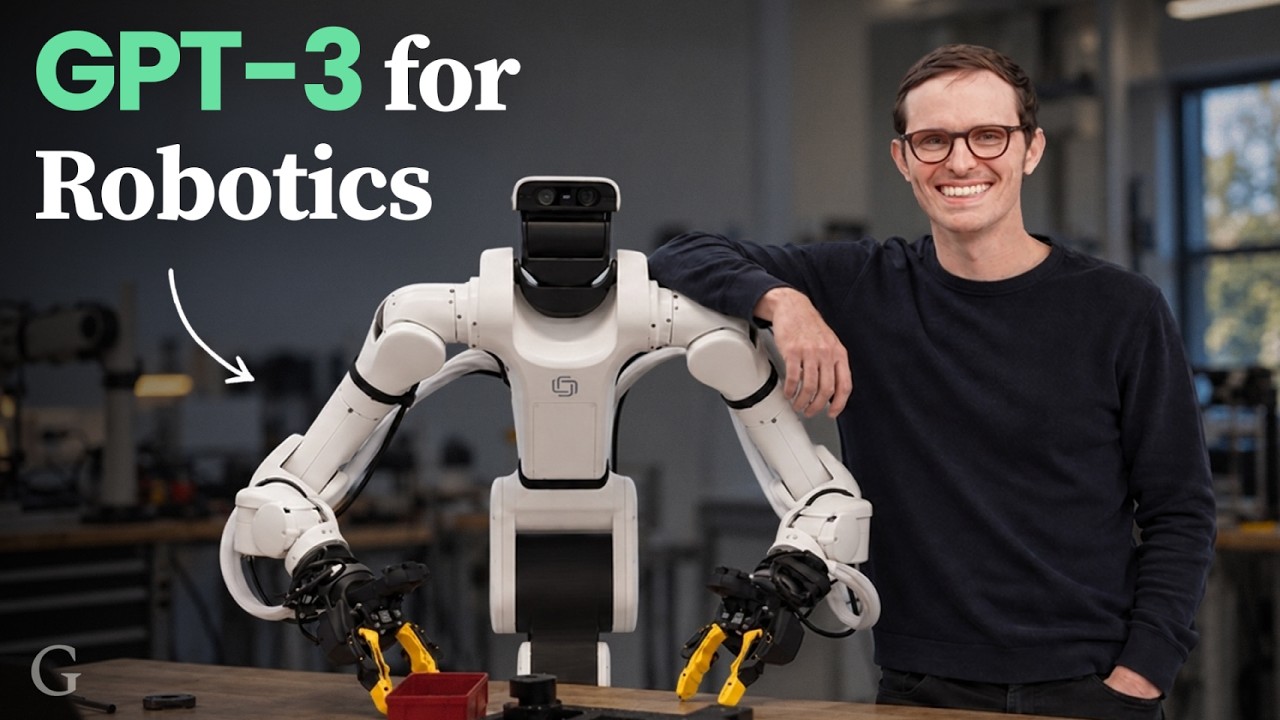
Recorded 20 October 2026 · 66 min
Pete Florence, co-founder and CEO of Generalist, says the company's Gen 1.5 model can learn a physical task from a single demonstration, a capability he compares to the in-context learning GPT-3 brought to language. Success rates are modest, he stresses, but rates above zero are the point. The model was never trained to learn this way, and Florence attributes the behavior to the structure of its training data.
The tension lies between that early promise and the long climb to reliability. Florence argues that dexterity, not locomotion or hardware, is the bottleneck. He bets on simple recipes and scaling rather than early narrow commercial deployment. Whether deployment data or diverse in-house data builds the better model remains open.
A GPT-3 moment, modestly — ▶ 3:06
Gen 1.5 can learn a physical task, such as taking bills out of a wallet, from a single demonstration. Florence is candid that success rates are modest; what matters is that they are above zero. The capability was not trained directly. He offers a hypothesis borrowed from GPT-3 research: data has 'burstiness', so one example is likely followed by similar ones, and physical activity behaves the same way. He was surprised by the timing but considers the capability inevitable.
Why some tasks succeed — ▶ 9:15
Florence cannot say exactly why the model handles some tasks better than others. Data coverage is not the whole story: Generalist can 3D print objects that have probably never existed and demonstrate a task with them, and the model still performs. He points instead to features that make manipulation hard: motion precision, force precision, and how tightly many degrees of freedom must be coordinated, especially bimanual work. This is intuition from experiments, not a tested theory.
Contact is the hard part — ▶ 13:42
Walking on flat ground has become a well-developed capability, Florence says, while generalized manipulation has been the hardest thing to master. He cites roboticist Matt Mason's framing: manipulation is selectively choosing contact with the world to reach a desired configuration. Contact is where physics becomes hard to predict, and decades of analytic attempts struggled. The progress that has come, he argues, mirrors language: models trained on massive varied data, with training recipes refined through heavy experimentation.
Touch is not the bottleneck — ▶ 17:34
Florence offers a simple test of how limiting touch is: a human can teleoperate a robot with no touch feedback and far outperform today's best models. That suggests the gap is mostly intelligence, not sensing. He still believes touch will matter for top performance. Proprioception, meaning joint angles and joint force via current or torque sensing, already gives most robots much of what touch provides. Fingertip-style cutaneous sensing is not yet widely deployed.
Simplicity over humanoids — ▶ 29:39
Generalist keeps hardware and data pipelines as simple as possible to maximize iteration speed on what Florence calls the model intelligence recipe, which he identifies as the real bottleneck rather than hardware. He invokes the bitter lesson: a few levers, such as compute and data, matter disproportionately, and talented teams risk being nerd-sniped. The team includes people who have built humanoids and Boston Dynamics robots. He calls humanoids an awesome form factor but not the priority for research velocity.
Efficiency beats raw data — ▶ 35:27
Asked about data volume, Florence says only that it is up, adding that data is table stakes. He claims algorithmic, infrastructure and data-pipeline advances can bring efficiency gains of 10x, 100x or even 1,000x over someone buying expensive hardware and seeing what happens. No supporting evidence is given. He also argues an hour of data is not a fundamental unit. Its value varies with tasks, objects and metadata, from zero for an idle robot facing a blank wall upward.
Why not deploy narrowly — ▶ 42:15
A robot at five or six nines of reliability in one commercial application already has the intelligence for that problem, Florence argues, so deploying it adds a narrow distribution of data. For a general model he wants the most diverse data possible, which he says his own models support. He accepts that reaching commercially valuable performance requires climbing through reliability levels. The aim is a general intelligence that can also reach deep mastery of particular tasks, not a narrow system for one.
Dexterity as robotics' coding — ▶ 44:49
Florence names dexterity as the closest analogue to coding in digital AI. Both are broad, and he sees a possible self-improvement loop: if dexterity is cracked, robots can build robots and then next-generation robots. His intuitive argument is that a robot that does not touch and move the world is essentially moving a sensor, a job a drone or a taped-up camera can often do more cheaply. The robot-building loop is a conditional prediction, not a demonstrated result.
Open source and data flywheels — ▶ 49:10
Florence expects strong open-source and closed robotics models, a rising tide that lifts all boats. He sees durable value in robotics beyond models, including better hardware and deep workflow knowledge of industries. The unresolved issue is the data flywheel: deployment data is valuable, but open-source creators have no obligation to receive it back, so it is unclear whether they can accrue the data needed to improve. On geopolitics and policy he offers little, saying the field is still early.
Tool use without examples — ▶ 57:00
Florence finds Gen 1.5's zero-shot physical generalization arguably more encouraging than its one-shot learning. Taught to sweep an object into a bowl with a brush, the model can use a dustpan instead, a tool with very different physical properties, with no new example. He likens it to asking a language model for a novel poem. He avoids assigning a toddler-equivalent age, noting a toddler still beats the model at some things, while Gen 1 could repeat a task hundreds of times.
Industrial first, homes later — ▶ 1:01:28
Generalist expects industrial settings to take off faster over the next couple of years, with learning and data from industrial deployment then helping carry benefits into homes and other consumer spaces. The transfer claim is Florence's expectation, not something demonstrated. His stated reason for homes lagging is safety: large, heavy robots are harder to deploy around people, whereas industrial sites can cordon robots off and rely on existing safety technology. He expects early home robots, such as clothes-folding ones, to appear at small scale.
Pete Florence's central claim is that physical AI has reached the stage language models were at with GPT-3: unreliable, but able to attempt a wide variety of tasks from a single example. Generalist's Gen 1.5 can learn to take bills out of a wallet from one demonstration. Florence is careful about the limits. Success rates are modest today, he says, and the significance is that they are above zero. That framing matters, because Sholto Douglas's reported 'GPT-3 moment' label could be read as a statement about performance. Florence is describing a threshold of kind, not a level of quality.
The most interesting part of the argument is the mechanism he proposes. GPT-3 was not trained to learn from examples. It was trained on enormous quantities of text, and later research attributed the capability to burstiness: when one SAT question appears, another is likely to follow. Florence argues that the physical world is bursty in the same way. A person who takes one bill out of a wallet will probably take another. Gen 1.5 was never trained on a task shown and then repeated, yet it behaves as if it had been. This is a hypothesis, and Florence is surprised by the timing, though he considers some version of the capability inevitable.
Why this matters depends on why manipulation has been so hard. Florence draws on roboticist Matt Mason's definition: manipulation is the selective choice of contact with the world to put it in a desired configuration. Contact is where physics becomes hard to predict, and decades of analytic attempts struggled with it. Meanwhile, walking on flat ground has become a well-developed capability. Florence says the progress that has come looks like language: models trained on massive variety, with recipes refined through heavy experimentation. He cannot fully explain why some tasks are easier than others. He offers motion precision, force precision and bimanual coordination as intuitions, not a theory.
One counterintuitive implication concerns sensing. Florence notes that a human can teleoperate a robot with no touch feedback and do far better than the best models. If so, the gap is mostly intelligence, not perception. He still expects touch to matter at the performance frontier, and notes that joint angles and joint force already give most robots much of what touch supplies. Fingertip-style sensing is not widely deployed. The pattern is consistent: when Florence looks for the binding constraint in robotics, he keeps finding the model, not the sensors or the machine.
That belief explains Generalist's strategy. The company keeps hardware and data pipelines simple so that research on the model recipe can iterate quickly. Florence invokes the bitter lesson, in which a few levers such as compute and data dominate, and he says talented teams are easily nerd-sniped by interesting side problems. Generalist builds its own hands but uses existing arms and cameras, and the stated test is whether something speeds model research. Humanoids are an awesome form factor, he says, but not necessary for that goal. The transcript does not show how this choice compares with alternatives. It is a stated philosophy.
The data strategy follows from the same logic, with one claim that deserves skepticism. Florence says algorithmic, infrastructure and data-pipeline advances can produce efficiency gains of 10x, 100x or even 1,000x over a company that buys expensive hardware and sees what happens. He offers no numbers behind this. He also declines to give current data volumes beyond saying they are up. His point that an hour of data is not a fundamental unit is more persuasive: an hour spent staring at a blank wall is worthless, and the value of the rest depends on tasks, objects and metadata.
The sharpest strategic tension is deployment. A robot at five or six nines of reliability in one application already has the intelligence for that problem, Florence argues, so deploying it adds data from a narrow distribution. Generalist wants the opposite: diverse data to build a broad base of intelligence. Yet he concedes that commercial value requires climbing through reliability levels, and that deployment data is useful for the right applications. His expectation is that industrial settings will take off first, with homes later because of the safety question. Taken together, this implies the company must eventually do what it is currently deprioritizing. When and how is unclear.
Florence's best analogy for the market is that dexterity is to robotics what coding is to language models. Both are broad capabilities, and a robot that does not touch and move the world is mostly moving a sensor around. He adds that coding drove a feedback loop, and dexterity might too: robots building robots. That is a conditional prediction, not a result. The related question is where value ends up. Florence sees durable value in hardware and industry workflow knowledge, not just models, and he flags that open-source model builders may have no way to collect deployment data back. Whether open models can improve without a flywheel is, in his words, among the biggest open questions.
The evidence Florence finds most encouraging is not one-shot learning but zero-shot physical generalization. A model taught to sweep with a brush can use a dustpan, which lifts rather than sweeps, with no new example. He compares this to asking a language model for a poem that has never existed. He also describes coaching: a strong base model, shown how not to fail in a particular way, simply does not repeat that failure. Yet he is careful to say that a very young toddler still outperforms the model at some things, and he declines to assign an age.
That caution leaves the key question exposed. Florence notes that in fast-moving AI research it is hard to name something likely in a year but impossible within a month, which is a candid reason to discount any timeline he gives. The harder issue is not whether new capabilities appear but whether glimpses become dependable work. Above zero is a milestone for a research program. It is not yet a product. The route from there to commercial reliability runs through the nines Florence describes, and Generalist has said little in this conversation about how it plans to climb them.
The open question. Can one-shot capability that succeeds only some of the time be pushed to commercial-grade reliability without the deployment data Generalist is deliberately deprioritizing? Florence says a robot with five or six nines of reliability already has the intelligence to solve its problem. He also says deployment data is valuable for the right applications. The transcript gives no success rates, no current data volumes and no quantified path from modest performance to dependable performance, so the bet on diverse data first remains untested in public.
Watch the full video at https://www.youtube.com/watch?v=5Gy4GbCCSwI.
Comments ()