Recorded 20 October 2026 · 27 min
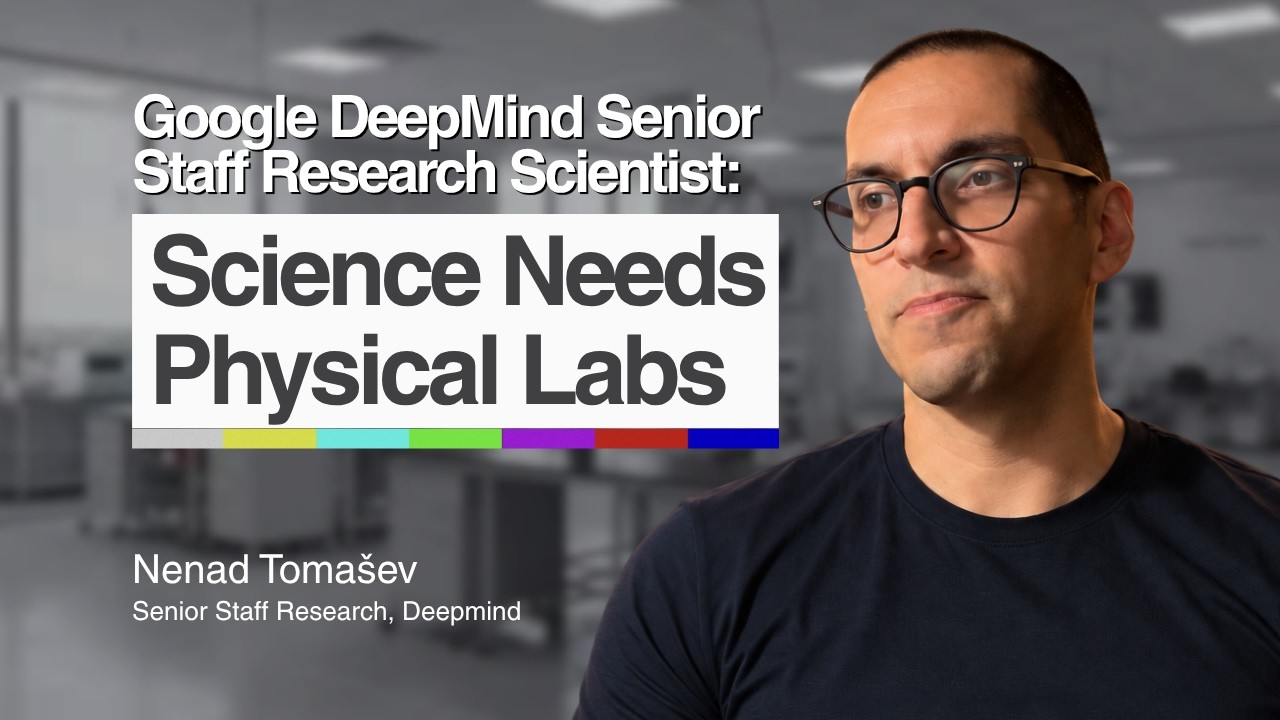
Nenad Tomasev, a senior staff research scientist at Google DeepMind working on agentic AI and AI for scientific discovery, argues that generating hypotheses is only half of scientific progress. Agents can now derive new insights autonomously, but without matching investment in physical laboratories, experts and wider infrastructure, the world gets more conjectures than it can validate. Some of those conjectures will be false.
The interview ranges from that thesis to capability gaps, value alignment and multi-agent systems, and the same question recurs: what tells a system, or a society, that an AI output is right? Tomasev offers frameworks more than answers. He repeatedly calls the hardest questions open, and says his papers are a personal viewpoint and a conceptual model.
Labs, not just models — ▶ 2:42
Tomasev's viewpoint paper, "Agentic AI in the public interest," holds that AI-driven discovery in areas like biomedicine and material science must be matched by infrastructure investment. Agents can already derive new hypotheses autonomously. Outside strictly computational fields such as mathematics or computational physics, though, physical laboratories must validate or disprove them, because some will be false. Putting all the investment on the AI side yields many more conjectures to process downstream. He calls for more people, experts and laboratories, and describes the paper as a personal viewpoint rather than a measured finding.
Training tomorrow's experts — ▶ 5:39
Experts have historically been made by doing science manually. As science becomes agentified, how the next generation of human experts develops is unclear. Tomasev draws a parallel with developers, who once wrote all their code by hand and now work with agentic coding. He separates a short-term question (making the most of the technology today) from a long-term one that is harder and that he thinks the whole community should answer together. His position is that science will stay a human endeavor. He offers no solution.
Cognitive friction versus automation bias — ▶ 7:27
To keep people intellectually sharp, Tomasev says one proposal is to introduce cognitive friction: occasionally withhold AI so a person must judge unaided, or add follow-up questions like a mini quiz to check the person is switched on. The risk is automation bias, where a very good AI makes it easy to just click yes. The opposite failure also exists, with weaker or less-trusted AI getting overridden too often. Both produce sub-optimal outcomes. He says the best interaction design remains open and depends on the use case and domain.
Verifiability explains capability gaps — ▶ 10:32
Tomasev, speaking only for his own part of the spectrum, says recent advances are concentrated in domains with formal or computational verification. Mathematics has formal specifications and provers that give the model definitive feedback. Coding has unit tests, integration tests and error traces. Domains where judgment is qualitative or subjective, and where people may disagree, are harder to make leaps in because they need more effort and time. He frames this as uncontroversial rather than the product of a talent monopoly or missing expertise, the explanations the host floated.
Alignment shouldn't freeze values — ▶ 12:37
A July paper on AI value alignment for evolving social norms uses mathematical models rooted in social physics. Tomasev's concern is that alignment is often treated as a fixed set of universal values to which models are then fitted, while societal values change over time. Models help because purely qualitative analysis cannot tell whether a harm is prevalent or merely possible, and likelihood matters for weighing risk. He wants technology that avoids trapping people in a filter bubble. He cautions that all models are wrong, some are useful, and that the paper is conceptual.
Sycophancy and measurable values — ▶ 16:25
Personalization can go wrong when models tell users they are right even when they are wrong. Tomasev wants accurate feedback when testing a research idea and says the community is aware of the problem. On how models could keep up with shifting values, he concedes the answer is unsettled. His route is to build environments and benchmarks capturing desired and undesired behavior, then adjust models accordingly. His premise is that once something is measurable, the community makes progress quickly. He gives no examples of such benchmarks for values.
Swarms are mobs — ▶ 22:22
Tomasev calls multi-agent systems the next frontier, as individual agents become highly capable. Current talk of swarms describes unstructured groups with no hierarchy or norms. The human equivalent is a mob, which can produce good or bad outcomes. His argument is that decoupling a system into interacting components is easier to govern than capabilities implicit in one opaque neural network. Organizations already manage products, projects and teams, and those ideas can be adapted, though agents are not humans. Safety, security and robustness guardrails are the work he describes.
The most useful way to read Nenad Tomasev's remarks is that generation is no longer the scarce resource; checking is. His central argument, drawn from a DeepMind viewpoint paper on agentic AI in the public interest, is that AI can autonomously derive hypotheses and insights, but outside strictly computational fields such as mathematics or computational physics, only physical laboratories can confirm or refute them. Some of those findings will be false. Pour all the investment into the AI side, he says, and the world ends up with many more conjectures than it can process downstream. His prescription is broader: more people, more experts, more laboratories, and a wider scientific ecosystem so the benefits spread across society.
The same logic surfaces when he explains where AI capability is lagging. Tomasev notes that recent advances cluster in domains with formal or computational verification. Mathematics has formal specifications and provers that give a model definitive feedback. Coding has unit tests, integration tests and error traces. Where judgment is qualitative or subjective, and people may disagree, leaps are harder. He frames this as uncontroversial and speaks only for his own corner of the field. The editorial inference is that the laboratory argument and the capability argument are one: progress tracks the availability of an authoritative signal telling a system whether it was right. Where that signal is slow, expensive or contested, it sets the pace.
Human expertise sits on the same fault line. Experts have historically been formed by doing science manually, and as science is agentified, how the next generation develops is unclear. Tomasev points to software developers, who once wrote all their code by hand and now work with agentic coding. He insists science will remain a human endeavor and that its human component must be preserved, but he offers no solution. He does describe mitigations: cognitive friction, in which AI is occasionally withheld so a person must judge alone, and quiz-style follow-ups. The risks run both ways. Automation bias makes it easy to click yes, while distrust leads people to override a capable system too often.
On alignment, Tomasev's worry is that values are treated as a fixed universal set to which models are fitted, when societies evolve. A July paper uses mathematical models rooted in social physics to make this tangible. The motivation is that purely qualitative analysis cannot say whether a harm is prevalent or merely possible, and likelihood matters when weighing a large unlikely harm against a smaller likely one. He wants technology that does not trap people in filter bubbles of the kind studied in social media. He is candid about limits, quoting the saying that all models are wrong, some are useful, and noting that the paper does not address mechanisms such as post-training, environments or feedback.
Here the strongest tension in the interview emerges, though Tomasev does not name it. Asked how models could keep pace with changing values, he says it is an open question but suggests that naming the issue lets the community build environments and benchmarks, after which, he says, it is very good at making progress. Yet his own account of capability gaps says progress is hardest where feedback is subjective and contested, and shifting values are exactly that. A benchmark encodes a snapshot of what is desired. Treating that snapshot as the target risks reproducing the fixed-values problem he warns against. He does not address this, and cites no existing benchmark for evolving values.
His most concrete structural proposal concerns multi-agent systems. Tomasev regards them as the next frontier, since individual agents are becoming highly capable and the natural step is connecting groups of users and agents. He criticizes the popular framing of swarms: an unstructured group with no hierarchy or norms resembles a mob, which can produce good outcomes but is unmanaged. His argument is that separating a system into interacting components is easier to govern than capabilities implicit in a single opaque neural network. Organizations already manage products, projects and teams, so those ideas can be adapted, with the caveat that agents are not human.
Taken together, the interview is prescriptive but light on evidence. It rests on a viewpoint paper, a conceptual model and a researcher's judgment, with few numbers and few tested results. The structural thesis is plausible: if verification is the binding constraint, then laboratories, evaluators, expert training and governance structures become as important as the models themselves. That is an inference, not a claim Tomasev makes in so many words. What remains unknown is whether those verification and governance capacities can be built at anything like the speed at which agents now generate hypotheses and act.
The open question. Can verification capacity grow as fast as generation? Tomasev's argument implies that laboratories, expert training and evaluations must scale alongside agentic hypothesis-generation, yet he offers no mechanism or evidence that this is happening. His benchmark-driven route to evolving values also assumes that desired behavior can be measured, even though he says subjective domains are where progress is hardest. Whether a benchmark can capture shifting values without locking them in is unresolved.
Watch the full video at https://www.youtube.com/watch?v=sTexzVhrJZI.
Comments ()