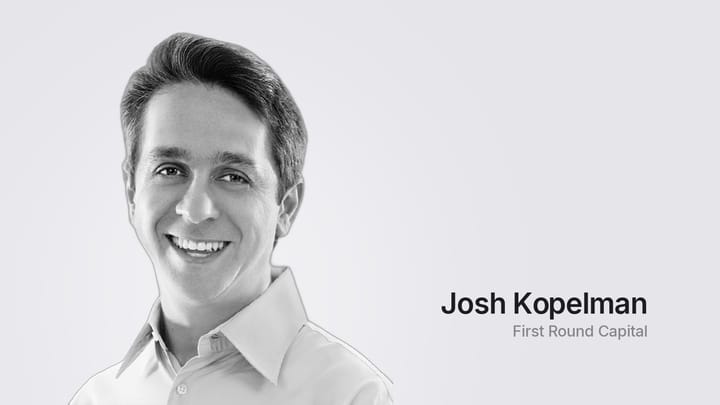

Recorded 21 October 2026 · 64 min
Late-stage money flowing into trillion-dollar private companies is a cyclical trade, not venture. Josh Kopelman, founder of First Round Capital, argues that seed investing is the evergreen business. A great company wins and a bad one goes to zero in any market, while buyers at $10 billion to $50 billion need someone to sell to later.
The conversation runs from Kopelman's own dot-com run, selling Half.com to eBay in 2000, to the arithmetic of a seed fund that grew from under $150 million to about $500 million on an unchanged strategy. The tension is that his returns lean on the outsized exits those cyclical bets create, and he says plainly he cannot tell whether this is 1997 or 1999. He ends on AI, where he thinks agency, not code, becomes the scarce skill for founders.
Last chair standing — ▶ 2:30
Half.com launched in February 2000, eBay called within months, and the deal closed in June 2000, three months after the Nasdaq peaked in March. Kopelman calls it "one of the last chairs, if not the last chair" in the internet's game of musical chairs. The company was nearly named eBizon, fusing eBay's person-to-person model with Amazon's shopping cart and credit cards, until lawyers warned that the two rivals would agree on exactly one thing: suing them. Investors' biggest worry was whether the timeline would reach long-term capital gains.
Rate card is for suckers — ▶ 4:09
With no Pets.com budget, marketing head Mark Hughes proposed getting a town to rename itself. Halfway, Oregon, population 350-something, became Half.com, Oregon for one year in exchange for 20 school computers, four customer-service jobs (over 1% of the town) and a snowplow. That bought a four-minute Today Show segment, the Wall Street Journal and 60 Minutes. Urinal guards cost about $2,000 against $50,000 for a book-section ad, and fortune cookies paying $10 per redemption reached 2 million a week. "Rate card is for suckers."
Priced on potential — ▶ 13:01
Private companies valued at $1-10 billion are today's potential-over-revenue cohort, much as JDS Uniphase was worth over $20 billion on under $30 million of trailing revenue. Kopelman took Infonautics public in 1995 on $600,000 of trailing revenue. Several of today's will be worth their price and more; most will not, as in every cycle. He cannot say whether this is 1997, 1999 or February 2000. One difference he welcomes: the washout is private, so gains and losses sit with the same people, not retail investors holding VC-inflated stocks.
Fund size is a tactic — ▶ 17:11
Fund size is "a tactic to achieve a strategy." First Round's strategy is fixed: about 70 companies per fund, 12-15% ownership going in, and at least two years, ideally two and a half, of deployment diversity. What changed is price. Seed valuations rose about 4x from 2004 to 2026, so a fund of a little under $150 million became one of about $500 million. "As much as I'd love to get 2004 valuations, not happening." The question is what the strategy costs in today's market, not hitting a target number.
Three companies, 20 years — ▶ 18:55
U.S. public and M&A exits totalled about $1 trillion from 2004 to 2014 and $2 trillion from 2014 to 2024, with concentration rising since. If SpaceX, Anthropic and OpenAI each average $1.5 trillion, that is $4.5 trillion: more than double the last decade's exits and more than every exit of the last 20 years. His conclusion is that exit scale more than covers the 4x rise in seed prices, "for the winners."
Evergreen versus cyclical — ▶ 20:51
Seed is "evergreen": at a $20-30 million post-money, a great company pays off and a weak one goes to zero, in any climate. Late stage at $10-50 billion prices has historically been cyclical. Tiger Global and SoftBank made money "hand over fist" until it stopped. Kopelman says he can't time cycles and would rather stay in the shallow end. Asked when to exit OpenAI or Anthropic, he declines: durability of trillion-dollar valuations isn't his day job. Founders taking secondary is healthy, not a signal.
Buying the back end — ▶ 24:52
LPs who bought Anthropic at $200 billion look like geniuses, but that is a risk-on trade that needs an ultimate buyer, which he expects to be the public markets. A pension fund putting $1 billion into a $30 billion company is trading, not partnering. The 2017-2021 cohort shows the downside: more than half of those unicorns haven't raised in four to five years, and more than half are shrinking or growing under 20%. The industry "price[s] ahead," and the more risk-on, the further ahead.
Regret is the confidence — ▶ 29:54
Kopelman's regret from decades of pounding the table in partner meetings is the level of confidence, not being wrong. He owes founders an "unvarnished opinion" drawn from movies he's seen, then "unwavering support," since founders hold 10x the data and drive the bus. The host pushes back: conviction is what founders buy, and six of seven bets are wrong anyway. Kopelman holds the line. VCs are paid to seek risk, but should name the knowable risks so strategy can be built around them. Neither claims all risks are knowable.
Rookies win early — ▶ 36:59
New technology briefly levels expert and rookie. When the web browser arrived, Kopelman was a student, and by graduation few packaged-software veterans had more Internet experience. Bitcoin put dorm-room traders ahead of Goldman derivatives desks. His Infonautics, which scanned newspapers and 50 magazines for Homework Helper, bet that information would stay closed; publishers went open instead. A second mistake: fixed-price deals meant any strategy change required renegotiating with every publisher, which he realized only 18 months in.
Cartographers, not navigators — ▶ 46:04
Schools hand students syllabi and "cheat codes"; founders get no map and must draw one: "Founders are cartographers, and we raise navigators." AI cuts the friction of being a cartographer as English becomes the language of building. Kopelman stays up until 3am running Claude Code to build MCP servers for things like Ring cameras. YC bet it was easier to teach a 23-year-old engineer business than an executive to code. Around 2030 that may flip, favouring non-technical founders. He calls it "one scenario."
AI doesn't break seed — ▶ 52:18
Ten companies in the same space, with the same tools, produce wildly different outcomes, because it comes down to who is around the table. Founders once spent 60-70% of raised money on people; now it may go to tokens, but they still need the money, and compressed barriers raise the pressure to spend faster. First Round has no thesis, since by the time a firm can articulate one it's too late. It wants founders who go "unreasonably deep" with customers on urgent, large, pervasive problems.
The ultimate buyer of a $200 billion private stake is the public market, and nobody has promised that buyer will show up. That is Josh Kopelman's objection to the trade his industry's limited partners love most. A pension fund putting $1 billion into a $30 billion company is not partnering with a founder. The founder does not know who it is. It is a trade, once done through a broker and now done in private markets. It works while the cycle runs. When the cycle turns, the holder owns an asset that "trades by appointment, or it doesn't trade."
The last cycle supplies the evidence. Of the unicorns minted from 2017 to 2021, more than half have not raised money in four to five years. More than half are shrinking or growing under 20%. Kopelman respects the founders who show up every day to grow into those prices, and some do. But the industry prices ahead of reality by design, and the more risk-on the mood, the further ahead it prices. The dot-com era had the same pattern at a more extreme scale. JDS Uniphase was worth over $20 billion on under $30 million of trailing revenue. He took Infonautics public in 1995 on $600,000.
This cycle differs in one respect he concedes: speed to revenue. It also differs in where the losses land. Dot-com VCs sold inflated stocks to retail investors, so the gains and losses fell on different people. Now the washout stays in private markets, where gains and losses belong to the same people. He thinks that is better for society. The obvious objection is pension funds, which hold both kinds of exposure. Kopelman does not resolve it. He also refuses to say what year this is. It could be 1997, with three more years of boom. It could be 1999, with three quarters. It could be February 2000, when you sell.
He knows what the right answer to that question looks like in hindsight. Half.com closed in June 2000, three months after the Nasdaq peaked. He calls it the last chair in a game of musical chairs. He does not claim skill for it.
So he plays a different game. Seed investing, in his framing, is evergreen. At a $20-30 million post-money, a great company pays off and a weak one goes to zero, whatever the climate. Late stage at $10-50 billion has historically been cyclical. Tiger Global and SoftBank made money hand over fist until the cycle stopped them. He says he is not smart enough to time that, so he stays in the shallow end.
The discipline shows up in how he runs First Round. Fund size is not a strategy, he says. It is a tactic. The strategy is about 70 companies per fund, 12-15% ownership going in, and two to two and a half years of deployment. That has not changed since 2004. The fund has: from under $150 million to about $500 million. Seed valuations rose about 4x over the period, and the fund moved with them.
Why can seed prices rise 4x and still work? Exits. U.S. public and M&A exits totalled about $1 trillion from 2004 to 2014 and $2 trillion from 2014 to 2024. If SpaceX, Anthropic and OpenAI average $1.5 trillion each, those three alone are $4.5 trillion. That is more than double the last decade of exits and more than the last 20 years combined. For the winners, the arithmetic covers the higher entry price.
Here is where the argument is weakest. The exits that justify seed pricing are the same trillion-dollar companies he calls a cyclical trade. Evergreen seed returns depend on a cyclical outcome at the top. Asked how he thinks about the timing and staying power of those valuations, he says he does not spend much time on it. His day job is helping founders find product-market fit. That is a fair division of labour. It is not an answer.
The day job is a judgment business, and he is blunt about his record. What he regrets from decades of pounding the table in partner meetings is the confidence he had, not the errors. His host pushes back. Founders need a partner with conviction, and six of seven bets will be wrong regardless. Kopelman concedes the premise but not the conclusion. VCs are paid to seek risk. They should still name the knowable risks, so strategy can be built around them instead of hidden. Unknown unknowns exist. Known ones deserve a plan.
The same instinct for naming risk shapes how he reads AI. New technologies briefly level the field between expert and rookie. He lived it as a student when the browser arrived. Dorm-room Bitcoin traders outran Goldman desks. Now the leveling is in who gets to build. Education hands students a syllabus and the cheat codes to the final. Founders get no map. "Founders are cartographers, and we raise navigators." AI lowers the cost of drawing your own map, and English is becoming the language of creating software. He stays up until 3am with Claude Code, building MCP servers for devices that lack them.
That has a consequence for who becomes a founder. YC bet that it was easier to teach a 23-year-old engineer business than to teach a 20-year business veteran to code. Around 2030 that bet may reverse, and non-technical founders could capture value that scribes once captured. He calls this one scenario, not a forecast.
The thesis that AI breaks the seed model, he rejects. Ten companies with the same tools chase the same market and end up with wildly different results, and the difference is the people. Founders once spent 60-70% of their raise on salaries. Now some of it goes to tokens, but the money is still needed, and compressed barriers make the pressure to spend faster greater, not smaller. First Round runs no thesis, because by the time a firm can state one, the best founders have moved on.
That leaves the open problem. If tooling erases the technical advantage, people are what is left, and seed is still a bet on them. But whether that bet stays evergreen depends on exits produced by a market he says he cannot time.
The open question. Kopelman calls seed evergreen and late stage cyclical, yet his own math says seed prices can rise 4x because three trillion-dollar companies produce more exit value than the last decade combined. If those exits are the cyclical trade he warns about, the evergreen claim rests on a cyclical outcome. He declined to engage on how durable those valuations are, calling it not his day job. That is the assumption to watch.
Watch the full video at https://www.youtube.com/watch?v=uMgQ6176_B0.
Comments ()