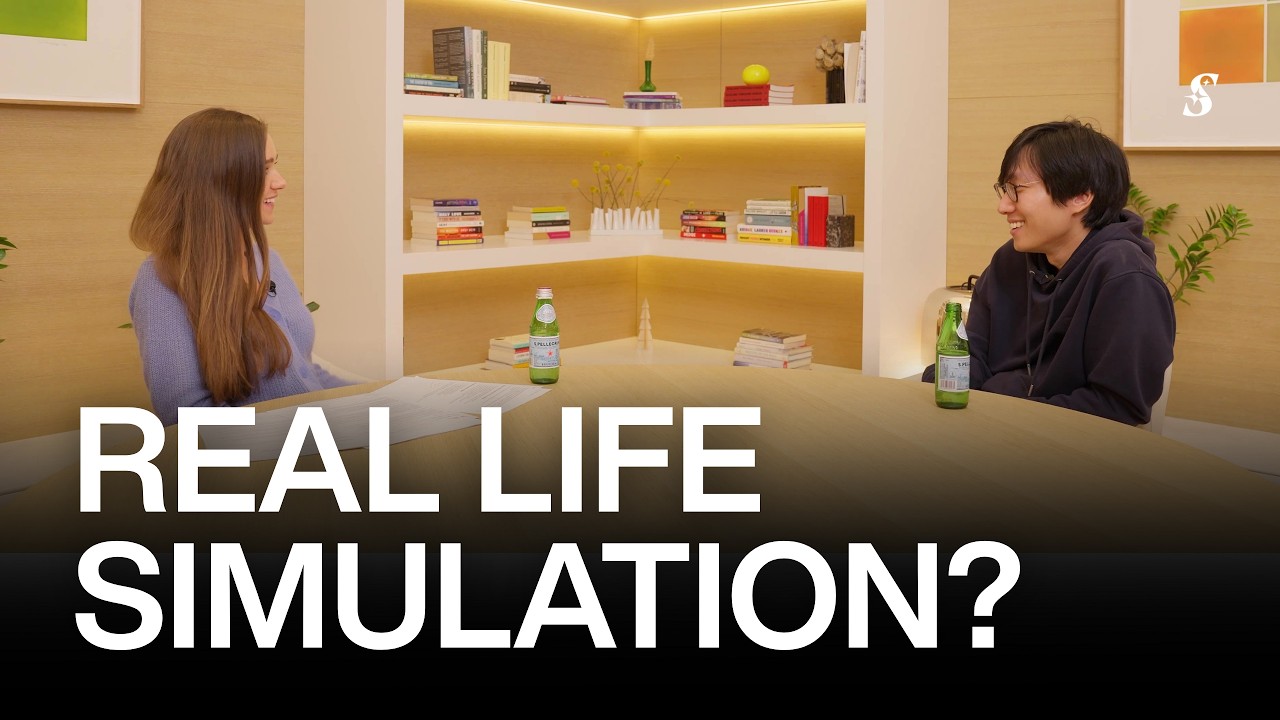
Recorded 26 October 2026 · 56 min
Simile is building a foundation model of human behavior, and its founder June claims the model can predict people's behavior with 85%+ accuracy. The system builds digital twins from long interviews with real people and tests them against what those people later do. Its first commercial use is replacing slow, expensive market research. June's larger ambition is to simulate whole societies, starting from individuals and letting their interactions produce outcomes nobody scripted.
The tension is between prediction and trust. Simile says survey answers and real behavior follow different mathematical shapes, that options and opportunity costs drive the gap, and that customers care less about forecasts than about causal levers. The evidence offered is a 1,000-person study, customer examples, and a confidence score attached to every output. Whether that is enough to support high-stakes decisions is the question running underneath the conversation.
Individuals first, then societies — ▶ 2:56
June frames simulation as a portrait of society, built from the bottom up. The building blocks are stable individual traits such as risk tolerance and aesthetic taste. The first test is whether a simulation can faithfully represent one person. A society-scale simulation then puts many such people in a shared environment, and what matters most is what emerges from their interactions, which June calls complex and chaotic. He also says it is likely that we live in a simulation, on the argument that any civilization wants to understand itself by recreating itself.
Smallville's emergent Valentine's party — ▶ 4:10
The 2022-2023 Smallville experiment placed 25 language-model agents, built first on GPT-3 and then GPT-3.5, in a game town. Each had a distinct name, life story and a memory, planning and reflection architecture. They woke, worked and formed relationships. A character organized a Valentine's Day party and others asked each other out, none of it pre-programmed. June says the work established two ideas: simulating people is possible, and generative models can power early agentic architectures. Everything Simile has built since extends the pursuit of greater accuracy, diversity and scale.
From believability to faithfulness — ▶ 6:52
Smallville was judged on believability: human evaluators compared agent answers with human-authored ones. Simile's later test measured accuracy. It recruited a representative sample of 1,000 US people and used a voice AI interviewer to collect their life stories. It trained a twin of each person, then brought them back two weeks later for surveys, behavioral studies and stimuli. Agents predicted the responses. At the end of 2024, June says, the twins predicted behavior with 85%+ accuracy. The transcript gives no baseline, and June stresses that simulations must be grounded in real data and evaluated alongside people.
Saying versus doing — ▶ 12:39
The modeling challenge, June argues, is a translation layer between stated attitudes and actual behavior. Survey answers tend to follow a normal distribution: asked whether they will go to the gym, people cluster around 5-6 on a 7-point scale. Actual behavior follows something closer to an exponential curve, because the activation energy required is higher than people expect. Some traits, such as risk tolerance, are not known to change, which makes them predictable once learned. Training data therefore includes behavioral and randomized-trial evidence, not just self-reports.
Optionality drives behavior — ▶ 14:07
June says the best single explanation of behavior is optionality. Surveys present abstract choices in a confined space, but real people weigh alternatives and opportunity costs: exercising means giving up an extra hour of sleep or another meeting. He illustrates with water. A sole source could charge $1 million, but widespread alternatives and packaging prevent it. This is why Simile models the environment as well as the people. Agents are exposed to a decision, such as what price they would pay, with the surrounding alternatives included.
Collapsing research costs — ▶ 15:51
The current business sells a web platform where users choose who to ask and what to ask, with no limit on questions. It targets work insights teams already do, including concept testing, conjoint analysis and max-diff analysis. June says studies that took years and cost hundreds of thousands to millions of dollars can run almost instantly, as a query. Customers named include CVS, on store layout, messaging and decor, and Banco in Brazil, on policy messaging. Simile also maintains vertical-specific simulated panels so customers have a ready population from day one.
Grounding in real panels — ▶ 23:16
Simile says it has partnerships with over 40 million real people across panels, including Gallup's panel of hundreds of thousands. It talks to tens or hundreds of thousands each week and can source new panelists within 24 hours. June names the controls: spacing participation to avoid fatigue and gaming, attention checks, and informed consent with the right to withdraw. The consent rule creates a disclosed blind spot, because underage people are excluded. Beyond that, June argues no population should be avoided, since the aim is a representative snapshot of society, bad behaviors included.
Built-in confidence score — ▶ 31:00
Alongside the foundation model, Simile jointly trains a model that outputs a 0-100 probability of how confident it is in each answer, based on the training data and the question asked. June compares it to a p-value in social science. Customers have found confidence above 90%, or usually 85%, robust enough for very high-stakes decisions. The design reflects June's view that the product is evidence and calibration, not just answers. Simile also does change management with customers to teach them when to rely on results and where more data is needed.
Electric vehicle messaging backfire — ▶ 33:47
June's example of an expensive mistake predates Simile. Automotive companies, all weighing electric vehicles, used simulation to test messaging for a new entry. One approach looked like a clear winner. Its downstream effect, however, was to shift perceptions of non-electric vehicles and lower sales across the entire market. June presents this as the kind of counterintuitive, system-level finding simulation should surface when it works best: not an answer to one narrow question but a view of the whole field. He offers no further detail about the study.
Causation over prediction — ▶ 42:45
June says customers care less about forecasts than expected. Told a market will crash in two quarters, they ask what to do to change it. Simile therefore prizes randomized controlled trial data, which varies a product feature or message and observes the behavioral change, over correlational transaction or mobility data. The same logic underlies his ambitions for climate coordination and UBI, which he suggests could be simulated instead of studied for five years. These are aspirations, not demonstrated results.
Forward deployment as moat — ▶ 45:03
Simile has about 100 people, roughly 20% of them academic labmates and relatives. June says simulation is in its GPT-4 or GPT-4.5 era: the technology is useful but changing monthly. He expects the field to reach where coding agents are today in about 1.5 to 2 years. Drawing on the coding-agent cycle, he argues that forward-deployed companies built stickier, more defensible customer relationships, and expects the same in simulation. Asked about a $15 billion offer, he says he would pursue the ambitious idea only Simile can pursue.
Simile's central bet is that a model of human behavior becomes valuable only if it captures why people deviate from what they say. June, the company's founder, does not treat people as survey respondents. His claim is that stated attitudes and actual behavior are governed by different functions. Answers to a question like whether someone will go to the gym tend to cluster in a bell curve around the middle of a scale. Actual behavior looks more like an exponential curve, because the activation energy to act is higher than people predict. Learning that translation layer, he argues, is the real modeling problem.
The mechanism he offers for the gap is optionality. Surveys put people in a confined space with a few options. Real life offers alternatives, and every choice carries an opportunity cost: the gym costs an hour of sleep or another meeting. June's water example makes the point. A sole supplier could in theory charge $1 million, but abundant alternatives prevent it. From this follows Simile's design choice to simulate environments as well as people, so that an agent facing a decision sees what else it could do. The idea is plausible and well explained, though the transcript gives no direct test of environment modeling.
The evidence for the people-modeling half is stronger and more specific. In the study June describes, Simile recruited a representative sample of 1,000 US people and interviewed each with a voice AI about their life story and hard decisions. It trained a twin of each person, brought them back two weeks later for surveys and behavioral studies, and asked the twins to predict the answers. At the end of 2024, June says, accuracy reached 85%+. That is a meaningful result. It is also a figure without a stated baseline, measured against self-reported and lab-style responses.
That qualification matters because June's own theory says self-reports are not behavior. If survey answers differ from what people do, then a model that predicts survey answers with 85%+ accuracy has not necessarily predicted behavior. June partly answers this by saying training data includes behavioral evidence, such as randomized controlled trials, transaction data and mobility data. The study he cites, however, includes behavioral studies and stimuli alongside surveys, and the transcript does not separate the accuracy of each. The thesis and the headline number rest on slightly different footing, and the gap is worth noting.
The commercial case is clearer. Simile sells a web platform that runs traditional insights work, including concept testing, conjoint analysis and max-diff analysis. June says these studies once cost hundreds of thousands or millions of dollars and took years, and now run almost instantly. Customers he names include CVS, which uses simulation for store layout, messaging and decor, and Banco in Brazil, which uses it for policy messaging. The economics are a collapse in marginal cost per question. Because users face no limit on questions, the constraint on research shifts from budget to the quality of what a customer chooses to ask.
Grounding is the other defense of the business. Simile says it works with over 40 million panel members worldwide, talks to tens or hundreds of thousands weekly, and can fill a new panel request within 24 hours. Gallup, whose panel includes hundreds of thousands of people, is a partner. June describes familiar polling controls: spacing contact to avoid fatigue and gaming, and attention checks. He also names a limit the company has chosen. Informed consent rules out underage participants, a blind spot he says Simile owns. Everyone else is meant to be included, because a representative snapshot of society cannot exclude anyone.
Simile's most distinctive product decision is to ship uncertainty with the answer. It jointly trains a model that gives each response a 0-100 confidence score, which June likens to a p-value. Customers, he says, treat 85-90% as robust enough for high-stakes decisions. This makes the product an evidence package, not an oracle. It also shifts trust onto the calibration model. A confidence score that is wrong in a systematic way would be more dangerous than no score, because it turns doubt into a threshold. The transcript does not show how that calibration is validated.
June's most interesting example concerns what simulation could miss on its own. In a study from before Simile, automakers tested messaging for a new electric vehicle. A winning approach shifted perceptions of non-electric vehicles and lowered sales across the whole market. The lesson he draws is that simulation is most useful when it surfaces counterintuitive, system-level effects. Yet the example cuts both ways. It supports the case for looking at the whole field, but it was a study run before Simile, and no one claims a simulation would have caught the effect beforehand.
This connects to what June says customers actually want. People, he found, are less interested in prediction than expected. Told a market will crash in two quarters, they ask what to do about it. That is why Simile prizes randomized controlled trial data over correlations, and why June points to causal mechanisms as the lever for shaping the future. His aspirations follow from it: simulating climate coordination among actors with competing incentives, or testing UBI instead of running five-year studies. These are research hopes, not products, and they depend on the same untested step from individual accuracy to society-scale emergence.
June is explicit that the competitive fight will be won in deployment as much as in modeling. He describes simulation as being in its GPT-4 or GPT-4.5 era, expects it to reach the maturity of today's coding-agent industry in about 1.5 to 2 years, and cites coding agents as evidence that forward-deployed companies build stickier, more defensible relationships. His answer to a hypothetical $15 billion offer is conditional: he would stay if there is an ambitious idea only Simile can pursue. The unresolved issue is whether a model's value lies in its accuracy or in the human work that teaches customers when to trust it.
The open question. Does 85%+ accuracy against survey and behavioral-study responses collected two weeks later carry over to real-world decisions made in changing environments? The transcript gives no baseline for the figure and no systematic evidence that Simile's confidence score, which customers treat as a decision threshold at 85-90%, stays calibrated when the environment itself is simulated. The electric vehicle example shows the promise: system-level effects that a narrow test missed. It also shows the risk, because the outcome came from a pre-Simile study and nothing indicates a simulation would have caught it in advance.
Watch the full video at https://www.youtube.com/watch?v=-6Kg5N7JL7I.
Comments ()