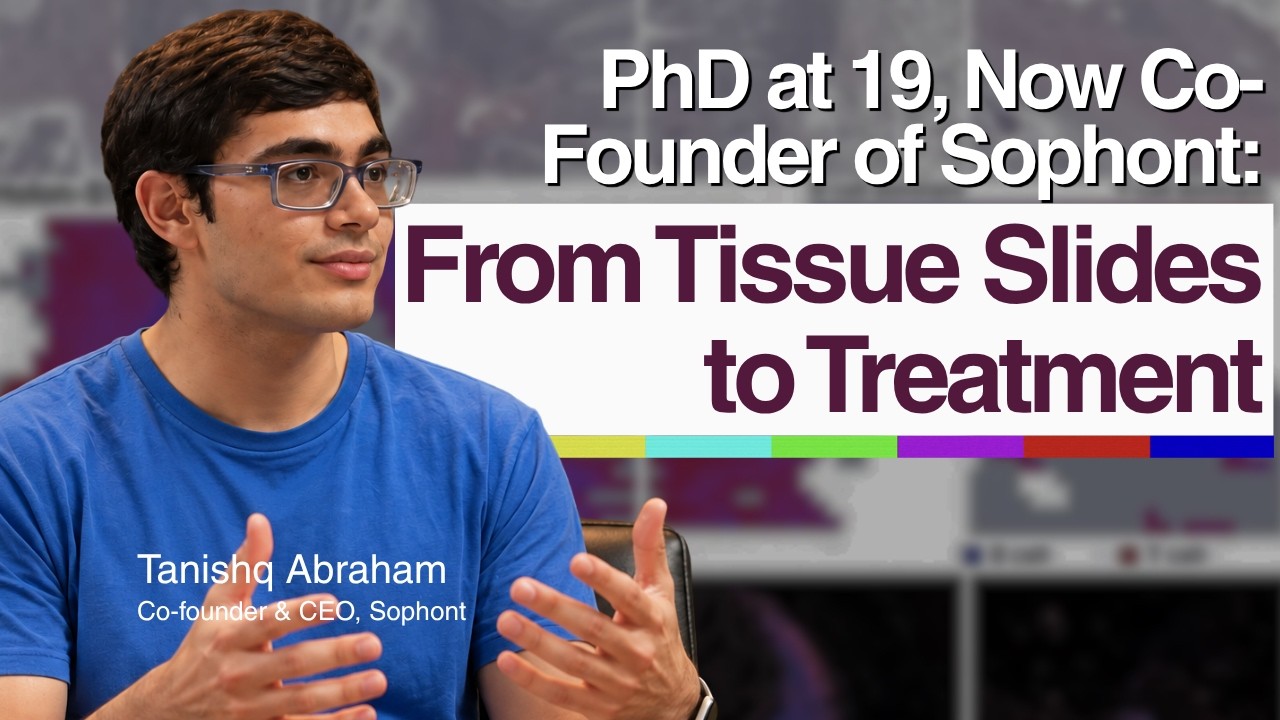
Recorded 21 October 2026 · 25 min
Thomas Ebrahimi, co-founder and CEO of Sophon, a medical AI lab, argues that the overlooked bottleneck in cancer is measuring each tumor's biology, not inventing drugs. His company's newly announced Holland S1 model is trained on pathology slides and tries to infer molecular and pathway-level information from the same biopsy images doctors already collect.
The tension is between ambition and evidence. Ebrahimi repeatedly stresses that the model still needs retrospective and prospective validation. He is also openly skeptical of the timelines implied by frontier labs promising cures. His case is that nearer-term tools, such as predicting treatment response, can help patients years before AI-designed drugs do.
Biopsy slides as readout — ▶ 0:42
Cancer is diverse: two patients with the same diagnosis, such as triple negative breast cancer, can differ in the genes expressed and in how cells interact. Molecular tests can map this but are expensive and time-consuming. Holland S1 is trained on pathology slides, the biopsy tissue already prepared for diagnosis, to infer which genes and pathways are active. Ebrahimi also calls cancer-type classifications 'a bit arbitrary' next to molecular biology, which is why the model trains across many cancer types.
Osteosarcoma test case — ▶ 3:41
The one concrete result offered is a patient with osteosarcoma, a rare bone cancer the model was not trained on. Holland S1 extracted biological insights the patient's medical team had already obtained through very expensive molecular tests. It identified a gene the team then targeted, and the treatment succeeded. Ebrahimi frames this as suggestive for rare cancers, not proof. It is a single case, and he says substantial further validation is required.
Cure as framework — ▶ 5:26
Ebrahimi rejects the idea that curing cancer means finding a magic drug. In his view a cure will be a widely successful, generalizable framework for personalized care: measure the tumor's biology, map it, then design treatment for that specific tumor. Holland S1 addresses only the first step, mapping. He calls this step under-appreciated and acknowledges separate AI work on treatment design, which he describes as exciting but a different paradigm.
Narrow models, real reach — ▶ 8:01
Holland S1 was trained only on cancer data, so Ebrahimi does not know whether it would work outside oncology. He sees the research direction extending to autoimmune diseases, and Sophon also applies the approach to neuroimaging to distinguish patients with neurodegenerative diseases. The models are not large-scale LLMs. He argues they can still have major impact by building on existing frontier AI tools and research, without needing frontier-scale training.
Validation gates deployment — ▶ 10:03
Near-term uses include applying Holland S1 to large archives of existing slides for research, and giving pharma companies features to predict patient response to drugs. Because the features map to specific biological pathways, he calls them interoperable. Later uses include diagnostic tests that tell a patient whether they are likely to respond to a treatment. All of this requires validation in large prospective clinical trials, so Sophon's next focus is retrospective and eventually prospective trials.
Mice don't predict humans — ▶ 12:44
Ebrahimi locates a main limiting factor in drug development: knowing whether a drug will work in humans. Candidates move from in silico to in vitro to preclinical work in mice, none of which represents human biology well. A drug can cure cancer in rats and mice and fail in people. He argues AI-for-biology needs more models trained on clinical data. Such models could show, for example, which pathway is more active in patients who do not respond to a drug, pointing to new targets.
Short-horizon over cures — ▶ 15:49
Asked whether frontier labs' biology push is legitimate, Ebrahimi calls it promising but limited in scope. He argues the timeline for AI-developed drugs is long, and that telling people AI will cure cancer while they wait 10 years creates what he calls 'cognitive dissonance'. His alternative is faster-payoff work, such as better diagnosis and predicting which drugs a patient responds to. His one-year forecast is modest: retrospective, possibly prospective, trials, not cures.
Thomas Ebrahimi's central claim is that curing cancer will not look like the discovery of a magic drug. In his view it will be a generalizable framework for personalized care: measure a tumor's biology, map it, then design treatment for that specific tumor. Most public enthusiasm for AI in oncology centers on the last step, designing drugs. Ebrahimi's company, Sophon, is working on the first, which he calls under-appreciated: what it takes to truly understand a particular person's biology. Holland S1, announced the day of the interview, is the product of that bet.
The problem it targets is diversity within a diagnosis. Two patients with triple negative breast cancer can have different genes expressed and different interactions between cells. Molecular tests can capture those differences, but Ebrahimi describes them as expensive and time-consuming. Holland S1 instead starts from the pathology slide, the biopsy tissue that is already prepared and examined under a microscope to diagnose solid tumors. The aim is to extract from that image what a doctor's eye cannot: which pathways and genes are active. The appeal, as Ebrahimi frames it, is that it uses a modality ordinary patients already have.
The evidence offered is thin but concrete. Ebrahimi describes a patient with osteosarcoma, a cancer the model was not trained on. Holland S1 surfaced biological insights that the patient's medical team had obtained through very expensive molecular tests, including a gene the team then targeted in a successful treatment. The case is notable because the model reproduced what costly testing found. It is also a single case, and Ebrahimi is careful to say that rare-cancer applications remain to be validated. Sophon has published case studies on its website, but the conversation includes no accuracy figures or cohort sizes.
A second argument concerns where AI-for-biology goes wrong. Drug candidates move from simulation to test tubes to mice, and Ebrahimi says none of those stages represents human biology well. A drug that cures cancer in rats and mice may not generalize to people. His prescription is to train foundation models on clinical data and human biology directly. If the model can show that a particular pathway is more active in patients who do not respond to a drug, that points to new treatment targets that are grounded in human tissue, not in animal models. This is an argument about where the data should come from, and it favors whoever has access to patient-derived data.
The same logic shapes his view of timelines. Ebrahimi calls frontier labs' moves into biology promising but, so far, limited in scope, citing blog posts and projects from Anthropic. His objection is to the horizon: if people are told AI will cure cancer but must wait 10 years, he sees 'cognitive dissonance'. Better diagnosis, and predicting which drugs a patient will respond to, can reach patients faster than developing drugs from scratch. Readers should note that this is also the market Sophon occupies. It is an opinion from a company with a stake in the answer, and the transcript offers no test of it.
The constraints are visible in his own account. Holland S1 was trained only on cancer data, and he does not know whether it works elsewhere. Using it to select treatments requires prospective clinical trials in the general population, and Sophon's immediate priority is retrospective trials, then prospective ones. His one-year forecast is correspondingly modest: trial evidence, possibly some simple applications such as tracking how patients respond to drugs, and explicitly nothing like a cure. He adds that this depends on the field devoting far more resources to medical and bio AI.
If the approach holds, the practical consequence is economic as much as scientific. A slide that every solid-tumor patient already has could stand in for tests that today are expensive and slow, and the resulting features could be reused by researchers and pharma companies. Whether slide-derived biology matches the molecular tests clinicians trust, and does so prospectively, is the question the coming trials will have to answer.
The open question. Can features extracted from a routine tissue slide predict treatment response reliably enough to change clinical decisions across the general patient population? Ebrahimi's evidence so far is a single osteosarcoma case and published case studies. He says the answer depends on large retrospective and eventually prospective trials, which have not yet been run. Until they report, it is unclear whether slide-derived biology can substitute for expensive molecular tests or only complement them.
Watch the full video at https://www.youtube.com/watch?v=G3IDxDh6FO4.
Comments ()