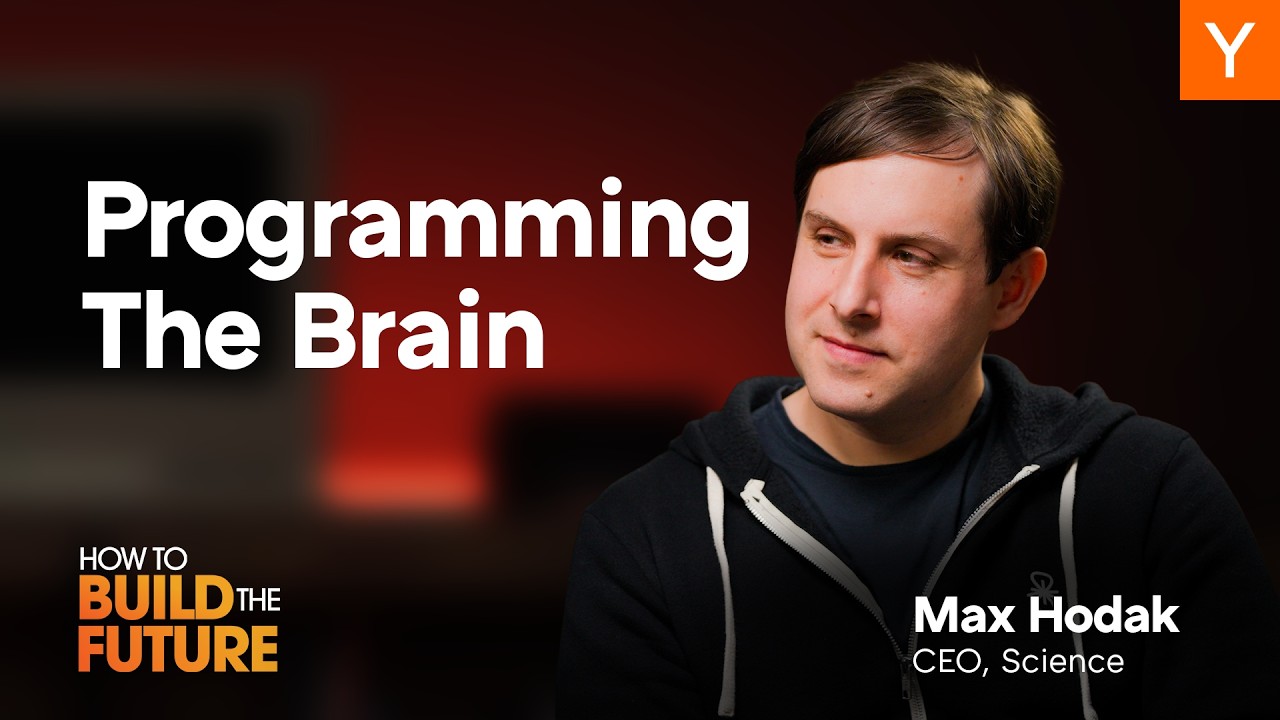
Recorded 9 March 2026 · 53 min
Max Hodak, a Neuralink co-founder who now runs Science, argues that medicine should be reframed as neural engineering rather than drug discovery. His evidence is Prima, a 2 mm retinal implant that produced form vision for people blinded by lost photoreceptors in a trial across 17 European sites. Science is now seeking approval.
The tension is between ambition and constraint. Hodak describes a takeoff era and suggests the first people to live to 1,000 may already be alive. He also concedes that implants require serious brain surgery, that his biohybrid approach has only been shown in animals, and that BCI will be a category of products rather than one device.
Prima's retinal solar panel — ▶ 0:53
Prima is a 2 mm by 2 mm silicon chip implanted under the retina, acting as an array of tiny solar panels. Patients wear glasses with a camera and laser projector. Where the laser hits the implant, it absorbs the light and excites the cells above it, bypassing dead rods and cones. A trial across 17 European sites was published in the New England Journal of Medicine, and more than 40 people have received the treatment. Science is submitting for approval, hoping for it later this year. Patients currently see black-and-white images in a small field. Hodak projects near-20/20 acuity and color within 10 years.
Many BCIs, not one — ▶ 3:47
Hodak expects BCI to become a category like pharma, with different modalities for different jobs. Ultrasound might one day act as a digital Ambien or Adderall, though high-quality ultrasound currently requires drilling through the skull. Implants are serious brain surgery, so risk-reward dictates starting with the most disabled patients. A cortical motor decoder at about 10 bits per second compares poorly with speech at about 40 and typing at about 20, so he would not undergo surgery for it. The calculus shifts as devices become more powerful and bidirectional, and as aging turns more people into patients.
Plasticity has hard limits — ▶ 6:08
Critical periods in early development are real. Adults born with congenital cataracts who had them fixed later could not make sense of the input, which was overwhelming. Yet adult brains remain highly plastic under feedback. With an electrode in almost any cortical area and a light that flashes in proportion to a neuron's firing, a person can learn to control that neuron within minutes. Early decoding experiments fixed the weights and let the brain adapt. Hodak suggests adults look less plastic because the brain sits in a stable basin fit to reality, which psychedelics may temporarily flatten.
Neural engineering over drugs — ▶ 13:31
Hodak argues humanity is poor at drug discovery: occasional lucky finds such as GLP-1, but more often a decade ending in a negative study. In blindness, he says drug work has produced essentially no effect, and a million-dollar-per-patient gene therapy offers marginal benefit to few. Prima let a patient who could not see faces for a decade read every letter on an eye chart. Because the device does not depend on why photoreceptors died, it may also work in retinitis pigmentosa and Stargardt's. Age-related macular degeneration affects 200 million people globally, and the severe form, geographic atrophy, affects 1 million to a couple of million.
Stimulate before compression — ▶ 15:38
The retina has 150 million rods and cones, 100 million bipolar cells and 1.5 million ganglion cells that feed the optic nerve. Rods and cones hold a bitmapped image. By the ganglion layer, the signal is compressed about 100x into edges, motion and other features, so stimulating one cell yields a directional gradient rather than a pixel. Second Sight stimulated ganglion cells through a 4.5-hour surgery and produced flashes the brain could not assemble into images. Prima stimulates bipolar cells upstream. Hodak says this was an empirical discovery and, as far as he knows, the first coherent image in a person's mind's eye from an implant.
The brain's API — ▶ 18:00
All information entering or leaving the brain passes through 12 cranial nerves and 31 spinal nerves, which Hodak calls its API. He says BCI is limited by the ability to record and stimulate signals, because the neuroscience becomes comparatively simple once recording works. Representations are concrete near inputs and outputs, such as image intensity or joint torque, and abstract deeper in, such as object space in inferotemporal cortex, which the host likens to a latent space. Hodak cites resemblance between representations in trained AI models and in the brain, and says neuroscience has learned more from AI than expected. In his view, neural activity is another latent that can be translated into a model.
BCI as consciousness tool — ▶ 26:16
Hodak rejects the framing of BCI primarily as an AI-merger story, calling it a longevity and healthcare story, though he sees something in the merger idea. His speculative claim is that if AI's end point is superintelligent machines, BCI's end point is conscious machines. If no external measurement can establish whether something is conscious, studying consciousness may require interfaces that let people observe it themselves. Understanding what the brain exploits could then enable superintelligent conscious machines that people join through ultra-high-bandwidth connections. He presents this as an early-stage vision, not a near-term product plan.
Biohybrid growth bet — ▶ 29:33
Inspired by the roughly 200 million fibers of the corpus callosum, Science seeds an implant with engineered, stem cell-derived neurons that are meant to graft onto the brain and form biological connections. No wires enter the brain, and no gene therapy modifies the patient's own neurons. A hypoimmunogenic cell line hidden from the immune system avoids per-patient manufacturing. Hodak's risk argument is that if the graft dies, the patient is mostly no worse off, unlike a one-way genetic modification. The results are from animal models, not humans. He concedes the trade-off of adding a living cell, and expects biohybrid to matter for high-end uses and be back-loaded.
The smartphone dividend — ▶ 37:42
Motor decoding for cursor and keyboard control was first done in humans in the late 1990s, so the barrier to making it practical is electronics. Earlier devices needed a connector through the scalp, leaving the skin open to infections that could climb down it. Neuralink's contribution, Hodak says, was electronics small and power-efficient enough to avoid dangerous heat and to close the skin. He credits what he calls the smartphone dividend: the money Apple and Samsung poured into miniaturized, efficient electronics, which BCI companies can now reuse. The implication is that a mature consumer supply chain, not new physics, enabled this step.
Perfusion's economic gap — ▶ 39:53
Science's vessel program began with a Lancet case of a 17-year-old kept alive on ECMO, consuming what Hodak describes as a half a million dollar a month ICU suite, and a literature debating ECMO as a bridge to nowhere. He saw a gap between what is technically possible and what is economic to deploy. Machine perfusion has transformed transplants, with over 75% of US liver transplants using it, but systems cost about $500,000 and move by private jet. The aim is a kidney checked as luggage or a circuit that fits in a backpack. Hodak argues survival without quality of life is not enough.
Startups as oral tradition — ▶ 48:25
Hodak's career advice rests on a failure. His first company, Transcriptic, a robotic cloud laboratory, had millions of dollars in revenue when he stepped down as CEO in 2017, but he says its promise was not fulfilled and the years were a slog. He thinks he should have worked for someone like Elon Musk earlier. His reasoning is that running a startup is an oral tradition passed down through a few Silicon Valley cultures, and learning it at 20 rather than 26 or 28 can change a trajectory. He allows that going solo sometimes works.
Hodak's central claim is that medicine has been organized around the wrong discipline. Drug discovery, in his telling, is a lottery: a few lucky finds such as GLP-1, and otherwise a decade down a path that ends in a negative study. His example is blindness, where he says years of drug work produced essentially no effect and a million-dollar-per-patient gene therapy offers marginal benefit to a small share of patients. Against that, Prima let a patient who had been unable to see faces for a decade read every letter on an eye chart. The implant also does not depend on why photoreceptors died. A drug must target the molecular failure in each disease, whereas a prosthesis only needs to get the visual signal back into the computer.
The retina case is more than a product story, because it shows why the point of intervention matters. The retina contains 150 million rods and cones, 100 million bipolar cells and 1.5 million ganglion cells that feed the optic nerve. Rods and cones hold a bitmapped image. By the ganglion layer, the signal has been compressed about 100x into features such as edges and motion, so stimulating one cell yields a directional gradient rather than a pixel. That is why Second Sight, whose implant stimulated ganglion cells and required a 4.5-hour surgery, produced flashes the brain could not assemble into an image. Science stimulates bipolar cells, upstream of the compression. Hodak calls the result empirical and, as far as he knows, a first.
Hodak describes the route to that choice as a structured search rather than a bet on a single asset. Around 2021, Science mapped a 2x2 matrix: stimulate bipolar or ganglion cells, electrically or with optogenetics. Ganglion targeting was ruled out because it would need a calibration of about 1 million degrees of freedom per patient. Science built both remaining options. Its optogenetic proteins respond to indoor office lighting, but remain 5 to 7 years from clinical translation if they work. For the electrical route, it acquired a small European company developing technology invented at Stanford about a decade earlier. He adds a caution: first principles carry engineers far elsewhere, but in biology one must also understand what evolution actually did.
Underneath sits a view of the brain as an information processor with a bounded interface. All information entering or leaving it passes through 12 cranial nerves and 31 spinal nerves, which Hodak calls the API of the brain. He argues the bottleneck for BCI is recording and stimulating signals, since the neuroscience becomes simple once recording works. Near inputs and outputs, representations are concrete, such as image intensity or joint torque. Deeper in, they become abstract, like the object space in inferotemporal cortex, which he and the host compare to a latent space. He cites the resemblance between representations in trained AI models and in the brain, and says neuroscience has learned more from AI than expected. If so, neural activity is another latent that can be translated into a model.
Plasticity is what makes the approach plausible in adults, though Hodak says it is widely misunderstood. Critical periods are real: adults who had congenital cataracts removed could not make sense of the new input, and the experience was overwhelming for them. Yet an electrode placed almost anywhere in cortex, paired with a light that flashes in proportion to a neuron's firing, lets a person learn to control that neuron within minutes. Early motor-decoding experiments fixed the weights and let the brain adapt. Adults look less plastic, he suggests, because the brain has settled into a stable basin fit to reality. Prima patients show the flip side: after years of blindness the brain turns up its noise, so early rehabilitation involves separating real percepts from phantom ones.
Hodak rejects the idea of a single BCI product. He expects a category like pharma, with different modalities for different jobs, possibly including ultrasound as a digital Ambien or Adderall, though high-quality ultrasound currently requires drilling through the skull. For implants, risk-reward dictates sequencing: start with the most disabled patients. A cortical motor decoder at about 10 bits per second compares poorly with speech at about 40 bits per second or typing at about 20, so he would not undergo brain surgery for it. The crossover comes as devices become more powerful and bidirectional, and as aging turns more people into patients. Hardware made this feasible: Neuralink's contribution was electronics small and efficient enough to close the skin, which Hodak attributes to a smartphone dividend funded by Apple and Samsung.
Science's riskiest bet is the biohybrid interface. Inspired by the roughly 200 million fibers of the corpus callosum, it seeds an implant with engineered, stem cell-derived neurons that are meant to grow into the brain and form biological connections. No wires enter the brain, and no gene therapy alters the patient's own neurons. A hypoimmunogenic cell line, hidden from the immune system, avoids manufacturing per patient. Hodak's argument is that failure is bounded: if the graft dies, the patient is mostly no worse off, unlike a one-way genetic modification. But the evidence comes from animal models, not humans. He acknowledges the trade-off of adding a living cell to a device, says biohybrid is needed only for the highest-end applications, and expects its impact to be back-loaded.
The perfusion program applies the same worldview to a different failure. Hodak was struck by a Lancet case of a 17-year-old kept alive on an ECMO circuit in what he describes as a half a million dollar a month ICU suite, and by a literature debating ECMO as a bridge to nowhere. He sees a gap between what is technically possible and what is economic to deploy. Perfusion has already transformed transplantation, with over 75% of US liver transplants using it, yet the systems cost about $500,000 and move by private jet. His aspiration is a kidney checked as luggage or a circuit that fits in a backpack. Survival in a hospital bed, he says, is not the goal; quality of life is.
From this foundation Hodak builds a more speculative narrative. He calls BCI a longevity and healthcare story more than an AI-merger story, while crediting the merger idea as Elon Musk's original motivation for Neuralink. If AI ends in superintelligent machines, he says, BCI ends in conscious ones. If no external measurement can reveal consciousness, studying it may require interfaces that let us see it for ourselves. He feels the field is in a takeoff era, compares the moment to the first 10 to 15 years of the steam engine, and says he cannot see past 2035. He thinks the first people to live to 1,000 may be alive now, but would not claim all disease will be cured by then, and puts his probability of AI doom above zero but well below 50%.
These claims rest on uneven evidence. The strongest is the Prima trial, which Hodak reports as a large effect across 17 sites, published in the New England Journal of Medicine and awaiting approval. Its present output is black-and-white vision in a small field of view. Near-native acuity and color are his projection over 10 years. As an editorial inference, the vision case may also be the easiest one for his framework: the eye's input begins as a bitmap and the working layer is identifiable. Deeper in the brain, Hodak says, representations become abstract, and he calls the experience of ultra-high-bandwidth interfaces impossible to imagine. The test of his thesis is whether the strategy of finding the right processing layer repeats outside the retina.
The open question. Does the retinal playbook generalize? Prima worked because the eye's input begins as a bitmap and Science could identify the processing layer to preserve. Hodak says representations become abstract deeper in the brain, and his biohybrid interface has so far been shown only in animals, which he expects to be back-loaded. Whether engineers can find equally clean intervention points for the brain's deeper functions, and whether those approaches survive human trials, is untested.
Watch the full video at https://www.youtube.com/watch?v=5gspRJVp9dI.
Comments ()