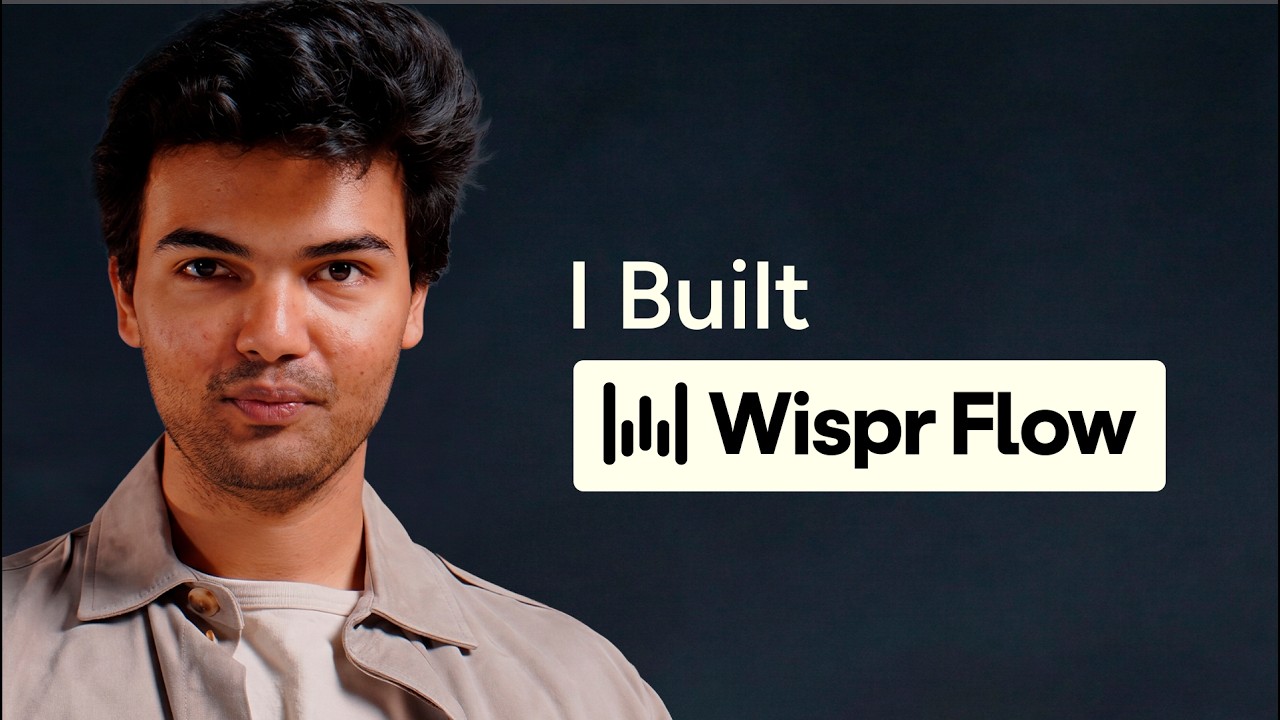
Recorded 30 September 2026 · 30 min
Sunek Otari, CEO and co-founder of Whisper Flow, argues that most aspiring founders start with the wrong thing: the idea, which he ranks only third in building a company. Self-reflection and a co-founder come first, and capital and product-market fit follow. His underlying claim is that startups die mostly because founders lose the will to fight, not because of competition or a lack of cash.
Framed as a playbook for starting a company in San Francisco in 2026, the talk with host Hector turns on incentives. Venture funding buys speed and demands outsized outcomes, so taking it is a choice about the life a founder wants. The evidence is almost entirely Otari's own experience, including Whisper Flow's eighth product and about $360 million raised, rather than data.
Idea comes third — ▶ 1:20
Otari orders the start of a company as self-reflection, then a co-founder, then the idea, and says 95% of people skip the first step. His test is what you care about, not what excites you: a founder thrilled by AI agents will have moved on within a year, while a concern held for many years can carry them through many bad days. He adds what you want from life and where you are uniquely strong. He also claims that 90% of startups die mostly because founders lose the will to fight. That figure is his assertion, with no source given.
Co-founder alignment before founding — ▶ 5:04
After starting one company alone, Otari concluded that nobody else, not family, friends or partner, understands a founder's daily emotional swings. For Whisper Flow he recruited Sahaj, a former roommate, and the two spent three months aligning on shared concerns, values and team preferences before founding. Their values were integrity and being customer-first, which ruled out selling user data for ads. Otari calls those three months the most important of the five-year journey. He also wants complementarity: a fast, spontaneous decision-maker should seek a slower partner, and a shy founder a more extroverted one.
Marry the problem, not the idea — ▶ 9:07
Otari's contrarian position is that the idea matters less than committing to a problem or a customer, such as blind users or high car emissions. An initial idea is then built quickly and tested against a yes-or-no question: does it make the customer's life better? The host recalls losing six months to planning, an LLC and paperwork that never revealed whether the problem was real. Otari's remedy is truth-seeking speed and a willingness to kill the first, second and third idea. In his view, everyone has 20 ideas a day, so what matters is whether you have set yourself up for success.
Build for 100 people — ▶ 12:17
A college professor's line has stuck with Otari: a product built for everybody is like a love letter addressed to whomsoever it may concern. His early goal is 100 people who swear by the product. Reaching that puts a company on a trajectory to success, while chasing everyone leaves it spinning in circles. The host recalls joining Whisper Flow with barely 100 users. Otari attributes the company's growth to users loving the product and to product-led growth. Narrowing from a million people to 100 makes the problem easy to verify.
Venture funding buys speed — ▶ 13:51
Otari frames two games: traditional business or venture-funded. Venture exists to buy speed, with an implied demand to build in one year what would take 10. The economics explain why. Institutions back funds promising 35-40% annual returns, against 10-11% from the stock market, by funding high-risk companies without revenue or product-market fit. So a traditional $100 million business owned outright could pay $1 million a year, while a $500 million venture-funded company built in two years may still be a failure that returns little capital to the founder. He cites Dollar Shave Club and Allbirds as ventures that went fast and could not sustain the pace.
Investors back people — ▶ 19:04
A seed round of $1 million at a $10 million valuation costs 10% of a company. Otari aims for 10%, though he says the norm is 20-25%. Whisper Flow has raised about $360 million across six rounds, and he says investors back him and his co-founder and the story they tell, at any round size. He does more reference calls on investors than they do on him, checking for integrity, loyalty in downturns and what he can learn from them. Speed means a founder must grow quickly too, so he values investors whose networks have seen companies like Spotify, TikTok and Salesforce scale.
Fit is unmistakable — ▶ 25:41
Otari says a founder asking whether they have product-market fit does not have it: when it arrives, the world pulls the product away faster than the team can build or fix it. Before then, founders alternate between idea and iteration. Whisper Flow was the eighth product his team built, and seven were killed. A spark appeared around July, and January was unambiguous fit, with a team of six. He says the hardest part is killing an idea you have grown attached to, and estimates he has built and killed 70 to 80 products. His advice to his younger self is simply to keep going.
Sunek Otari's central claim is that a startup is first a test of endurance and only second a test of ingenuity. Ideas are cheap, he says: everyone has 20 a day, so having one separates nobody. What separates founders, in his telling, is whether they are still fighting when the hard stretch arrives. He asserts that 90% of startups die mostly because founders lose the will to fight, not because of competition or cash, and that 95% of people skip the step that guards against this, self-reflection. Neither figure is sourced; both are his opinion. But they explain the architecture of his playbook, where nearly every early decision is meant to protect staying power.
Self-reflection is the mechanism. Otari distinguishes what excites you from what you care about. A founder energized by AI agents, he says, will have lost interest within a year, while a concern held for many years can carry them through many bad days. He adds two more inputs: what you want out of life and where you are uniquely strong, whether in creating, organizing or design. The payoff is matching. Someone who notices which parts of life feel chaotic, such as a farmer planning a year or a parent ordering food, can aim a strength at a real problem.
The same logic governs the co-founder choice. Otari started one company alone and concluded that nobody else understands a founder's daily emotional swings. For Whisper Flow he recruited Sahaj, a university roommate, and the two spent three months aligning before founding the company, a period Otari calls the most important of the five-year journey. They tested for shared concerns, shared values and a shared view of team. Integrity and customer-first meant no business that sells user data for ads. Beyond alignment he wants complementarity: a fast decision-maker should seek a slower one.
Only then does the idea arrive, and Otari treats it as disposable. His contrarian view is that committing to a problem or customer matters more, since one problem can be attacked with many ideas. Each is tested quickly against a yes-or-no question: does it make the customer's life better? The scarce skill is killing what fails. Whisper Flow was the eighth product his team built, and seven were killed. He estimates he has built and killed 70 to 80 products. Fit then arrived gradually, with a spark around July and unambiguous product-market fit by January, when the team numbered six.
Narrowing runs through his advice on early users. A product built for everybody, his professor said, is a love letter addressed to whomsoever it may concern. Otari's target is 100 people who swear by the product. Reach that and a company is on a trajectory to success; chase everyone and it spins in circles. Whisper Flow's growth, he says, came from users who loved it, followed by product-led growth. The advice is also practical: delight among 100 people can be checked, while usefulness to a whole market cannot be verified early.
Capital is where Otari is most analytical. Venture funding, he argues, exists to buy speed, and the bargain is that investors want in one year what a traditional business takes 10. The economics explain why. Institutions fund venture funds promising 35-40% annual returns, against 10-11% from the stock market, by backing high-risk companies without revenue or fit. That demands outsized outcomes. A $500 million company built in two years may still leave a founder with almost no capital, he says, while a traditional $100 million business owned outright could pay $1 million a year. He cites Dollar Shave Club and Allbirds as ventures that went fast and could not sustain it.
If a founder takes that route, Otari says investors are backing people rather than ideas. Whisper Flow has raised about $360 million across six rounds, and he says this holds from first rounds to rounds of hundreds of millions. For a seed round he aims for 10% dilution, such as $1 million at a $10 million valuation, though he says the norm is 20-25%. He picks investors by running more reference calls on them than they run on him, checking integrity, loyalty in downturns and what he can learn. A fast-growing company, he argues, needs a fast-growing founder, which makes those advisers part of the product.
The evidence for all this is personal. Otari's record supports the value of iteration, but it cannot show that three months of alignment or ruling out ad-funded models causes durability rather than accompanying it, and the survivors of the process are the ones telling the story. A tension also runs through the sequence. He puts capital at step four and fit at step five, and describes venture as a bargain on speed. Yet his own path to fit involved eight products and months of iteration. How a funded founder absorbs that much failure under a compressed clock is left unanswered.
The open question. Otari's playbook assumes founders fail mainly by losing the will to fight, a 90% figure he offers without a source. If that is true, do self-reflection and months of values alignment preserve that will, or do founders who already have it simply find these steps easy? His evidence is his own record and observation, which cannot separate cause from survivorship. It also leaves open how a venture-funded founder, under a compressed timeline, can afford to kill seven products before finding the eighth.
Watch the full video at https://www.youtube.com/watch?v=cqp8dI6zbzc.
Comments ()