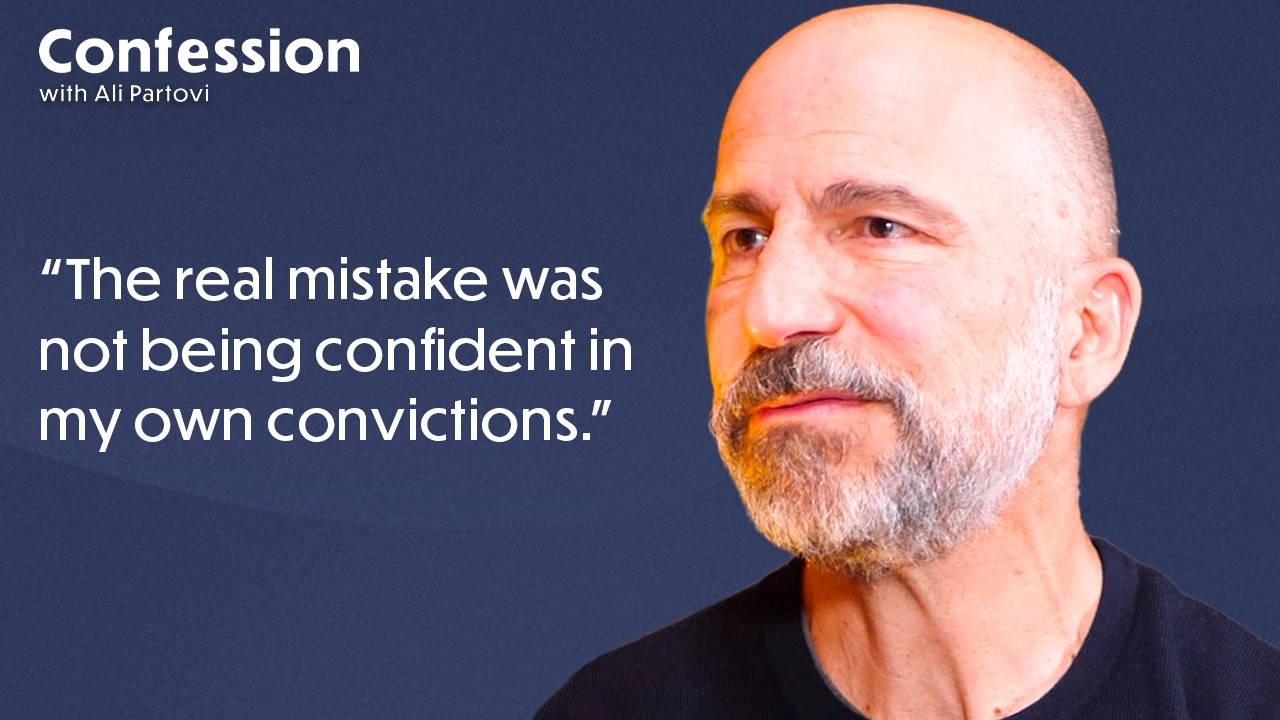
Recorded 13 October 2026 · 41 min
Dara Khosrowshahi, CEO of Uber, tells investor Ali Partovi that the costliest decision of his career was a failure of conviction. As a rookie Expedia CEO, he let a skeptical board talk him out of buying Priceline, whose Booking.com unit he now says is worth $140-150 billion. His broader argument is that leaders err less from poor judgment than from missing information, and that they must volunteer their own fear first to get honest information back.
The conversation is candid because the two are second cousins who share an immigrant family history. It also holds an unresolved tension. Khosrowshahi urges leaders to discount experience at moments of dislocation, yet concedes that his board's pushback was proper. His lowest point, the COVID-era layoff of more than 5,000 people, shows the opposite failure: delaying a hard decision by asking for more data.
The unspoken second chance — ▶ 10:26
After the family lost everything in the Iranian revolution, no one ever told Khosrowshahi to rebuild. He and his cousin both sensed it anyway, as an undercurrent of responsibility. His parents had not moved their money out of Iran, and they spent what remained on private school. He suggests this unspoken duty may explain the family's later career success. His father tried entrepreneurship in the US, missed twice and mostly gave up; his mother went to work. The one thing the family kept, he says, was each other.
Ignorance and desperation — ▶ 15:04
Khosrowshahi reached the CEO job by accident. He studied bioelectrical engineering at Brown, entered finance only to be near his girlfriend, and then joined Barry Diller, who had been his client. When the IAC Travel CEO resigned, he was CFO and raised his hand. He describes it as desperation on Diller's part and ignorance on his own. IAC Travel, which included Expedia, Hotels.com and Hotwire, was later spun off as public Expedia. The unplanned path made him a technology executive.
The Priceline deal that wasn't — ▶ 18:06
As a rookie CEO of Expedia, then structured as a holding company with 5,000-6,000 employees, Khosrowshahi negotiated to buy Priceline, a low-cost rival that owned a then-small Booking.com. He then missed a quarter, and the stock fell from the 20s to about $16-17. The board, including Diller, asked why it should fund another acquisition of roughly $1.5 billion (the transcript wording is garbled) before the core business was fixed. He backed off. Priceline later recovered, and the board would not revisit the deal. He now calls Booking.com a company worth $140-150 billion.
Deference as a liability — ▶ 23:36
Khosrowshahi blames the failure on conviction, not analysis. He knew travel would grow faster than GDP and that online adoption was early. He still weighted a board of gray-haired 50- and 60-year-olds above his own judgment, which he links partly to an Iranian cultural deference to elders. His claim is that in technology, the greatest value arises when history does not repeat, so leaders need some lack of respect for experience, as with those who saw AI as different. He concedes that history sometimes rhymes. He also suspects the board was testing how badly he wanted the deal.
Seniority degrades information — ▶ 28:48
A CEO's schedule is manufactured by well-meaning staff who decide what he should hear, so the higher the role, the less the leader knows. Khosrowshahi argues that most CEO mistakes come from missing information rather than bad judgment. His countermeasures are personal transparency, which he showed by admitting fear in his farewell email to Expedia staff, and deliberately unstructured meetings with engineers beyond his direct reports. He says 80% of those meetings are a waste for decisions, but they open informal channels of information.
Leaders must go first — ▶ 33:04
Subordinates face personal risk in delivering unwelcome facts, such as a competitor winning abroad, so candor does not start with them. Khosrowshahi says the person in power has to be honest first, about problems, mistakes and weaknesses, and that this gives others permission. He rejects the 'come with answers, not questions' stance, because he wants to hear unresolved problems and mistakes as data. He applies the same standard to investors: he presents Uber's strengths, but also where it is not doing well competitively, framed as opportunity.
Layers erase sharp edges — ▶ 33:34
Uber's 'toe-stepping' norm told people to say unpleasant things in meetings. Khosrowshahi says it was weaponized, because some took it as license to be a jerk. He kept the underlying honesty and dropped the abuse. His reasoning is structural: as companies grow, more layers edit facts on their way upward, and the editing removes the sharp edges of a problem, which are the best clue to solving it. He also wants to keep troublemakers, whom large organizations tend to expel.
85% of volume vanished — ▶ 35:45
Before COVID, Uber was losing about $1.5-2 billion a year while facing DiDi, Chinese rivals in Latin America, and Lyft gaining share in the US. Mobility, the profit engine, funded technology and Uber Eats. Overnight 85% of volume disappeared, and the loss rate jumped to a $4-5 billion annual run rate against roughly $8-10 billion in cash. By his account, that arithmetic forced the company into deep cuts. The pandemic hit at a moment when Uber was already unprofitable and heavily contested.
Data as procrastination — ▶ 36:57
Khosrowshahi recognizes in hindsight that he was using staff meetings and requests for more data to postpone the layoff decision. His CFO at the time told him the team had talked enough, that they respected his judgment, and that he should say what he wanted to do. He spent a night alone and then announced the largest layoff in company history, over 5,000 people, along with business shutdowns and divestitures. This is the mirror image of the Expedia failure, delay rather than retreat.
Time cannot be repaid — ▶ 38:50
He calls the layoff his rock bottom, though he says it was necessary for survival and that he would repeat it. His reasoning is that money can be recovered, as his family's was, but time cannot, and employees bet their prime career years on Uber, unlike diversified shareholders. He says the leaner company gained discipline, and Uber Eats, around 10% of the business before COVID, is now 50% and may eventually exceed mobility in scale, though perhaps not in profit.
Khosrowshahi's two worst moments as a chief executive are mirror images. At Expedia, he retreated from a deal he believed in because a skeptical board pushed back. At Uber during COVID, he delayed a decision he knew he had to make by asking for more data. By his own account, neither was an analytical failure. The first was a failure to hold a conviction, and the second a failure to act on one. Read together, the stories suggest that the hardest part of senior leadership is not judgment itself but the nerve to commit under pressure, and to know when pressure should be resisted and when it should be heeded.
He arrived at Expedia by accident. He had studied bioelectrical engineering, drifted into finance to be near a girlfriend, and joined Barry Diller as a deal person. When the head of IAC Travel resigned and no replacement was available, Khosrowshahi, then CFO, volunteered. He calls it ignorance on his part and desperation on Diller's. After the spin-off, he ran a public company of 5,000-6,000 people, structured as a holding company, in which he saw himself less as an operator than as a portfolio manager. The stock had started around $40-45, then slid as travel suppliers sold directly and industry growth slowed.
That was the setting for the Priceline deal. Khosrowshahi had negotiated to acquire the low-cost rival, which had bought a then-small Booking.com. Then Expedia missed a quarter, and the stock, already in the 20s, fell to about $16-17. When he presented the deal, the board asked why it should fund another acquisition of roughly $1.5 billion (the transcript wording is garbled) before he had fixed his own earnings. He calls that a proper case. He also suspects the directors were testing his resolve. They would probably have approved it, he says, if he had laid his body on the tracks. He chose to wait a quarter or two.
Waiting proved fatal to the deal. By the time Expedia's results recovered, Priceline's stock had also risen, and the owners would not sell. Priceline later renamed itself Booking.com, which Khosrowshahi now values at $140-150 billion. The claim needs care. He bought into the deal as a way to neutralize a low-cost competitor, not because he foresaw Booking.com's rise. The figure is also his retrospective estimate, and the proposal was never made public. His reasoning at the time was sound enough: travel would grow faster than GDP, and online adoption was early. Even so, he acknowledges that the real error was not the missed quarter but losing confidence in his own view.
His diagnosis is cultural as well as personal. He links his deference to an Iranian habit of respecting elders, and he says he weighted the experience of a gray-haired board above his own judgment. From this he draws a broad principle for technology. The greatest value, he argues, arises when history does not repeat, so leaders need some lack of respect for experience. He cites AI as the example, where those who saw it as fundamentally different succeeded. He adds qualifications: history sometimes rhymes, and a board should check a CEO. Such moments are rare and, as he puts it, lonely by design. Diller once told him he had not been hired to be average.
The second half of his argument concerns information. Khosrowshahi holds that executives rarely make mistakes of judgment alone. More often they decide without the facts. The mechanism is structural. A chief of staff curates his calendar, and staff filter bad news according to their own judgment of what he should hear. As organizations grow, more layers edit the facts, and the editing removes what he calls the sharp edges of a problem, which are often the best clue to the solution. His fix is to be blunt, to speak with engineers outside his direct reports, and to keep troublemakers. He concedes that 80% of those random meetings are useless for decisions. The payoff is the unconventional channels that open.
He also reverses the usual sequence of candor. Staff face personal risk in reporting that a competitor is winning abroad, so the person with power has to be honest first. Khosrowshahi admitted fear in his farewell email to Expedia and says he tells investors where Uber trails, framed as opportunity. He does not ask people to arrive with answers. He wants mistakes and unsolved problems brought to him as data. Uber's old 'toe-stepping' norm shows the risk. It started as an invitation to disagree, but in his account some people used it as license to be a jerk. Candor needs a standard of conduct, and he kept the honesty without the abrasiveness.
COVID tested those principles. By his account, Uber was losing about $1.5-2 billion a year, and mobility profits funded technology and Uber Eats. Then 85% of volume disappeared overnight, and the loss rate jumped to $4-5 billion a year, with roughly $8-10 billion in cash. He kept holding staff meetings and asking for more data, which he now sees as a way to avoid the decision. His CFO broke the loop by telling him the team respected his judgment and he should say what he wanted to do. After a night alone, he announced layoffs of over 5,000 people and the closure or sale of several businesses.
He does not recant. He says the cuts were necessary for survival and he would make the same decision, though he feels he let employees down. His reasoning is that time, unlike money, cannot be recovered, and employees invest it during their most productive years. The leaner company, he says, gained discipline, and Uber Eats grew from roughly 10% of the business before COVID to 50%. That is a favorable outcome, but it is a retrospective judgment, and it raises the question that his two stories leave open. He regrets retreating at Expedia and delaying at Uber, yet each was clear only afterward. A leader still has to say in advance which pressure to resist.
The open question. How can a leader tell a genuine dislocation that justifies lonely conviction from a board's legitimate check on a CEO who has just missed a quarter? Khosrowshahi's evidence is retrospective: Booking.com's current value and the example of AI. Hindsight cannot show how a leader should judge such moments as they happen, or how often an unmoved board was right to refuse.
Watch the full video at https://www.youtube.com/watch?v=90WmbQ5p2Oc.
Comments ()