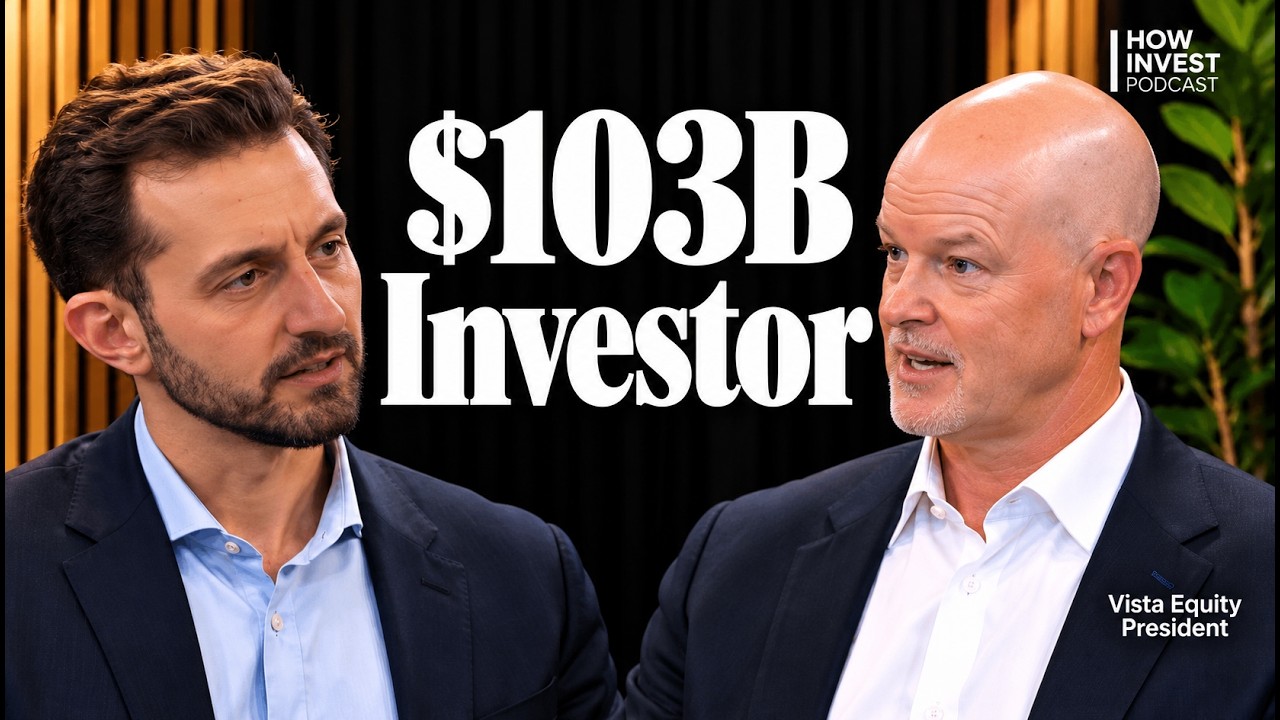
Recorded 23 October 2026 · 59 min
David, a senior Vista executive at the software-focused private equity firm, argues that AI changes what software is: from a tool that manages human workflows into a digital worker. He cites a BCG estimate of a $3 trillion services market now open to agentic software, and contends that incumbent vendors are best placed to capture it.
The tension is whether incumbents will actually innovate or be displaced by AI-native entrants. David concedes some will lose, but bets that data custody, workflow knowledge and deterministic outputs favor incumbents over frontier labs and in-house builds. He also admits enterprises are capturing little measurable efficiency so far.
Operational playbook as edge — ▶ 2:08
Vista's founder Robert Smith, an engineer by training, set out to make value creation replicable and predictable rather than reliant on financial engineering. Vista codified best practices across four areas: product and technology, go-to-market, talent, and operations. A dedicated value creation team teaches management to implement and measure them. When David joined in 2014, Vista had $13 billion of AUM and 100 employees, with a goal of $50 billion by 2025. David says AUM is now about $100 billion, so the plan was exceeded.
Software as the worker — ▶ 10:02
Software historically automated workflows between humans, first on-premise, then as a service. David argues agents let vendors deliver digital workers for the first time, which creates a market that did not exist before. He cites BCG's estimate of a $3 trillion services market available to agentic software. This is a third-party estimate relayed by an interested investor, not an independently verified figure. The implication is that vendors compete for labor budgets, not only software budgets, and can be paid for work done.
Cloud re-rating as template — ▶ 11:38
David frames AI as a repeat of the 2014-2016 SaaS re-rating, when investors doubted whether cloud delivery helped or hurt software. Companies trading at 2.5-3x revenue on-premise fetched 6-8x once converted. Almost 50% of software is still on-premise 20 years into the migration, and it is valued lower. His inference is that SaaS companies that fail to create AI-driven value propositions will see growth dim and valuations suffer, while those that prove they can charge for digital workers will re-rate upward. The February selloff, he says, reflected fear of the unknown, not changed financials.
Platforms, applications, and incumbents — ▶ 14:47
David expects LLMs to become platforms on which applications sit, as with earlier software platforms, citing roughly 100,000 software companies as evidence that vertical expertise is hard to replicate at scale. He expects open-weight models too, with intelligence priced by level: an MIT professor is overkill for high school algebra. Incumbents, he argues, hold the customer relationship, the data, workflow context and 20 years of security trust, and can push a new agent to a thousand customers almost overnight. He concedes AI-native applications will still disrupt some incumbents.
Mission critical beats ROI — ▶ 20:50
Vista's screen separates mission criticality from ROI. A product with strong ROI can be cut when budgets tighten, while a mission-critical one cannot be switched off. Vista looks for software that is mission critical, embedded in workflows and handles the most important data. It checks this against retention, where roughly 95% implies stickiness and 20% annual customer loss does not. Historically, Vista found core software returns a little over 600% to customers. Being a system of record, David adds, is a factor but does not alone make a business durable.
Cost deflation and productivity gap — ▶ 22:43
David expects AI to lower the cost of writing and operating software, and argues falling cost expands buyers, so consumption of software rises. Asked why efficiency does not appear in economic data, he says enterprises are capturing less than assumed. Giving staff generic tools removes only modest friction relative to token spend. The prize is agents that effectively create two of you, not faster email. Firms must then choose between reinvesting savings in growth and harvesting cash, and he expects both outcomes across his portfolio.
Recent renewals trump history — ▶ 29:19
In a fast-moving market, David says retention data from 3 years ago is less relevant than data from 3 months ago. Vista combines an assessment of how durable a product is against agentic competition, given its data and workflow, with a view of how much agentic opportunity it can harvest. It then tests those views against recent renewal rates and contracting cycles. The explicit admission is that Vista may believe something is durable and then find the data does not support it. The data takes precedence.
Determinism protects regulated incumbents — ▶ 32:44
David notes that LLMs are probabilistic, while businesses like insurers must produce the exact same answer every time. His example is Duck Creek, a Vista property and casualty insurance company, whose agents handle over 90% of first-notice-of-loss intake. Fraud agents run in parallel, and humans are pulled in for personal injury, claims above a dollar threshold, or fraud flags. Deep regulatory and industry knowledge, he argues, is what allows safe agents that two people in a garage could not easily replicate in regulated industries.
Data custody drives adoption — ▶ 38:16
David argues data security is why many enterprises will adopt generative AI through their existing software vendors rather than directly from frontier labs. CTOs and CIOs worry about whether models retain or train on their data, and the stakes rise in banking, insurance and healthcare. Vista companies bring the agentic capability to the data in its existing secure environment and do not allow models to train on customer data. Some use open-source models, others frontier models in a post-train configuration, retaining data in the customer's environment. This is a position, not demonstrated across all vendors.
Agent X factory and discipline — ▶ 44:09
Vista has built over 100 people focused on agentic and AI transformation, plus an Agent X factory that helps portfolio companies shape product strategy and build products hands-on. Spending priorities split into efficiency, such as code generation, customer service and shorter sales cycles, and new agentic products customers will pay for. Whereas product work five years ago meant roadmaps, it now aims to create new TAMs. Vista holds 90-91 companies, targets 15-20 investments per closed-end fund and 4-6 years of vintage diversification, and says it will not buy where it cannot add material value.
David's central claim is that AI changes the unit of sale in software. For 50 years, he says, software helped humans manage workflows between humans. Agents let vendors deliver digital workers instead, and that opens a market vendors could not reach before. He points to a BCG estimate of a $3 trillion services market available to agentic software. The figure is a third-party estimate relayed by an investor with a stake in the answer, and it should be read that way. But the logic is worth taking seriously: if software performs work, its budget is no longer the software budget. It is the labor budget, which is a different order of magnitude.
His framework for what happens to software companies is historical. In the 2014-2016 period, investors debated whether cloud delivery hurt or helped software. Companies trading at 2.5-3x revenue on-premise fetched 6-8x once converted to SaaS. Almost 50% of software is still on-premise 20 years into that migration, and it is valued below cloud peers. David expects the same sorting now. SaaS companies that cannot create new value propositions will see growth dim and may erode, while those that prove they can charge for digital workers will re-rate upward. In this telling, the February selloff reflected fear of the unknown, not deteriorating financials.
Why should incumbents win the new market? David's answer starts with an analogy to software platforms. Frontier models, he expects, will become platforms on which applications sit, just as earlier platforms did not absorb every product built on them. The roughly 100,000 software companies in existence reflect how hard it is to develop expertise in a vertical, a workflow and a dataset. Incumbents already own the customer relationship, the data and the workflow context. They have also spent 20 years earning trust on security. A vendor with a thousand customers can push a new agent to all of them almost overnight, a distribution advantage a native startup lacks.
The most distinctive part of the argument concerns determinism. LLMs are probabilistic, David notes, and a business cannot operate on probabilistic outcomes in some functions. An insurer must quote the exact same answer every time. His example is Duck Creek, a Vista property and casualty insurance software company. Its agents handle over 90% of first-notice-of-loss intake, run fraud checks, and escalate to humans for personal injury, claims over a dollar threshold, or fraud flags. The design is the point: agents handle the bulk, while rules decide where humans enter. Building that safely in a regulated industry, he argues, requires knowing the business and its regulatory consequences.
Data custody supports the same conclusion from a different angle. Enterprise technology chiefs, David says, worry about whether frontier models retain or train on their data, and the worry intensifies in banking, insurance and healthcare. Incumbent vendors can bring intelligence to the data inside its existing environment rather than shipping data to the model. Some use open-source models, others use frontier models in a configuration that does not let the model train on or take the data out. His forecast follows: many enterprises will take generative AI through their existing software vendors, with agents embedded in applications they already trust. It is a coherent prediction, though it is stated as a belief and not demonstrated across the market.
This shapes what Vista screens for. David separates mission criticality from ROI: a product with strong ROI can be cut in a downturn, while a mission-critical one cannot. Vista wants software that is mission critical, embedded in workflows and handling important data, then tests stickiness with retention rates, where roughly 95% suggests durability and 20% annual loss does not. In an environment this fluid, he says, retention data from 3 years ago matters less than renewal data from 3 months ago. Vista also asks whether each company can expand its own addressable market with agents. A system of record alone, he cautions, is not a moat.
The economic payoff is less certain than the strategy. Asked why AI efficiency is not visible in macro data, David concedes that enterprises are capturing less than assumed. Generic tools given to staff to experiment remove only modest friction relative to token spend. The real value, he says, lies in agents that effectively create two of you. He also expects Jevons-style dynamics: lower software costs should widen the customer base rather than shrink consumption. Companies then face a choice between reinvesting savings where they see growth opportunity and harvesting cash. He expects both, and is not a macroeconomist by his own account.
Vista's own response is an operating apparatus rather than a stock-picking one. It has over 100 people focused on agentic and AI transformation, and an Agent X factory that helps portfolio companies shape product strategy and build products hands-on. Its portfolio of 90-91 companies, 15-20 investments per closed-end fund and 4-6 years of vintage diversification are unchanged by the AI cycle. The stated discipline is to avoid investing behind momentum and to buy only where Vista can add material value. The insistence that new products must be something customers will pay for, not merely impressive, is the practical filter.
The evidence gaps are material. David concedes that AI-native applications will disrupt some incumbents, as cloud-native entrants did to on-premise vendors, and that some Vista companies will not succeed. He does not claim to know that frontier labs will not build many applications. He says only that he does not personally believe they will, nor that enterprises will build at scale themselves. Nor does he offer data showing customers paying for digital workers at the scale the $3 trillion framing implies. What he offers is a structural argument about data, trust and workflow depth, and a historical analogy that supports it only if incumbents move.
The unresolved question is whether the incumbent advantage is durable or merely a head start. Trust, data custody and a thousand-customer distribution base are real assets, but they are only an advantage if incumbents ship agents customers value. The Duck Creek example is the strongest evidence offered, and it is a single company in a heavily regulated niche. If agents expand revenue per customer as David expects, the re-rating he describes would arrive first for the vendors who can show it in recent renewal data. If they mainly cut costs, the benefit may flow to customers, which David concedes is the usual outcome of cost reductions: a little to both.
The open question. Will incumbent software vendors actually convert their data custody and customer trust into agentic products customers pay for, or will AI-native entrants and the frontier labs take the services market first? David's thesis rests on incumbents moving fast and on enterprises preferring in-environment agents, yet he offers no evidence yet of pricing power or measurable ROI from digital workers.
Watch the full video at https://www.youtube.com/watch?v=G1bh6uLfR1Q.
Comments ()