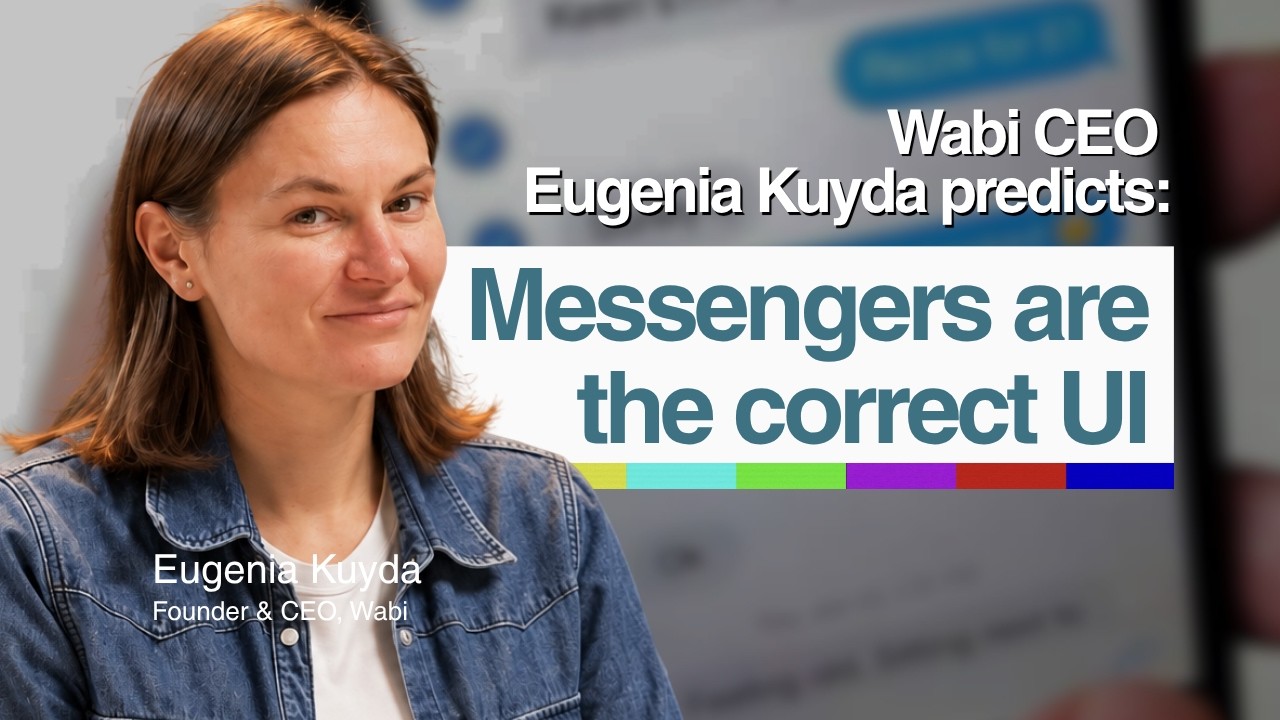
Recorded 24 October 2026 · 14 min
Eugenia, CEO of Wabi, argues that the only correct interface for personal AI agents is a messenger shared with friends and family, where the agent, automatically built apps and a social graph live together. Speaking on MTS the day Wabi 2.0 opened to the public on the App Store, Play Store and desktop, she predicts that within a year one of the biggest consumer AI platforms will be multiplayer and carry network effects.
The tension is between today's single-player agents, which she compares to the Microsoft DOS era, and a product that depends on broad access to a user's email and bank data in order to act proactively. Her claims are forecasts and early user feedback. The conversation offers no usage figures and does not address privacy tradeoffs.
Messenger-first, multiplayer design — ▶ 1:45
Eugenia's starting premise is that many parts of life, such as raising kids and family logistics, are not single-player. Bolting an agent onto an existing group chat is tedious, so Wabi was built as a messenger from the start. People and agents share the same space because, in her view, talking to people and talking to agents should not be two parallel interactions. The design choice follows from a claim about how people actually handle shared responsibilities, not from a technical constraint.
Threads and apps replace text — ▶ 2:25
A single text thread with an agent is hard to parse, Eugenia says, and for many tasks a visual interface beats reading text on a phone. Wabi's agent therefore starts separate threads and builds apps. Her own health thread holds a weight tracker, weightlifting log, supplement tracker and calorie tracker. After a workout log and a poor sleep score, the agent messaged her unprompted with a simple 20-minute workout. She says it does the same across her other life goals.
The DOS era of agents — ▶ 3:55
Eugenia argues that today's single-thread agent interaction is not how people will use agents later, and compares it to the Microsoft DOS era. Most agents also target productivity, such as filing claims or finding refunds. She wants to extend agentic capability into relationships and personal goals: helping someone be a better partner, stay on top of friendships, and get closer to the targets they set for the year. This is a bet about which domains agents should serve, not only about interface.
Proactivity solves the blank box — ▶ 6:01
Eugenia's design principle is that users should not face an empty text box wondering what to prompt. Wabi scans connected accounts such as email and starts working without being asked. If it detects an upcoming trip, it invites the user to a thread and builds likely-useful apps, such as a map of restaurants, sights and events near the Airbnb. She says early users call it the most proactive agent they have tried, which is user feedback relayed by the founder, not measured data.
More data, more value — ▶ 7:41
Asked what data personal agents need, Eugenia answers: as much as users will give. Connecting Gmail lets Wabi start immediately, including a search for any money owed to the user. She says some users have recovered a few hundred dollars. Connecting bank accounts through Plaid lets it find subscriptions to cancel and infer more context. Her logic is a flywheel: each connection yields more help, which motivates the next one. The tradeoffs of granting that access are not discussed.
Users want apps, not building — ▶ 9:06
Wabi 1.0 had users build personal apps for themselves. The 2.0 launch removes the invite list and changes the premise: people love personal apps but do not necessarily want to build them. The agent now builds everything proactively, though users can still request something specific. Eugenia predicts it will feel obvious in hindsight that a messenger with friends and family is the only correct interface for agents, and that single-thread, text-only agents will look archaic.
Network effects as the moat — ▶ 10:40
Eugenia says single-player AI products have little moat and few switching costs. Moving between Claude and ChatGPT is easy, and with agents the key context sits in Gmail anyway. She predicts that within a year one of the biggest consumer AI platforms will be multiplayer, with network effects, and that winners will focus on users talking to other people, not just to AI. This is a forecast with no supporting data in the conversation.
Eugenia's thesis is that the dominant shape of personal AI today, one user talking to one agent in one text thread, is a transitional form. She compares it to the Microsoft DOS era. Her alternative, embodied in Wabi 2.0, is a messenger where an agent, automatically generated apps and a user's real social graph share the same space. She says this will be obvious in hindsight and calls a messenger with friends and family in it "the only correct interface for personal agents." It is a strong claim, and the rest of her argument is built to support it.
The first support is a view of how people live. Eugenia observes that much of life is not single-player: parenting, family logistics and similar responsibilities involve other people. Adding an agent to an existing group chat is tedious, she says, so Wabi starts as a messenger in which people and agents occupy one conversation. Her point is that these should not be two parallel interactions. If the premise is right, a standalone agent app is structurally mismatched to many of the tasks users want help with, however capable the model behind it.
The second support concerns format. A single text thread is hard to parse, and for many tasks a visual interface beats reading text on a phone. Wabi's agent therefore opens separate threads and builds apps inside them. Eugenia's own health thread has a weight tracker, a weightlifting log, a supplement tracker and a calorie tracker. When a poor sleep score followed a logged workout, the agent reached out with a simple 20-minute routine. The product evolved here too. Wabi 1.0 asked users to build their own apps. Version 2.0 rests on the finding that people love personal apps but do not necessarily want to build them.
That shift makes proactivity the core mechanism. Eugenia wants to spare users the blank prompt box. Wabi reads connected accounts, such as Gmail, and starts work unprompted. A detected trip triggers an invitation to a thread and a set of apps, perhaps a map of restaurants and events near the rental. She also says Wabi searches email for money owed to the user, and that users who connected Gmail got back a few hundred dollars. Connecting bank accounts through Plaid lets it flag subscriptions to cancel. Her stated logic is simple: the more users connect, the more the agent can do.
That logic carries a cost the conversation does not examine. Broad access to email and financial data is the price of proactivity, and the host does not ask whether users will accept it. The evidence for the product's quality is also thin. Eugenia reports that early users call Wabi the most proactive agent they have tried, but offers no usage, retention or satisfaction figures. The health example is persuasive as an illustration, yet it is one founder's own account. These are reasonable early-stage limits, but they bound how much weight her claims can bear.
Eugenia also wants agents to serve more than productivity. Most agents, she notes, are aimed at tasks like finding refunds or filing claims. She asks what happens if an agent helps someone be a better partner, stay on top of friendships, connect with people who matter, or move toward goals set for the year. The host's framing of an agent that handles invisible work before being asked fits this vision. It shifts the competitive question from which model is smartest to which product understands the rest of a user's life.
The strategic payoff, in her telling, is a moat. Single-player AI products, she argues, have little protection from switching. Moving between Claude and ChatGPT is easy, and with agents the important context lives in Gmail, which any agent can read. She expects one of the biggest consumer AI platforms to be multiplayer within a year, with network effects. An editorial observation sharpens the tension: Wabi's own proactivity depends on the same email context she describes as portable. If so, the defensibility she predicts would have to come from the social layer, not from understanding the user. Whether families and friends will adopt a shared agent messenger is the claim the evidence does not yet reach.
The open question. Will network effects actually form around an agent inside a group chat? Eugenia's case rests on the assumption that people will bring family and friends into a shared agent messenger, and that this will create switching costs that single-player products lack. The conversation offers no retention, engagement or multiplayer-usage data to test that assumption. It also leaves open how much of Wabi's value comes from social features rather than from the email-driven proactivity she says is easy to replicate across agents.
Watch the full video at https://www.youtube.com/watch?v=g_1Ymd3K3qQ.
Comments ()