Recorded 20 October 2026 · 25 min
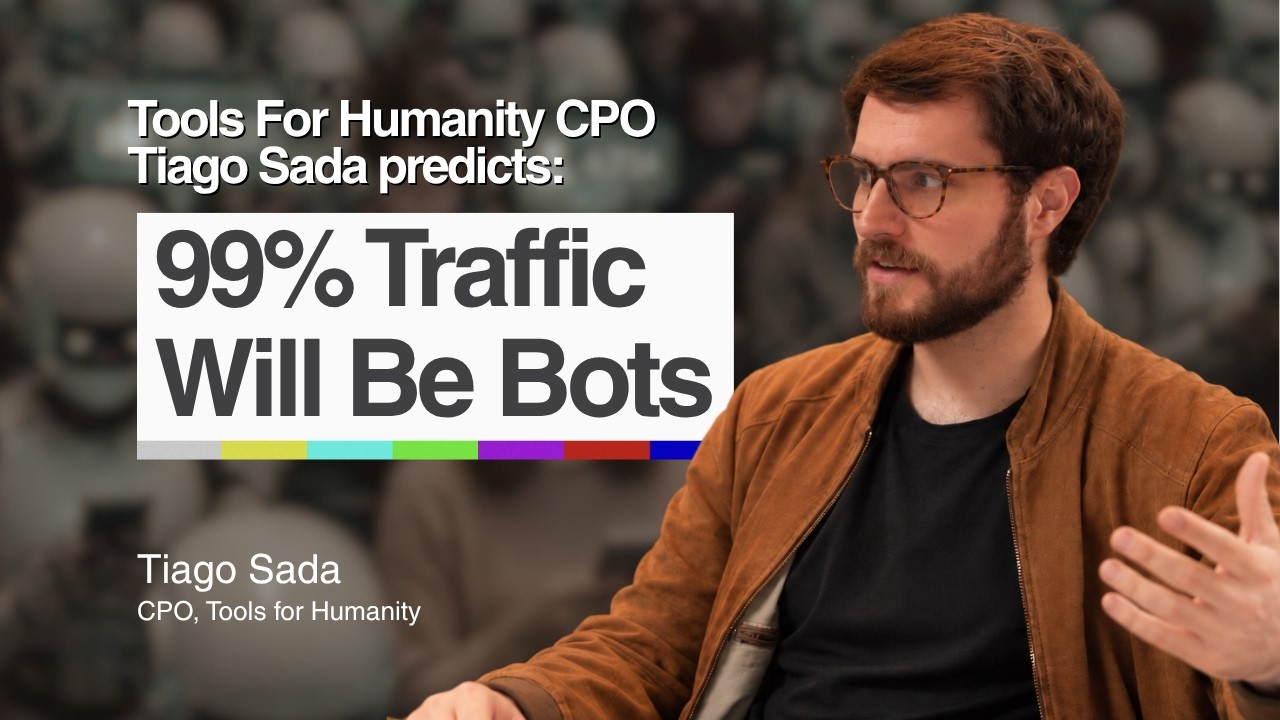
Tiago Sada, chief product officer at Tools for Humanity, the company behind World, argues that the internet's trust problem is now one of volume rather than individual fakes. He cites Cloudflare's announcement that more than 50% of online traffic is bots and predicts the share will reach 99% within a year. The interview followed World's launch of World ID for finance at Money 2020, including a Zoom deepfake-verification badge and an upgraded AgentKit.
The tension is a choice banks face. They can lock out agents, which Sada says drives customers to rivals, or admit agents and somehow tell good bots from bad. His answer is delegated proof of human, built on a one-time biometric scan, and he dismisses conventional KYC as both invasive and beatable by AI. The interview is largely one company's case for its own infrastructure, with little independent evidence on offer.
Real-time deepfakes, irreversible losses — ▶ 2:31
Sada says models recently crossed a threshold, generating video at more than 60 frames per second in real time, so deepfakes no longer need pre-generation. Finance is where this bites hardest because harm is permanent. His example is an earnings call: if a fake CEO shares market-moving news, the stock moves whether the fraud is found 5 minutes or 2 hours later. A deepfake on Twitter can be apologized for; money lost cannot be recovered. World is therefore starting with executives and plans to extend downward through organizations.
Bots as majority traffic — ▶ 4:25
Citing Cloudflare's announcement that more than 50% of online traffic is bots, Sada forecasts that the figure could be 99% a year from now. The forecast comes with no stated basis, so it is best read as his expectation. His mechanism is that banks and other platforms already struggled to separate human from bot, and good bot from bad. Agent volume now makes that harder. His broader claim is that institutions have not yet reckoned with what 99% automated activity means.
Blocking agents is unstable — ▶ 5:43
Sada says JPMorgan Chase has announced it will block bots, and he believes Citigroup or Bank of America did the same, though he hedges on that. Lockdown is safe, but he argues customers who expect to use their own agents will migrate to banks that allow them. He points to Paul Graham's tweet about Amazon blocking agents as a sign that an open competitor will emerge. The implication, which is his argument rather than an established outcome, is that the advantage goes to whoever admits agents safely.
Power of attorney for bots — ▶ 7:10
World's AgentKit lets a user delegate proof of human to an agent, like granting power of attorney. The agent announces itself as a bot representing a specific verified human. That creates accountability: a site can block all bots from that person, impose a timeout, or offer a one-time 30% discount that cannot be reclaimed through ChatGPT. Technically, the credential travels via OAuth through MCP, and websites choose whether to consume the signal. Sada calls it a super simple product.
Vertical-by-vertical distribution — ▶ 10:26
Adoption depends on websites listening, so World is picking one anchor partner per vertical. In finance these include Bain Capital, Pantera Capital and Open Exchange, which runs public-company earnings calls. World ID for Zoom is slated for general availability at Zoomtopia, open to any company that wants it, with pilot-stage companies already reaching out. Sada says social media was last year's focus and finance is this year's because that is where World feels pull. He teased further news at Cloudflare Connect without detail.
Why KYC fails — ▶ 12:09
Sada says KYC fails on privacy and on effectiveness. It forces users to hand companies an ID photo, birth date, address and legal name, and some firm eventually leaks them. It also no longer works, because AI makes fake IDs and deepfaked selfies easy, letting attackers invent people or impersonate real ones. He concedes legal identity has a role but not for proof of human. World instead uses a one-time Orb scan. The photo is not stored and goes only to the user's phone. Zero-knowledge proofs run on-device, including on Android, and keep activity unlinkable across websites.
Identity first, economics later — ▶ 17:05
Sada rejects the label of UBI company, saying World bet that AGI would arrive sooner than expected and that society would need tools to keep humans central. Any experiment by governments, labs or nonprofits needs two things: a way to prevent double dipping and financial rails for distribution. World built both, but now prioritizes identity because it was the first thing to break on the internet. Economic questions, he says, will come in future years, and he admits he has no idea what will work.
Sada's central argument is that online trust collapses once machines outnumber humans, and that this inversion has already begun. He cites Cloudflare's announcement that more than 50% of online traffic is bots and predicts the share could reach 99% within a year, a forecast offered without any stated basis. He does not argue that bots are the enemy. He uses agents daily and expects most computer use to run through them. The difficulty is that platforms built for human traffic cannot tell good bots from bad ones, and the volume of both is rising.
Finance is where Sada says this turns acute, because the damage cannot be reversed. He says models recently crossed a threshold, generating video above 60 frames per second in real time, so deepfakes no longer need to be pre-generated. His example is an earnings call. If a fake CEO shares market-moving news, it hardly matters whether the fraud is discovered 5 minutes or 2 hours later, because the stock has already moved. A deepfake on Twitter can be apologized for. Lost money cannot be recovered. That asymmetry explains why World starts with executives and Zoom, and hopes protection will trickle down through organizations.
The second pressure is competitive. Sada says banks facing a tsunami of bots can lock down, as he says JPMorgan Chase has announced. He believes Citigroup or Bank of America did the same, though he hedges on which. Lockdown is safe, but he argues it costs customers who expect to use their own agents, and they will move to banks that let them. He reads Paul Graham's tweet about Amazon blocking agents as evidence that an open rival will appear. This is his prediction, not an observed outcome. It implies that blocking is a holding pattern and the prize goes to whoever admits agents safely.
World's proposed mechanism is delegation. A user passes proof of human to an agent, much like power of attorney, so the agent announces itself as a bot acting for a specific verified person. That makes accountability possible. A site can block all bots from that person, give a timeout, or grant a one-time 30% discount that cannot be claimed again by switching to ChatGPT. Technically, the credential travels via OAuth through MCP, and websites decide whether to consume it. Sada calls the product simple. Its value, though, depends entirely on the receiving side choosing to listen.
Sada's case against alternatives rests on KYC failing twice over. It is invasive: users surrender an ID photo, birth date, address and legal name, and eventually some company leaks them. It is also ineffective, since AI makes fake IDs and deepfaked selfies easy, so attackers can invent people or impersonate real ones. He accepts that legal identity has uses but says it does not answer the proof-of-human question. World instead scans users once in person with the Orb. The photo is not stored and goes only to the user's phone. Zero-knowledge proofs and anonymous computation, running on-device, keep data in the user's custody and make activity unlinkable across websites.
Strategically, Sada frames World as a company that chose identity because it broke first. He says it was never really the UBI company. It bet that AGI would arrive sooner than expected, and that any societal experiment would need ways to prevent double dipping and financial rails for distribution. Economic questions come later, and he admits he does not know what will work. Distribution follows the same patient logic, one vertical at a time: social media last year, finance now. Anchor partners include Bain Capital, Pantera Capital and Open Exchange, and World ID for Zoom is slated for general availability.
Much of this remains assertion. The 99% forecast has no stated basis. The 40 million user figure is mentioned loosely and without detail on what it measures. Nothing shows how many platforms will read the signal, and the interviewer did not press on any of it. One tension is also unexplained. World promises that activity cannot be linked across websites, yet Sada's examples of per-human bans and one-time discounts require a site to recognize the same person repeatedly. Presumably that recognition happens within a single site, but the interview never says so. If bot traffic does approach 99%, the decisive question is whether proof of human becomes a shared standard or fragments into competing schemes.
The open question. Can proof of human reach enough websites to matter? The protocol only works if platforms choose to read the signal, and Sada's pending Cloudflare Connect news was left undisclosed. A technical gap also remains. World promises that activity cannot be linked across websites, yet his examples of per-human bans and one-time discounts require a site to recognize the same human repeatedly. The interview does not explain how those two properties coexist.
Watch the full video at https://www.youtube.com/watch?v=W9KrNbY2Q6s.
Comments ()