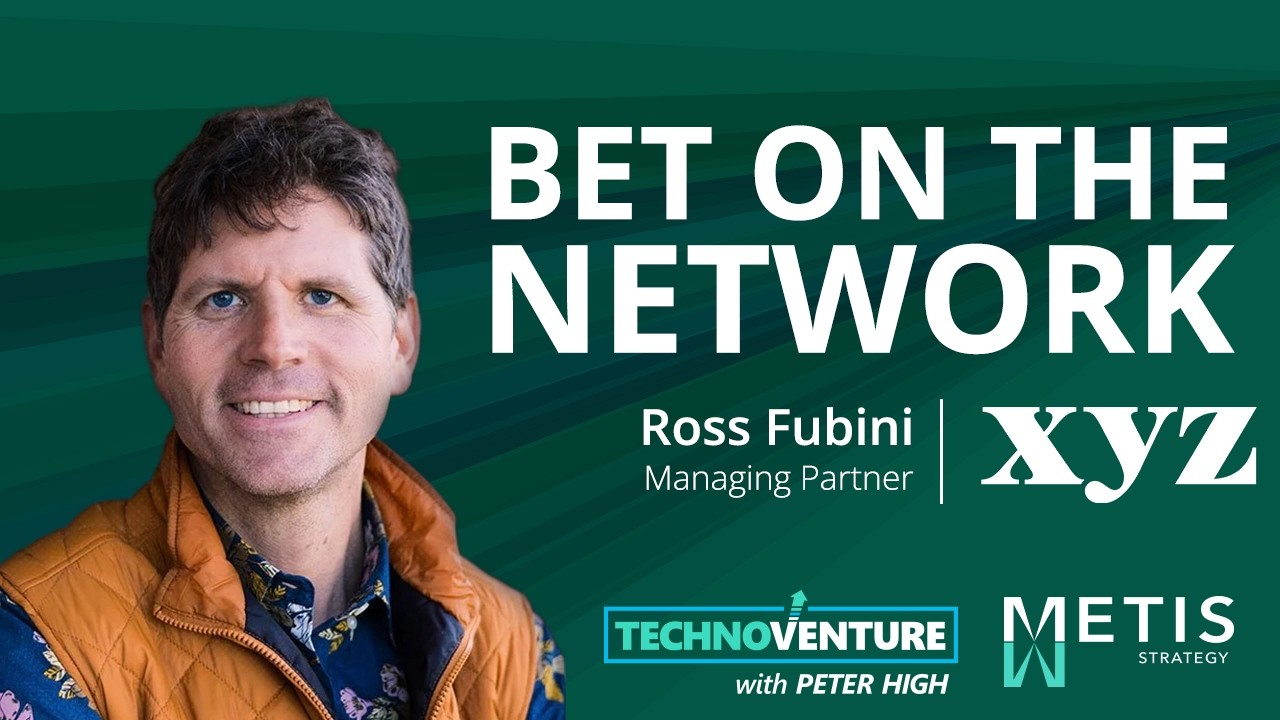
Recorded 25 September 2026 · 58 min
Ross Fubini, founder of XYZ Venture Capital, built his firm on one early bet: that Palantir alumni would form a talent network worth backing before anyone else noticed. A decade on, he says the lesson has broadened. Execution alone no longer convinces him. He now wants founders who are also carried by a market wave.
The conversation with host Peter Hai tests that framework against defense technology, forward-deployed engineering, and AI. Fubini is candid about what remains unproven. AI lifts every boat, weak ones included, and he expects another shakeout among startups built on top of frontier models. The harder question is where durable advantage comes from when software becomes cheap to produce.
Nobody knows except the founder — ▶ 2:42
At Cubetree, Fubini expected board member Gus Tai to answer whether to sell bottoms-up or top-down to the CIO. Tai told him to figure it out. Fubini recently saw the same exchange at a late-stage company raising roughly another $500 million, with more people in the room and the same shrugs. His conclusion is that investors supply facts, pattern recognition and support, but the decision belongs to the founder. He calls this empathy surprisingly atypical among venture investors, based on his own experience, and says it shapes how he handles failing companies and fundraises.
Fundraising is a qualification problem — ▶ 10:24
Raising his first fund was hard at every level. Fubini says he spent as much energy pursuing a friend for $50K as pursuing Yale, and only later saw that the two cases are the same. An institution either fits its strategy and has an open slot, or it does not. An individual either trusts you or does not. In both cases he says you know within two minutes. Recognizing that early saves time and emotional energy, and he now passes the lesson on to new fund managers.
Sell a new network, not a strategy — ▶ 11:41
Limited partners already have someone covering YC, fintech, Series A and growth, and are fielding about 20 pitches from would-be new Series A firms. The pitch that works is access to a network others do not see. In 2017, Fubini's was Palantir. Only Palo Alto residents watching the real estate and young technologists knew it was special. He checked the original deck, and roughly two-thirds of the slides, 8 or 11 of 14, were about the Palantir network. XYZ has backed 135+ companies, about 40 by ex-Palantir founders, including four out of Anduril.
Palantir as founder crucible — ▶ 17:15
Fubini identifies two features. First, Palantir was a learning machine: ideas were reviewed quickly, kept or killed, and the next one pursued. Second, it worked like early McKinsey. CEO Alex Karp opened a door, and small teams of young, unconventional people were inserted into an account to find a business worth at least $10 million to the company and build it. Fubini says this differs from running Stripe's Atlas program or Facebook's photos team, which start with a flywheel. Palantir alumni learned to find problems and seek revenue from scratch.
Execution needs a wave — ▶ 20:20
In XYZ's early years Fubini would back anyone with execution ability, believing execution solved everything. He has changed his view: the company also needs a wave independent of the founder, pushing it forward. His metaphor is surfer, surfboard and wave, with a cyclist's line that it doesn't get easier, you just go faster. Founders work equally hard, but six- and seven-figure deals close more easily and recruiting gets easier. Without a wave, he says the next financing round is harder, and he tells founders to keep moving until they find one.
Why Anduril was a naive bet — ▶ 23:53
Fubini cites two reasons. He had coached Brian Schimpf at Palantir and trusted the team, which also included Palmer Luckey on marketing. And he believed that the government, the world's largest buyer, should be able to buy products, with margins moving from around 7% toward 20% and potentially 30-50%. He calls that belief naive but credits timing and team for proving it right. Prominent firms he approached declined to join, partly, he says, because earlier VC generations held that defense contractors never made money.
Caring as a deal pipeline — ▶ 28:33
Fubini says he coaches executives, including Schimpf at Palantir and later an Anduril engineering leader, because he wants them to succeed. He is also candid that it is greedy, since they are the best people in a company, will eventually start businesses, and lead him to others he should meet. He uses this ability as a rubric when adding senior partners. Partner Art Clark, who ran product under Schimpf at Palantir and AI infrastructure at Apple, does the same. Fubini calls it a rare skill and interest in venture.
AI lifts boats and hides flaws — ▶ 32:13
Fubini compares AI to the internet and mobile, saying both comparisons are right and wrong. As a tide it raises every company, masking problems such as 300% annual revenue growth with zero margins. It also opens industries like manufacturing, through robotics and AI that directs humans where to intervene. But AI does not make a vertical app win. He expects another cycle like the thin-wrapper era, as customers ask what a company adds if an Anthropic or open-source model delivers the same result. The platform shift is real, but advantage must be built on top of it.
Cheap software shifts the moat — ▶ 35:37
As generating software gets faster, Fubini argues that defensibility matters more. Fast UIs are not the moat. The moat is the data set underneath, which makes the system smarter, and a deep understanding of the use case, so that what it generates is adopted better than incumbents such as Salesforce. He also sees venture interest shifting to hardware because it is defensible and now paired with cheap cameras and AI. Capital markets have grown to believe in frontier hardware as they came to believe in defense. He is bullish on construction and manufacturing, though XYZ has not yet invested in construction.
Forward deployment is hard to staff — ▶ 40:34
Founders originally lived with customers. As companies grow, the best engineers move to next-generation products, because field work means travel, secure buildings and difficult customers. Palantir's aim was to keep the early ethos by putting its best people near customers. Fubini gives two reasons for current demand. Customers are desperate to learn whether AI is process outsourcing or something transformative, and the approach also speeds customer discovery. He warns that many companies using the label are practicing ordinary solution selling and services, which he says is not the same idea.
AI as 11 p.m. thesis partner — ▶ 46:50
Fubini uses Claude to prepare for meetings with founders and guests, which he says has changed initial research. More surprising, he uses voice mode late at night to work through investment theses, such as what a company must prove in six months to justify more capital. He is not asking for multiples, and notes that the AI makes dumb mistakes and flatters him. He says venture investors are generally bad AI adopters, partly from ego and partly because taste is central to the job. For him, the value is in better thinking, not in outsourcing judgment.
Fubini's central claim is that venture outcomes depend on two things beyond founder quality: the network a founder comes from, and the wave a company rides. The first shaped XYZ Venture Capital's founding. The second is a correction he made after a decade of investing. Early on, he says, he would have backed anyone with strong execution, because execution solves problems one lily pad at a time. He no longer believes that, and the shift explains much of how he now evaluates companies at the two-person stage.
The network thesis has unusually good evidence behind it. In 2017, Fubini saw Palantir as a place where young technologists went to work on arcane problems in government, banking and insurance. Venture firms routinely tell their history backwards, but he checked the original XYZ pitch deck and found roughly two-thirds of the slides were about the Palantir network. Since then XYZ has backed 135+ companies, about 40 of them founded by Palantir alumni. Four came out of Anduril alone. The network has produced other networks, and Fubini hopes the advantage proves durable.
Why that group, though? Fubini points to the way Palantir trained people. It was a "learning machine" in which ideas were tested fast and discarded without sentiment. It also behaved like early McKinsey, dropping small teams into accounts that had never bought software, with the instruction to find a business worth at least $10 million to the company. He contrasts this with Stripe's Atlas program and Facebook's photos team, where a flywheel already exists. Palantir alumni learned to find problems and seek revenue from nothing, which is close to what a founder has to do.
The network is also a fundraising instrument. Fubini says limited partners already have coverage of YC, fintech, Series A and growth, so a new fund cannot compete by offering the same access. It has to show a network the LP does not already see. This logic extends to how he works. He coaches executives because he cares about their success, and he admits it is also greedy, since the best people eventually start companies and introduce him to others. His senior-partner rubric is the same. Art Clark, who ran product at Palantir and AI infrastructure at Apple, shares that instinct.
Anduril shows both ideas at work. Fubini trusted the team because he had coached Brian Schimpf at Palantir and found him technically gifted, with an understanding of how government buys. He also held a belief he calls naive: that the government, as the world's largest buyer, should be able to buy products at higher margins than traditional contractors. He cites a move from around 7% margins toward 20%, and potentially 30-50%. Prominent firms declined to join, partly, he says, because earlier VC generations believed defense contractors never made money. In his telling, timing and a changed environment rewarded the naivety.
The wave idea is Fubini's response to the limits of execution. His image is a surfer, a surfboard and a wave: the founder cannot create the wave but must find one. A company on a wave works just as hard, but deals close more easily and hiring gets easier. A company off the wave can still make progress, and he says going from half a million dollars to a million is not bad, but the next round and the whole journey will be harder. His advice to such founders is to keep moving until they find a wave. This is a change in how XYZ prioritizes investments.
AI complicates the framework, and Fubini says so. He calls it a tide that lifts everyone, hiding problems such as 300% annual revenue growth with zero margins. A tide, unlike a wave, does not distinguish between companies. He expects another cycle like the thin-wrapper era, as customers ask what a startup adds if an Anthropic or open-source model delivers the same outcome. As software generation gets easier, he locates the moat in the data set that makes a system smarter and in a deep understanding of the use case. He also sees capital markets now backing hardware as defensible, though that is a view about investor sentiment, not proof of returns.
Forward-deployed engineering is a practical case of the same tension. Fubini says the model works because customers are desperate to learn what AI means for them, and because it speeds customer discovery. But it is hard to sustain. The best engineers prefer building next-generation products to travelling to difficult customer sites, and many companies use the label for ordinary solution selling and services. His point is that adopting the vocabulary is easy and keeping the early-stage ethos is not.
There is a limit to how far his framework can be tested. Fubini describes the wave through its effects: deals closing more easily, recruiting becoming easier, effort producing more. These are signals that appear after a company is already moving. His own warning about AI suggests they can also be tide effects, produced by general enthusiasm and a lot of capital rather than a company's advantage. XYZ invests at the two-person stage, where those signals do not yet exist, and he offers no early test that separates a wave from a tide. He also says openly that bubbles happen and that XYZ is in several.
The network thesis faces a related question. Its evidence is one prediction that proved right, made with unusual access to an unusual company. Whether the method generalizes is something Fubini treats as a hope: he wants a durable advantage from new networks, with the DC area and defense-adjacent founders as the current examples. If the advantage lies in being early to see a network before it becomes obvious, it may not survive once the network is widely known. That is also the position of every investor who now follows Palantir alumni.
The open question. Fubini's wave test relies on signals such as deals getting easier to close and recruiting getting easier at the same effort. He also says AI is a tide that hides flaws like zero margins behind 300% annual revenue growth. How does an investor separate a company riding a durable wave from one merely lifted by a tide, especially at the two-person stage where XYZ invests? He concedes that bubbles happen and that "We're in several," but the discussion offers no early test that reliably tells the two apart.
Watch the full video at https://www.youtube.com/watch?v=4YhQ-WJn2NQ.
Comments ()