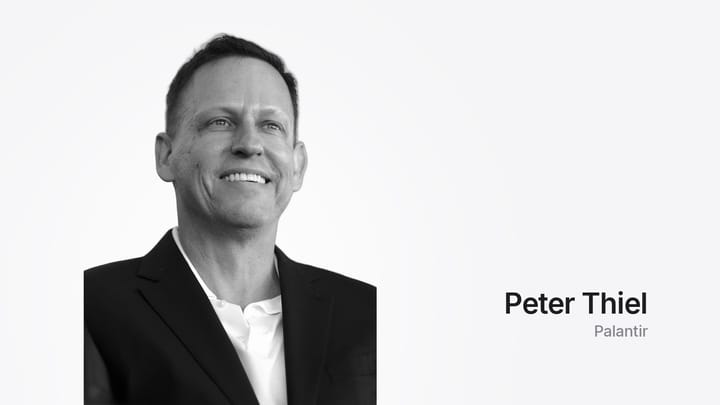

Recorded 24 September 2026 · 65 min
Peter Thiel argues that the alternative to AI is not a calm, slow world. It is a society with no progress, where each generation stops expecting to do better than the last and, in his words, everything "starts to derange." Slowing down is therefore not a neutral choice, and he thinks unilateral Western restraint would mainly hand ground to China.
The interviewer, a German media figure, presses him on AI doom, American anti-AI sentiment, his 2009 line about freedom and democracy, Trump and Vance, Argentina's Milei, Germany's far left and far right, Europe's tech gap, and longevity. Thiel returns repeatedly to one frame: decades of stagnation produced zero-sum politics, and AI is the first force big enough to break it.
The tension is that he calls stagnation proven but says AI is no panacea. He declines to grade Trump, to advise centrist politicians, or to say how Germany recovers. He admits he is not electable.
Stagnation, proven in retrospect — ▶ 0:59
Since the 1970s, progress came in bits (computers, internet, mobile, software) but not atoms. Mechanical, chemical, aerospace and nuclear engineering were already bad fields to study by the 1980s. Thiel ties the slowdown to polarization: when there is a loser for every winner, politics turns zero-sum. The internet drove late-1990s growth but was not big enough to lift civilization. AI may be bigger and could re-accelerate growth. His defense of the thesis: now that AI exists, nobody disputes that decades of stagnation came before it.
No-growth world isn't peaceful — ▶ 5:27
Thiel concedes extinction odds can't be argued down to 0%, and that even 5-10% sounds bad. But "always go slower" does not follow, because a society with no progress on any dimension does not work. The middle class expects its children to do better, and when that intergenerational compact breaks, society derails in strange ways. He rejects the implicit picture of zero growth as a peaceful social democracy. The alternative to AI is far from neutral, and you can never just turn the clock back.
Slowing down helps China — ▶ 7:05
Genuinely slowing AI would need one-world government with real force, which the classical liberal in him calls "a cure that's worse than the disease." The realistic version is fake global governance: conferences and empty statements, while only the West slows. He calls the Pope's anti-AI encyclical a gift to the Communist Party, which won't listen to the Pope while Americans might, making him a "useful idiot." Chinese-seeded anti-AI content is plausible, but Thiel thinks Western sentiment is mainly self-inflicted.
Europe doesn't feel urgency — ▶ 10:57
In Thiel's telling the US is where AI is happening, China is a fast follower and Europe is "extremely far behind." The evidence is commercial. Sales of Palantir, which he has backed for many years, to US corporations have accelerated tremendously as companies rush to get ahead of the curve. In Europe the mood is still inertia: "don't do tomorrow what you can save for the day after." He also warns that without a broad growth story, extreme left and right parties keep gaining ground.
Bad, not evil — ▶ 13:50
The functional antonym of good is bad, not evil. A Ferrari is "evil" because it guzzles fuel; an East German Trabant is bad because it barely works. An evil actor is at least competent. He contrasts Marlowe's Faust, a fake scientist who goes to hell, with Goethe's, whose dubious bargain works out and who is redeemed. He prefers being good, but thinks society is full of badness: if 99% of businesses and political and business leaders are incompetent, that is the problem to discuss. He says we moralize too much.
The Weimar arithmetic — ▶ 16:24
Thiel says his 2009 line that freedom and democracy are incompatible was aimed at libertarians who overrate winning elections, and that he issued a correction two weeks later. Today he sees a real trend against democracy. In 1932 the Nazis and Communists together took over 50% of the German vote, and after that it is almost too late. In Berlin the Linke took 25% overall and 47% of voters aged 16-24. He argues centrist leaders underestimate the scale of the problem. Britain has had seven prime ministers in 10 years.
50% odds on 2028 — ▶ 27:11
Thiel fears the Democratic establishment is as exhausted as the Bush-era Republicans were in 2016. The Democratic Socialists grew from 5,000 members in 1982 to 50,000 after the Sanders campaign, and the median age fell from 66 to 33. He puts the chance of a democratic socialist winning in 2028 at 50%. A Republican wipeout in the midterms would make Democrats indifferent between center-left and far-left candidates. Fukuyama told him "no way." On Trump he says ask in 10 years. He sees mirror-image mistakes: infighting in term one, loyalty over competence in term two.
The deficit trilemma — ▶ 34:13
Argentina fascinates because its past may be the West's future: "riches of Argentina" was once a common expression, and growth was subpar for a century. Thiel rejects Leninist accelerationism, the idea that things must get worse first. He frames three choices: massively cut spending as Milei did, massively hike taxes, or keep borrowing. Since 2008 it has been the third. With interest rates no longer zero, deficits compound. He expects a forced non-centrist outcome, either socialist-level taxation or harsh austerity, and says Merz's best idea is to borrow more.
Concorde or Minitel — ▶ 41:00
Thiel wants Europe to be a reliable ally and rejects moral equivalence between the US and China as offensive. But he stresses it is in America's interest for Europe to be functional. The test is whether European AI in 2026 resembles the Concorde, a state-led effort that caught up in supersonic flight, or the French Minitel, which tried to make the internet French and dug a deeper hole. His assessment is that Europe is further behind than it was on Minitel. Where it is that far behind, it should work with America.
Fear of success — ▶ 44:00
Beyond fear of failure, Thiel suspects German founders fear success: they sell or exit rather than scale like Musk or Zuckerberg. His data point is the 50 wealthiest people in each country. In the US, 12 are Gen X or younger, and 9 of them made their own money. In Germany, 20 are Gen X or younger, and all 20 inherited it. Germany could build great new companies in the late 19th and early 20th century and after 1945, but something broke after 1995. He admits he has no answer.
Longevity and dementia — ▶ 57:30
Thiel calls it a shocking social decline that we stopped believing, as Bacon, Franklin and Condorcet did, that death and disease can be cured. Nixon declared war on cancer in 1971, and 55 years later it is still far from solved. His case for hope: if biology is an information science, its processes may be reversible. He rejects uploading, since identity is physical, and says transhumanism isn't extreme enough by Christian standards. Biotech is "surprisingly difficult," and the single target he wants tackled is dementia.
A world without progress is not a safe harbor. It is the more dangerous option, and Peter Thiel's whole position follows from that. The precautionary instinct says that if the chance of catastrophe is 5-10%, you slow down. Thiel concedes he cannot call the probability zero. But he refuses the implied picture of a calm, social democratic world at zero growth. The real alternative is a society where the promise that children will do better than their parents has broken. Once that compact goes, he says, everything "starts to derange." Doing nothing is itself a choice with consequences.
The argument starts from the stagnation thesis he began making 20 years ago. Since the 1970s, progress came in bits, not atoms. By the 1980s, mechanical, chemical, aerospace and nuclear engineering were already bad things to study. Thiel links that slowdown to a political sickness. When there is a loser for every winner, politics becomes zero-sum and polarized. The internet powered the late 1990s but was not big enough to carry civilization to the next level. AI might be. He has changed his mind only partly, and the change is a kind of vindication. Nobody now disputes that stagnation came before AI. Even so, he adds: "I don't think AI is the panacea for everything."
The obvious objection is that the West could simply slow down. Thiel says that would take a one-world government with real force, which the classical liberal in him calls "a cure that's worse than the disease." What you get in practice is fake global governance: conferences and empty statements. Meanwhile the West restrains itself and China does not. He applies this to the Pope's anti-AI encyclical. The Chinese Communist Party will not listen to the Pope, while Americans might, which makes him a "useful idiot" for Beijing. Thiel is inclined to believe reports that China seeds anti-AI content. He thinks the main driver is something the West is doing to itself.
What happens without growth is where the argument turns political. Thiel points to Germany in 1932, when the Nazis and Communists together took more than 50% of the vote. After that point, he says, it is almost too late. Today the Berlin Linke took 25% of the vote and 47% of voters aged 16-24. Britain has had seven prime ministers in 10 years, each assuming that winning the job was the hard part. Thiel thinks centrist leaders systematically underestimate the scale of the problem. He will not defend the extremes' solutions. But he notes their appeal. Asked about the Linke, he says its pitch can be that nobody else even talks about the problems, which is how he describes his own first step on stagnation.
The same pattern is underway in the US. Thiel notes that the Democratic Socialists grew from 5,000 members in 1982 to 50,000 after the Sanders campaign, while the median age fell from 66 to 33. He puts the chance of a democratic socialist winning in 2028 at 50%. The mechanism is complacency. If the Republicans are wiped out in the midterms, Democrats will assume they win regardless and stop guarding against a far-left nominee. Francis Fukuyama told him "no way." Thiel's answer is that history does not respect that kind of confidence.
Underneath sits a plain arithmetic problem. Welfare states are large, taxes are high, and deficits were only sustainable at zero interest rates. Thiel sees three options: Milei-style spending cuts, massive tax hikes, or more borrowing. For close to 20 years, since 2008, the answer has been more borrowing. He expects that to end in a forced, non-centrist outcome, either socialist-level taxation or tough austerity. Merz's best idea, he says, is to borrow more. That is why he rejects the Leninist idea that things must get worse before they get better. He worries that nothing improves and the West simply drifts, because the people replacing the incumbents have no better answers.
Europe, in this picture, is the clearest case of drift. Thiel is blunt that it is further behind on AI than France's Minitel program was on the internet. The Concorde shows Europe can catch up in a field the US led. Minitel shows what happens when it cannot. He suspects part of the cause is a fear of success, not just a fear of failure. Of the 50 wealthiest Americans, 12 are Gen X or younger, and 9 of those made their own money. Of the 50 wealthiest Germans, 20 are Gen X or younger, and all 20 inherited it. He treats this as a competence failure, not a moral one. Evil actors are at least competent. The bigger problem is a world where 99% of leaders are simply bad at their jobs.
Which is where it gets harder. The chain from stagnation to extremism to AI as the cure has gaps, and Thiel leaves several open. He admits he does not know how to speak about probabilities of AI catastrophe. He declines to grade Trump and says to ask in 10 years. He offers no advice to centrist politicians and no answer on what Germany should do beyond a question to think about. He concedes his own 2009 line was more deranging than stimulating. His central prescription is to talk about the problem and go faster. That leaves unanswered who captures the growth. Thiel says he is not electable and describes politics as "both toxic" and "the air we breathe," something he thinks about a lot and tries to compartmentalize. If AI delivers growth that stays inside corporate budgets, the compact he wants repaired stays broken.
The open question. The causal chain is stagnation, then zero-sum politics, then extremes, with AI as the cure. But Thiel concedes AI is no panacea and offers no mechanism for how its gains become broad enough to repair the intergenerational compact. His only AI evidence is Palantir's US sales. His 50% estimate for a democratic socialist winning in 2028 rests on a stack of conditionals, starting with a Republican wipeout in the midterms. Watch whether AI growth shows up in young people's rents and wages, not just corporate budgets.
Watch the full video at https://www.youtube.com/watch?v=B7yl7fEHeKM.
Comments ()