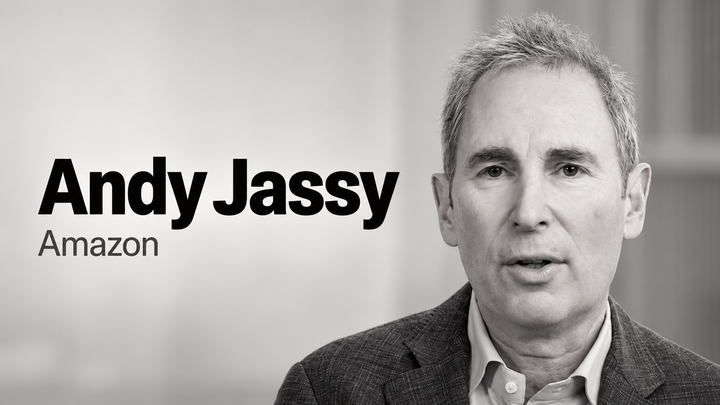
Recorded 23 October 2026 · 60 min
Andy Jassy, Amazon's CEO, says that even with $220 billion of planned capex in 2026 the company is leaving meaningful demand on the table. He says 2026 capacity is sold out, 2027 largely so, and a good chunk of 2028 as well. His defense of that spending rests on how Amazon stages its commitments, not on belief that demand will arrive.
The tension is between that confidence and the shape of the demand behind it. By his own description, usage is concentrated in AI labs and a few runaway apps, while the broad enterprise middle is mostly not there yet. Jassy also acknowledges free cash flow headwinds, and he thinks inference remains an order of magnitude too expensive. The conversation shows what must hold for the buildout to pay off.
Crisis forced regionalization — ▶ 1:53
After Amazon doubled its fulfillment network in about 18 months and built a last-mile network the size of UPS in about 20, cost to serve was well above target. The squeeze forced the company to re-examine closely held beliefs. It replaced a flat national network with regional ones, which shortened transportation distances, lowered cost and sped delivery. Jassy credits that faster delivery with unlocking retail demand and says the problem was a blessing: it prompted changes Amazon would not otherwise have considered for years.
AI growth dwarfs early AWS — ▶ 11:28
AWS began because product teams spent 70-80% of their time on undifferentiated infrastructure and only about 20% on what differentiated their products. AWS was a $60 million annual run rate business after 3 years. Three years into the generative AI wave, AWS's AI business is above $25 billion in run rate, which Jassy calls several hundred times faster. AWS as a whole grew 36.7% last quarter on a $169 billion run rate. These are Jassy's own figures.
Capex staged by reversibility — ▶ 14:13
Data centers must be funded about 2 years before servers can go in, but they are bought once and last about 30 years. Servers and networking gear are bought only months ahead, so Amazon can see demand first and will not buy hardware if it is not needed. That hardware breaks even in about 3 years, lasts 5-6 years, and is mostly sold on 5-year deals. Fast, simultaneous buildout still creates free cash flow headwinds in the early years.
Data center politics rebutted — ▶ 16:34
Jassy calls much of the opposition 'myths and mistruths' and offers rebuttals. Golf courses use 200 times more water than all Amazon's data centers. Backup generators run about 0.1% of the year, roughly 10 hours. Rates in Indiana, Georgia and Mississippi have flattened or fallen. He says the real issue is decades of underinvestment in grids, which AI demand has finally pushed. He cites about $3 billion of tax paid in St. Joseph County, Indiana, and a further $1 billion over 5 years for community programs.
Demand is a barbell — ▶ 21:15
AI demand clusters at two ends. AI labs and a few runaway apps, such as ChatGPT and Claude Code, consume enormous compute. At the other end, enterprises use AI for cost avoidance in areas like customer service, fraud and process automation. Between them sit enterprise production workloads, most of which do not yet use inference pervasively. Jassy expects this middle to become the largest segment, with most enterprise applications using inference within 5-7 years, but says he cannot predict the pace.
Refusing to squeeze core customers — ▶ 24:37
Sold-out capacity and memory shortages force real trade-offs, such as allocating memory between HBM for accelerators and DRAM for core services. Jassy rejects pricing out long-standing core customers in favor of labs that will pay more, because those customers run their businesses on AWS. He cites the pandemic, when Amazon helped customers cut costs despite lost short-term revenue. He expects supply constraints in different components for several years, not only in 2027, and says Amazon is likely adding more capacity than anyone else.
Chips target inference cost — ▶ 28:40
Amazon bought Annapurna Labs in 2015 mainly to offload virtualization, networking, security and storage from EC2 servers. The team then built Graviton, used by 99% of the top 1,000 EC2 customers and about 40% more price-performant than x86, and later Trainium, 30-40% more price-performant than comparable processors. Jassy says inference is still an order of magnitude too expensive for pervasive use. The higher the cost gap, the bigger the benefit required to justify rewriting CPU applications for accelerators.
Investing in customers — ▶ 34:40
Amazon invested in Anthropic and OpenAI, figures the interviewer put at about $18 billion and $50 billion, while also serving both as customers. Jassy's rationale is partnership depth. Anthropic builds on Trainium and made a multi-year, multi-gigawatt commitment, and many customers run Anthropic on Bedrock. OpenAI access answered customer demand that prior arrangements had blocked, and the two built a stateful runtime environment that Jassy thinks agents will need. He did not directly address the dot-com comparison raised by Wall Street.
Smaller, cross-functional teams — ▶ 38:12
A Bedrock team rebuilt an inference engine with 6 engineers in 76 days, work the interviewer said would have taken 40 people a year. Jassy described a weekend in which 4-5 people turned an agreed idea into a prototype that was 80% shippable by Sunday. He predicts fewer humans doing today's work and smaller teams of cross-functional people, since models can supply roughly 80% on many functions. He expects slow-moving incumbents to be more vulnerable to agent-native startups, and new jobs he cannot name to emerge.
Patching in minutes — ▶ 42:55
Jassy argues the nearer-term AI risk is cybersecurity, not sci-fi scenarios. Models find vulnerabilities humans missed, so defenders will have to respond in minutes, whereas today humans classify, patch and slowly deploy. That requires applications rewritten so agents can update code under constraints. He predicts most companies will need to rewrite nearly all their code for this. He mentioned a service called Continuum that finds vulnerabilities and builds patches, though he called the task easier to say than to do.
Incremental AI loses — ▶ 47:31
Jassy says existing products that treat AI as an incremental improvement will probably not win 3-5 years from now. Alexa was the obvious case: generative AI meant its brains had to be rewired, and teams proud of past work resisted starting over. Harder cases are Prime Video, Fire TV, Prime Music and retail, where a better technology solution is less obvious. He says teams are building totally reimagined versions. Whether the new experience arrives as a separate app or is added piece by piece is a race he expects to be interesting.
Andy Jassy's case for spending $220 billion on capex in 2026 rests on sequencing rather than faith. The commitments that are hardest to reverse, he argues, are the ones where Amazon can see demand furthest ahead. Data centers must be funded about 2 years before servers go in, but they are bought once and have a useful life of about 30 years. Servers and networking gear are purchased only a few months before use. If demand does not fill a new building, Amazon does not buy the hardware. On that logic, Jassy says, Amazon could spend a lot more without it being a bad use of capital, and would still not satisfy all demand.
The evidence he offers is demand, and it is striking. By his account, 2026 capacity is sold out, 2027 is largely sold out and a good chunk of 2028 is as well, with some capacity held back for on-demand services. AWS grew 36.7% year over year last quarter on a $169 billion annual run rate. Its AI business passed $25 billion in run rate within about 3 years of the generative AI wave, against roughly $60 million in run rate after the first 3 years of AWS itself. Jassy calls that several hundred times faster. These are the seller's figures, however, and sold-out capacity is only as good as the customers who contracted it.
Jassy is candid that the risk lies in cash timing, not in empty buildings. Servers break even in about 3 years, last 5 to 6 years, and most deals run about 5 years. Building many data centers at once therefore creates free cash flow headwinds in the early years, until the facilities are online and the hardware investment pays back. Cash goes out well before it comes back. It follows, though Jassy did not frame it this way, that the quality of those multi-year commitments matters more than any single quarter's utilization.
Who is buying matters too, because demand is lopsided. Jassy describes a barbell. At one end are the AI labs, consuming "gobs and gobs of compute", along with a few runaway apps such as ChatGPT and Claude Code. At the other end are enterprises using AI for cost avoidance and productivity, in customer service, fraud and business process automation. In the middle are enterprise production workloads. Many already use inference, but the overwhelming majority do not use it pervasively. Jassy expects this middle to become the largest segment of AI usage, and predicts that within 5 to 7 years quite a few, if not most, enterprise applications will use inference pervasively. He says he cannot predict the pace. He also did not say how much of the sold-out capacity sits at each end. So the buildout leans on today's labs, while its largest prize is a forecast.
The hinge for that forecast, in Jassy's telling, is the cost of inference. It has fallen quite a bit in recent years, but in his opinion it is still an order of magnitude too expensive. The reasoning is specific. Moving an application from CPUs to AI accelerators means rewriting it, and the larger the cost gap, the more benefit the rewrite must deliver. Cut the cost and the bar drops, and all applications can become smarter. This is where Amazon's chip strategy fits. Annapurna Labs was acquired in 2015 mainly to offload virtualization, networking, security and storage so nearly all of each EC2 server could serve customers. With Intel holding virtually all CPU share, Amazon found it hard to get attention on price performance, so the team built Graviton. It is used by 99% of the top 1,000 EC2 customers and is about 40% more price-performant than other x86 processors. Jassy sees the same pattern in AI, with one dominant provider, and says Trainium is 30-40% more price-performant than comparable processors.
That is the gap worth noticing. A 30-40% improvement is large by chip standards, but it is not an order of magnitude. Jassy treats chips as one piece of the answer and names others, such as talent comfortable with post-training and fine-tuning, and the organizational muscle to prioritize what to build. He gave no path by which these combine to close a 10x gap, or a date.
Supply adds another constraint. Memory, power and data center capacity are finite, and Amazon must decide how to split memory between HBM for accelerators and DRAM for its core business. Labs may pay almost anything, yet Jassy says Amazon will not squeeze core customers who run their applications on AWS. His precedent is the pandemic, when Amazon helped customers optimize costs even though it knew that would reduce revenue in the short and medium term. The stance is consistent with a long-term view of customers, but it is a policy, not a result. It has not yet been tested against the scarcity he predicts will last several years and span different components, not only 2027.
The investments in Anthropic and OpenAI deepen the dependence on a few large buyers. The interviewer put the sums at roughly $18 billion and $50 billion and noted that both companies are also customers. Jassy explained the rationale as partnership. Anthropic builds on Trainium and made a multi-year, multi-gigawatt commitment, and many customers run its models on Bedrock. OpenAI's models answered customer demand that earlier arrangements had blocked. He did not directly address the dot-com comparison that unsettled Wall Street. A reasonable inference is that investments in customers who also commit to Amazon's chips tie future compute demand closely to those companies' success.
The same logic of staged bets and willingness to rework things runs through Jassy's view of Amazon itself. A cost-to-serve crisis after the pandemic buildout led to regional fulfillment, which both cut costs and sped delivery. Now he expects AI to compress teams, with cross-functional people starting from models that supply roughly 80% on many functions. He predicts fewer humans doing today's work, though he also expects new jobs. He argues that companies treating AI as incremental will lose within 3-5 years, and that security will require rewriting code so agents can patch it in minutes. These are predictions, and Jassy does not claim certainty. The open question is whether the enterprise middle of the barbell arrives on a timeline that matches the capacity being poured today.
The open question. How much of the sold-out capacity belongs to the AI labs rather than to broad enterprise production workloads, and how quickly will enterprise inference become affordable enough to matter? Jassy believes inference is still an order of magnitude too expensive and cites 30-40% price-performance gains from Amazon's chips. He did not explain how the remaining gap closes, or what happens to five-year commitments if the middle of the market arrives later than he expects.
Watch the full video at https://www.youtube.com/watch?v=-YMMRQ1qscI.
Comments ()