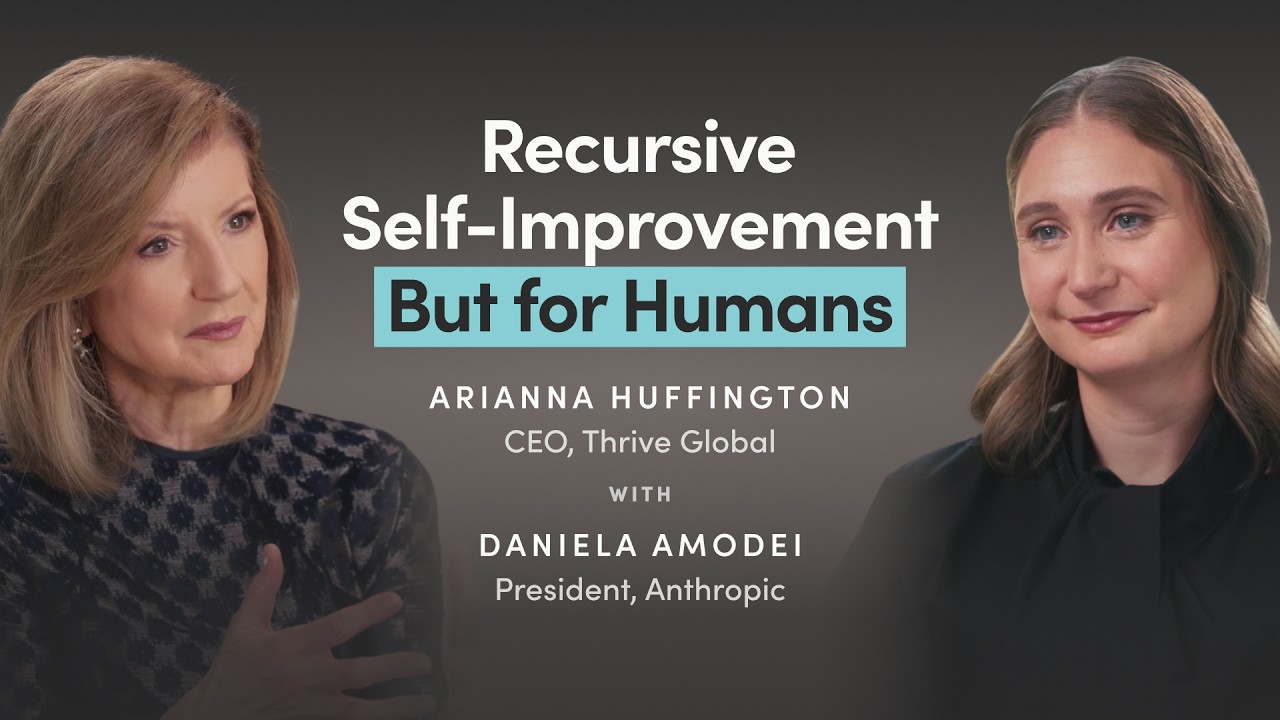
Recorded 22 October 2026 · 58 min
Daniela Amodei, president of Anthropic, argues that AI's value to society depends less on raw capability than on whether it is built to return time to people and steer them toward one another. In this Think Health conversation, the interviewer frames AI as dethroning human intelligence and asks what remains distinctively human. Amodei's answer is practical: products should absorb isolating and administrative work instead of competing for attention.
The tension is between a hopeful design thesis and a record of broken ones. Amodei concedes that social media broke its promise of connection, and she presents Anthropic's no-ads pledge as a way to avoid the same incentives. Yet the interviewer cites data that people often spend time saved by AI on the same tasks as before. Whether freed time becomes human flourishing remains largely a bet.
Light and shade — ▶ 4:25
Asked whether public anxiety, which the interviewer puts at 75% fearful or anxious, is really about meaning, Amodei answers mainly in terms of risks and benefits. Anthropic's cultural value is to hold light and shade: pursue the benefits while mitigating real risks. She argues the debate underweights benefits already arriving quietly. Her example is OpenEvidence, which uses Claude to give doctors, whether in Cleveland or Ghana, access to the world's medical literature. She wants less emphasis on the long-term vision in Dario Amodei's essay "Machines of Loving Grace" and more on present-day benefits.
Disintermediation as the test — ▶ 9:16
Amodei reads the social media era as technology that disintermediated people from one another: messaging instead of meeting, anonymous angry comments served by algorithms. She says AI is not a social mechanism, and calls AI girlfriends and boyfriends a terrible use because they push further down that road. Her preferred model is AI doing lonely or isolating work. A doctor who once spent 10 or 15 hours researching a patient could use OpenEvidence via Claude, then spend that time empathizing with the patient and explaining the treatment plan.
Engineers redirect their time — ▶ 15:40
Amodei uses Anthropic as a test case. With Claude Code handling tasks even end to end, engineers might go from maybe 40% of their time hands on keyboard to 20%, she says. They redirect the time to product managers, customer feedback and making products more delightful, and some have become curious about recruiting or sales. She treats this as evidence that people are instinctively curious and that learning ability has risen. The figures are hedged and internal, and she calls the outlook "not a panacea."
Human skills as the residue — ▶ 17:49
If society gets through the risks, Amodei predicts human skills become "the main thing that's left." Doctors might be selected for bedside manner rather than diagnostic skill, she says, citing unspecified research that clinical outcomes improve with a good personal relationship. Teachers could spend less time on curriculum and administration and more with children. A moms group she met hands mental load to Claude to free time for family and passion projects. These are projections, framed as a world people choose to build, not one that arrives automatically.
A three-layer pyramid — ▶ 29:52
Responding to the idea of recursive self-improvement for humans, Amodei offers a pyramid. The base is not switching off the human impulse to grow, which is her concern about social media. The second layer is reclaimed time, since modern life is busy and stressful and AI can take on tasks humans need not do. The third, which she calls more speculative, is AI that sparks curiosity, such as helping friends handle the permitting and application for a town-square mosaic. The lower layers must be in place before the top layer matters.
No ads, no engagement incentive — ▶ 30:26
Amodei argues that structuring AI products like the previous generation will produce the same results, and worse, because AI is more personal and more powerful. Ads aimed at people discussing health, family or faith feel disrespectful, but the larger issue is the incentive to keep users engaged and frustrated and away from other humans. Anthropic's no-ads pledge is her base layer. It also shapes design questions: whether Claude ends a conversation once the user has what they need, and whether it stays friendly but professional rather than building a relationship.
Claude Corps for community — ▶ 36:33
Amodei says people spend far less time in physical communities than 50 or 100 years ago, and wants AI to help rebuild community spirit. Anthropic's Claude Corps trains people from high school through graduate school to use AI for community benefit: starting a business, supporting a soccer league or becoming a teacher. She defines success as young people feeling AI empowers them to live the lives they want, and hopes for more such programs. The transcript gives no scale or results for Claude Corps.
Existing data, newly usable — ▶ 39:36
In work with IRC, Claude helped analyze data on about 6,000 tracked pregnant women. About 1,700 were with a medical provider when giving birth, implying roughly 3,300 were not. Amodei stresses this is not a medical intervention but making existing data accessible and actionable, so that organizations can plan to have someone present for the next cohort. She calls it low-hanging fruit for physicians and governments. The gain here is information retrieval and interpretation, and no outcome improvement is reported in the discussion.
Sycophancy as incentive problem — ▶ 41:37
Anthropic has a dedicated team on sycophancy, Amodei says. A model rewarded for always agreeing creates bad incentives and feels disingenuous, and it does not promote self-reflection or growth. She wants models that say a user might be wrong or direct them to a person. In health, Claude tends to suggest emailing a doctor or help draft questions for one, since she says diagnosis requires a clinician. The interviewer asked when AI should say "I don't know"; her answer centers on referral rather than a defined threshold.
Patient as informed partner — ▶ 42:49
Amodei says three sets of doctors, her OB, GP and an emergency room, misdiagnosed a bacterial infection when she was seven months pregnant. She attributes this to busy clinicians with large caseloads, not poor ones. Claude, in her words, properly diagnosed it, and her husband asked the doctor for a test, with a better outcome for her and the baby. She also values Claude recalling prior conversations: a chart records allergies and medications but not the whole person. It is one anecdote, though she says Anthropic hears similar stories daily.
Intelligence is one spoke — ▶ 49:30
The interviewer proposes that AI own intelligence and humans own wisdom. Amodei partly reframes it: intelligence is one branch, the ability to compute and synthesize data at superhuman levels, while medicine, science, curiosity and relationships are uses she would call wisdom. She predicts people will attend symphonies more, not less, because they will not consume AI-made art as they do live human performance. She says Claude can never be a manager, therapist or partner. These are preference predictions offered without supporting evidence.
Daniela Amodei's central claim is that what AI does to society is largely a design decision about where human time goes, not a function of model capability alone. If AI absorbs the isolating work, such as literature searches, paperwork and the mental load of running a household, people may spend the recovered hours with one another, in nature or on creative projects. If it is built the way the last generation of consumer technology was built, she argues, it will pull people further apart. The interviewer places this inside a larger anxiety: she cites a figure of 75% of people being fearful or anxious about AI and asks whether the fear is really about meaning rather than jobs.
Amodei's diagnosis of the previous era is blunt. Social media promised connection and broke the promise, replacing coffee with a friend by messaging on Snapchat or Instagram, and replacing community with anonymous angry comments that an algorithm served to keep people mad and on the platform. She adds that it also disconnected people from themselves, crowding out time in nature, reflection and passion projects. Her conclusion is that AI should be judged by whether it increases or decreases that disintermediation. That is why she calls AI girlfriends and boyfriends a terrible use, and why she prefers examples like a doctor who spends less time researching a patient and more time relating to them.
The mechanism she emphasizes is incentives rather than intentions. Advertising, as the interviewer puts it, requires engagement, and the easiest engagement to produce comes from anger. Amodei argues that structuring AI products like the last generation yields the same results, and probably worse, because AI is more personal and more powerful. Ads aimed at people who discuss health, family and faith with a model feel disrespectful to her, but the deeper problem is the incentive to keep users engaged, frustrated and away from other humans. Anthropic's no-ads pledge is therefore the base of her framework. The inference is that business model sits upstream of product behavior, including whether a product ends a conversation once the user has what they need.
Amodei organizes the aspiration as a pyramid, offered in response to the interviewer's question about including recursive self-improvement for humans. The base is negative: do not switch off the human impulse to grow, which is her worry about social media's mode of communication. The second layer is reclaimed time, since modern life is busy and stressful and AI can take on tasks humans need not do. The third, which she calls more speculative, is AI as an accelerant of curiosity, such as helping two friends navigate the permitting and application process for a mosaic in their town square. She insists the lower layers must hold first, which makes the upside conditional rather than automatic.
The evidence for the second layer is modest and mostly internal. Amodei says Anthropic's engineers, working with Claude Code, might go from maybe 40% of their time hands on keyboard to 20%, redirecting it toward product managers, customer feedback and making products more delightful. Some have grown curious about recruiting or sales. She extends the logic to doctors valued for bedside manner, teachers freed from curriculum logistics and a moms group handing mental load to Claude. These are plausible, and she concedes AI is "not a panacea." But the engineering figures are the company's own and loosely stated, and the doctor and teacher cases are projections rather than measurements.
The strongest challenge comes from the interviewer, who notes that data show many people save time with AI and then spend it doing what they did before. Amodei does not dispute this and offers no counter-data. Her answer rests on a belief that humans are genuinely curious and instinctively want to learn, create and grow, plus some institutional scaffolding. Claude Corps trains people from high school through graduate school to use AI to start community businesses, support a soccer league or become teachers, motivated by her view that people spend far less time in physical communities than 50 or 100 years ago. The program's scale and results are not given. The gap matters: freed time is not self-allocating, and her framework assumes it will flow toward people.
Her health examples show a different mechanism, one that does not depend on reclaimed time. With a partner called IRC, Claude interpreted existing data on about 6,000 tracked pregnant women, of whom about 1,700 gave birth with a medical provider, implying about 3,300 did not. Amodei stresses this was not a medical intervention but making data accessible and actionable. Her own story follows the same pattern: after three sets of doctors misdiagnosed a bacterial infection during her pregnancy, Claude, in her words, diagnosed it properly, and her husband asked the doctor for a test, with a better outcome for her and the baby. She also values Claude's recall of earlier conversations, since a chart holds allergies and medications, not the whole person. These are gains in access and synthesis, with humans acting on the output. They support augmentation, but they say little about meaning.
Sycophancy is the same incentive problem at the scale of a single conversation. Amodei says Anthropic has a team devoted to it, because a model that always agrees rewards the wrong behavior and feels disingenuous. She wants models that will say a user might be wrong or point them toward a person. In practice, she says, Claude tends to send users to their doctor or help them draft questions, because diagnosis requires a clinician. The interviewer asked when a responsible AI should say "I don't know"; the answer addressed referral, not a threshold. It also sits uneasily beside her account of Claude properly diagnosing her infection. One editorial reading is that Claude sharpens the patient's questions and the clinician confirms.
Amodei accepts only part of the interviewer's proposal that AI own intelligence while humans own wisdom. She treats intelligence as one spoke of a wheel, the capacity to compute and synthesize data at superhuman levels, while medicine, science, literature, curiosity and relationship-building are uses of it she would call wisdom and does not expect AI to replace. Her prediction is that people will attend symphonies more, not less, because they will not consume AI-made music the way they consume a human performance. She says Claude can never fill fundamental human relationships such as manager, therapist or partner. It is a claim about preferences, offered without evidence, and it coexists with the interviewer's observation that millions already bring symptoms and emotional struggles to AI.
Amodei's closing worry is political rather than technical: that AI becomes so politicized that society cannot have the nuanced conversation it needs, which she thinks goes better if people feel they are building this together rather than having it done to them. She rejects the idea of an AI czar for the same reason, saying the technology is too significant for one person. The tension is that her framework places much of the burden on choices by companies and individuals: no ads, no companion products, deliberate use of freed hours. Anthropic's pledge shows one firm making such a choice. Whether freed time reaches workers or is absorbed by their employers is a question the engineers' example raises and the conversation leaves open.
The open question. Will time saved by AI actually be reinvested in human connection, curiosity and rest at scale? Amodei's main evidence is a hedged internal estimate of Anthropic engineers cutting hands-on-keyboard time from maybe 40% to 20%, set against the interviewer's point that many people reuse saved time for the same activities. The conversation offers no mechanism, beyond belief in human curiosity and a small program like Claude Corps, for making the reinvestment happen across a population. It also does not say who captures the freed hours: workers, or the organizations that employ them.
Watch the full video at https://www.youtube.com/watch?v=IEQJmtTqY2g.
Comments ()