
Recorded 21 June 2026 · 80 min
The companies that change the physical world may end up bigger than the ones that change the digital one. That is the bet behind Applied Intuition, which puts intelligence on cars, trucks, tanks and drones, and which already does 70% of its business outside automotive.
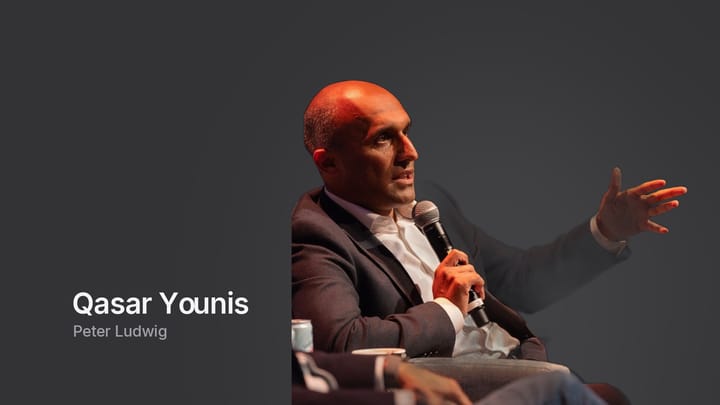
Qasar Younis and Peter Ludwig sit down with two early investors on the day of the company's biggest launch, Dana, a platform meant to let a high school kid build an autonomous system. Along the way they walk through mining, trucking, ports, defense and the economics of self-driving.
The tension is speed against reality. Buyers run on 20-25 year asset cycles and thin margins, regulators react to single accidents, and Cruise shows how fast a program can die inside a large manufacturer. Younis argues the technology is no longer the question. Cost, trust and distribution are.
Physical may outgrow digital — ▶ 3:03
Looking back 25 years at the internet, the early names were surveying and analytics companies. The monoliths that came of age were Amazon, which delivers you stuff, and Apple. Younis expects the same sorting in the intelligence revolution. Companies that impact the physical world "might actually be bigger" than those that impact the digital world. Digital AI means building software, optimizing ads and making videos. Physical AI means manufacturing, mining, logistics, transportation and supply chains, which is where the global economy sits. The mission is intelligence on a billion machines.
Cars are the minority — ▶ 4:00
Automotive is already about 30% of Applied Intuition's business, so 70% is non-automotive. In 10-20 years even manufacturers as a customer base will be a small share. Cars are "just an easy one" because everyone drives, but at roughly 3% of global GDP a minority share is still huge. Manufacturers were originally the distribution channel to consumers. Defense, construction, mining and agriculture have made mining operators and the Department of War customers in their own right.
Retrofit first, then redesign — ▶ 6:02
Haul trucks, port equipment and mine dirt movers are built to last 20-25 years. Owners have not earned back their ROI, so they will not buy new however much better it is. Step one is making those machines intelligent. Step two is removing the cab: underground the human is the constraint because humans need to breathe, so machines can be smaller and shaped differently. The bigger unlock is system-level intelligence across a port, mine or quarry, where a mixed fleet talks and one failure does not halt the rest.
The labor math — ▶ 7:44
The average American farmer is 58, and fewer than 10% are under 35. Demand for food and rare earth materials keeps rising while the humans who bottleneck them shrink in number. Trucking is the same. Younis asks what happens if freight drops from a few dollars a mile to 20 cents, and food gets cheaper downstream. The unlock is large, and it does not require every machine to be redesigned from the ground up.
A boring AI company — ▶ 8:48
Applied has north of 1,000 engineers and is 83% engineering. Younis says it wins by making great products, and that it is not good enough at sales to be a sales-enabled company. The staff include safety and hardware specialists because everything must meet the real world. Models have been deployed on 50-some platforms, with no iOS or Android to abstract the hardware. The company has raised about $1 billion, all of it "sitting in the bank", with an asterisk: it may spend it next month. The open choice is how aggressively to chase giant markets.
Sovereignty will fracture physical AI — ▶ 10:50
Progress is not just robotaxis and humanoids. Ports and other nooks matter as much. Younis uses the internet arc: a browser that went everywhere, then China blocking Facebook, then local players favored against Uber and DoorDash. Waymo from America and Pony from China both meet hesitation in third countries. Physical AI means defense and moving machines, so he expects fracturing over globalization and demand that AI be localized. Applied is a technology provider with no China office. He calls the issue understated.
Private data is the entry fee — ▶ 13:21
Digital foundation models train on the internet. Physical ones need private data from mines, logistics and similar fields, so Applied collects it itself. It runs one of the largest data collection fleets on the planet and holds hundreds of petabytes. It has secured permission to collect proprietary data in places like Korea, where mapping companies are not even allowed, and across the Middle East and Latin America. Because physical models cannot diffuse through a phone, that works in Applied's favor. Safety evaluation, such as a humanoid falling on children, is where state of the art is being proven.
Imitation gave way to closed-loop RL — ▶ 16:59
Applied started a synthetic data team more than 5 years ago and says synthetic data accelerates autonomy. Transformers hit self-driving hard. Imitation learning, copying human drivers, has given way to end-to-end reinforcement learning in a closed loop. The system finds where it fails, then finds or synthesizes similar data and retests. Younis expects a fully closed loop with no humans in some years. Real-world errors remain, from overheating to miscalibrated sensors to fog on a sensor, and these gnarly hardware problems decide reliability.
Why Cruise really died — ▶ 24:56
A person was dragged 20 feet, and General Motors pulled the plug. Younis says large manufacturers behave like extensions of the state, and he stresses the executives are not stupid. Union negotiations were running that year, so a union that cannot get a billion dollars is hostile to a program accused of hurting people. Cruise did not "dance exactly right" with the government, which gave bureaucrats ammunition against a big target. Robotaxis also clash with GM's profits from personal ownership. He calls it multivariate and does not claim to know exactly what happened.
Horizontal, like a chip maker — ▶ 28:20
Applied's hypothesis is to let manufacturers handle distribution. Self-driving trucks run commercial loads in Japan, with safety drivers, under the Isuzu brand. Isuzu is nearly 100 years old and knows its trucks, test tracks and regulators. Younis says Applied walks like a silicon company: design wins, long relationships, and once it is in, it is hard to remove. Caterpillar buys Cummins engines and nobody calls it a bad company. Tesla and Waymo are vertical. Automakers range from build to buy, and Applied sells tools to builders and intelligence to buyers.
Cost, not competence, delays cars — ▶ 35:40
Tesla's L2 stack costs under $1,000. Around $500, Younis expects automakers to subsidize it to free, as happened with navigation systems that once cost $3,500-4,000. Every OEM, without exception, is working on an FSD competitor. His timeline is start of production around 2029-30, with systems cheap to free by the early 2030s. Automakers want a price envelope that protects thin margins across 100-plus countries in version 1. A Suzuki buyer has different expectations from a Tesla buyer. The mobile phone arc, wait then ubiquity, is his analogy.
Tesla versus Waymo is engineering — ▶ 38:27
Waymo is not one end-to-end model. It leans on HD maps and geofencing, and its research-lab origin left it with bespoke, expensive sensors and compute. It is easier to add features to something cheap than to trim something overbuilt. Who gets there first, Tesla or Waymo, is the live debate. No breakthrough is needed, and what remains is a grind down to dollars per mile. Robotaxis should be available in the 200 biggest US cities by 2030 and routine by 2032-33. Younis says Uber should be scared.
Trucking is a calculator business — ▶ 42:24
North of 5 US companies run long-haul trucks with drivers, and China is in double digits. You buy a car with your heartstrings and a truck with a calculator, so sellers must prove savings every mile. Japan was chosen for its labor shortage and imploding demographics. Quarry owners want it today. The jobs are poor: 4-8 days away from family, and mining is 1% of the labor pool but 8% of work-related fatalities. Driver-out is "a few years" away. Fully redundant steering and braking are not yet in high-volume production.
Dana lowers the barrier — ▶ 50:00
Dana is an agentic platform for physical AI, named for the street Applied sits on. The pitch is that a ninth grader could make a delivery robot. They define requirements, generate scenarios from a satellite image, train on public data like YouTube, deploy, watch it hit a wall and close the loop. Workflows that took days or weeks run in minutes. Younis compares it to the iPhone, whose early hits were beer and fart apps. He is fine with enabling competitors, citing how Google thrived while others learned from open source tools.
The moat is real-time constraints — ▶ 1:01:14
World models mean about 100 different things. The spectrum runs from physics-based simulation with technical artists, through Gaussian 3D scenes, to purely neural video generation that reacts but is not guaranteed accurate. Perfect alignment with reality "solved the universe". Labs can run trillion-parameter models slowly. Physical AI works in real time, with milliseconds, safety and determinism constraints, so onboard models must be much smaller. That is the moat. Younis guesses Grand Theft Auto 6 will be the last major game built with legacy graphics tooling, and GTA 7 will be world-model based.
The physical economy is running out of people, and that makes autonomy a necessity rather than a convenience. The average American farmer is 58. Fewer than 10% are under 35. Demand for food keeps growing, and so does demand for the rare earth materials that mines produce, but the humans who bottleneck both are shrinking in number. Trucking follows the same curve. Qasar Younis, who runs Applied Intuition, does not treat this as a hiring problem that better pay will fix. Mining is 1% of the global labor pool and 8% of work-related fatalities. Australian mines and offshore rigs offer six figures and still struggle to fill roles. Long-haul drivers are away from their families for four to eight days at a stretch, and even truckers do not want their kids to follow them. His reading is that people are choosing, and the market is telling you something.
Price is where the prize shows up. Younis asks the listener to imagine freight moving at 20 cents a mile instead of a few dollars, and food getting cheaper downstream. In digital AI, accountants and venture associates worry about their jobs, and the pushback is loud. In his corner, he says, the pressure runs the other way. Quarry and mine operators tell him that if Applied can do it, they will give it everything. He says those buyers want it today and the constraint is how fast his side can ship. Japan is the proof of pull. A massive labor shortage and an imploding demographic are why Applied runs self-driving trucks there, with safety drivers on board, carrying commercial loads.
That raises the question of who captures the value. Applied's answer is to be horizontal. Automotive is already 30% of the business, and Younis expects manufacturers to shrink to a small share of customers over 10 to 20 years. Cars are, in his words, "just an easy one." They stick in people's heads because everyone drives. They are also about 3% of global GDP, so a minority share is still large. But mining operators and the Department of War now sit alongside manufacturers as customers. Younis describes the company as a silicon company that does not make chips. It wins designs, builds long relationships, and once it is in, it is hard to remove. The trucks in Japan carry the Isuzu badge, not Applied's. Isuzu has the test tracks, the government relationships and nearly 100 years of knowing its own machines. Younis compares it to Cummins. Caterpillar buys engines from them, and nobody concludes Caterpillar is a bad company. Tesla and Waymo are vertical. Applied sells to builders as tools and to buyers as finished intelligence, and it meets each automaker wherever it is on that spectrum.
The installed base dictates the product. Haul trucks, port equipment and mining dirt movers are built to last 20 to 25 years. Their owners have not earned back the investment, so they will not replace them however much better the new machine is. The first job is therefore making existing machines intelligent. The second is designing machines with no cab at all. Underground, the human is the constraint, because humans need to breathe and the work is dangerous. Remove the human and the machine can be smaller and shaped differently. The third job is system level. A whole port, mine or quarry runs a mixed fleet that talks to itself, so one breakdown does not halt the rest. Human-driven machines are not plugged into their own systems, so nobody knows a brake is about to fail. Predicting that alone is worth a great deal.
The obvious objection is that self-driving has been imminent for 20 years. Why is it not here? Younis says the answer is mostly cost, then institutions. Cruise is the cautionary case. It was moving faster than Waymo, was bought by General Motors, and then one accident, a person dragged 20 feet, ended it. Younis offers context rather than blame. Large manufacturers behave like extensions of the state. Union negotiations were underway that year, and a union that cannot get a billion dollars is unlikely to love a program accused of hurting people. Cruise also did not handle the government exactly right, which hands bureaucrats ammunition against a big target. Robotaxis do not fit a company that earns its profits from personal ownership either. He calls the whole thing multivariate and insists the executives are not stupid.
Cost then sets the pace for everyone else. Tesla's L2 stack costs under $1,000 for chip, sensors, package and software. At around $500, Younis expects automakers to give it away, as they did with navigation systems that once cost $3,500 to $4,000. Every OEM, without exception, is building an FSD competitor. Start of production lands around 2029 to 2030, and by the early 2030s you simply assume the car drives itself. Automakers resist on price envelopes and thin margins across 100-plus countries in the first version, not on technical grounds. A Suzuki buyer is not a Tesla buyer. Robotaxis follow a different path. Waymo leans on HD maps and geofencing, and its research-lab origins left it with bespoke sensors and compute. It is easier to add features to something cheap than to trim something overbuilt. Which wins is the live debate. What is not debated, he says, is whether it happens, or whether a breakthrough is needed. What is left is a grind down to dollars per mile. He puts robotaxis in the 200 biggest American cities as available by 2030 and routine by 2032 or 2033.
Technically, the difficulty sits where the digital world escapes it. A language model can train on the internet. A physical model needs private data from mines, ports and logistics, and nobody has it lying around. Applied runs one of the largest data collection fleets in the world and holds hundreds of petabytes. It has negotiated access in places where an American company normally cannot collect, from the Middle East to Latin America to Korea, where even mapping companies are barred. Because physical models cannot diffuse through a phone, that closed access works in its favor. The method has moved from imitation learning to end-to-end reinforcement learning in a closed loop. The system finds its own failures, finds or synthesizes similar data, and retests. Humans are still in the loop. Hardware reminds you why: overheating, a miscalibrated sensor, fog on a sensor the day before the interview. The hardest constraint is time. Labs can build trillion-parameter models that run slowly. A machine has milliseconds, determinism and safety limits, so the onboard model must be far smaller. Applied calls that the moat.
There is a geopolitical layer too. Waymo from America and Pony from China both find other countries hesitant to wave robotaxis in. The internet arc went from a browser that went everywhere, to China keeping out Facebook, to local players favored against Uber and DoorDash. Younis expects physical AI to be the sharpest case, with fracturing instead of globalization and demand that AI be localized. He calls the issue understated.
That is the context for Dana, the platform Applied is launching. The pitch is that a high school kid who can make iPhone apps should be able to make autonomous systems. Younis says there is "no reason autonomy should be this obscure, difficult technology." The walk-through is a ninth grader defining a delivery robot for four campus buildings, generating scenarios from a satellite image, training on public data, deploying, watching the robot hit a wall, and closing the loop. Dana is an agentic platform, and nearly a decade of tools is inside it. Workflows that took days or weeks now run in minutes. The analogy is the iPhone. Nobody in 2005 could picture Instagram, and the early hits were beer and fart apps. When development cost falls toward zero, people build things nobody planned for.
The strongest objection is to the business logic. The chip-maker analogy depends on lock-in. Yet every automaker is working on its own self-driving stack, the ones that want to build get Applied's tools, and Dana puts the same tools in anyone's hands, competitors included. Younis is untroubled. Google thrived on search and YouTube while others learned from open source products, then closed source, then venture-backed ones. That is an analogy, not an answer. Other answers are soft. Asked how long safety drivers will stay in long-haul trucks, he says a few years, without going into Applied's own details. He adds that fully redundant steering and braking are not yet in high-volume production. The company has raised about $1 billion and says it is all in the bank, with an asterisk: it may spend it next month. It is also 83% engineering and, by its own admission, not good enough at sales to be a sales-enabled company.
If a ninth grader can build the system, the moat has to be somewhere else. Applied says it is in the constraints: real time, safety, determinism, validation and data nobody else collected. That may be right. Whether it holds when every automaker and a well-funded Waymo are building toward the same place is the part nobody tested in this conversation.
The open question. The chip-maker analogy depends on lock-in, yet every automaker is working on its own self-driving stack, and Dana hands the same tooling to anyone, competitors included. Younis answers with Google's history on the web, which is an analogy and not an argument. If a ninth grader can assemble an autonomy system, the moat has to sit in real-time constraints, safety validation and proprietary data. Nobody tested whether that holds once the automakers and Waymo spend their way to the same place. Watch whether Dana's early adopters are customers or rivals.
Watch the full video at https://www.youtube.com/watch?v=56XgWH9ch0U.
Comments ()