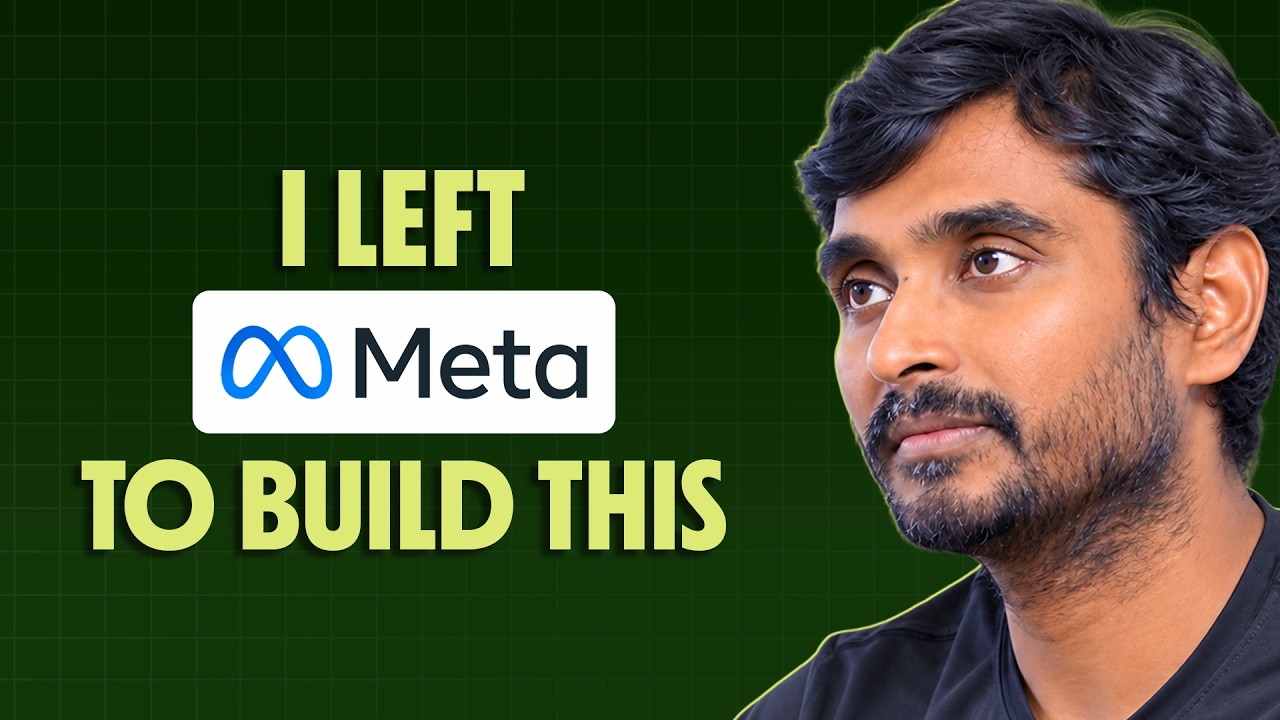
Recorded 23 October 2026 · 85 min
Manohar left a VP role at Meta a few weeks ago to become founder and CTO of Warp. His core argument is that AI progress tracks verifiability. Code and math fell quickly because outcomes can be checked automatically, while the physical world offers no equivalent loop. Warp is his attempt to build one, starting with wet-lab automation for small-molecule drug discovery. The host, Siddharth of Neon, is an investor in the company.
The discussion tests how far that thesis reaches. Manohar accepts that the frontier's general intelligence keeps absorbing application-layer work. He argues open ecosystems win the long arc, yet closed models will likely keep leading on capability, and he defines sovereignty as capability rather than ownership. The unresolved tension is whether chemistry, where verification takes a week or more, can follow the curve that code did.
The missing physical loop — ▶ 4:56
Manohar says the next bottleneck is not a bigger model but learning from reality at the atomic level. A model forms a hypothesis, acts on a physical instance, observes the result and learns, and that loop "hasn't been built yet." Code, math, chat, enterprise agents and personal assistants were all built without atoms in the loop. He frames leaving Meta as a choice of problem over position. His stated conviction is that the most learning will come from models acting in physical space, with video-to-sim and real-to-sim-to-real gaps as the current obstacles.
Verifiability explains coding's speed — ▶ 8:34
Models went from early promise on code to people coding "in English" within about a year. Manohar attributes this to verifiable loops: reinforcement learning rollouts can be unrolled, code can be compiled, and Lean lets math proofs be checked. Progress then becomes "a matter of computation" plus self-play-style improvement. The real world lacks this, and its loop is bottlenecked by humans, atoms and long lead times. Editorial inference: domains where verification can be automated are the likeliest to move next.
Why wet labs stall learning — ▶ 9:47
A designed small molecule must be made in a wet lab, following roughly 10 steps, by a chemist who works about 8 hours and then sleeps. Few chemists can run the precision equipment. Results arrive after a week or two as LCMS spectrography and may not be digitized. In materials science, a 1% change in composition yields a different material, forcing repeats. His counterfactual is foundation models for target selection, robots plus humans running 24x7, and riskier hypotheses, which would turn a data-poor domain into a data-rich one.
Beyond personal assistants — ▶ 12:34
Manohar does not call personal assistants trivial, since he uses them daily, but says shopping and travel planning scratch the surface and may not be AI's ultimate benefit. What changed his mind is math proofs he calls "almost field medal quality," though he concedes he is not a math expert and a debate is raging. His inference is that enough compute, a good starting seed and a verifiable domain can yield discovery. He hedges that models may only help humans discover rather than discover alone.
Harnessing a growing nucleus — ▶ 15:45
The frontier's expanding capability is real, Manohar says, because each new model simplifies customization built on the last. His test for application builders is whether cost, efficiency and speed improve with each model. Teams should avoid an "impedance mismatch" where every new model forces re-engineering, and should compete where they hold unique data and iteration speed from subject expertise. The alternative is betting on a new paradigm, such as world models whose simulations serve as RL rollouts. He treats the two as an explore-exploit balance that must not be confused.
Open ecosystems, closed frontier — ▶ 19:08
Open ecosystems win the long arc, he argues, through exploration parallelism: people take parts of a full engine, innovate, and others learn from it. PyTorch lacked TensorFlow's feature parity at the start but grew developers exponentially as its core improved. Open weights are not open source, though, since users cannot pretrain from random weights. Closed models will probably lead in capability, reliability and readiness, while open weights offer control and sovereignty at a capability cost. He also argues cybersecurity needs frontier models in the loop, so safety must be navigated before fully opening.
Distribution versus captured value — ▶ 24:11
Siddharth argues closed ecosystems such as Apple and Tesla capture the most economic value. Manohar concedes that depends on the metric: Android runs on more devices, but market cap favors closed. If a technology's core value is democratization, open wins; if it is easy, reliable packaging, closed wins, and he would accept closed for commoditized technology. He endorses the host's summary that open gets distribution while the frontier captures value. Closed models stay ahead through compounding loops, he says, unless a new paradigm overturns the current one.
Paradigm shifts reset leaders — ▶ 27:38
Speech was considered nearly solved in the 1990s using MFCCs, and computer vision relied on handcrafted features until AlexNet in 2012. Manohar calls LLMs to VLMs to VLAs to world action models iterative improvements, not paradigm shifts, which would force a restart with new scaling laws, datasets and skills. His evidence for speed: a GPU he assembled on his desk at Facebook, because data centers held only CPUs, has roughly 20 times its flops in a phone about 12 years later. He frames decisions as "what if" questions: 10x better hardware, learning or serving cost.
Sovereignty as capability — ▶ 31:32
Sovereignty driven by imitation fades once economics favor the better product, Manohar argues, while sovereignty framed as innovation sustains motivation, as in the Cold War. He would measure it by whether a country can build what it needs at every layer: a sovereign model is meaningless without hardware, and hardware without adoption loops. Siddharth counters that India's closed era pre-1991 gave consumers little choice. Manohar, saying he is not an economist, replies there is no clear equilibrium. He proposes serving users globally and enabling healthy participation, drawing sector-specific lines, with autonomous-vehicle security as a case for closure.
Launching on X — ▶ 39:36
Frontier launches have moved to X because it lets companies read the first reactions and adapt in real time, he says. He cites a recent Meta launch where inference problems were found and fixed publicly, shifting the conversation away from model quality. His caveat is that "perception leads reality, but reality catches up," so X fine-tunes a launch rather than defines it. Math results launched where the math community was absent produced a one-sided debate, and the real requirement is "meat on the bone."
Spot, learn, leap, deliver — ▶ 44:02
Manohar's decision cycle is to spot a bottleneck, learn from experts with humility, take a leap without second-guessing, build with a high bar for talent, and deliver something real people use, not a demo, paper or patent. In robotics, hours with experts convinced him that dexterous manipulation is the key bottleneck and "hand is the ultimate frontier." He says a chatbot could state that conclusion, but not convey the assumptions experts live with. He admits his 2009 bet that robotics would be mainstream by 2014 was wrong by more than a decade.
Disagreeing with LeCun — ▶ 49:05
Yann LeCun, Manohar says, has held for two decades that existing paradigms have limits, and he favors giving research labs freedom and resources and leaving them alone. Manohar disagrees: he prefers multidisciplinary teams of researchers and engineers with audacious goals and milestones, and says both models can produce strong results. From Mark Zuckerberg he learned to simplify a space to its core after mastering its detail, citing the Instagram acquisition that staff doubted. He judges leaders by their frameworks rather than outcomes, and says Zuckerberg's boldness could push products out faster than they are ready.
Making discovery compound — ▶ 1:01:19
Kevin Weil, formerly OpenAI's CPO, told Manohar that wet-lab automation was the bottleneck in a data-poor domain, and Saul Rosenberg, now chief science officer, argued for a small-molecule focus. Manohar describes small molecules as a small part of the discovery pipeline. His success metric goes beyond faster drugs to new compounds per week per chemist, so lead optimization is not chemistry-bound. The ultimate goal is to "make discovery compound" with each experiment run by humans, robots or both. He chose this start because physical intelligence is rudimentary but maturing fast.
Making the elephants dance — ▶ 1:06:53
Asked how Warp will move pharma at its pace, Manohar says the answer is solving a fundamental bottleneck so the whole industry gains an incentive to do more. He expects foundation models, having penetrated code and math, to eventually reach chemistry and biology. He names the obstacles himself: a geopolitical question over whether to onshore wet labs, incumbents that prefer someone else take the risk, and whether to add antibody data to small molecules. He offers no resolution, only the stated aim of "scientific super intelligence" built with partners, existing companies and new ones.
Manohar's central claim is that AI improves fastest where outcomes can be checked cheaply, and that the physical world is the largest domain where they cannot. Code is his proof case. By his account, people sensed something one Thanksgiving, progress was evident by summer, and by the next Thanksgiving he no longer wrote code except in English. The reason, he says, is verifiable loops. Reinforcement learning rollouts can be unrolled, code can be compiled, and Lean lets proofs be checked. Once a domain has automatic verification, progress becomes "a matter of computation." This is a causal claim about speed, not a forecast about capability, and the rest of his argument rests on it.
The real world lacks that machinery. His example is drug discovery. A chemist who designs a small molecule through retrosynthesis must make it in a wet lab, following roughly 10 steps, in work that pauses when the chemist sleeps. Few chemists can operate the precision equipment. Results arrive after a week or two as LCMS spectrography output and may not even be digitized. In materials science, a 1% difference in composition produces a different material, forcing repeated experiments. Each turn of the loop is slow, manual and low-bandwidth. The model cannot self-play against chemistry. He says the loop is "bottlenecked by humans, bottlenecked by atoms, bottlenecked by very long lead times."
His proposed remedy is infrastructure rather than a bigger model. Companies would use the best foundation model to choose targets, deploy autonomous robots with humans in the loop around the clock, and, because the system is efficient, test riskier hypotheses. The result, in his words, is that "the data poor domain becomes a data rich domain." These are conditionals, not demonstrated outcomes. The stakes he names are concrete: a patient receiving a drug 3 months earlier, or drugs personalized by age, genome and culture. His framing reverses a common assumption. As frontier models scale, he says, the missing piece is the "new age infrastructure" that lets them learn from experiments, not more compute alone.
That logic explains his answer to the host's suggestion that data centers should not be wasted on trivial things. Manohar declines the framing. He uses personal assistants daily and does not call them trivial, but says shopping and travel planning are "scratching the surface" and he is not confident they are AI's ultimate benefit. What shifted his view was math, where he cites proofs that are "almost field medal quality." He is careful, noting he is not a math expert and that a debate is raging. His inference is that compute, a good seed and a verifiable domain can yield discovery. He also allows that models may only help humans discover rather than discover alone.
Here the argument's evidence and its goal diverge, and it is worth saying so plainly. The strongest proof that models can innovate comes from math, a domain where verification is cheap and fast. The domain Warp targets is one where, by Manohar's own description, verification is expensive and slow. The case for chemistry therefore depends on engineering that has not yet been shown: shrinking wet-lab feedback toward something resembling a compiler. This is an editorial reading, not his concession, but his framing invites it. He presents the loop as the thing that has to be built, which is what makes it a company rather than a prediction.
Outside Warp, the same lens shapes his advice on whether the frontier will absorb everything around it. He accepts that the nucleus is growing, since each new model simplifies customization built on the last. His test for builders is practical. Do cost, efficiency and speed improve for your application? Is your architecture such that a new model helps rather than forcing re-engineering, which he calls an "impedance mismatch"? Do you hold unique data and iteration speed from subject expertise? The alternative is a different paradigm, such as world models whose simulations serve as the rollout. He treats these as an explore-exploit balance and warns against confusing them. Warp arguably does both: it uses frontier models while building a physical data generator.
On open versus closed models, his position is more layered than the slogan that open ecosystems win. The mechanism he gives is exploration parallelism. In an open ecosystem, users take parts of a full engine, adapt them and others learn from the result. PyTorch lacked TensorFlow's feature parity at the start, yet its developer base grew exponentially as its core improved. But open weights are not open source, because users cannot pretrain from random weights. Closed models, funded for the scaling ladder, will probably lead on capability, reliability and readiness. Open weights offer control and sovereignty at a capability cost. He adds that safety work must keep pace, because cybersecurity will need frontier models in the loop.
Siddharth's strongest challenge came here: closed ecosystems such as Apple and Tesla capture the most economic value. Manohar concedes that the answer depends on the metric. Android runs on more devices, but market cap favors closed. If a technology's value is democratization, open wins; if it is easy, reliable packaging, closed wins, and he would accept closed for commoditized technology. He agrees with the host's summary that open wins distribution while the frontier captures value. Read carefully, then, his claim that open ecosystems win concerns adoption, not profit. Closed labs stay ahead through compounding loops, he says, because models in the loop help build the next version, unless a new paradigm breaks that.
That qualification is why paradigm shifts matter to him. He points to speech in the 1990s, considered nearly solved with MFCCs, and to computer vision, which relied on handcrafted features until AlexNet in 2012. Later steps, from LLMs to VLMs to VLAs to world action models, he calls iterative improvements rather than paradigm shifts. A real shift forces a restart, with new scaling laws, datasets and skills. His hardware example is personal: he once assembled a GPU on his desk at Facebook because data centers held only CPUs, and a phone now holds roughly 20 times its flops, about 12 years later. His working method is to ask what happens if hardware, learning or serving cost becomes 10x better.
His view of sovereignty follows the same pattern of asking what is durable. Sovereignty as imitation, he argues, fades when economics favor the better product. Sovereignty as innovation, as in the Cold War, sustains motivation because a team wakes up with an identity and wants to win. He would measure it by whether a country can build what it needs at every layer, since a sovereign model means little without hardware and hardware means little without adoption. Siddharth countered with India's pre-1991 era of two cars, and with what he had heard about the US blocking BYD and China's closed market. Manohar called the equilibrium unclear, saying he is a technologist, not an economist. His rule is to draw the line sector by sector.
The same preference for frameworks over outcomes appears in how he describes his own decisions. His cycle is to spot a bottleneck, learn from experts, leap, build with a high bar and deliver something real people use. In robotics, conversations with experts led him to conclude that dexterous manipulation is the key bottleneck and "hand is the ultimate frontier." He admits his 2009 bet that robotics would be mainstream by 2014 was wrong by more than a decade. The cycle also describes how Warp formed. Kevin Weil, formerly OpenAI's CPO, flagged wet-lab automation. Saul Rosenberg, now chief science officer, argued for a small-molecule focus. DJ Patil is chief operating officer, and Manohar is CTO.
The same frameworks-over-outcomes habit shows in his account of working with two prominent figures. Yann LeCun, he says, believes existing paradigms have limits and favors leaving research labs alone with freedom and resources. Manohar disagrees and prefers multidisciplinary teams of researchers and engineers pursuing audacious goals, while saying both approaches can work. From Mark Zuckerberg he took the habit of mastering a domain's detail and then simplifying it to the core for strategic decisions. He cites the Instagram acquisition, which staff doubted. He is candid that Zuckerberg's boldness can push products out faster than they are ready. On his own disagreements with the Meta CEO, he declined to specify any.
Warp's stated metric is deliberately larger than faster drugs. Manohar wants new compounds per week per chemist at a scale where lead optimization is no longer bottlenecked by chemistry, and ultimately wants discovery to "make discovery compound" with each experiment done by humans, robots or both. He starts with small-molecule lead optimization because physical intelligence is rudimentary but maturing fast. The interview was not adversarial toward the company. Siddharth's firm Neon is an investor, and Manohar thanks it and names Lightspeed as the main investor. The one sharp question, about pharma moving at Warp's pace, drew a candid answer: unlocking the bottleneck creates an industry-wide incentive, though incumbents may prefer others take the risk.
The unresolved issue is whether the code analogy transfers. Code improved because verification was fast, cheap and automatic. Manohar's own account of chemistry has verification taking a week or two, requiring scarce operators and possibly undigitized outputs. Round-the-clock robots may help, but he offers no baseline for compounds per week per chemist and no evidence yet of how far the cycle can shrink. He is also modest about forecasts. When Siddharth predicted that the top 5 companies would be labs within a decade, he replied that financial predictions are mostly wrong, and held only that the most learning will come from models acting in physical space.
The open question. Code improved quickly because verification was nearly instant and automatic. Wet-lab verification, by Manohar's own account, takes a week or two, needs scarce operators, and may not be digitized. Can round-the-clock robots with humans in the loop shrink that cycle enough to produce reinforcement-learning-scale data? The conversation offers a metric, compounds per week per chemist, but no baseline, no target and no evidence yet that the physical loop will compress the way the code loop did.
Watch the full video at https://www.youtube.com/watch?v=d78Buj5rWuA.
Comments ()