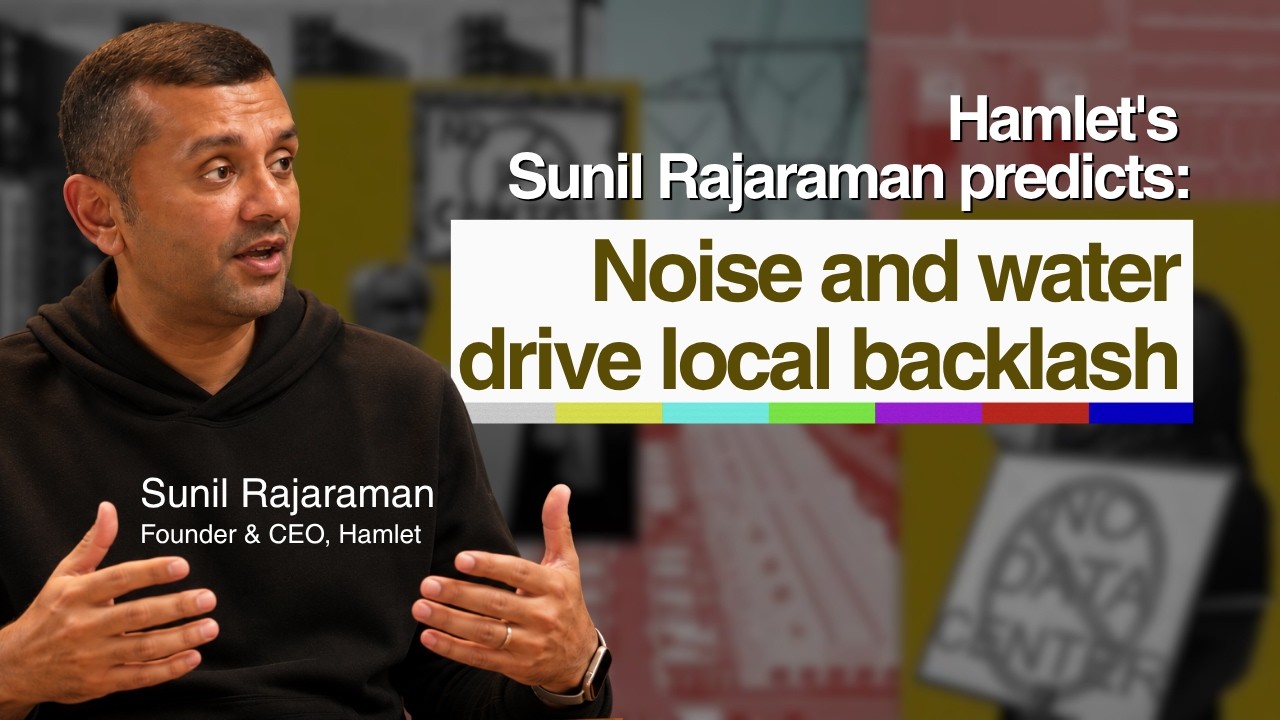
Recorded 20 October 2026 · 21 min
Sunil Rajaraman, founder and CEO of Hamlet, argues that the most consequential political fights, data centers among them, are being decided in city council and planning commission chambers that almost no one watches. Hamlet crawls, transcribes and indexes local meetings across the US, applying AI to recordings that many cities began producing during COVID.
The tension is between mission and market. Hamlet is a venture-backed company that sells aggregated data to data center developers, real estate developers, retailers and political action committees, even as Rajaraman says he wants to give data away. The conversation also tests a popular narrative: that opposition to data centers is really about AI. Rajaraman's data points to something messier and more local.
Pandemic recordings meet AI — ▶ 2:04
Rajaraman found the problem after running for city council: nobody attends meetings, yet everybody cares, and residents typically hear about local politics through Nextdoor or Facebook groups. His enabling insight is that roughly 6 years ago most American cities went online for COVID and began recording meetings. Combined with current AI, that archive makes it possible to understand how cities work in a way that was not feasible before. Coverage is partial: he puts recorded meetings at more than 50%, with a vast majority of California cities equipped and small townships often not.
Selling data, giving some away — ▶ 3:47
Hamlet is a venture-backed for-profit company. It aggregates meeting data and sells it to data center developers, real estate developers, retailers and political action committees seeking to get something done in a community. Rajaraman calls this a constant balance with his mission-driven aim, and announced free API access for verified academics and journalists. Internally Hamlet tracks hundreds of topics, with sentiment broken down by elected official and public commenter, and it has begun publishing rankings of community opposition on issues such as data centers, Flock Safety and short-term rentals.
Chatbots, weak local data — ▶ 7:48
Rajaraman says people already prompt AI tools for guidance on how to vote and expects AI's effect on this election to be more dramatic than most assume. His caution is that data about local officials is still quite inaccurate. He can only speculate why: local officials are probably not important enough a problem for foundation model companies, whereas federal and state data matter more, so quality drops considerably at the local level. He also said he could not immediately cite the articles he recalled. The host reported that Claude declined to tell her how to vote; Rajaraman said careful prompting yields suggestions but not recommendations, though he had not tried recently.
Local data's original sin — ▶ 8:41
Rajaraman blames content management providers whose software was not very good. The result is roughly 19,000 city websites, more than 3,000 counties and 80,000 special districts, each structured differently. Hamlet must build data pipelines across thousands of cities, identify speakers, then assess sentiment, using partners including Databricks (Lakebase, valued for data branching), Assembly for transcription and Browserbase for scraping. He describes no single-model solution. Some jurisdictions run 1990s-era software without cloud servers, and in one community years of records were accidentally deleted, something he says happens more often than people expect.
Beyond transactional govtech — ▶ 10:04
Rajaraman says many govtech companies have converged on the same business problem: scraping and cleaning data, or making it easier to bid on projects. He regards these as sound businesses but pursues a different thesis. If Hamlet understands what people care about and how council members, planning commissioners, school board members and the public think psychologically, he believes it will solve the mission problem and the business problem together. He calls this answer esoteric and less transactional than it sounds. It is a stated belief; the interview offers no evidence that it works commercially.
Volunteer officials, real money — ▶ 11:25
Rajaraman cites turnout in city council elections of roughly 10-25% and notes that neither he nor the hosts could reliably name their own council members. Although these seats are typically volunteer positions, he says members raise campaign money from interests. He has seen contributions from large tech companies, which could relate to a data center proposal, and the National Association of Realtors may give to candidates. He is explicit that he is not calling these donors good or bad, only that there is more money involved than people assume. No totals are given, and he presents the data center link as a possibility.
Data center opposition varies locally — ▶ 14:25
Most communities oppose data centers, Rajaraman says, but for reasons that are deeper than expected. Water use is common, though developers say facilities now use recycled water. Noise recurs: in one community, a resident whose pool was near a data center was being compensated monthly by the developer for about 2 years. Fires have led to fire departments being sent to data centers in small communities. The host cited Jasmine Sun's local reporting that residents think about electricity prices and water, not AI. Rajaraman agrees that blanket explanations are inaccurate, adding that pickleball also comes up often, and that changing minds means working at the town level.
Rajaraman's central claim is that the decisions shaping daily life are made in council chambers, planning commissions and school board meetings, and that anyone ignoring them is missing the plot of politics. Data centers are the current example, but he insists the pattern is broader: every important fight about cities is being settled in those rooms. The rooms are nearly empty. He says nobody shows up but everybody cares, and he puts turnout in city council elections at roughly 10-25%. Residents typically hear about local politics through Nextdoor or a Facebook group. The gap between where power sits and where attention goes is the problem Hamlet exists to address.
What changed is the combination of recordings and AI. Rajaraman, who discovered the problem after running for city council himself, says most American cities went online during COVID about 6 years ago and began recording meetings. AI can now process that archive at a scale no human observer could. Coverage is incomplete: he puts recorded meetings at more than 50% of the total, with a vast majority of California cities equipped and small townships often not. Hamlet tracks hundreds of topics, including data centers, Flock Safety and short-term rentals, and breaks sentiment down by elected official and public commenter. An obvious caveat follows from his figures: the dataset will over-represent places that record their meetings.
The harder problem is fragmentation. Rajaraman blames content management providers whose software was not very good, leaving roughly 19,000 cities with 19,000 different websites, plus more than 3,000 counties and 80,000 special districts, each structured differently. Hamlet must build data pipelines across thousands of cities, identify speakers and then assess sentiment, and it leans on partners including Databricks, Assembly and Browserbase rather than a single model. The same mess, he suggests, may explain why chatbots handle local officials badly. He can only speculate, but he thinks the problem is not important enough for foundation model companies, and data quality drops considerably below the state level.
The payoff of this granularity is a corrective to national narratives. Most communities oppose data centers, Rajaraman says, but the reasons run deeper than expected. Water use is common, though developers say facilities increasingly use recycled water. Noise is frequent: in one community, a resident whose pool sat near a data center was being compensated monthly by the developer for about 2 years. Fire risk has led to fire departments being sent to data centers in small communities. The host noted that Jasmine Sun's local reporting found residents thinking about electricity prices and water rather than AI. Rajaraman calls the blanket picture completely inaccurate and says pickleball disputes show how idiosyncratic local passions are.
Power inside communities is also less formal than civics suggests. Council seats are typically volunteer positions, yet Rajaraman says members raise money from interests. He has seen contributions from large tech companies, which might reflect a planned data center, and the National Association of Realtors may give to candidates. He does not call these donors good or bad, offers no totals, and the link to any specific project is a hypothetical. He adds a more anecdotal claim: the most influential person in a community is probably whoever built its Facebook group when the community first joined the platform. Neither claim comes with systematic evidence here, but both point to channels of influence invisible to anyone following only national politics.
Then the commercial model enters. Hamlet sells aggregated data to data center developers, real estate developers, retailers and political action committees who want to get something done in a community. Rajaraman calls this a constant balance with his mission and announced free API access for verified academics and journalists. He argues that most govtech competitors converge on scraping data or helping firms bid on projects, whereas understanding how council members and the public think will solve the mission and business problems at once. He concedes the answer is esoteric, and it is a belief rather than a demonstrated result. An editorial reading: the sentiment-by-official data that helps residents prepare would also help a developer or committee target persuasion, and the interview does not say how Hamlet would arbitrate between those uses.
Both speakers see AI reshaping elections. Rajaraman says people already ask chatbots how to vote and expects AI's effect on this election to be more dramatic than most assume. The host imagines personal agents that encode preferences or even delegate voting power. Yet a voter-facing agent is only as good as its local data, which Rajaraman calls quite inaccurate. Within a year, he wants companies like Hamlet to end the balkanization of data across 19,000 governments. Whoever structures that data will help mediate how citizens, and their chatbots, understand local officials. The interview leaves open whether that role is best held by a for-profit firm whose customers include the parties lobbying those officials.
The open question. Can one dataset serve both residents and the parties trying to move them? Rajaraman believes that understanding how officials and the public think will solve the mission problem and the business problem together. He offers no evidence for this, and he did not explain how Hamlet would handle a developer or political action committee using official-level sentiment data to target persuasion. Free access for verified journalists and academics helps, but it does not settle who else gets the data, or whether a commercially funded layer can become the trusted source on local officials that voters and chatbots increasingly seem to want.
Watch the full video at https://www.youtube.com/watch?v=2QNAR0qmYAg.
Comments ()