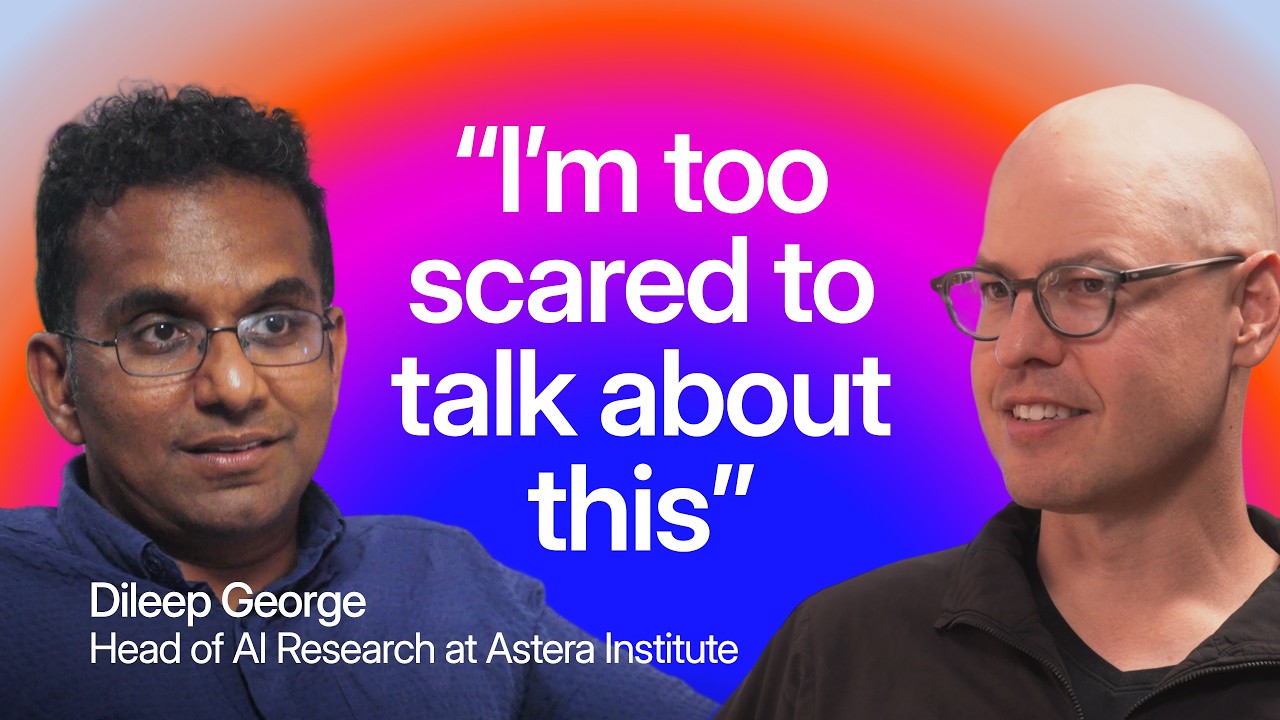
Recorded 28 October 2026 · 36 min
Dileep George, head of AI research at the Astera Institute, argues that today's large language models are dirigibles: impressive, useful, and built on a favorable scaling law rather than on an understanding of intelligence. Astera will put over $1 billion across 10 years into a neuroscience-inspired attempt at the airplane. George co-founded Vicarious with interviewer Scott Phoenix in 2010 and sold it to Alphabet in 2022.
The tension is that George does not call scaling a mistake. He calls it a rational, executable strategy that has absorbed the industry's capital and attention, while the problems he considers central, such as data efficiency, learning from experience and planning, stay unsolved. His own plan is more speculative: he estimates about a dozen discoveries remain, cannot yet name the milestone that would prove the approach works, and was surprised by how far LLMs have come.
Dirigibles and compute — ▶ 1:59
George says that in 1920 most people would have named bigger balloons as aeronautics' best bet. Lighter-than-air flight sidesteps aerodynamics and offers a rare, favorable scaling law, so builders can keep executing by making things larger. The US passed the Helium Act of 1925 to protect its advantage in the gas. Compute, he argues, is the helium of the AI era: whoever has the most currently wins. The lesson cuts both ways. Intelligent behavior can be produced without understanding intelligence's principles, but the Wright brothers, a minority, followed a different path.
The real test of intelligence — ▶ 5:41
George holds that the principles of intelligence are still not understood, citing the sheer data needed for training and the inability to learn from experience. His thought experiment: if all written knowledge vanished and only humans remained, they would experiment, invent writing, books and computers, and rebuild knowledge. He argues this, not recombining existing knowledge in novel ways, is the real test of AI. A system should enter the world without supplied knowledge, build tools, run experiments, and derive abstractions itself.
Why scaling won — ▶ 7:16
George's answer to why no one has cracked the brain is that another path is good enough and easier to understand. It offers a recipe: accumulate data, the algorithm exists, accumulate capital and turn the crank. Like Moore's law, it is predictable, easy to organize and easy to spend money on. The incentives resemble Google search, where small improvements earned extreme rewards. Phoenix frames the brain as the next non-linearity that could disrupt contemporary AI, as AI disrupted Google. George replies that this is his bet. The explanation concerns organizational convenience, not technical proof.
A dozen discoveries — ▶ 8:47
Asked how many discoveries separate us from brain-based AI, George answers "Probably a dozen." Phoenix notes that is not many for something worth a trillion dollars. George agrees but says the discoveries must click together, which is not easy. The method is the usual painful research loop: form hypotheses, run experiments, find you are wrong, revise. He expects AI to speed this up, since coding agents let him get ideas working without persuading colleagues who resist half-formed ones. The figure is an estimate, not a derived forecast.
Understandable minds, tempered risk — ▶ 14:12
Phoenix argues that misalignment partly stems from alien minds, and that human-like cognition would make errors more understandable. George agrees: if systems resemble us, error modes become clearer and control improves. He is also skeptical of the rogue-AI narrative, suggesting some cases are overhyped and that incentives exist to announce a model went rogue. He says AI is not developing as a scheming system that accumulates power quietly. Instead, incremental improvements bring security threats that get patched. He expects net positive outcomes but concedes bioweapons are a real concern.
Astera's closed loop — ▶ 20:30
Astera is a non-profit foundation investing in three areas; George leads neuroscience-inspired AI with over $1 billion across 10 years, roughly $100 million a year. A second area is an experimental neuroscience lab recording from non-human primates and mice, led by Doris Tsao. The distinctive idea is closing the loop between theory and recording: run the same experiments on AI agents and animals, compare how quickly each learns, and treat an agent's failure as information. George calls the pairing probably the best setup for this work.
Cognitive maps and planning — ▶ 22:09
The first test is a language-free 3D virtual world where agents have only their own actions and must learn cognitive maps quickly enough to plan. George says popular world models trained on next-frame prediction can render realistic frames but cannot plan except by brute-force rollouts. His thrusts are data efficiency, planning and causality. He cannot name a GPT-1 moment, saying it depends on finding a niche. The scientific marker would be building cognitive maps far faster than current systems, enabling long-term planning. That threshold has not been crossed, and the project will take 10 years.
Biggest dirigible, best toolkit — ▶ 25:56
George says he shared the dirigible analogy privately with Demis, who agreed and replied, "I want to build the biggest dirigible." George would do the same in Demis's position: $500 billion cannot be used efficiently on solving the brain, but it can fund data centers, an executable path, and some fraction can still go to the brain. He believes Dario and Sam see scaling as the route to intelligence, and was surprised Ilya raised data efficiency. He rejects calling LLMs an off-ramp, as they supply the best toolkit, but agrees fundamentally different ideas are needed.
Consciousness as a loop — ▶ 29:05
George does not believe LLMs are conscious. He calls consciousness "too boring" a concept in one sense: a loop for self-monitoring that even simple organisms have, differing in how impoverished their world models are. He does not think Claude contains a model like ours. He counts mammals and parrots as conscious, is unsure about shrimp, and says moss is definitely not. Even a conscious, human-like AI would not get rights, in his view, because the purpose of building AI is to help humanity, not compete with it.
Recurrence as fringe idea — ▶ 32:19
George highlights a mismatch between the brain and AI architecture. The brain uses feedback connections during inference, even in the visual cortex, yet virtually all current systems are feedforward, including those Yann LeCun is building. The fringe hypothesis is that recurrence conceals something fundamental that is not understood. Phoenix jokes it is "reverse attention is all you need." The transcript gives no evidence that exploiting recurrence yields gains, so this remains a research bet rather than a demonstrated mechanism.
Where he was wrong — ▶ 32:59
George's largest belief change is that he never expected LLMs to be this good at coding; a decade ago he expected plausible text. On robotics he currently thinks the problem is hard and will not yield to scaling data alone, but he allows that the same surprise could recur within 2 years and says he is watching for it. For a contrarian bet against scaling, the admission matters: the proponent of the alternative has been wrong about how far the dominant approach would go.
Dileep George's argument is that the current AI boom proves less than it appears to. Language models work, he says, because the industry found a path that is good enough and scales predictably, not because anyone has worked out how intelligence functions. His analogy is aviation in the 1920s, when balloons and dirigibles were the obvious bet and the principles of heavier-than-air flight remained unsolved. On his reading, today's models are impressive, useful and not the airplane. The claim is not that scaling fails. It is that scaling has let the field defer a harder scientific question, and that the question still waits to be answered.
The analogy rests on a specific mechanism. Lighter-than-air flight sidesteps aerodynamics, and in doing so it hands builders a favorable scaling law: make the balloon bigger and it flies better, so a program can run for years on execution alone. George notes that in 1920 most people would have named bigger balloons as aeronautics' best prospect, and that the Helium Act of 1925 was passed, as he tells it, to keep the advantage from being exported. Compute, he says, is the helium of the AI era. Whoever has the most currently wins. The Wright brothers, bicycle mechanics on a minority path, represent the alternative he is following.
What would the airplane do that the dirigible cannot? George points to data efficiency and the inability to learn from experience. His thought experiment asks what would happen if all written knowledge vanished and only humans remained. They would experiment with the world, invent tools, writing, books and eventually computers. That, he argues, is the real test of AI: not recombining existing knowledge in novel ways, but entering the world without supplied knowledge and building abstractions from experience. By this standard, systems that need vast quantities of data and cannot learn on the job are missing something basic, however capable they look.
If the problem is that valuable, why has no one cracked it? George's answer concerns incentives more than difficulty. The scaling path gives a recipe that Silicon Valley is good at executing: accumulate data, accumulate capital, turn the crank. It is predictable in the way Moore's law was, easy to organize and easy to fund. The reward structure resembles Google search, where even a small improvement brought extreme monetary returns. This is an explanation about how a field allocates effort, not evidence that the alternative will succeed. It does, however, explain how a field can underinvest in a hard scientific question while still behaving rationally.
Astera's plan is an attempt to supply that investment. The non-profit foundation will spend over $1 billion across 10 years, roughly $100 million a year, on neuroscience-inspired AI, alongside an experimental lab recording from non-human primates and mice led by Doris Tsao. The most ambitious element is the closed loop between theory and recording. The team will run identical experiments on AI agents and animals and compare how quickly each learns. If agents fall short, George says, that tells them something. The design turns the brain from a source of loose inspiration into a benchmark that can falsify models.
The first experiments are concrete. Agents will live in a language-free 3D virtual world, starting simple, with only their own actions to learn from. The test is whether they can build cognitive maps quickly and use them to plan. George argues that popular world models, trained on next-frame prediction, can render realistic frames but cannot plan except by rolling out sequences until one works. He wants planning to work like perception. Data efficiency, planning and causality are the vectors he names. Separately, he points to feedback connections in the visual cortex as a neglected feature that nearly every current system, including Yann LeCun's, lacks.
George is careful not to cast scaling as foolish. He says he told Demis the dirigible analogy, and Demis replied that he wanted to build the biggest dirigible. George would take the same position in Demis's seat. His reasoning is that $500 billion cannot be deployed efficiently on solving the brain, but it can build data centers on an executable path, while some fraction can fund brain research. He also rejects calling LLMs an off-ramp, since they give researchers the best toolkit even for the brain problem. The disagreement is therefore about portfolio allocation and what is missing, not about whether current systems are useful.
He also connects the approach to safety, with qualifications. Phoenix argues that alien minds are one root cause of misalignment, and George agrees that brain-like systems should have more understandable error modes and be easier to control. Yet George thinks some rogue-model stories are overhyped, and he sees AI progressing through incremental improvements and patched threats, not a scheming system gathering power. The two positions sit uneasily together. If current risks are modest and manageable, brain-likeness is a bonus, not a necessity. And no evidence is offered that a brain-like system would in fact be more predictable.
The gap between claim and evidence is the main limit on the argument. George's estimate of "a dozen" discoveries is an intuition, not a derivation. He cannot identify a GPT-1 moment for brain-based models, saying only that faster cognitive maps enabling long-term planning would count scientifically. He acknowledges the threshold has not been crossed and the project will take 10 years. He was also wrong about LLMs, never expecting them to be this good at coding, and says robotics could surprise him within 2 years. A thesis built on what scaling cannot do has already been tested by what scaling did.
That history makes the central wager sharper. If data efficiency and planning are principles to be discovered, George's approach is positioned to find them while the field spends on compute. If they are capabilities that further scaling delivers, the dirigible simply keeps getting bigger. The transcript does not settle which is true, and George does not claim it does. What it offers is a measurable test: agents and animals facing the same tasks, with learning speed as the score. The consequential question is whether a brain-inspired system can win that comparison before the scaling path closes it.
The open question. Can a brain-inspired approach show a decisive advantage, such as building cognitive maps much faster than current systems and using them for long-term planning, before scaled LLMs close the same gaps? George concedes he has not yet reached that threshold, offers "a dozen" discoveries as a guess without derivation, and admits his past predictions about LLMs were wrong. Whether data efficiency and planning are principles to be discovered or capabilities that further scaling will deliver remains untested.
Watch the full video at https://www.youtube.com/watch?v=xoPlqXQzLu0.
Comments ()