Recorded 29 October 2026 · 38 min
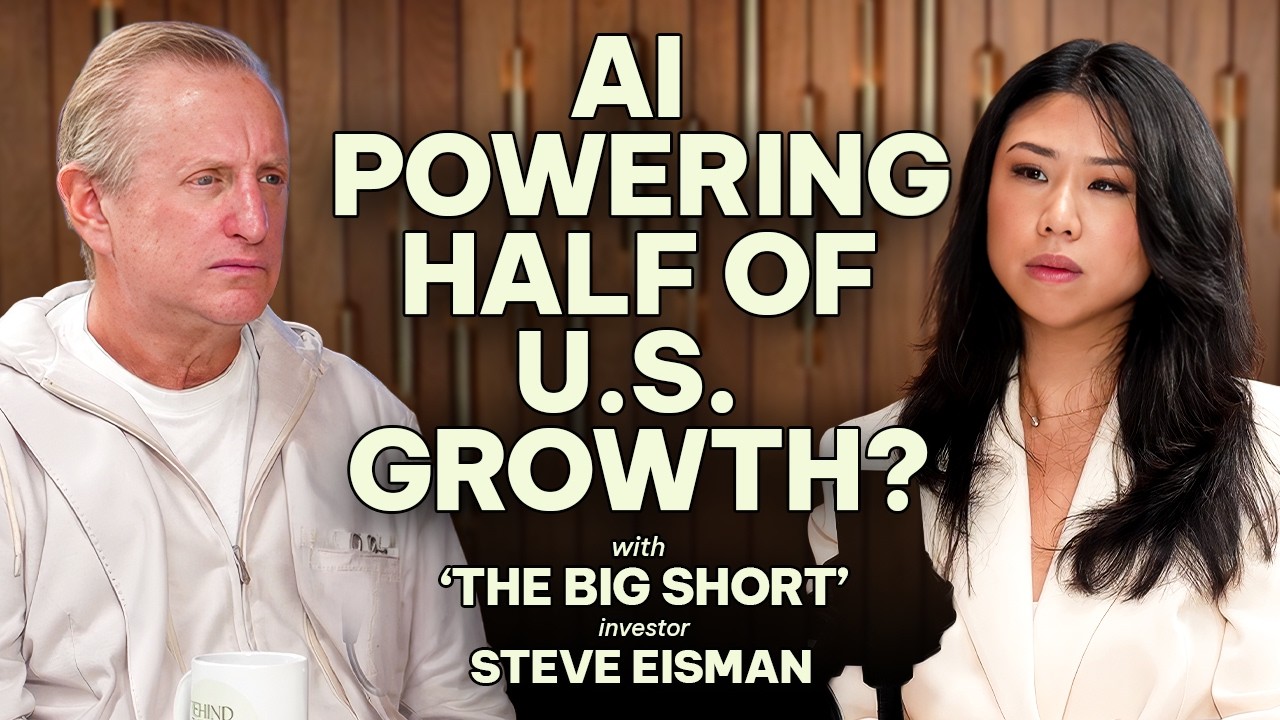
Steve Eisman, the investor known for betting against subprime mortgage bonds before 2008, argues that US growth and the stock market now rest on a narrow chain of AI spending. Citing Apollo economist Torsten Slok, he says AI capex accounts for half of this year's roughly 2% GDP growth, and that the chain depends heavily on OpenAI and Anthropic.
The tension is between alarm and evidence. Eisman repeatedly says he is not yet predicting a collapse, and he notes that AI lacks the monthly credit databases that made subprime legible. He is calmer about private credit, which he expects to produce losses and restructurings but not a systemic crisis.
Subprime déjà vu — ▶ 4:07
Eisman's 2006 call came from pattern recognition, not prophecy. The first generation of subprime lenders went effectively bankrupt in 1998 and 1999. A second generation listed from 2002, mostly run by the same people under new names. He had seen the play and waited for evidence. It arrived in summer 2006, when loans securitized earlier that year went bad quickly because underwriting standards had kept deteriorating. Preparation, in his telling, mattered more than foresight.
Incentives over ethics — ▶ 6:01
Everyone in the subprime chain, from lenders to the Wall Street firms that bought, securitized and sold the loans, was paid on volume, not quality. The only way to grow volume was to loosen underwriting standards and enlarge the pie. Consensus supported this. A research head told Eisman that national US housing prices had never fallen since World War II. Eisman asked whether that was a law of physics or an accident of history.
A chain of dependence — ▶ 8:22
Citing Torsten Slok, Eisman says GDP growth of about 2% this year is half AI capex. He traces the chain: a 10-Q footnote says 70% of Nvidia's receivables come from five accounts, probably hyperscalers. Wall Street research, which he describes cautiously, suggests 70% of hyperscaler AI revenue comes from Anthropic and OpenAI, equal to 25-35% of cloud revenue. Oracle's $600 billion backlog is half OpenAI. Trouble at either lab would reverse the chain. He frames this as a conditional, not a prediction.
Token maxing fades — ▶ 15:45
Eisman names three risks to AI revenue. The first is the end of token maxing, when employees were ordered to use AI around the clock regardless of cost; he says that lasted much of the summer and buyers are now cost-conscious. The second is a price war, after OpenAI's CFO said a recent price cut raised usage tenfold. The third is how hard it is to build data centers at this scale. He speculates, without evidence, that Anthropic may want to list before third-quarter numbers.
The market is one trade — ▶ 18:06
The stock market is more exposed than the economy, Eisman argues. Consumers are 70% of GDP, which dilutes AI's contribution. Infotech is 38% of the S&P, and adding tech businesses classified elsewhere, like Google and Amazon, pushes it above 50%. Of the S&P's 11 sectors, only staples, health care and real estate look uncorrelated to AI. Utilities, banks and industrials all serve it. His conclusion is that the entire stock market is one trade, so an AI reversal would mean a massive correction, not just a recession.
Circular financing, conditionally — ▶ 21:12
Circular financing, as Eisman defines it, is Nvidia investing in or lending to a company that then buys more Nvidia chips. He has concerns but treats it as a secondary issue: if Anthropic and OpenAI succeed, it will not matter. If OpenAI went bankrupt, Nvidia would have problems from the arrangements it has made. He acknowledges earlier cases of circular financing but not on this scale. The real bottleneck, in his view, is the health of the two labs.
No database this time — ▶ 22:43
Eisman explains why he hedges on AI more than he did on subprime. Moody's kept a database with every credit metric for every securitization, updated monthly, so deterioration could be checked directly. AI has no equivalent. No returns data exist, and he says the picture is anecdotal and no one's account can be fully trusted. He is waiting for the S-1 filings, because a public listing forces the companies to disclose numbers that are largely unknown today.
Private equity's IPO drag — ▶ 23:56
Eisman blames private equity for keeping companies private. Buyout holding periods have stretched from about 3 years to 7-10, and investors are frustrated by delayed payouts. After the financial crisis, institutions moved money into private equity expecting lower volatility. Eisman says that confuses perception and reality: with no daily pricing, volatility is hidden, not absent. He thinks the inflows are over. He also agrees that founders can now raise far more private capital, reducing the need to list.
Rates as pressure point — ▶ 27:44
Outside AI, Eisman sees interest rates as the main pressure point. At some level of higher rates the stock market corrects, but nobody knows the level. He thought 4.5% was the Rubicon and says he was 100% wrong. He judges that Treasury Secretary Bessant tried to push bond yields lower and failed, damaging his credibility. On the Fed, he says the chair does not report to the president and sees no issue, despite the rhetoric.
Software refinancing wall — ▶ 31:42
Private credit, an outgrowth of private equity, mostly lends to private equity buyers, and many funds are owned by private equity firms. During COVID, with rates near zero, buyout firms borrowed to buy many software companies. That debt needs refinancing from next year at higher rates and lower valuations. Lenders will demand more equity, and sponsors will either pay or walk away, as one did from Medallia. Eisman expects bankruptcies and restructurings, but not a systemic crisis: banks were levered 40 to 1 in 2008, private credit funds 2 to 1.
Life insurance blind spot — ▶ 35:28
The area Eisman would regulate first is life insurance, which he calls the black hole of the financial system. Many life insurers are owned by private equity firms, and the insurers then buy paper created by those owners. The structure is hard to map and involves many interconnected entities. Life and property and casualty insurers are regulated by the states, not the federal government, and he thinks they escape effective oversight as a result. His concern is qualitative, since he gives no figures.
The AI boom, in Steve Eisman's reading, is less a diversified expansion than a single chain with a few weak links. Economist Torsten Slok of Apollo, whom Eisman cites, estimates that US GDP will grow about 2% this year and that half of that is purely AI capex. Eisman's contribution is to trace where the money comes from. Nvidia sells chips, hyperscalers buy them, and the hyperscalers' appetite depends on commitments from a very small number of customers. If those commitments faltered, he argues, the chain would run in reverse and the economy would fall into recession almost immediately. He frames this as a conditional, not a forecast. He says he is not making the prediction yet, only describing what happens if something goes wrong.
The evidence for concentration is specific, though some of it is inferential. A footnote in Nvidia's 10-Q says 70% of its accounts receivable comes from five accounts, which Eisman believes are directly or indirectly the hyperscalers. He then cites Wall Street research, which he says he is describing carefully: roughly 70% of hyperscaler AI revenue comes from Anthropic and OpenAI, equal to 25-35% of total cloud revenue. Oracle is the starkest case, with a $600 billion backlog, half of it from OpenAI. Of the two labs, he considers OpenAI the weaker, with less revenue, slower growth and bigger losses. His summary is that Nvidia's revenue growth of more than 100% ultimately depends on two young companies that lose money.
The stock market, Eisman argues, is more exposed than the economy. Consumers are 70% of the US economy, which is why AI accounts for only half of GDP growth. Equity indices have no such buffer. Infotech is 38% of the S&P, and adding tech businesses classified elsewhere, such as Google and Amazon, pushes the figure above 50%. Of the S&P's 11 sectors, he sees only staples, health care and real estate as uncorrelated to AI. Utilities build the power, banks provide the financing and industrials do the construction. Hence his view that "the entire stock market's one trade." The implication is that sector diversification protects less than it appears, though the claim rests on his judgment of correlation, not on data shown in the interview.
What could break the chain? Eisman names three risks. The first is the end of what he calls token maxing: employees, in his Uber example, ordered by superiors to use AI around the clock regardless of cost. He says that phase lasted much of the summer and buyers are now more cost-conscious. The second is a price war. OpenAI's CFO said a recent price cut raised usage tenfold, a figure Eisman says he does not understand, and he asks whether Anthropic will follow. The third is the difficulty of building data centers at unprecedented size and number, which he says cannot be handicapped. He also speculates that Anthropic may be rushing to list before third-quarter numbers because growth may have flattened. That is conjecture, and he presents it as one.
The strongest limit on the argument is the absence of data, which Eisman openly acknowledges. In subprime, Moody's kept a database with every credit metric for every securitization, updated monthly, so deterioration could be verified. For AI, no comparable numbers exist, and he calls the picture anecdotal. That explains both his hedging and his eagerness for the S-1 filings, since going public forces companies to open their books. Circular financing gets similar treatment. Nvidia investing in or lending to customers that then buy its chips worries him, but he says it would not matter if Anthropic and OpenAI succeed. He also admits a miss: he thought 4.5% interest rates would trigger a stock market correction, and he was 100% wrong.
Eisman's confidence in reading cycles comes from pattern recognition rather than prophecy. As a sell-side analyst he covered the first generation of subprime lenders, which effectively went bankrupt in 1998 and 1999. When a second generation listed from 2002, often run by the same people under new names, he waited for evidence. It arrived in summer 2006, when loans securitized earlier that year deteriorated quickly because underwriting kept slipping. The mechanism was incentives: everyone in the chain was paid on volume, not quality. Consensus held that national housing prices had never fallen since World War II, which Eisman asked was a law of physics or an accident of history. The transcript does not claim AI shares those incentives. He uses subprime mainly as a contrast on data availability.
Private credit is the problem he expects to hurt without breaking the system. He calls it an outgrowth of private equity, lending largely to private equity buyers and often owned by private equity firms. During COVID, with rates near zero, buyout firms borrowed to buy many software companies. That debt must be refinanced from next year at higher rates, and software valuations, despite a recent rally, remain far below purchase prices. Lenders will ask sponsors for more equity, and sponsors will either pay or walk away, as one did from Medallia. Eisman expects bankruptcies and restructurings but no systemic event, because banks were levered 40 to 1 in 2008 and private credit funds are levered 2 to 1. He declines to call it contained, recalling Bernanke's remarks on subprime.
The same private equity dynamics, he argues, explain the thin IPO market. Buyout holding periods have stretched from about 3 years to 7-10, leaving investors short of cash returns. After the financial crisis, institutions moved money into private equity expecting lower volatility. Eisman says the lack of daily pricing hides volatility without reducing it, and he thinks those inflows are over. He also agrees that founders can raise more private capital than before, reducing the pull of public markets. The area he would regulate first is life insurance, where private equity owners have their insurers buy paper the owners create. Because states, not the federal government, regulate it, he sees little effective oversight. That concern is qualitative, since he offers no figures.
The unresolved issue is whether the AI chain can be tested before it is stressed. Eisman's argument is internally coherent: spending depends on commitments from two companies, and those companies' finances are largely unseen. But the opacity cuts both ways. Without numbers, he cannot say whether the end of token maxing is a pause or a ceiling, or whether price cuts expand usage or merely compress revenue. The S-1 filings he is waiting for may supply the first hard answers. Until then, the claim that any AI reversal brings immediate recession is a conditional that is plausible given the cited concentration but unsupported by company-level disclosure.
The open question. Will the first S-1 filings from OpenAI and Anthropic show revenue durable enough, once token maxing fades and prices fall, to support the commitments that underpin the Nvidia, hyperscaler and Oracle chain? Eisman himself says almost nothing is known about these companies' financials, so his conditional warning cannot yet be tested.
Watch the full video at https://www.youtube.com/watch?v=f7tOKtnWmJw.
Comments ()