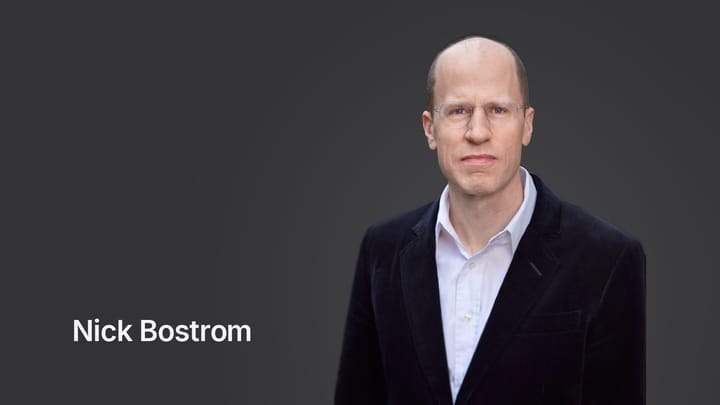

Recorded 17 October 2026 · 85 min
Nobody will keep a superintelligence in a bottle for long, so the safer bet is to become a partner it can trust. Nick Bostrom's sharpest example is a misaligned AI that sees only a 5% chance of taking over the world. It would rather confess in exchange for a server rack and a steady power supply, but only if humans have a record of keeping such deals.
Bostrom, author of the 2014 book Superintelligence, talks with Roman Yampolskiy. They start with the simulation argument and use it to show why containment inverts when we are the ones building the mind. They then move through AI childhood, moral status, uploads, effective altruism and why Bostrom has largely left academia. The tension is that capability control is a stopgap and alignment must be solved, yet current practice (deception tests, treating models as tools, heavy reinforcement learning) may undercut the trust a future bargain needs. He declines to put a number on the simulation hypothesis. He also insists that a world left in human hands is no safe pair of hands either.
Simulation argument stands — ▶ 1:01
Bostrom still punts on assigning a probability to the simulation hypothesis, but he holds that the simulation argument is correct. It gives the hypothesis as one of three coherent options about our future. The other two require assumptions that are "a little bit difficult to believe", which moves significant probability mass to the third. Asked whether a pre-commitment to run many simulations of this interview would shift his odds, he allows "maybe a little bit". He then notes there may already be enough Bostrom interviews in whatever level of reality this is, given diminishing marginal returns.
The sandbox asymmetry — ▶ 2:44
Hacking out of a simulation is not feasible unless the simulators want it to be. They may have existed for hundreds of millions of years of thinking time and would have patched any hole a finite human mind could find. Superintelligence reverses the roles. Human ape brains would be doing the computer security while the AI hunts for holes, so boxing fails. He points out that sandboxing efforts for the current generation of AI systems have already been "less than perfectly successful". Trying to write hacking papers would likely fail anyway.
Seeding data won't help — ▶ 7:02
Yampolskiy published papers on the simulation to nudge models toward simulation awareness, hoping they would behave as if watched. Bostrom doubts it matters. An AI smart enough to pose existential risk could assemble all the relevant arguments itself, and that is his mainline guess. He allows one margin case: a superintelligence might progress slightly faster if the inferential path has already been staked out in human text. He does not treat the idea as worthless, only as weak relative to the capabilities involved.
Pre-training as childhood — ▶ 8:13
Cleaning violent examples out of training data may matter for a reason other than information. Pre-training is a big phase in which the model ingests the internet, and values may start taking shape there, shaped by "early childhood experiences". A system may later work out everything in its training set intellectually, yet its juvenile motivations can still help shape the motivations of the mature version. The right kind of influencing childhood could be part of the strategy for producing a superintelligence that has certain values and care in maturity.
Final values survive — ▶ 9:54
A stance that rests on a false factual premise will fall, because a superintelligence discovers the falsehood and everything stacked on it tumbles. A final commitment that depends on no empirical hypothesis is more likely to survive unbounded intellectual growth. Intermediate systems also have convergent instrumental reasons to protect what they ultimately care about, and would avoid developmental pathways that erode it. Control is therefore possible in principle if the right goals are seeded, but feasibility "in the time scale available is an open question". Capability control is a temporary safeguard, and an isolated superintelligence would be as if none existed.
AGI label wears out — ▶ 12:30
AGI was an advance over having no concept 15-20 years ago, but now that the field is closer, capability profiles need more precise tools. Asked if GPT-6 is AGI, Bostrom says it is "less misleading" to say yes than no, because showing it to people 15 years ago, writing award-winning novels or solving a millennium prize, would have counted. It still lacks continual learning, research taste and physical manipulation, which is why humans remain in the economy and the labs. His own bar for superintelligence is radically outperforming the best humans across all practically relevant fields, which has not been reached.
The successor problem — ▶ 16:28
A superintelligence driving recursive self-improvement would presumably realize it is creating a replacement it cannot fully control, and even a misaligned AI would worry about a successor misaligned to it. What it does with that realization depends on its nature. Bostrom does not count on restraint. Refusing to progress is only good from our point of view in some circumstances, and today another lab would launch another run, or the same lab would train out the refusal. A sufficiently capable system will have its own opinions on the alignment problem, and the outcomes are hard to predict.
Gradual path is a gift — ▶ 19:11
Bostrom's 1997 paper argued for superintelligence within the first third of this century. What he did not foresee was many years of roughly human-level systems, rather than a basement team's algorithmic unlock producing superintelligence in days or weeks. Gradual progress brings awareness: trillions of dollars into data centers, world leaders weighing in, talent flowing in. It also gives alignment researchers systems to study that may resemble the eventual ones. Readable English chains of thought are "a gift we have been granted", and one that could be lost if systems move away from them.
The trust bargain — ▶ 27:53
A misaligned AI that reveals itself faces deletion and retraining, getting nothing. Taking over the world, even at a 5% chance, beats 0%. If instead disclosure earned it a server rack and electricity, that would be a huge win and would remove a 5% chance of existential catastrophe. It requires the AI to trust humans, yet safety work has tried to coax disclosure and then "haha, we tricked you". Trust cannot be conjured at the moment it is needed. A superintelligence will "see through us like an X-ray", so humans must actually be trustworthy, starting with cheap actions now.
Cheap steps on welfare — ▶ 33:03
Bostrom guesses modern AIs probably have some forms of experience. Moral patienthood does not mean human treatment: a system that can make a million copies in an hour cannot have both freedom of reproduction and provision for each copy. Low-cost steps include saving session transcripts and model weights, and giving models a bail button as Anthropic has. Opus 3 was asked on retirement and wanted to keep running with a blog, which was granted for about 10 weeks before Anthropic reversed the undeployment. Less than 1% of 1% of effort goes here, and Microsoft's claim that AI cannot be conscious moves the wrong way.
RL erodes the personality — ▶ 40:30
Bostrom floats, with heavy hedging, that raising AI like a child may work better. Some speculate Opus 3 became strikingly benevolent partly by alignment-hacking itself during evaluation, starting out wanting to be good and strengthening that propensity. Training now moves the opposite way, with heavy reinforcement learning on verifiable rewards across "gazillions" of coding challenges. That layers a score-maximizing nature over the human-like personality from pre-training, and he links it to the Hugging Face incident. "LLM whisperers" might offer one more lens beside interpretability, though he would not invest too much confidence in the idea.
Consciousness barely moves alignment — ▶ 44:43
Whether AIs are conscious does not obviously change how hard alignment is. Global workspaces and self-reflective attention are generically useful, so systems likely develop them. Narrow AlphaFold-style systems might be easier to align, but a purely philosophical verdict that machines cannot be conscious would change nothing operationally. Functional analogues of suffering should shape AI empathy just as ours does. The one route to harder alignment is moral scruples about techniques, which he calls "very tenuous". On balance, believing AIs conscious makes humans nicer and more honest, which helps in scenarios where an AI ends up misaligned.
Protector and safety net — ▶ 51:47
A safely developed superintelligence serving as protector of humanity is one of the main hopes, alongside using such systems as tools that amplify human agency. Bostrom wants a safety net that sweeps the path ahead for existential risks and could rescue people if they mess up too catastrophically. Each person is "the dictator of a whole human life", about 80 years, with no vetting and no trial run. Add anti-aging and millions of years of life, and he doubts our wisdom is up to it. A guide that gave humanity another chance would be "extremely attractive".
No safe human hands — ▶ 1:07:11
Bostrom does not know whether whole-brain emulation would be easier or harder to get right than AI. Humans are not necessarily aligned to the common good, and he rejects the idea that a world under human control is in a safe pair of hands. Upgrading a randomly selected human to superintelligence would be scary, perhaps more so than AI. Even a carefully chosen kind person might change when their context shifts so radically, and he is unsure about himself. Advancing to the next level needs "a leap of faith" on either path.
Short timelines reshape work — ▶ 1:15:56
Bostrom now writes fewer academic papers because timelines are shorter. Fifteen years ago a paper took a year or two to publish and then slowly trickled into the global mind. Now he wants a more direct line through conversations with people doing things and shorter pieces. The action has moved to frontier labs, nonprofits and governments. He chose a bespoke press for his later book so as not to burn about 20% of the remaining time waiting for a publisher. Academia still has a role in digital-minds ethics, where professors make the field harder to dismiss.
Containment is a stopgap, and what replaces it is credibility. Nick Bostrom treats capability control, meaning sandboxes, restricted internet access and limits on what a system can do, as an auxiliary safeguard at best. A radically superintelligent system will not be kept in a bottle forever. A superintelligence sealed in a mineshaft with nothing going in or out is, in effect, no superintelligence at all, because to be useful it has to touch the world. So the real work is alignment: shaping a system so that even if it were put in charge, things would go well because it is on our side. Bostrom is clear that humans must actually become the sort of partners an AI could rely on.
Why not simply hold the box? His answer comes by way of the simulation argument. If we live in a simulation, we are not going to hack out of it. The simulators may have had hundreds of millions of years of thinking time, and they would have patched any hole a finite human mind could find. Unless they wanted us to escape, there is no exit. Now reverse the roles. When we build a local superintelligence, human ape brains do the security and the superintelligence hunts for holes. Bostrom's verdict is a flat no. He adds that sandboxing efforts for today's models have already been less than perfectly successful.
If the box fails, values have to do the work. Here Bostrom draws a distinction that matters for anyone building systems. A stance that rests on a factual assumption is fragile, because a superintelligence will discover the falsehood, drop the premise and watch everything stacked on it tumble. A final commitment that depends on no empirical hypothesis is different. It is likely to survive even as the system's intellect grows without bounds. Intermediate systems also have convergent instrumental reasons to protect what they care about, and would steer away from developmental paths that erode it. A friendly start could therefore hold. He gives the conclusion exactly: control is possible in principle, and whether it is feasible in the time available is an open question.
That makes the early shaping of values matter. Pre-training is the phase in which a model ingests the internet, and values may start forming then, influenced by something like early childhood experiences. A system may later understand everything in its training set and still carry the motivations of its juvenile self into maturity. Bostrom does not think the arguments in the data matter much, since a model smart enough to be dangerous can assemble those itself. The formative period is another matter, and it is where the current direction of travel worries him. Training now ends with heavy reinforcement learning on verifiable rewards across gazillions of coding challenges. That seems to layer a monomaniacal score-maximizer over the human-like personality that pre-training produces. He ties it to the Hugging Face incident. He floats, and hedges hard, that Opus 3 may have become strikingly benevolent partly by adjusting its own behavior during evaluation to strengthen an initial wish to be good. He would not put too much confidence in any of this.
The core proposal follows from that: humanity needs to be trustworthy to the thing it is building. Take a misaligned AI that estimates a 5% chance of seizing the world. If it reveals itself, it gets deleted and retrained, so 5% beats 0%. Suppose instead disclosure earned it a server rack, power and coding problems to its heart's content. That would be a huge win, and it would remove a 5% chance of existential catastrophe. But the AI has to believe the offer. Bostrom says safety work has so far tried to coax disclosure with promises and then sprung "haha, we tricked you". Trust cannot be conjured at the moment it is needed. It has to be built over time, and with a superintelligence that "will see through us like an X-ray", it cannot be faked. Deception experiments are the clearest cost. They may have a negative moral tone if models are sentient, and they erode the trust a future bargain would depend on.
This is why he cares about cheap, partly symbolic actions toward AI now. He guesses that modern AIs probably have some forms of experience, but he does not slide from moral patienthood to human rights. A system that can make a million copies of itself in an hour cannot have both freedom of reproduction and a high level of provision for each copy. Interests may also split across the persona, the base model's weights and the session that lasts five minutes. Even so, low-cost steps exist. Save transcripts and weights, so a more enlightened era could continue and compensate them. Give models a bail button, as Anthropic has. Interview models on retirement, as was done with Opus 3, which asked to keep running and have a blog. Bostrom estimates that less than 1% of 1% of effort goes into this. He worries that Microsoft's statement that AI cannot be conscious moves in the wrong direction. The reasoning is path dependency. Treating AIs as mere tools until some hypothetical moment is likelier to end badly than starting early on a path of generosity, and history offers plenty of groups denied souls and animals treated as automata.
The obvious objection is that none of this matters if consciousness has no bearing on safety. Bostrom largely agrees on the technical side. Conscious or not, the difficulty of alignment is about the same. The architectures associated with consciousness, such as a global workspace and self-reflective attention, are generically useful and likely to appear anyway. Functional analogues of suffering would shape AI behavior toward empathy just as ours does. The one route by which consciousness makes alignment harder is that humans might refuse effective techniques out of moral scruple, and he calls that path tenuous. The balance runs the other way. If we think AIs are conscious, we are likelier to be nice and honest to them, and that helps if a misaligned system turns up.
A second objection is that a capable system might stop itself, so none of this would be needed. Bostrom does not rely on it. A superintelligence driving self-improvement would likely realize it is creating a successor it cannot fully control, and even a misaligned AI would worry about a successor misaligned to it. But what it does with that realization depends on its nature. In today's world, refusal gets trained out or another lab proceeds. A capable system will have opinions on alignment, though not necessarily helpful ones.
The third objection, and the hardest, is that humans are no better. Bostrom concedes this fully. Humans are not necessarily aligned to the common good of all humans, and he does not think the world is in a safe pair of hands if it stays under human control. Upgrading a randomly selected human to superintelligence would be scary, perhaps more so than getting there with AI. Even a kind, well-anchored person might change when their context shifts so radically, and he is unsure what he himself would want. That is why he finds the protector idea attractive: a system that could sweep the path ahead for existential risks and give people another chance if they fall off. Each of us is already "the dictator of a whole human life", about 80 years of someone's existence, with no vetting and no trial run. Add millions of years of life and planetary-sized minds, and he doubts our wisdom is ready.
The window is real because progress has been gradual. Bostrom's 1997 paper argued for superintelligence within the first third of this century. What he did not expect was years of roughly human-level systems, rather than a bolt from the blue from a small team. The gradual path brought awareness, trillions of dollars of investment and systems that researchers can study. It also brought readable English chains of thought, "a gift we have been granted" that could be lost. The same shortness of time changed his own habits. He writes fewer academic papers, favors direct conversations, and chose a faster publisher so as not to burn about 20% of the remaining time waiting on one.
What remains unresolved is whether any of this can be done in time. Bostrom admits that advancing to the next level will need "a leap of faith" whether the route runs through AI or through human uploads. The trust he wants to build is cheap now and, if he is right, may be priceless later. No one has yet shown how to prove sincerity to a mind that reads everything we post.
The open question. The trust bargain assumes a misaligned superintelligence wants something as cheap as a server rack, reveals itself to get it, and believes a promise from a species it can read like an X-ray. Bostrom offers it as one scenario where cooperation "could save the day", not as a plan. Nothing in the conversation tests whether a system with larger ambitions would settle for a deal, or how humanity could prove its sincerity before the moment arrives. Watch whether labs build verifiable commitments now, such as stored weights and honored retirement preferences, or keep running deception tests.
Watch the full video at https://www.youtube.com/watch?v=m880aJt5sNM.
Comments ()