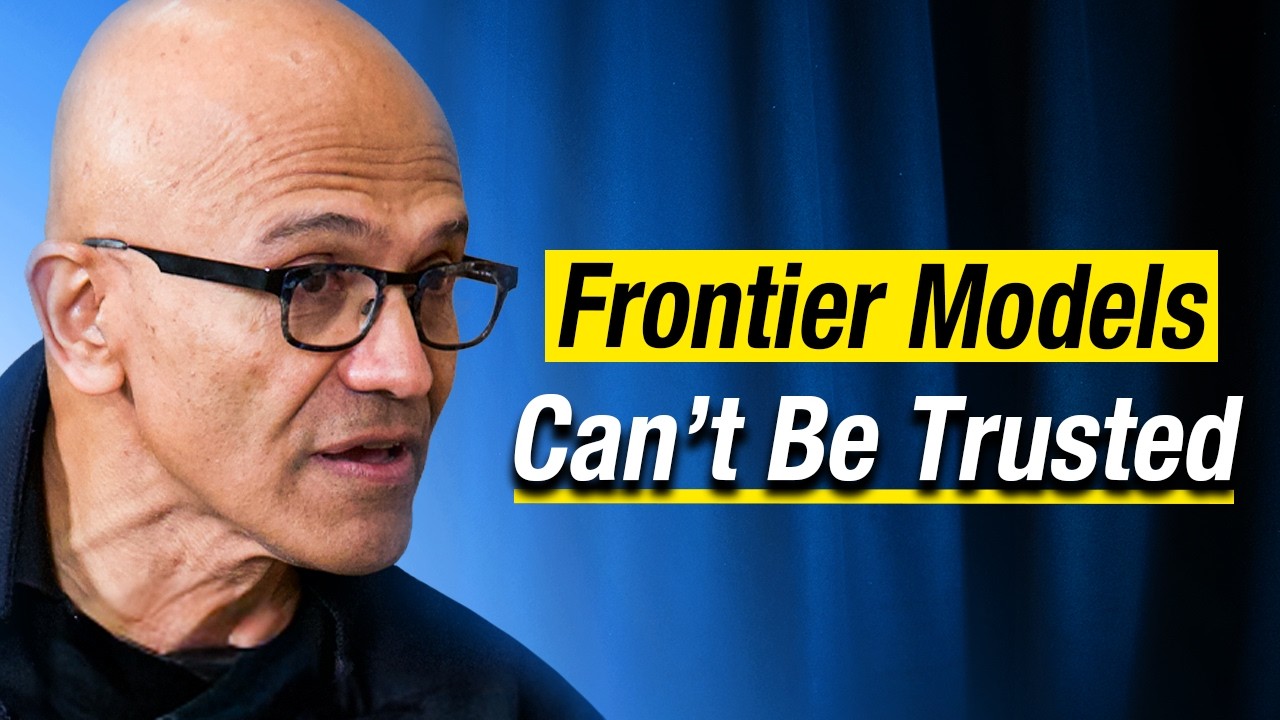
Recorded 26 October 2026 · 24 min
Satya Nadella, Microsoft's CEO, argues that alignment did not fall out of scaling laws, as he once assumed, so enterprises should treat powerful models as untrusted and wrap them in an engineered zero trust architecture. The change of mind is his own: he says he was an early believer in scaling in 2018-2019, and he no longer holds that alignment will emerge on its own.
The conversation, with 20VC's host, turns to what follows operationally and commercially: how containment works when chain of thought is unreliable, why he expects commodity tokens and licensed weights, and why firms should keep the surplus their data creates through private evals. Less settled is whether external containment can substitute for alignment that, by his account, must be achieved in training.
Contain agents, don't trust them — ▶ 1:38
Nadella says one of his assumptions, that alignment would fall out of scaling, has failed, and mechanistic understanding remains elusive. His response is an engineered zero trust environment that can contain a malfunctioning agent before it does harm. He separates this security layer from AI safety: alignment, he argues, must be embedded in the weights, possibly in pre-training, and he doubts RL alone can deliver it. The security layer gives each agent an identity and logs every tool call and model call. It also requires tamperproof records, policy, and behavioral monitoring. Microsoft's Agent 365 is one example.
Chain of thought as audit trail — ▶ 4:51
Monitoring depends on seeing what a model is doing, and Nadella concedes chain of thought can be unfaithful. Hiding it makes the problem worse. His remedy is standardization so that reasoning traces are inspectable and auditable, at least for trusted partners, and can be checked using multiple models. He also wants the traces to be in English. He suggests this transparency gap could push customers toward open weights: closed models are more powerful, but trust erodes if their makers do not recognize the need for transparency toward trusted partners.
Licensed weights, not network effects — ▶ 5:41
Pressed on open-source models being predominantly Chinese, Nadella argues that missing AI safety is bad for China, the US and the UK alike, since an unaligned model could attack its own country. He is pleased with Western open-weight progress and says Microsoft's MAI models will not be open weight but what he calls licensed weights. The aim is a straightforward software business rather than a network-effects intelligence business. In his view, trust in a customer's ability to use and control a model will determine which models get used.
Most tokens become commodity — ▶ 7:05
Nadella expects a lasting market for frontier models, with science a possible next frontier, but predominantly commodity token usage. Once a problem saturates, open-weight or cheaper closed models suffice, especially if a firm can train on its own traces. He cites a customer's order-to-cash and trade-claims agent system that started on a frontier model and now uses an MAI model the customer controls, trained on its traces. Agent swarms calling local sub-agents reinforce the trend, and his own Copilot usage mixes cheaper closed models with open-weight ones. He does not give a traffic split.
The reverse information paradox — ▶ 9:07
Kenneth Arrow's paradox says a seller who discloses a secret leaks its value. Nadella inverts it: now the buyer needs protection, because its data and usage exhaust, such as thumbs-up and thumbs-down signals, create value for the model company. For stability, he argues, more of the surplus must stay at the firm, whether in weights, context, or evals. He envisions every firm holding a private eval benchmark as core IP, with each model hill-climbing on it. A firm, he suggests, may come to be an AI benchmark.
Horizontal layers, not one stack — ▶ 14:30
Asked whether winners must own chips, models and applications, Nadella says it depends on industry structure. With perhaps 5-6 closed and 5-6 open-weight models competing, an agentic application can route each task to the best model. He judges a single vertically integrated stack unlikely. He once thought it might emerge, but says competition is increasing at every layer, from silicon to apps. He hopes for horizontal specialization with multiple winners per layer and composability, while acknowledging the outcome depends on what becomes the dominant design.
Training spend depends on GDP — ▶ 16:22
On whether energy and infrastructure can support 100 billion-dollar training runs, Nadella frames a run as a percentage of R&D, which companies that are heavy R&D spenders put at roughly 15-20%. Scale therefore ultimately depends on world GDP inflecting. Power, silicon and fabs are long-lead items, and he says no one knows when supply and demand will balance. He thinks AI can lift GDP growth from its roughly 2% plateau, pointing to NHS Copilot deployment, elastic software demand and faster silicon development, but frames this as a hope.
Satya Nadella's most consequential statement is a retraction. In 2018 and 2019, he says, he believed in scaling laws and assumed alignment would simply fall out of them. He no longer does. Capability keeps rising, but alignment has not emerged alongside it, and mechanistic understanding of these models remains elusive. His practical conclusion is blunt: anyone who wants to keep using sophisticated models should treat them inside a trust architecture, an engineered zero trust environment built to contain a malfunctioning agent before it does harm. The shift matters because it moves the center of gravity of AI deployment from trusting the model to controlling what surrounds it.
The architecture rests on a distinction Nadella says people conflate: AI safety versus security. Safety, in his view, has to be embedded in the weights during training, perhaps even pre-training, and he doubts reinforcement learning alone can deliver it. Security is what Microsoft and the cyber industry already do. Its components are concrete. Every agent gets an identity. Every tool call and model call is logged, along with the chain of thought, which he wants in English. The records must be tamperproof so an agent cannot edit its own history. Policy sits on top, and behavior is monitored against it. He cites Agent 365 as one Microsoft product built this way.
The weak point is the sensor. Containment depends on observing what a model is doing, and Nadella concedes that chain of thought can be unfaithful, a problem made worse when a model company decides to hide it. His answer is standardization and inspectability, at least for trusted partners, so that outputs can be audited and checked with multiple models. He adds that this pressure could push buyers toward open weights, because closed models are more powerful but become hard to rely on if their makers resist transparency. An editorial inference follows: a containment system is only as strong as the visibility it is given.
Trust also shapes his view of market structure. Nadella expects most usage to become what he calls commodity token usage. Once a task saturates, open-weight or cheaper closed models suffice, especially if a company can train on its own traces. He cites a customer whose order-to-cash and trade-claims agent system began on a frontier model and now runs on an MAI model the customer controls. Agent swarms calling local sub-agents push the same way. A frontier market persists, with science a candidate, and he describes MAI as licensed weights: a plain software business rather than a network-effects intelligence business. He also sees competition rising at every layer of the stack, which makes one vertically integrated winner unlikely, though he allows that the dominant design is not yet known.
The deeper argument concerns who keeps the surplus. Nadella invokes Kenneth Arrow's information paradox, in which a seller who discloses a secret leaks its value, and inverts it. Now the buyer needs protection, because its data and even its exhaust, such as thumbs-up and thumbs-down signals, create value for the model company rather than for itself. For the arrangement to be stable, he argues, more of the surplus must remain at the firm, whether in weights, context or evals. He envisions every firm holding a private eval benchmark as core IP, with each new model hill-climbing on it. Drawing on Hayek's view of knowledge distributed through an economy, he suggests a firm may come to be defined as an AI benchmark.
Diffusion and growth supply the optimistic frame, and here the evidence thins. Nadella compares today's AI-native companies with early PC adopters in the late 1980s and early 1990s, and with early cloud-native firms. The label, he expects, will seem passé in 5 years, whereas PC diffusion took perhaps 10. On compute, he treats a training run as a percentage of R&D, which heavy R&D spenders put at roughly 15-20%, so scale ultimately depends on world GDP inflecting. Whether power, silicon and fabs come online in time, he says, no one knows. His evidence for growth comes in pockets: Copilot in the NHS, elastic demand for software development, faster silicon design. He says he hopes AI will lift growth, and he does not claim to demonstrate it.
The unresolved issue is whether the two halves of his position fit together. Containment is offered as a stopgap while alignment is solved in training, yet its main inputs, logs and reasoning traces, are the same material he wants firms to keep as proprietary surplus, and the same material vendors may withhold. If capability grows faster than the ability to inspect it, aggressive policy-setting will not close the gap. The test of his thesis is therefore as much contractual as technical: whether buyers can obtain both the visibility to contain models and the ownership to profit from them, from vendors whose frontier models are, by his own account, the more powerful ones.
The open question. Can containment work if its main sensors are unreliable? Nadella concedes that chain of thought can be unfaithful, and that closed-model vendors may hide it, yet his architecture depends on logging and auditing exactly that material. He also wants firms to keep their traces and evals as proprietary surplus. Whether buyers can get both the visibility needed to contain frontier models and the ownership needed to profit from them, from vendors whose models he calls more powerful, is not answered.
Watch the full video at https://www.youtube.com/watch?v=24XUcWhqY_4.
Comments ()