Recorded 24 October 2026 · 16 min
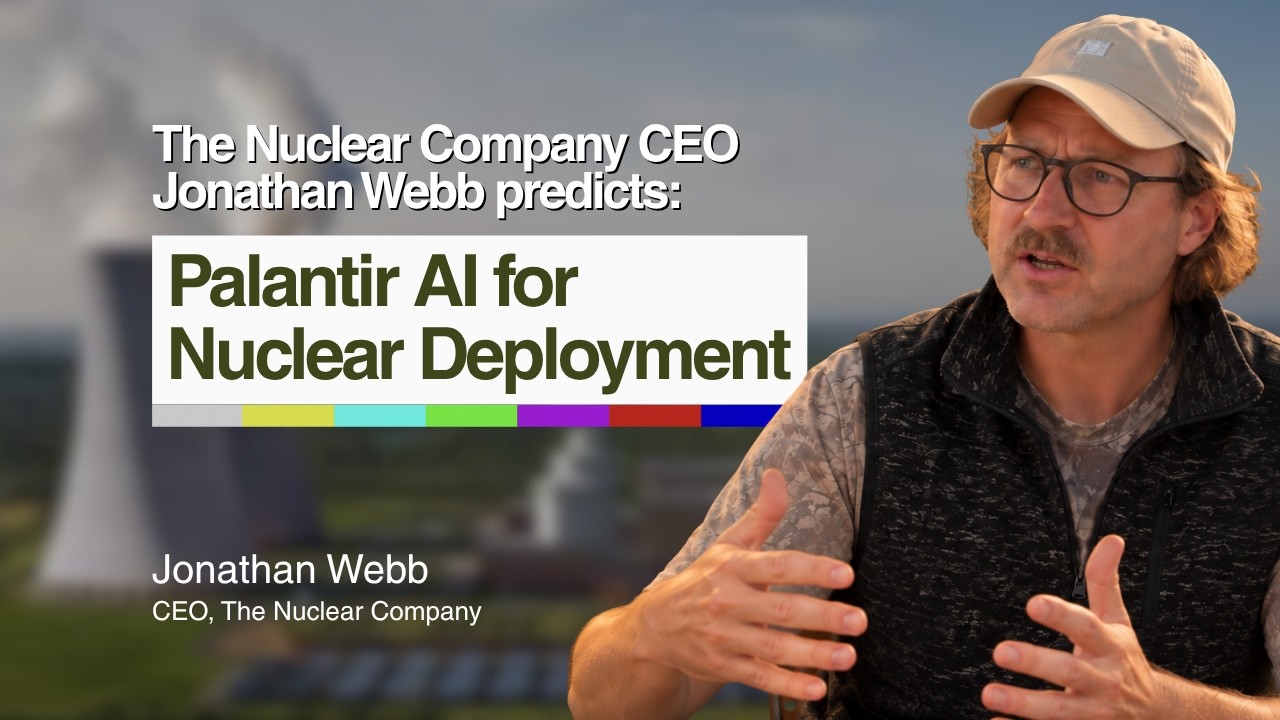
Jonathan Webb, CEO of The Nuclear Company, argues that Vogtle's cost and schedule overruns came from two fixable failures: a reactor design that was not finished when construction began, and very low construction labor efficiency. The day the company announced Prosperity 1, a proposed 6.6 gigawatt nuclear campus in Lewis County, Kentucky, he told the MTS host that the project rests on Westinghouse's AP1000, now a mature design, and on Palantir-based tools that give frontline workers real-time information.
What makes the discussion worth reading is the gap between diagnosis and proof. Nothing has been built, permitting for a greenfield site lies ahead, and Webb declined to name power buyers. His efficiency figures are his own estimates, and they differ between the opening clip and the interview. The central question is whether software and better preparation can deliver gains that 10,000 workers over 12 years did not.
Infrastructure-first site selection — ▶ 1:31
Prosperity 1 occupies about 4,000 acres on the Ohio River in Lewis County, Kentucky, chosen after Webb's team screened about 1,500 properties across roughly a dozen states. His case is physical. A 765 kV line, which he calls the largest transmission line in the country, connects the site to PJM. The river holds about 6 times the water the reactors would need. Rail and barge access handle materials. He adds that regional coal plant closures created the need for new power, and pitches the site for fleets of any reactor type.
Why the AP1000 — ▶ 2:41
Webb chose Westinghouse's AP1000 because the company wants gigawatts on the grid quickly and can apply Vogtle's lessons on what went right and wrong. He says the Georgia units reached about a 93% capacity factor once running, despite cost and schedule problems during construction. The plan is to permit a greenfield site with the Nuclear Regulatory Commission, citing federal priority on nuclear. He calls it realistic to start non-nuclear construction in 2027 and reach full-scale work in 2028. That is a target, not a regulatory commitment.
Finished design before construction — ▶ 4:38
Webb's first explanation for Vogtle's overruns is design maturity. Construction began without a finished design, and he cites a thousand design changes during the build. In his telling the AP1000 design is now finalized, so a new project should avoid that churn. The implication, which is the editor's inference, is that the overruns reflected design immaturity rather than reactor performance, which matches his praise for how the units run. He offers no figure for how much of the overrun the design changes caused.
Labor efficiency as the lever — ▶ 4:55
Webb's second diagnosis is productivity. Vogtle 3 and 4 employed roughly 10,000 people over 12 years, he says, at maybe 15-30% labor efficiency (the opening clip says 15-20%). Reaching even 60%, which he calls still very low, would sharply cut schedule and therefore cost. His mechanism is a Palantir-built nuclear ontology that merges millions of logistics and supply chain data points to give frontline workers, whom he calls the client, real-time information. He does not explain how efficiency was measured or what results the system has produced.
Betting on regional workforce — ▶ 5:55
Webb names two advantages: the physical quality of the site and the people of the region. He says the company is betting its future on the workers of eastern Kentucky, southeast Ohio and West Virginia, drawn from coal and Rust Belt industries. Technology will be used heavily on site, but he stresses that building the assets still takes people. The position is notable because it pairs a software-driven productivity thesis with a labor-intensive build. He gives no figures on workforce size, training, or availability.
Neighboring demand, unsecured offtake — ▶ 8:01
Webb points to load growth around the site: a data center campus about 10 miles west, another about 20 miles east, the DOE campus in Piketon, Ohio, about 50 miles north, and a Nucor steel campus being built in West Virginia. This arrives as coal plants are retired and baseload leaves the grid. But these are neighbors, not announced customers. Webb says he is in many conversations and looks forward to securing the offtake that will be needed, which implies it is not yet secured. He said he could not discuss everything.
China framing and near-term milestones — ▶ 11:31
Webb casts the project as a national test: the US has one competitor, China, and in his view China is winning. The site, he says, will show that big things can be built again with lower cost and schedule, without compromising quality or safety. Near-term steps are concrete: teams begin confirmatory analysis on site the following week, followed by laydown yards, with materials arriving by CSX rail and barge. He frames the effort as needing the country's best talent, from partners and new hires alike.
The Nuclear Company's pitch is that the AP1000's troubles at Vogtle were failures of preparation and execution, not failures of the reactor. Jonathan Webb is explicit about the machine's merits. He says the Georgia units reached a 93% capacity factor once operating, and calls the AP1000 a great asset to run. What went wrong, in his account, was the build. That framing matters because it underpins the whole business case. If the technology is sound and the problems were managerial, they are fixable by a new project team. If the problems were inherent to the reactor, they are not.
Webb offers two specific causes. The first is design maturity. Vogtle's builders started before the design was finished, and he cites a thousand design changes during construction. Scaling a reactor under those conditions, he says, was the problem, and the design has since been finalized. The second cause is labor. By his description, 10,000 people worked for 12 years at maybe 15-30% efficiency. The opening clip gives 15-20%, so the figure is soft. Even raising it to 60%, which he still calls very low, would produce what he calls a massive reduction in schedule and, as a result, in cost.
The mechanism he proposes for that productivity gain is software. Working with Palantir, the company is building what Webb calls a nuclear ontology for deployment, merging millions of data points from logistics and the supply chain. The goal is to give frontline workers, whom he calls the client, real-time information about what to do and what they need. The logic is plausible: if most of a megaproject's labor cost is idle or misdirected time, better coordination should recover some of it. But the transcript supplies no evidence of results. It does not explain how the 15-30% baseline was measured or what improvement the system has delivered anywhere.
Site selection is the second pillar. The company says it screened about 1,500 properties in roughly a dozen states before settling on 4,000 acres in Lewis County, Kentucky. The reasons are physical and verifiable in principle: a 765 kV line connecting to PJM, a river with about 6 times the water the reactors would need, and rail and barge access. These matter because they remove infrastructure risk from a project where delay is the central enemy. Webb pairs this with a workforce argument, saying the company is betting its future on the people of eastern Kentucky and the surrounding region.
Demand is where the argument is thinnest. Webb notes data center campuses 10 and 20 miles away, the DOE campus in Piketon, Ohio, about 50 miles north, and Nucor's steel campus in West Virginia, all while coal plants close. The regional supply gap is real in his telling. Yet none of these is an announced customer. Webb says he is in many conversations and looks forward to securing offtake, which suggests the power is not yet sold. Proximity to demand is a good starting position. It is not a contract.
The timeline carries a similar caveat. Webb says non-nuclear construction could realistically begin in 2027 and reach full scale in 2028, with the NRC reviewing a greenfield application and federal policy supportive of nuclear. He frames the stakes geopolitically: the US has one competitor, China, and he says it is winning. Those claims are his judgment, not findings. Nor does he say how long a greenfield permit will take, which is the variable most likely to determine whether 2028 holds.
What the interview ultimately lays out is a sequencing bet. The company has de-risked what it can control before breaking ground: site, design, and data tooling. The parts it cannot yet control, permitting and offtake, remain open. The test of the productivity thesis will come only after the early site work, when thousands of workers are on a nuclear build and the measured efficiency can be compared with the number Webb claims Vogtle achieved.
The open question. Can data-driven coordination really lift construction labor efficiency from Webb's estimated 15-30% toward 60% on a nuclear build? The transcript gives no method for measuring that baseline, no evidence the Palantir-based system has changed outcomes on a comparable project, and two different versions of the figure. Until nuclear construction begins, which Webb places after the 2027 non-nuclear work, the claim stays unverifiable, and so do the schedule and cost reductions that depend on it.
Watch the full video at https://www.youtube.com/watch?v=esf5hIJZ7bs.
Comments ()