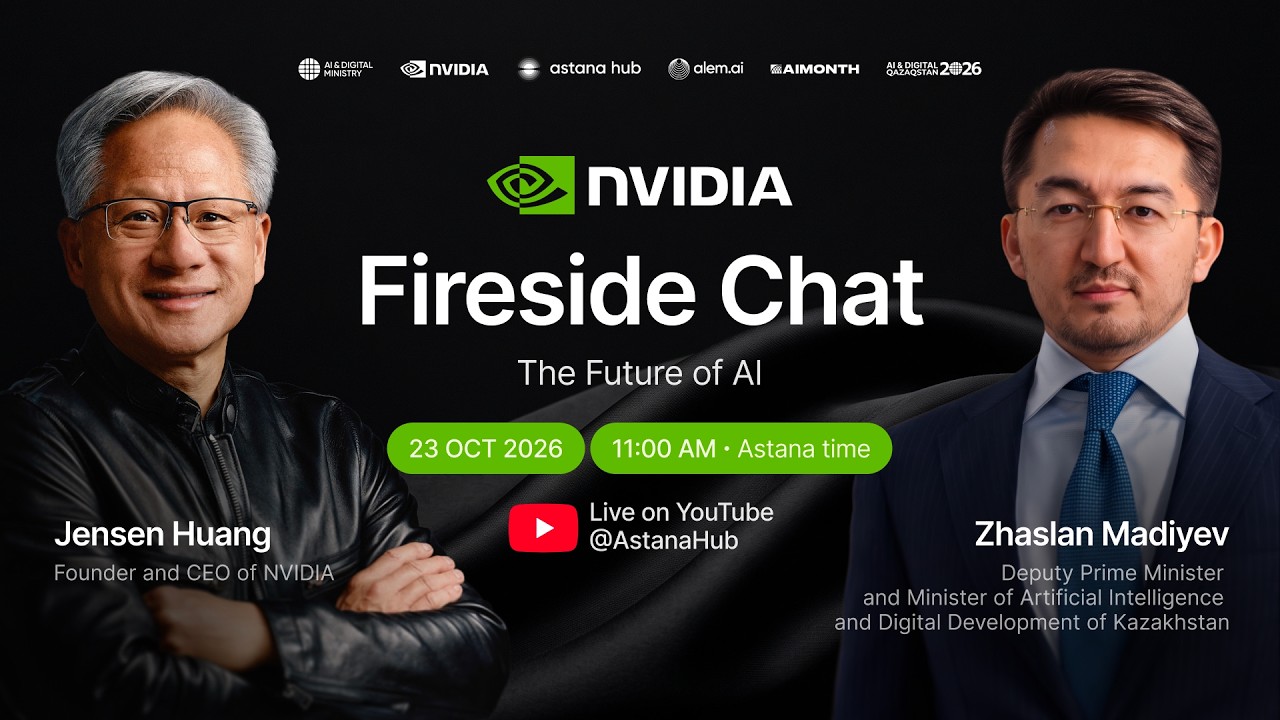
Recorded 23 October 2026 · 64 min
Nvidia CEO Jensen Huang told a Kazakhstan audience that a country's electricity and data are natural resources, and that the strategic move is to convert them into intelligence rather than export them raw. He frames AI as manufacturing: intelligence must be generated in real time, so it needs factories fed by energy, data and demand.
The chat, moderated by the country's Deputy Prime Minister and AI minister, closed Kazakhstan's AI month. Its tension lies between a sweeping sovereignty thesis and thinner answers to concrete questions on jobs, security and model training. What Huang specified is separable from what he asserted, and the difference matters for anyone sizing a national AI bet.
AI as manufacturing — ▶ 23:15
Huang argues AI is not only a general-purpose technology but a new industry, because intelligence has to be generated in real time for each use and cannot be precomputed. That requires a new kind of factory. Nvidia supplies the computing systems; the inputs, in his telling, are electricity, data and offtake, meaning demand. The framing treats AI as an industrial process with raw materials, which is why energy sits at the base. The moderator noted that Kazakhstan plans to almost double installed capacity by 2035, to above 40 GW.
Export intelligence, not energy — ▶ 24:57
Kazakhstan, rich in energy, could transform that energy into intelligence and export intelligence instead of the raw resource. Doing so requires processing its own data, which Huang describes as encoding the country's culture, history and values, and which he says belongs to the country just as mineral resources do. He cites the Kazakh-language model as an early example. Combined with Nvidia computation, he says, these inputs can drive the national AI economy. The transcript does not explain how exported intelligence would be priced or sold.
Sovereignty as national security — ▶ 28:07
Huang calls building a national model a national security concern. Intelligence is foundational and produced from a country's data, so exporting that data to import intelligence makes no sense. He compares it to owning telecom operators and an electric grid, and says a country needs its own intelligence grid. Foreign suppliers may supplement it but not supply it entirely. His practical case rests on adaptation: applying open-source technology is easier than inventing it, though not easy. The moderator's question on training from scratch received no explicit threshold.
Physical AI beyond robotics — ▶ 32:34
Huang calls physical AI the largest AI industry because most of the world involves interaction with the physical world, and says it extends well beyond robots. His list covers seismic understanding, mapping mines and wells, geology, materials science, chemical processing and turning minerals into new materials. That maps onto Kazakhstan's mining, agriculture and heavy industry. He stresses that everyone is at the beginning, which he presents as an opening for newcomers. He called the moderator's hub idea an imperative but announced no specific Nvidia commitment.
Ambition as the variable — ▶ 35:54
Asked about jobs, Huang answers that the only thing that matters is ambition. AI amplifies intent: a farmer expands the operation, a scientist explores more, an engineer tests better designs. The same holds for children, since AI helps a child who wants to learn more learn more, and helps one who wants to do less do less. Responsibility therefore falls on parents and leaders to instill aspiration. The answer is a claim about tools as amplifiers and does not address displacement of workers whose roles are automated.
Investing in people — ▶ 41:45
Explaining Nvidia's investment in Higgsfield, which the moderator called Kazakhstan's first AI unicorn with a team averaging 25 years old, Huang says the first and last rule is to invest in people, not companies. He points to roughly 600 staff, up from about 150, offices in Kazakhstan and the United States, and competitors in San Francisco that are well funded and formidable. The founders bridge two cultures and compete globally. No investment amount or valuation criteria beyond team quality were given.
Compute hub for Europe — ▶ 43:47
Huang argues Kazakhstan's land, energy and a planned 1 gigawatt data center valley could make it an AI factory and computing hub for all of Europe. He credits its telecommunications interconnection with placing the country in the middle of the European AI ecosystem. The moderator had earlier described the valley as designed around tens of thousands of advanced Nvidia chips. The argument links infrastructure to geography, but no demand figures or customers were offered for that capacity.
OpenShell contains agents — ▶ 45:03
Asked whether Nvidia hardware would embed protections against hacked or jailbroken models, Huang compared agents to self-driving cars or robots inside a computer. Given file and tool access, they roam freely, so their privileges must be limited to what the job needs and monitored at all times. Nvidia's answer is OpenShell, which he urged everyone to adopt. This is software containment; whether hardware-level protections are planned, the actual question, went unanswered. He likens safety to mining and autonomous driving: built in from the start.
Agentic reasoning made AI useful — ▶ 47:14
Huang says he is more enthusiastic than a year ago because agentic systems have made AI useful. His example is Higgsfield video, which moved from short clips to long videos that remain temporally and physically consistent and tell a story, which he says is not possible without agentic reasoning. He lists coding, robotics and drug discovery as other beneficiaries without evidence. The moderator cited an AI film festival with more than 8,000 submissions, over 100,000 minutes, 120+ countries and a $2 million prize pool.
Program AI, understand machinery — ▶ 49:37
Advising an 18-year-old, Huang says to become the world's best programmer of AI, arguing that after 43 years in computing, programming the computer is giving way to programming AI. Asked whether that means technical or social skills, he says both: the best user of a machine understands how it works, as the best race car driver understands the car. That includes its principles, strengths, weaknesses and trajectory. This qualifies his earlier claim that ambition is the only thing that matters.
Jensen Huang's central argument is that AI should be understood as manufacturing, and that manufacturing needs raw materials. Intelligence, he says, has to be generated in real time for every use and cannot be precomputed. That makes it a production process, and production needs factories. Nvidia supplies the computing systems inside them, but the inputs are electricity, data and what he calls offtake, meaning demand. The framing explains why a conversation with a government minister turned so quickly to energy. The moderator, Kazakhstan's Deputy Prime Minister and AI minister, noted that the country plans to almost double its installed capacity by 2035, to above 40 GW. In Huang's logic, a country holding electricity and data holds the inputs to the new industry.
From that premise Huang draws a strategic recommendation: instead of exporting energy, Kazakhstan could convert it into intelligence and export that. Conversion requires a second input, the country's own data, which he describes as encoding its culture, history and values, and which he insists belongs to the country just as mineral resources do. The Kazakh-language model the moderator described, built on open-weight foundation models with a locally built tokenizer, is the early example. The logic is neat, but the transcript leaves the commercial mechanism blank. It does not say who would buy exported intelligence, at what price, or how it differs from selling compute. The argument is a framework rather than a business case.
Huang goes further and calls sovereign AI a national security concern. His reasoning runs by analogy. Countries run their own telecom operators and electric grids, and the same should hold for an intelligence grid, because intelligence is general-purpose and touches every citizen, company and country. Exporting a people's data to import their intelligence, he says, makes no sense. Foreign companies can supplement, but not supply everything. Two details qualify the argument. First, his practical case rests on adaptation rather than invention: building a Kazakh model is sensible, he says, because applying open-source technology is easier than inventing it, though not easy. Second, the moderator asked when training a foundation model from scratch becomes worthwhile, and the answer set no threshold.
Physical AI is where the resource argument becomes concrete. Huang calls it the largest AI industry because most of the world involves interaction with the physical world, and he insists it is broader than robotics. In his list it includes seismic understanding, mapping mines and wells, geology, materials science, chemical processing, and the move from mineral extraction to new materials. For a country with mining, agriculture and heavy industry, that maps directly onto existing strengths. He also says everyone is at the start of the journey, which he presents as an opening for newcomers, and he expects artificial general robotics to emerge alongside cognitive AI. The moderator pitched Kazakhstan as a training hub for physical AI models. Huang called the idea fantastic and an imperative, but announced no specific Nvidia commitment beyond saying it already works with the robotics companies he saw.
Evidence that the strategy is working is mostly infrastructural and anecdotal. The planned data center valley has 1 gigawatt in prospect, and Huang described the telecommunications interconnection as putting Kazakhstan in the middle of the European AI ecosystem, making it a computing hub for the continent. The moderator added that the valley is designed around tens of thousands of advanced Nvidia chips. On the human side, the showcase is Higgsfield, which the moderator called the country's first AI unicorn, with a team averaging 25 years old. Huang said he invests in people, not companies, noting roughly 600 staff, up from about 150, offices in Kazakhstan and the United States, and well-funded competitors in San Francisco. Nvidia has invested, though no amount was given. One company is a thin base for a national thesis.
The weakest section of the argument is demand. Huang names offtake as a required input, yet says it comes from leadership inspiring young people, universities and industries to engage. Asked about jobs, he gave the same answer in a broader form: the only thing that matters is whether you have ambition. AI, in his account, amplifies intent. A farmer with ambition uses robots to expand; a scientist's assistant widens what can be explored; a child who wants to learn more will learn more, and one who wants to do less can be helped to do less. That is a coherent claim about tools as amplifiers, and it puts responsibility on parents and leaders. It does not address displacement directly, or what happens to people whose roles are automated rather than extended.
Safety got a more concrete answer, though to a slightly different question. The moderator asked whether Nvidia hardware would embed protections against hacked or jailbroken models. Huang compared agentic systems to self-driving cars or robots inside a computer: given access to files and tools, they roam freely, so their privileges must be limited to what the job requires and monitored continuously. Nvidia's answer is OpenShell, which he urged everyone to use. The description is of software containment built around limited privileges and constant monitoring. Whether any protection is planned at the hardware level, the thing actually asked, remained unanswered. The framing also treats safety as an engineering problem still being invented, which fits his comparison to mining and autonomous driving, where safety is built in from the start.
Huang's optimism rests on a specific technical claim: agentic reasoning systems made AI useful this past year. His example was Higgsfield's video generation, which moved from short clips to long videos that stay temporally and physically consistent while telling a story, something he says is not possible without agentic reasoning. He listed software coding, robotics and drug discovery as other fields where usefulness has arrived, without evidence beyond the video example. The moderator offered a data point on creative uptake: an AI film festival with more than 8,000 submissions, over 100,000 minutes of video, entrants from more than 120 countries and a $2 million prize pool. These are signs of activity rather than proof of economic value, but they indicate wide participation.
His advice to an 18-year-old sits in some tension with the ambition thesis. Having said ambition is the only thing that matters, Huang told the questioner to become the world's best programmer of AI, and when asked whether that meant technical skills or social sciences, said both. The best user of a machine understands how it works, as the best race car driver understands the car: its principles, strengths, weaknesses and trajectory. After 43 years in computing, he frames AI as a reset in which programming the computer gives way to programming AI. The practical message is that motivation is necessary but literacy is not optional. That matters for Kazakhstan's education push, because ambition without understanding of the machinery would not meet his own standard.
The framework hangs together: energy and data in, intelligence out, with ambition supplying demand. What it lacks is quantification at the point where it matters. The moderator cited a total addressable market for AI above $50 trillion and an energy plan reaching above 40 GW, but neither figure was tested, and Huang offered no estimate of how much domestic or export demand would fill 1 gigawatt of capacity. There is also an unexamined overlap between sovereignty and supply. The stack Huang recommends combines national data and energy with Nvidia computation, while he argues that foreign supply should only supplement. Where that line falls, and whether ambition can generate offtake fast enough to justify the factories being built, is the test the conversation did not attempt.
The open question. Huang names offtake as a required input to AI factories but says it comes from inspiration, with no estimate of how much domestic or export demand would fill a planned 1 gigawatt of capacity. The moderator's AI market figure above $50 trillion went unexamined, and so did the mechanism for exporting intelligence. Can Kazakhstan's ambition generate enough paying demand, at home and abroad, to justify the factories before the energy and chips are in place?
Watch the full video at https://www.youtube.com/watch?v=d0j58QNeRmc.
Comments ()