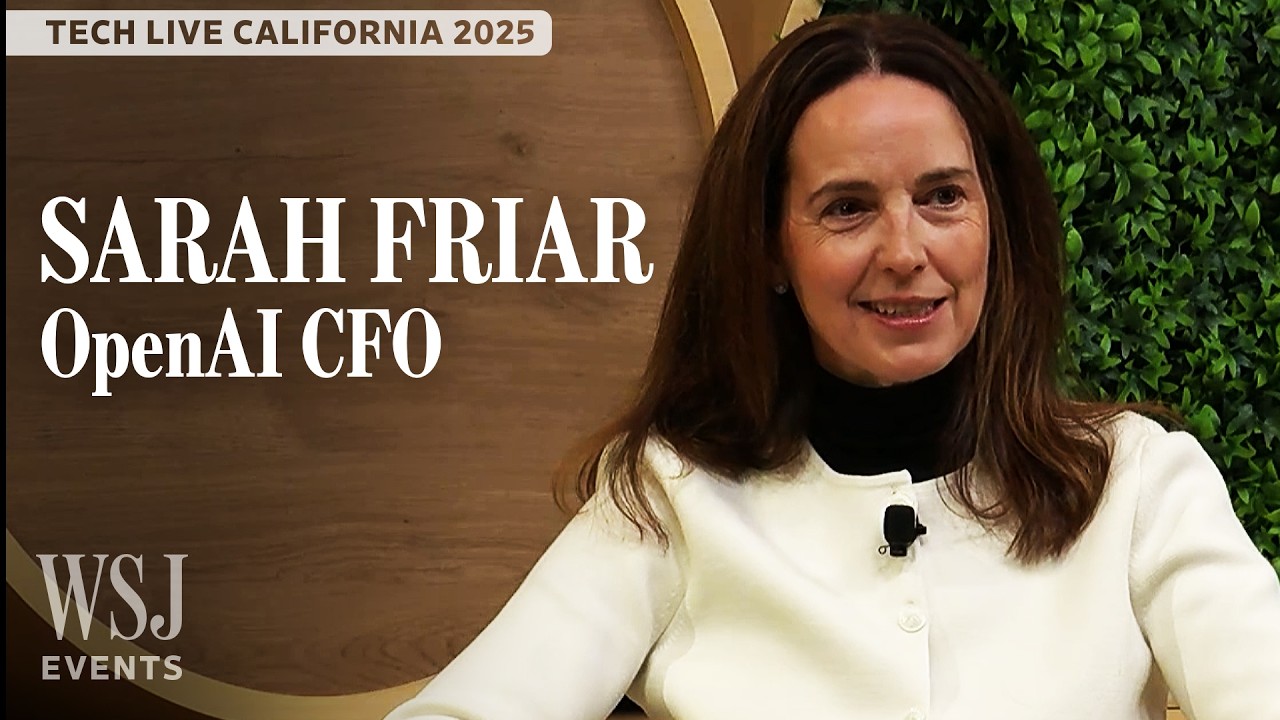
Recorded 29 October 2026 · 49 min
Sarah Friar, OpenAI's CFO, makes one claim repeatedly in this onstage interview: the company's growth is limited by compute, not demand. OpenAI ends the year at about 2 gigawatts, 10x its capacity two years ago, and Friar floats a scenario of 20 gigawatts within two years. She says shortages already keep finished products from market, which she uses to justify financing at country scale.
The tension is how to pay for it. A 1-gigawatt build costs about $50 billion, and the chips, which make up most of that, are hard to finance because nobody knows how long they stay useful. Friar's answers rest on assertions the transcript gives no figures to test: healthy margins, a rejection of the circularity critique, and a dismissal of reported losses.
A 10x compute curve — ▶ 3:17
OpenAI ends this year at about 2 gigawatts, versus roughly 200 megawatts two years ago. Friar asks the audience to imagine another 10x, to 20 gigawatts in two years, a scale she compares to the island of Ireland's 6-7 gigawatts of use. She frames AI as electricity with the lights just switched on, before heating, appliances and everything else. The 20-gigawatt figure is a hypothetical curve she posed, not a stated plan, but she says with certainty that OpenAI is massively constrained on compute today.
Aligning partners through warrants — ▶ 3:48
Friar lists three funding sources: private equity raised, fast-rising free cash flow, and ecosystem financing. Her example is the AMD warrant structure, built on the observation that announcing a deal with OpenAI often lifts a partner's stock price. OpenAI wants a share of that effect, so both sides get paid together when either does well. She calls it very strong incentive alignment and says OpenAI will go deeper on similar structures, though she gives no specifics on what comes next.
Chips are the hard financing — ▶ 5:14
A 1-gigawatt build costs about $50 billion: roughly $15 billion for land, power and shell, and $35 billion for frontier Nvidia chips. Data centers have 20-30 year lives and are easy to finance. Chips are harder because their time on the frontier is uncertain: 3, 4, 5 years or longer. Friar notes that A100-class chips are still used after 6-7 years when compute is scarce, which would ease financing. She wants a government backstop or guarantee to lower borrowing costs and raise loan-to-value, but says nothing is in the works.
Scarcity delays launches — ▶ 8:25
Friar defines compute constraint concretely. Sora 2 probably waited 6-7 months between readiness and launch. Pulse, a proactive overnight agent using memory, sits in the $200-per-month Pro tier because there is not enough compute to serve it to Plus or free users, not because of monetization strategy, she says. She defends Sora's compute cost as training for world simulation, a team name inside OpenAI, which she believes is central to multimodal AI. She offers no return-on-investment analysis for that choice.
Subscription protects answer integrity — ▶ 13:28
Revenue grew from $1 billion two years ago to $4 billion last year and $13 billion this year, built first on subscriptions. Friar argues this lets OpenAI add other models without compromising a commitment to the best answer, not the sponsored one. Commerce emerged because deep-research users could not complete purchases in the app. OpenAI takes part of the seller's economics through partners such as Walmart, Shopify and Etsy. She floats Instagram-style ads in Sora and possible value-sharing in research deals, but says nothing is in place.
Enterprise mix tips to 60/40 — ▶ 18:29
Consumer revenue was about 70% at the start of the year and enterprise 30%; the split is now tipping to 60/40. Enterprise revenue grew about 9x year over year, and OpenAI announced 1 million enterprise customers that morning. Friar says customers are moving from pilots to production and from wall-to-wall ChatGPT toward API use. Amgen uses the product to speed FDA submissions by weeks to months. Walmart uses it for merchandising and risk. Focus sectors are financial services, healthcare and consumer packaged goods.
From historians to insight — ▶ 21:03
Friar's own finance team shows the augmentation argument. Junior accountants once chased variances in the monthly or quarterly flux review, mostly confirming miscoding or typos. An agent now scans the line items and checks Slack and Google Docs for explanations, such as a decision to expand performance marketing that explains a 300% jump. People then discuss ROI instead. She cites a Wharton study showing junior jobs are not disappearing, but concedes that customer success is an area where chatbots work without humans. Her evidence is anecdotal.
Margins as the safety valve — ▶ 24:16
Asked about an implied $11.5 billion September-quarter loss from a Microsoft filing, Friar calls it a way overestimation without giving her own figure. She says there is no IPO preparation. She is not focused on break-even because the business is growing about 9x and has gross margins akin to good software, so she could reach break-even by pulling back investment. These margin claims come without numbers, so the claim that growth spending is a choice rather than a necessity cannot be verified.
Rejecting the circularity charge — ▶ 28:55
Pressed on a loop in which OpenAI is both customer and shareholder of CoreWeave, whose largest customer is Microsoft, an OpenAI investor and partner, Friar rejects the premise outright. She describes the web of deals as supply-chain build-out like any other business. Her substantive point is diversification: a year ago OpenAI bought compute almost solely from Microsoft, and it now wants multiple vendors for design choices, efficiency and price competition. She does not address the financial structure of the loop directly.
Memory raises both value and risk — ▶ 33:56
Friar names memory as ChatGPT's first principle. It lets apps like Booking.com or Expedia know a user's preferences, which she expects to raise conversion rates. Study mode shows personalization as changed behavior, using Socratic questioning rather than only answers. She acknowledges harms and says OpenAI pulled back a sycophantic model and published a long post. Her mitigation for addiction is user-controlled personalization, such as asking for more closed-ended answers. For enterprise she cites SSO and says OpenAI does not train on customer data.
Expert across three inputs — ▶ 40:03
Friar defines OpenAI's identity as being the expert at the frontier, resting on compute, data and researchers. She says the logarithmic scale for pre-training is intact, post-training is still on an exponential and test-time compute is being explored. Data comes from licensing deals, including News Corp, Le Monde and the FT, plus synthetic data. She asserts OpenAI is where breakthrough researchers want to work, since AI is all it does. All of this is her own characterization of the company, without comparative evidence.
AGI as economic work — ▶ 45:46
OpenAI defines AGI as models capable of the majority of economically valuable work. Its economics team published GDPEval, which breaks sectors into job types and sums how much work a model could do or accelerate. Friar adds that public perception matters: people need to feel the change in their lives, and journalism, governments and educators should foster optimism that is neither Pollyannaish nor doomerism. The Foundation, which she calls among the largest nonprofits ever created, can fund work the for-profit would find harder.
OpenAI's CFO, Sarah Friar, begins from a claim that reverses the usual worry about AI spending: the company is limited by supply, not demand. Her evidence is operational. Sora 2 probably waited 6-7 months between readiness and launch. Pulse, an agent that works overnight using memory, is confined to the $200-per-month Pro tier because there is not enough compute to run it for Plus or free users. She insists this is not monetization strategy. If she is right, every gigawatt added unlocks products that already exist, and the spending looks less like speculation than like backlog. That framing is hers, and the transcript offers no independent demand data beyond OpenAI's own usage figures.
The scale she describes is large. OpenAI ends this year at about 2 gigawatts, against roughly 200 megawatts two years ago. Friar asks the audience to imagine another 10x, to 20 gigawatts in two years, which she compares to the 6-7 gigawatts used by the island of Ireland. That figure is a scenario, not a commitment. But it explains why she thinks the finance has to be as inventive as the engineering. Her electricity analogy carries the same logic: the lights are on in a few homes, and the heating, the appliances and the rest of the grid have not been built.
The hardest financing problem is chips. A 1-gigawatt build costs about $50 billion, roughly $15 billion for land, power and shell and $35 billion for frontier Nvidia chips. Lenders know how to finance data centers with 20-30 year lives. Chips are different because nobody is sure how long they stay on the frontier, whether 3, 4, 5 years or longer. Friar notes that A100-class chips remain in use after 6-7 years when compute is scarce, and that longer lives make financing easier. An editorial inference follows: the scarcity she describes is itself an argument for chip longevity, so her demand thesis and her financing thesis lean on each other.
Hence the search for new capital. Friar names equity raised as a private company, free cash flow that is climbing quickly, and ecosystem deals. Her favorite example is the AMD warrant structure, designed around the observation that a partner's stock often rises when it announces work with OpenAI, so OpenAI wants a share of that effect. She also welcomes a government backstop or guarantee, which would lower borrowing costs and raise the loan-to-value ratio, and she says the US government has seen AI as a strategic asset in competition with China. On whether anything tangible is in the works, she says nothing is going on and nothing is to be announced.
The revenue case is the other half of the argument. Friar reports $1 billion in revenue two years ago, $4 billion last year and $13 billion this year, built first on a consumer subscription that she says people once would have called crazy. Enterprise is catching up fast: the mix is tipping from 70/30 consumer-to-enterprise toward 60/40, enterprise revenue grew about 9x year over year, and the company announced 1 million enterprise customers. She cites Amgen using the product for faster FDA submissions and Walmart using it for merchandising and risk. Pricing may move toward value, through credits, research deals and perhaps revenue sharing, though nothing is in place.
The subscription base, in her telling, also lets OpenAI add commerce without selling out the answer. She says users did deep research on cars, strollers and coffee pots but could not complete the purchase in the app, so OpenAI now takes part of the seller's economics through partners such as Walmart, Shopify and Etsy. The north star, she says, is the best answer, not the sponsored one. Yet she also floats Instagram-style ads around Sora's visual content. The two positions are not necessarily contradictory, but the boundary between a rev-share on transactions and paid placement is exactly where the claim will be tested, and she gives no mechanism for enforcing it.
Labor is the area where her evidence is thinnest. Friar describes an agent in her own finance team that scans the flux review, the comparison of actuals against plan across hundreds of line items, and checks Slack and Google Docs for explanations. Junior accountants who used to chase miscodings and typos can then focus on insight. She cites a Wharton study suggesting entry-level jobs are not disappearing, and concedes that customer success can run with chatbots and no humans in the loop. A single team's experience and one study do not settle the white-collar question the interviewer raised, and she does not claim they do.
The financial claims carry more weight and offer fewer numbers. Asked about an implied $11.5 billion loss in the September quarter drawn from a Microsoft filing, Friar calls it a way overestimation, without giving her own figure. She says gross margins in both consumer and enterprise are akin to good software companies, and that she could reach break-even by pulling back investment. She also says the company is not preparing for an IPO. Her answer on circularity is similarly assertive: she rejects the premise, points to the diversification away from Microsoft as nearly sole compute supplier a year ago, and does not address the specific CoreWeave-Microsoft loop the interviewer described.
On product and safety, Friar says memory is a first principle, because it makes apps such as Booking.com or Expedia faster and more relevant and, she expects, lifts conversion rates. She also acknowledges the risks of sycophancy and over-reliance, saying OpenAI pulled back a sycophantic model and published a long post. Her mitigations are largely user-driven, such as asking the model for more closed-ended answers and reminders about human relationships. That puts the burden of avoiding addiction on the user, in a product whose commercial logic rewards deeper personal data and more engagement.
Beneath all of this sits a technical bet. Friar says the logarithmic scale for pre-training is intact, post-training is still on an exponential, and test-time compute is being explored. She defines AGI as models capable of the majority of economically valuable work, measured through GDPEval. The financing thesis stands or falls on whether those scaling returns persist while chips retain useful life. If both hold, her scarcity story is plausible. If either weakens, the claim that growth spending can simply be dialed back becomes the question that matters, and the transcript gives no numbers to answer it.
The open question. Friar's financing logic depends on two assumptions she never quantifies: that frontier chips retain enough useful life to be financed against, and that returns to additional compute keep justifying the spend. If chip economics turn out shorter-lived than the hopeful case, the claim that OpenAI could reach break-even by pulling back investment would need to be tested against gross margins and a cost base of roughly $50 billion per gigawatt. Which of her assumptions fails first?
Watch the full video at https://www.youtube.com/watch?v=rPPtj_RxUCI.
Comments ()