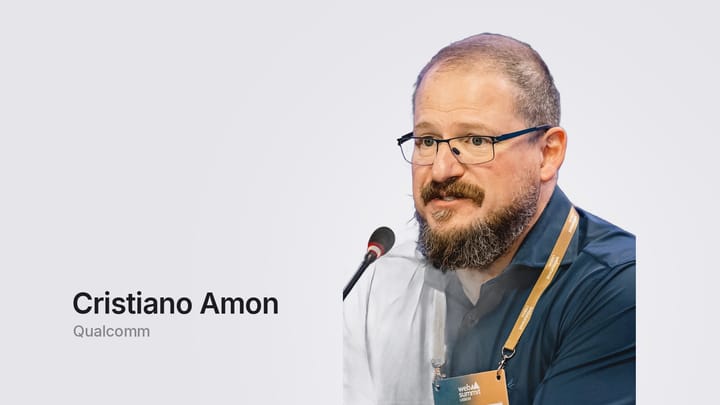

Recorded 9 October 2026 · 46 min
The AI smartphone will be defined by third-party agents, not by features a phone maker bundles into its OS. Qualcomm CEO Cristiano Amon draws the parallel to the iPhone launch: Nokia and BlackBerry matched the roughly 15 bundled apps and missed that outside developers were the product.
Amon's chips sit in Android phones, smart glasses, cars and, increasingly, data centers. The conversation is about where AI compute ends up. The tension is cloud versus edge. Agentic products like Muse run in cloud VMs, which seems to sideline the phone. Amon rejects the framing: personal context, sensor data and local apps live on the device, so cloud and edge become one system.
Underneath sits a chipmaker's bet. An open Apache 2.0 software layer lets Qualcomm compete on hardware merit, while 6G turns radio networks into sensing infrastructure.
China ships, US debates — ▶ 0:54
AI is being adopted into consumer devices "very very fast" in China, while the US conversation is dominated by frontier models and enterprise adoption. China is currently focused on physical AI and everything on the edge. US polling is "incredibly negative," driven by job fears and data center worries, including higher electricity bills. He calls the jobs concern universal but says he does not see the electricity-bill worry in China, where AI is treated as a feature and an evolution.
Flat opex, early days — ▶ 1:56
Qualcomm has expanded into many businesses in parallel on "a flat scale of operating expenses," and Amon credits much of that to using AI in the development process. On how early AI is, he uses the internet analogy: in the early days, nobody could have declared that Altavista wins search, MapQuest wins maps and Orkut wins social. Many questions about AI are still unanswered, and he says we are in "very early" days.
Guardrails, not extremes — ▶ 5:13
On pacing the frontier, his answer is "somewhere in the middle": keep investing in the development roadmap and add guardrails. His practical risk is cybersecurity. Everything is digitized, so models that find vulnerabilities let anyone attack without a specialized cyber warfare team. He wants serious companies, the right regulation and hard guard bands, as with other major technologies. Qualcomm's contribution is hardware hooks and controls for storing information securely and for deciding whether your personal graph is stored at all.
Memory, not demand — ▶ 9:07
Smartphones have not recovered to 2019 volumes. This is a mature replacement market of 1.2 billion phones a year. Premium and high tiers keep gaining share "like clockwork" because AI pulls workloads from laptop to phone. Memory prices rose 5-6x, hitting mid and low tiers hardest. He puts the market down 20% this year (the host cited about 14%) and says "It's not a demand problem": pent-up demand is building, and AI phones arrive at the right time. Qualcomm has still grown at a double-digit CAGR in Android.
100B parameters by 2028 — ▶ 13:52
Unnamed companies at the forefront of AI have told Qualcomm that by 2028 they need to run at least a 100 billion parameter model on a phone, running "kind of all the time." AI companies are starting to build phones themselves. He cites a ByteDance phone made by Nubia, with more coming. His read is that the phone is pivotal for agents and that a "battle of the agents" over which agent does what is coming. He declines to name the companies.
Hybrid, not cloud versus edge — ▶ 14:56
Debating cloud against edge is "futile": more will run in the cloud, and some things must run on device. His test is airplane mode, where a powerful phone becomes useless, and AI will be the same. Palm's webOS promised phones as cloud shells, and app stores won instead. Recalling Nvidia's last earnings, and warning he may have the numbers wrong, he says about 40% of revenue came from AI companies and hyperscalers and 40% from on-prem, neoclouds and sovereign AI. Accept on-prem and you accept hybrid.
Agents define the AI phone — ▶ 18:39
Today's "AI phones" are OS-maker feature sets, which he says is not an AI smartphone, just as copying the iPhone's roughly 15 bundled apps was not the smartphone. The vision became clear with OpenClaw: text an agent, and it plans, routes between local and cloud, draws on a personal memory graph and sensor data that exist only on the phone, and acts for you. Orchestrators and agents are third-party, apps turn horizontal, and "the boundaries of OS and apps no longer matter."
Glasses lead wearables — ▶ 25:46
VR is a console-style gaming market. Smart glasses ship 50-60 million units across about 40 designs, and the inflection came from generative AI, not display technology. Glasses moved from camera extension to translating, identifying and guiding. The ideal is 35 g or less, 6-10 hours of battery, and a fashion product. Qualcomm research built a small on-glass model loaded with a company directory to name people. Watches, pins, pendants and camera earbuds will play roles. A third mass form factor is coming but unidentified: "It feels like an iPod moment."
Designing for the battery — ▶ 31:09
Data centers are a natural next step after PCs and cars, whose autonomy chips are server-class. He reads the market as moving at breakneck speed. Inference was once Nvidia GPU only, then split into prefill and decode, with decode splitting further, and he treats Nvidia's tie-up with Groq as proof specialized inference is real. "If you have something innovative and disruptive there's room for you." Qualcomm's niche is building chips "assuming there's a battery on the other side," which matters when compute versus energy is the constraint.
Open software, hardware fight — ▶ 35:36
Qualcomm bought Chris Lattner's Modular because AI lacks an open common platform like Linux, Kubernetes or Android, and there is a software control point today. Modular will be Apache 2.0 open source, hardware-agnostic, and Qualcomm will "celebrate" deployments on Nvidia, AMD, Broadcom and Intel chips. The logic: once the platform is open, Qualcomm can compete on hardware, which is what it has done its whole life in mobile. Developers also need one platform spanning data centers, cars, PCs, phones and wearables.
6G as sensing network — ▶ 39:32
Amon claims every even-numbered G has been a success. 5G brought unlimited data plans and HD video download. 6G brings high-definition video upstream anywhere, turning everyone into "walking cameras" for see-what-I-see glasses. It also treats the radio signal as radar across billions of connections, mapping everything that moves, including drones, and it can carry tokens. Demonstrations come at the 2028 LA Olympics with prototypes and silicon, early deployments in 2029-30, and scale after 2030. He declines to give an exact date.
The phone becomes an AI device when third parties build agents that act across it, and not before. Cristiano Amon is blunt that today's offerings do not qualify. A set of features from the OS maker, however polished, repeats the Nokia and BlackBerry error. They matched the roughly 15 apps bundled with the first iPhone and missed that the product was whatever outsiders would build next. Amon expects the same sequence in AI. Put the harness and the capability in place, he says, and uses will appear that nobody has yet imagined.
What does that look like? Amon points to the moment OpenClaw launched. You text an agent what you want. It plans, decides what runs locally and what goes to the cloud, and pulls from a personal memory graph and sensor data that exist only on the phone. Then it acts, across apps and services such as payments, from different companies. "The boundaries of OS and apps no longer matter." The mechanism that keeps the phone central is context. The cloud does not have your sensors, your history or the small app in the corner that opens your garage door. For the agent to operate that app, it has to go to the phone.
The obvious objection is that the heavy token usage in products like Muse happens in cloud VMs. Amon's reply is that cloud versus edge is a "futile" debate. More will move to the cloud, and some things must stay on the device because they have to. His test is airplane mode. A phone with enormous processing power becomes useless without a connection, and AI will behave the same way. His history lesson is Palm's webOS, when everyone said apps would live in the cloud and the phone would be a shell. App stores won instead. The current data point is on-premises compute. Recalling Nvidia's last earnings, and warning he may have the numbers wrong, he says about 40% of revenue came from AI companies and hyperscalers and another 40% from on-prem, neoclouds and sovereign AI. Accept on-prem and you accept hybrid. The only question is where the prem ends: the PC, or the phone.
There is a demand signal behind this too. Amon says some of the companies at the front of AI, which he will not name, have told Qualcomm that by 2028 they need to run at least a 100 billion parameter model on a phone, running "kind of all the time." AI companies are starting to build phones themselves. He cites a ByteDance phone made by Nubia and says more are coming. His reading is that a "battle of the agents" is coming, and that friction decides it. If the agent is slow, you do the task yourself.
The edge thesis also has a geography. In China, he says, AI is arriving through devices and consumers, with a focus on physical AI and the edge. In the US the conversation is frontier models, enterprise, data centers and electricity bills. He does not see the electricity-bill worry in China, where AI looks like an evolution. Inside Qualcomm, AI gains in development let the company expand into many businesses on a flat scale of operating expenses.
The same logic explains Qualcomm's software strategy. If AI runs from data centers to cars, PCs, phones and wearables, developers need one platform that targets all of it. Amon says that platform does not exist for AI, unlike Linux, Kubernetes or Android in earlier eras. That is why Qualcomm bought Chris Lattner's Modular and will release it as open source under Apache 2.0. Amon says Qualcomm will celebrate every Modular deployment on Nvidia, AMD, Broadcom and Intel chips. A software control point, in his telling, means hardware innovation that nobody can use. Open the layer and competition moves to silicon, which is what Qualcomm has done its whole life in mobile. A newcomer to data centers gains the most from that.
Its data center pitch rests on a narrow claim. Qualcomm builds chips "assuming there's a battery on the other side." When the binding constraints are compute and available energy, he argues, that heritage is an opening, much as parallel processing built for graphics gave Nvidia its opening in AI. He also reads the market as unsettled. Inference was once Nvidia GPUs only. It then split into prefill and decode, and decode is splitting further. Nvidia's dealings with Groq are, to him, proof that specialized inference is real. In a market changing that fast, there is room for anything innovative and disruptive.
The devices and the network follow from the premise that AI is the new UI. Smart glasses are his biggest bet. The market today is 50-60 million units across about 40 designs. He writes off VR as a gaming-console market. Glasses took off because of generative AI, not display technology. They went from extending the camera to translating, identifying and guiding, and they sit close to the eyes, ears and mouth. The constraints are 35 g or less, 6-10 hours of battery, and fashion. A third mass form factor will come, he says, but he cannot say which. "It feels like an iPod moment." 6G is the network for that world. He expects it to carry high-definition video upstream anywhere, making everyone a "walking camera," and to treat the radio signal itself as radar, mapping everything that moves. Demos come at the LA Olympics in 2028, early deployments in 2029-30, scale after 2030.
Here is where it gets harder. Amon says the smartphone market is down 20% this year because memory prices rose 5-6x, and flatly says "It's not a demand problem." The host cited about 14%. The premium tier is resilient, he says, while mid and low tiers are sensitive. He asserts pent-up demand and offers no figure for it. The memory shock lands just as he wants an AI phone cycle to begin, which he calls a silver lining. And the agent experience he describes is mostly a vision. Today's feature sets, by his own definition, are not it.
His hedges are signal too. He will not name the AI companies asking for 100 billion parameter models. He may have the Nvidia figures wrong. He will not give an exact date for the 6G phone chip. The hybrid argument is also hard to falsify. Some things run in the cloud and some on device is true by definition. It says nothing about where the tokens, and the value, accumulate. The host put that question directly, and the answer was coexistence rather than numbers. And Palm's webOS is the failure he chose to remember.
The test comes in 2028. Either the labs get a 100 billion parameter model running on a phone all day, or the phone is the shell Palm once predicted. Amon is betting on the first.
The open question. Amon says the 20% smartphone decline is "not a demand problem", yet he offers no figure for the pent-up demand he says is building. The tiers he calls price-sensitive are where the memory shock bites, and he treats that as a silver lining for AI phones. He also does not reconcile the shock with the labs' ask to run a 100 billion parameter model on a phone by 2028. Watch whether that target is met, and whether agents land on the device or stay in cloud VMs.
Watch the full video at https://www.youtube.com/watch?v=FcYL3h5bwlk.
Comments ()