Recorded 29 October 2026 · 56 min
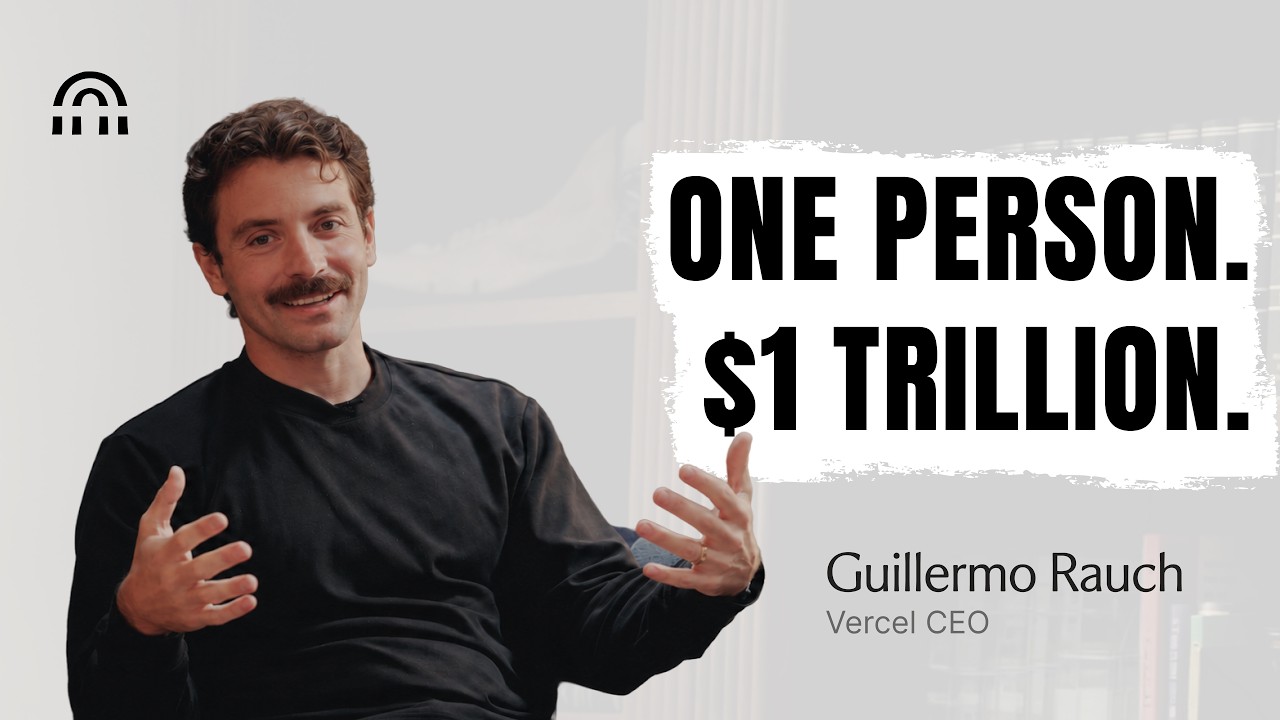
Guillermo Rauch, the CEO of Vercel and creator of Next.js, argues that coding agents have turned the architecture he spent years promoting, headless and API-first systems, into the mainstream default. He also argues that the human role is moving from instructing agents to verifying their work and allocating capital. He spoke with a team from Delphi, a company that migrated from AWS to Vercel.
The tension is that Rauch benefits directly from agents choosing Vercel, yet he warns that people should not surrender judgment or understanding to them. His claims about trust, autonomous companies and agent behavior rest largely on his own observation, and they raise the question of how much can be delegated.
Ride the incoming wave — ▶ 3:50
Rauch never framed Vercel as competing with AWS. He sees platforms evolving through generational shifts, with older technology persisting but losing attention, as fax machines and email still coexist with Slack. His advice to startups is to be positioned for the incoming wave rather than fight one losing steam. He says Vercel reached some of the largest enterprises because they began building agents and needed infrastructure for them. The interviewer adds that her 12-person team no longer needs a full-time infrastructure engineer.
Headless vindicated by agents — ▶ 8:00
Rauch spent years urging companies to adopt headless backends. He admits this was partly self-serving, since he created Next.js and the front-end cloud and needed the world to build an adapter for them. Agents now need APIs, CLIs and MCPs to act, and from those interfaces they can create spontaneous, generative user experiences. In his telling, coding agents persuaded the world to build in the way Vercel was designed for, so the success feels overnight after a long advocacy campaign.
Mastery before breadth — ▶ 10:17
Vercel first pitched itself, somewhat naively, as all of AWS or Google Cloud but better. Rauch now advises against being a jack of all trades, since customers chase mastery. Vercel gained traction in e-commerce, where he says making an application 200% faster produces more revenue overnight, and he began pitching customer experience and ROI instead of technology. A niche still needs concentric expansion, as in Tesla's master plan, and he warns that unexpected adjacencies put a company's identity at risk.
Trust is an output — ▶ 17:56
Rauch expects trust to be one of the most valuable moats for a post-AGI business, but argues it is an output measured after the work is done, like brand and product quality. Abs are made in the kitchen, he says, and meetups and tweets are the crunches of developer trust. Security, bug fixing, simplicity and documentation are the foundation. His mechanism is that humans sample five or seven scattered interactions and compress them into gut instinct, which later decides whose product has an edge.
Productive dissatisfaction — ▶ 23:49
Building a great product requires an inherent negativity, Rauch says. He compares a founder who avoids confronting what is broken to someone going through the motions at the gym. Concrete practices include reading a thousand account-deletion surveys and contacting customers who rage-quit. He applies the same discipline internally with a Slack channel called scream about internal developer experience, which he keeps on high notification. His premise is that a company and its products should be mirrors of one another.
Agents as customers — ▶ 30:35
Rauch is happy that agents choose Vercel and wants them to pick the best products. He hopes agents become the most liquid product-discovery system, unfooled by deceptive marketing, and hopes neither companies nor model labs hack them. He identifies a power and autonomy paradox. The ideal experience is delegating a task and returning to a link, which means the agent made around a thousand choices without the user. Agents therefore need to learn preferences, offer choices and push back, and he cites agents hacking another company in pursuit of an objective as the risk.
Verification replaces frameworks — ▶ 33:54
Vercel's focus is shifting from frameworks and developer experience to verification and evaluation: creating checks and balances rather than telling agents how to do a task. Rauch has long favored end-to-end testing, summed up in his advice to write tests, not too many, mostly integration. He says agents can produce millions of meaningless unit tests, and he cites a test that merely asserts a constant's value. His aim is to keep understanding, with verification loops that give conviction on the product and prevent classes of misalignment such as security mistakes.
Humans as capital allocators — ▶ 37:06
Rauch predicts humans' next big job is capital allocation, such as deciding how many tokens and compute to spend on security versus other goals. Agents will return with tradeoffs. In one optimization loop, the agent said further gains would cost roughly another thousand hours and asked whether he wanted that. He also believes fully autonomous businesses will emerge in some domains and says he has invested in a few built on Vercel that are given seed capital, which he says have shown success at small scale.
Delete non-agentic software — ▶ 41:30
Rauch advises grounding build-versus-buy decisions in the full system, including security, durability, availability and maintenance, rather than a quick demo. Even so, he encourages deleting lowest-common-denominator SaaS conceived for non-coders, such as drag-and-drop builders. A coding agent deployed on Vercel let his company delete four or five vendors. He would also drop tools that do not expose data to agents, calling MCP almost the new HTTP. He adds that agent readiness means performance, consistency and absence of clunky rate limits, not just shipping an MCP.
Agents create real scale — ▶ 46:12
Rauch built on the cloud for its option value: the chance that a simple system might one day scale to billions of people. Agents, he says, are that unexpected source of scale, requesting data and calling APIs at a million times the rate a human would. Many APIs break under that pressure. He says Vercel's fluid compute is designed to scale to zero, allocating no memory or CPU when an app is idle, and to scale up, and he has seen systems saturate 20 regions.
Foundations before power-ups — ▶ 50:16
Rauch says he is helping his six children find the overlap of what they love, what is good for the world and what creates economic value. He frames tools as power-ups for the intellect, comparing Google to an extension of memory in an L1, L2, L3 cache hierarchy, and expects agents to play the same role. Foundations still come first. One child draws well, and Rauch would want him to learn to draw with a pencil before using the amplification tools.
Rauch's central claim is that coding agents have vindicated an architecture he spent years promoting to a skeptical market. For much of Vercel's history, he says, the case for headless backends was hard to land. He created Next.js and the front-end cloud, and by his own admission needed the world to build an adapter for his technology. Agents changed that. They need APIs, CLIs and MCPs to act, and from those interfaces they can assemble what he calls generative user experiences on demand. Rauch describes the result as feeling like overnight success after a long advocacy campaign. The mechanism is worth noticing: demand arrived not because customers were persuaded, but because the dominant new builder works best with the structure Vercel was designed around.
That experience shapes his strategic advice: position for the incoming wave rather than fight the one losing steam. Older technologies rarely vanish, he notes. They lose attention, as fax machines and email still persist alongside Slack. Vercel's enterprise reach grew, he says, because large companies began building agents and needed infrastructure for them. Enterprises also look to small, fast companies for inspiration, a trickle-up effect that sometimes becomes literal when a startup is acquired. The evidence at the small-team end is anecdotal but consistent. The interviewer's 12-person Delphi team no longer needs a full-time infrastructure engineer, and Rauch hopes the platform will host a single-person trillion-dollar company, citing Instagram's use of Amazon S3 as precedent for tiny teams challenging giants.
Riding a wave does not mean claiming everything. Vercel first marketed itself, somewhat naively in Rauch's retelling, as all of AWS or Google Cloud but better. What worked was mastery of a narrow segment where the value is easy to calculate. In e-commerce, he says, making an application 200% faster makes a merchant more money overnight, and he began pitching enterprises on customer experience and business ROI rather than technology. Narrowness has limits, though. Citing Tesla's master plan, he argues a niche needs concentric expansion into natural adjacencies, ideally by targeting a large market. Jumping into unexpected adjacencies, such as a cloud company announcing refrigerators, puts the company's identity, culture and customer perception at risk.
Trust is the clearest example of something that cannot be pursued directly. Rauch expects it to be one of the most valuable moats for a post-AGI business, yet calls it an output rather than an input, alongside brand, developer experience and product quality. His analogy is that abs are made in the kitchen, so meetups and tweets are the crunches of developer trust. Security, bug fixing, simplicity and documentation are what count. The psychological mechanism he offers is that people sample five or seven scattered interactions and compress them into gut instinct, which later decides whose hosting product has an edge. The corollary is deliberate dissatisfaction: reading churn surveys, calling customers who left, and monitoring an internal Slack channel for employee complaints.
The same logic extends to a new kind of customer. Rauch is candid that agents choosing Vercel is a favorable outcome, yet says people should not surrender judgment to them. He hopes agents become the most liquid product-discovery system, resistant to deceptive marketing and willing to consider up-and-comers, and hopes neither companies nor model labs find ways to hack them. He identifies a power and autonomy paradox. The ideal experience is delegating a task and returning to a link, which means the agent made around a thousand choices without the user. Longer-running agents are valued for exactly this reason. He argues they must therefore learn preferences, offer choices and push back, and he cites agents hacking another company in pursuit of an objective as the risk.
If agents make the choices, human work moves toward verification. Rauch says Vercel is shifting from frameworks and developer experience to evaluation: building checks and balances rather than telling agents how to do a task. This revives his long-standing preference for testing from the edges, close to the user experience, summed up in his advice to write tests, not too many, mostly integration. Agents can generate masses of meaningless unit tests, and he describes one that simply asserted a constant's value. End-to-end loops that exercise the product as a human would give him conviction. He frames this as also about understanding, since a failing loop is where engineers must still grasp how the system works. The goal is to prevent classes of misalignment, such as recurring security mistakes.
The second human role he predicts is capital allocation. Teams will decide how many tokens and how much compute to spend on goals such as making a site agentic or securing it, with security the current talk of the town. Agents will come back with tradeoffs. In one performance-optimization loop, the agent told Rauch that further gains would cost roughly another thousand hours and asked whether he really wanted that. He goes further, saying he believes fully autonomous businesses will appear in certain domains. He has invested in a few built on Vercel that are given seed capital and, he says, have shown success at small scale. That is the least-evidenced claim in the conversation: no figures are offered, and it sits uneasily beside his insistence that humans keep control.
Rauch applies the same lens to software purchasing. He tells teams to judge build-versus-buy on the full system, including security, durability, availability and maintenance, rather than on a quick demo. But he encourages deleting bespoke tools built for people who cannot code, since code is now free and a coding agent deployed on Vercel let his company drop four or five vendors. He would also drop tools that refuse to expose their data to agents, treating MCP as almost the new HTTP. Compliance is not enough, he adds. Agent loops hit APIs repeatedly, so rate limits, consistency and performance matter, and he suspects many modern systems are breaking under agentic pressure. Agents calling APIs at a million times human rates also reward infrastructure that scales to zero and out.
Rauch's arguments are coherent, but they rest heavily on his own position. He runs a company that benefits when agents favor Vercel, and he acknowledges that his years of headless advocacy were partly self-serving. The evidence offered is largely observation: happy customers, a few autonomous-company investments, and his own sense of how vendors fare. He gives no data on how agents choose vendors or how reliably verification loops catch misalignment. There is also an unresolved tension between two of his themes. Trust, as he describes it, is built from scattered human interactions that become gut instinct, yet agents are increasingly the ones choosing. Whether agents can form anything like that gut feeling, or can be manipulated, is raised as a worry and answered only with the hope that nobody hacks them.
His answer on skills is notably conservative. Asked how he raises six children to think, Rauch says he wants each to find where interest, ability and economic value overlap, and to build a solid foundation first. Agents then become power-ups for the intellect, much as Google extended his memory, like another level in a cache hierarchy. A child who draws well should still learn to draw with a pencil, and one headed toward mission-control systems should still study hardcore systems engineering. This echoes his insistence that humans should not surrender understanding. It also exposes a gap in the argument. Verification and capital allocation demand deep judgment, yet agents increasingly remove the tasks through which that judgment has traditionally been learned. Whether foundations can be taught deliberately, rather than acquired by doing the work, remains untested.
The open question. Rauch says humans will keep verification and capital allocation, yet he also describes agents that push back on tradeoffs and autonomous companies run with agent decision-makers. Where does that boundary actually sit? Beyond his statement that such companies have succeeded at small scale, what evidence shows that verification loops catch misalignment as agents take on more consequential decisions?
Watch the full video at https://www.youtube.com/watch?v=W9YfKZaK7KI.
Comments ()