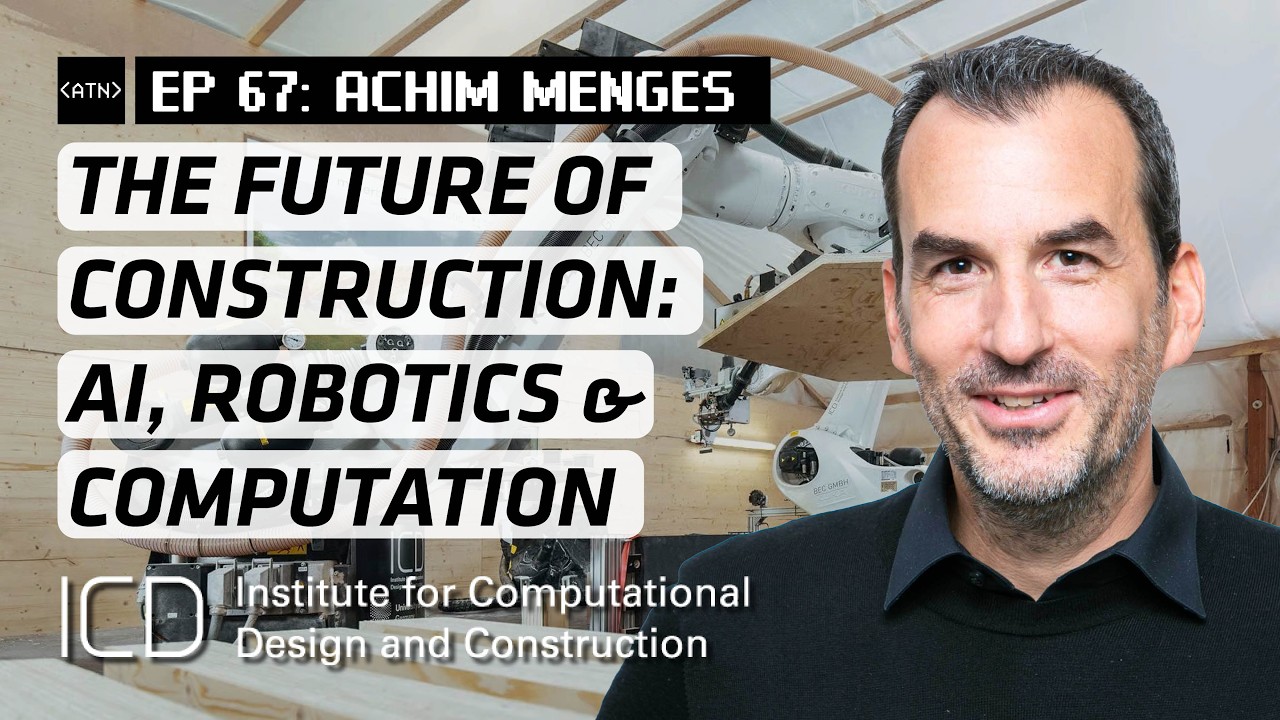
Recorded 30 October 2026 · 55 min
Achim Menges argues that construction robots fail when they imitate human builders. They succeed only when design, structure and construction method are rethought together for teams of humans and robots. After nearly 20 years of building experimental pavilions and, increasingly, real buildings, he says the technology is advancing faster than the industry is willing to use it.
The tension is between two uses of digital tools: making existing processes more productive, which wins quickly, and rethinking design and construction from first principles, which Menges considers far more valuable but which threatens the business models of architects and contractors. AI is lowering the skill needed to run robots, yet the conversation leaves open who will bear the risk of building differently.
Digital-physical rupture — ▶ 4:00
Menges came of age in the first generation of digital architecture practice and saw designs lose much of their on-screen quality when rationalized into something buildable. The digital process, he says, created an enormous problem that then had to be solved. Looking for alternatives, he turned to Frei Otto's form-finding methods, which were not computational but fully aligned with materialization, and to Otto's models, which he calls analog computers. The goal became using digital tools to build the logic and constraints of materialization into design from the start.
Robots as designable tasks — ▶ 6:58
ICD added "construction" to its name in 2014 because of a distinction between machines. A CNC mill still mills and a CNC saw still saws, whereas a robot is an entity for which tasks themselves can be designed. That moved the institute from letting materialization inform design to designing the materialization processes too. Menges frames computation as the means of integrating design and construction, with robots as the point of convergence. ICD's first robot, bought secondhand in 2009, was cheap but demanded skills that were hard to find.
Academic traction, practical stakes — ▶ 12:33
When ICD started, the field was not taken seriously as research: there was no funding and there were no reviewers able to assess grant applications. Traction grew with a wider community, including ETH Zurich colleagues such as Philip Block, and brought funders' expectation of direct societal benefit. Menges says ICD never had to abandon its speculative methods. It applied them to experimental architecture and to contributions implementable in the short term, which meant navigating certifications, contractual frameworks and the institutional boundary between architect and educator.
Two streams, one blocked — ▶ 17:45
Digital technology can make existing practice more productive, or it can rethink design and construction from their foundations. The first stream has gained far more traction because its impact comes faster. The second, Menges says, has not been embraced, since it challenges institutional boundaries and the business models of architects and contractors. Design-and-build, common in the UK and US, aims mainly at cheaper construction. He wants value measured beyond euros per square meter, to include architectural quality, and a culture of integrated design and delivery.
Why cars don't transfer — ▶ 25:23
Mercedes-Benz approached ICD early because it wanted far more individualization in its cars, a problem architecture handles since every building differs. ICD researchers later moved to Mercedes and BMW. Direct transfer of methods nonetheless proved limited. Automakers can build 40, 50 or even hundreds of prototypes and test them to destruction. Load-bearing building components cannot be destroyed 50 times, so buildings must be proven sound and safe by other means. Menges says this different mode of verification explains why the engineering methods differ profoundly.
Don't automate manual building — ▶ 29:13
Over roughly 15 years, Menges says, using robots to automate previously manual construction has not worked well. Manual methods evolved over hundreds if not thousands of years, so robots struggle to compete with them on their own terms. Robots build differently from humans, so the opportunity is to rethink construction methods, building systems and structural systems around robot strengths, for teams of humans and robots. He calls full robotic construction a "misguided vision" and sees skill-sharing and new building systems as the key.
Materials shape the technology — ▶ 33:46
ICD's focus on timber and natural fibers steered it away from layer-printing concrete, which Menges says mainly relies on mineral materials with a very high cement ratio. The institute has used large-scale additive manufacturing for responsive elements and for reinforcing timber components. He accepts that printing concrete or earth forces a rethink of how buildings are delivered, but says such technologies should foreground environmental concerns. His framing pairs digital technology with the climate challenge and a larger share of biogenic building materials.
Automate first, integrate later — ▶ 35:37
Most AEC startups, Menges observes, use AI to automate parts of design or construction for immediate productivity gains. He favors the few, especially in Europe, that take on the harder challenge of the building's hardware. The host's taxonomy is automating an existing process, such as Automated Architecture's timber frames, versus reinventing the whole system, as ICON attempts and as Facet Homes tried. Menges agrees that entering via a smaller step fills a gap in the chain, but says the real gain lies in vertical integration from design to construction.
AI lowers the skill barrier — ▶ 39:40
In Menges's experience, small and medium businesses hesitated over robotic fabrication less because of investment cost than because of dependence on one skilled operator. AI-enhanced human-machine collaboration can ease that fear. In ICD's fiber winding, a robot that finds its own path points removes, by his estimate, about 3/4 of the programming complexity and cuts errors. Physical AI could let robots work on site through local orientation, like renovation tradespeople, without a whole-building world model. He also expects finer-grained use of material instead of pouring in excess because it is cheaper.
Generative design remains unproven — ▶ 43:32
Menges is optimistic but cautious about AI in design. Data-driven simulation is already stripping out complexity and time, letting designers monitor decisions much better. Spatial generative design is less certain, and he says it remains to be seen whether it will meet the huge promises made for it. Reaching solutions that are interesting architecturally, constructionally and environmentally, not just something, will take considerable effort. Computer vision, by contrast, is already inseparable from AI, giving robots what he calls decent eyes and a brain.
Culture before technology — ▶ 47:28
Asked for a timeline, Menges says it depends on the success of construction startups. He once assumed the industry would adopt ICD's demonstrations, but it has not, because the technologies challenge its business models. He sees two needs: a construction culture with different mechanisms of risk-taking, and a new construction industry whose startups treat these technologies as opportunity rather than threat. He distinguishes software startups from founding a construction company. As a modest signal, ICD received 350 applications for one job post, and many alumni enter the building industry.
Construction robotics has underdelivered because it has mostly asked the wrong question. Achim Menges's answer is that robots should not replicate manual construction at all. Over roughly 15 years, he says, projects that used robots to automate previously manual processes have not been very successful, because those processes evolved over hundreds, if not thousands, of years and are already highly effective. A robot laying bricks competes with a method refined for human hands. Robots, by contrast, build differently from humans. The payoff therefore lies in redesigning the building system, the structure and the construction method together, so that the building is designed for teams of humans and robots to construct. Menges doubts that fully robotic construction will ever arrive and calls it a "misguided vision".
This view grew out of a frustration with digital design itself. Menges belongs to the generation that saw digital architecture reach practice and watched the qualities of designs on screen get lost when they were rationalized into something buildable. He looked instead to Frei Otto's form-finding models, which he calls analog computers, because they carried the logic of materialization into the design from the start. ICD's 2014 addition of "construction" to its name follows the same logic. A CNC mill still mills, but a robot is an entity for which tasks can be designed. Once the fabrication process is itself a design variable, design and construction can no longer be treated as separate stages.
The automotive industry, which surrounds ICD in Stuttgart, might seem to offer a template, and Menges explains why it largely does not. Mercedes-Benz came to ICD early, wanting more individualization, which is a problem architecture solves because every building differs. But automakers can build 40, 50, even hundreds of prototypes and test them to destruction before production. A load-bearing building component cannot be destroyed 50 times and then built. Buildings must be proven sound and safe by other means, and Menges argues this mode of verification is why the engineering methods differ so profoundly. The implication, which is editorial rather than his own claim, is that construction innovation must carry its own verification burden, and that this raises its cost and risk.
Within that constraint, Menges sees AI mainly as a lowering of skill barriers. In his experience, small and medium businesses were deterred from robotic fabrication less by investment cost than by dependence on one skilled operator who might fall sick and halt production. If a robot can find its own path points, as in ICD's fiber winding, he estimates it strips about 3/4 of the programming complexity and reduces error. That is a claim from his own lab work, not a published benchmark, and the transcript offers no further data. Computer vision is the area where he sees the clearest gains today. Physical AI, which would let robots work from local orientation without a whole-building model, he treats as a future opportunity.
The design payoff he emphasizes is material. Construction today uses excess material because pouring more in is cheaper than working out whether it is needed. Robots that can build highly differentiated structures with fine-grained use of material could reverse that. This connects the robotics argument to ICD's choice of timber and natural fibers over layer-printed concrete, which Menges says mainly uses mineral materials with a very high cement ratio. He does not dismiss printing concrete or earth, but says such technologies should foreground environmental concerns. Digital technology and the climate challenge, in his framing, have to be addressed at the same time.
Menges is more cautious about AI in the design stage itself. Data-driven simulation already strips out complexity and time, and designers can monitor their decisions much better. Spatial generative design is less proven. He says it remains to be seen whether it will meet the huge promises made for it. He calls himself optimistic, but not about a quick result. The difficulty is generating solutions that are interesting architecturally, constructionally and environmentally, not merely something. This restraint matters because his thesis depends on integrating design with construction. An AI that produces plausible forms without that integration would repeat the rupture he describes at the start, the gap between what looks good on screen and what can be built.
The larger barrier, he argues, is institutional. Digital tools can make existing practice more productive, or they can rethink design and construction from their foundations. The first wins traction faster. The second challenges institutional boundaries and the business models of architecture practices and contractors. Design-and-build, as practiced in the UK and US, mostly pursues cheaper construction. Menges wants outcomes judged by more than euros per square meter, adding architectural quality and opportunity. The startup landscape reflects the split. Many young companies automate a part of the process for immediate gains, which Menges accepts as a sensible entry point. The real gain, he says, lies in vertical integration from design to construction, and only a few companies attempt the harder route through the hardware of the building.
Here the evidence is thinnest. Menges admits that when ICD began he assumed the industry was waiting to be shown what could be done and would adopt it. It was not. Even now, he says, not all stakeholders find this attractive. His remedy is a new construction culture with different mechanisms for taking risk and a new industry of startups that see the technology as opportunity. The signs he cites are modest. ICD received 350 applications for a single position, and a large share of its researchers go into the building industry. Those suggest a pipeline of talent, not a change in how contracts are written or buildings are financed.
Menges is also building a test of his own argument. ICD's new home, a climate-neutral building scheduled for completion in late 2028 or early 2029, is meant to have load-bearing components that are outcomes of the institute's research, built with off-site and on-site robotics developed in-house. It will show that the approach can be built and certified. It will not by itself show who will take on the risk of the next building. The constraint he identified in the automotive comparison, that structures cannot be destroyed 50 times to prove them, applies to the business model as well. Someone has to carry the cost of being first.
The open question. Menges expected incumbents to adopt integrated design and construction once ICD demonstrated it, and they did not. He now places the burden on new construction startups and a culture of risk-taking. What mechanism creates that culture, and who finances novel load-bearing systems that, unlike cars, cannot be tested to destruction 50 times before use?
Watch the full video at https://www.youtube.com/watch?v=dNTKJhnn_dM.
Comments ()