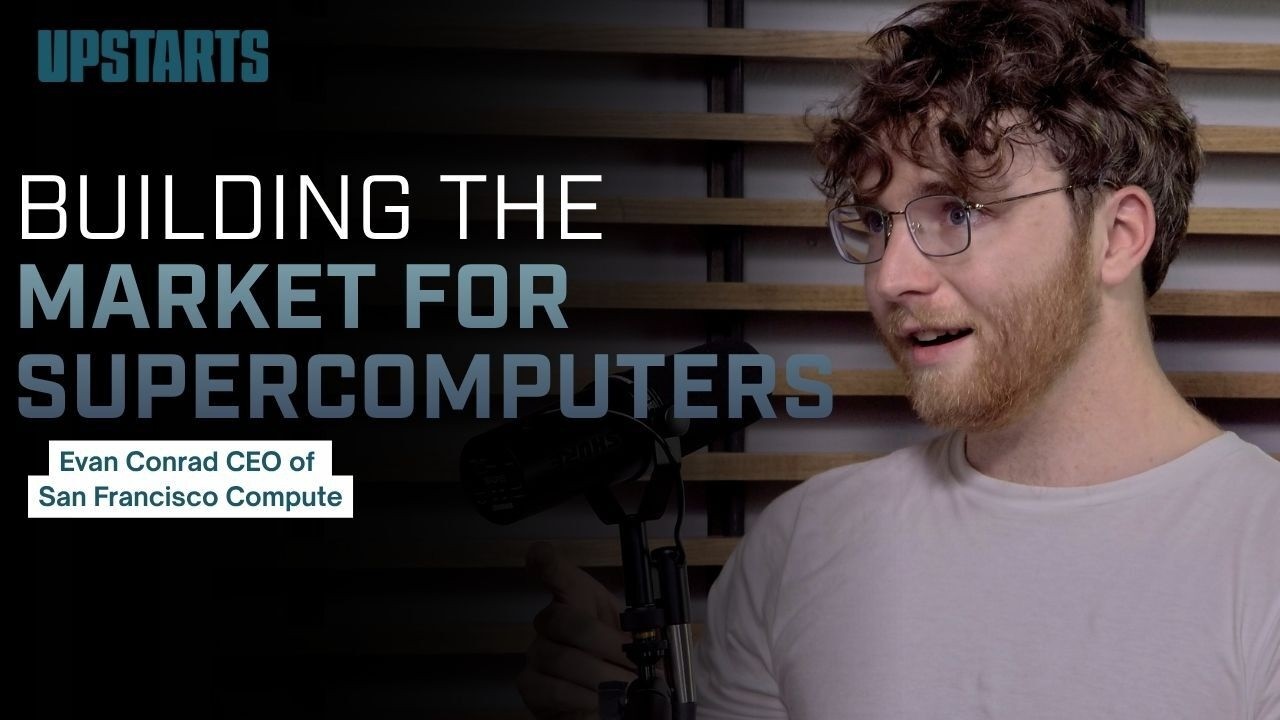
Recorded 29 October 2026 · 39 min
Evan Conrad, co-founder and CEO of San Francisco Compute, argues that the binding constraint on scaling AI compute is credit rather than hardware, land or power. Lenders will not underwrite a small AI lab, so buyers post deposits that can equal their entire bank balance. Conrad's company aims to let lenders underwrite the future price of GPUs instead of the borrower.
The tension is structural. A credible forward market needs physical delivery, which means operating clouds, yet it must be independent of any cloud owner to be trusted. SF Compute therefore builds cloud capabilities while declining to become a cloud, a posture Conrad says forgoes enormous sums. Most claims come from the founder himself, and the model's results at scale remain undemonstrated.
Credit is the bottleneck — ▶ 1:27
Buyers of GPU clusters face sold-out supply, no on-demand option, long lead times and deposits that can consume their entire bank balance. Conrad says the deposit exists because lenders will not underwrite an AI lab's credit. If a lender instead trusts what GPU prices will be in the future, the deposit shrinks or vanishes. He treats demand-forecasting error, overshooting or undershooting capacity, as the same underlying problem: risk. His remedy is a compute market that is physically settled and independent of the existing clouds.
An overbought cluster — ▶ 2:34
The company began as an AI lab building audio models. It bought too large a GPU cluster, leaving about $500k in the bank against a bill of about $400k a month on roughly a 12-month commitment. The first month went fine, the second did not, and each month afterward it had to sell capacity or go bankrupt. Subleasing that capacity became the seed of the business. Conrad says it was driven mostly by lack of alternatives, and that the company is still in survival mode.
Operations expertise is the moat — ▶ 7:18
Subleasing showed Conrad that buyers and owners often do not know what they are doing. His examples: a cluster in the wrong data center browned out from voltage problems, a broken InfiniBand fabric left a cluster unsellable without its owner knowing, data centers that were literally chicken coops, and a site visit flooded by a monsoon. Each failure pushed the company deeper into the stack until it operated the entire service. It now consults before hardware is purchased, including on the bill of materials, to prevent common mistakes.
Physical settlement without owning — ▶ 8:45
SF Compute performs the functions of a cloud without owning hardware. Partners own the assets, set prices and write the rules, and the company operates the cluster, even white-labeled behind a partner's website. Conrad compares it to a grid operator turning electricity into a commodity. Independence is essential, he argues, because an asset owner cannot also be the market. The cost is that attempts to build compute markets usually became GPU clouds or platform companies; staying asset-light means less upside but, he says, resilience to market swings.
The valuation ladder — ▶ 11:59
Conrad says AI labs without credit must raise at high valuations to fund deposits. In his account the starting valuation was about $100 million a year or two ago and is now about $1 billion. He extrapolates $5 billion, $15 billion and $30 billion, which he says eventually becomes unreasonable. When that happens, he argues, startups like his former audio lab simply cannot exist. He says SF Compute is intentionally arming the rebels, while still expecting to sell to frontier labs provided capacity stays liquid.
Leases trap capacity — ▶ 15:19
Conrad says even large labs face the same problem at scale. He cites xAI as having overbuilt compute and then been able to sell it because it owned the hardware and held the residual value. Labs on leases were often barred from subleasing, or had to find a subleasee themselves. That uncertainty worries lenders, who then demand big deposits or prefer customers with better credit. Resale liquidity, in other words, functions as a credit feature.
Deals dwarf venture funds — ▶ 23:01
Conrad says a midsize compute deal exceeds many venture funds' entire assets under management and the lifetime earnings of whole categories of SaaS companies. SF Compute nearly did not announce its $245 million contract because, by compute standards, he says it is not large. Early on, he recalls, the team thought $5 million was a lot. The scale explains why financing structure, rather than product features, is the central problem in this market.
Why cash-settled futures fail — ▶ 28:32
Conrad says compute is only partly fungible. Depending on VM implementation, GPU kernel launch performance can differ by 40% between operators, and early H100s had problems that were fixed in later units, so a single H100 price conflates different assets. Cash-settled futures pay out in cash against an index, which can diverge from the real cost of the compute a buyer later needs. SF Compute's contracts deliver actual GPUs starting on a stated date, letting buyers hedge with the resource itself.
What a working market enables — ▶ 31:55
Conrad lists the intended benefits: pay more for shorter lead times, little or no deposit because the lender underwrites compute prices, and fewer delays because clouds can order hardware before a customer is signed. A liquid market could also let buyers pay for replacement nodes when burn-in failures send nodes to RMA. These are stated goals. He says the current achievement is simply that a purchasable price exists, and that availability remains capped by the capacity SF Compute has to sell.
Scarcity and geopolitical leverage — ▶ 34:47
Conrad predicts GPU prices will rise and that demand outpacing supply is locked in for at least 4-5 years. He argues the real bottleneck is credit and revenue streams, not power and land, and that data center moratoriums are pushing compute out of the United States while AI labs stay there. He reasons that US influence over capital flows becomes a geopolitical asset. As a comparison, he notes the $500 billion Stargate figure exceeds many countries' GDP and could add 5-10% to some. This is his forecast, not a demonstrated outcome.
Rental price versus earnings — ▶ 37:39
Conrad says a B300 can earn roughly $20-$50 an hour depending on workload, while the rental price appears in the transcript as $550 an hour, maybe $6, likely a transcription error for about $5.50-$6. He expects the two figures to converge soon, and acknowledges he is a market participant. His advice: own GPUs if you have strong credit, power or land, or a strategic need such as a portfolio; otherwise lease. The transcript's later figures are garbled, so the exact numbers should be treated cautiously.
The scarcest input in AI compute, Evan Conrad argues, is not silicon but creditworthiness. Hardware, land and power matter, but the constraint that decides who gets a cluster is whether a lender will finance it. A two-person AI lab cannot satisfy a bank, so it posts a deposit that can equal its entire bank balance, which in turn forces it to raise at a high valuation before it has trained anything. Conrad's company, San Francisco Compute, is built on the premise that this can be loosened if the lender stops underwriting the borrower and starts underwriting the asset. If a bank is confident what a GPU cluster will be worth, the identity of the first customer matters much less.
That premise demands a specific kind of market. Conrad rejects cash-settled futures built on price indices, and his objection rests on fungibility. Compute, he says, is only partly interchangeable. GPU kernel launch performance can differ by 40% between operators depending on how the VM is implemented, and early H100s had faults that were later fixed, so one H100 price blends different assets. A cash-settled contract pays out against an index that may be divorced from the cost of the compute a buyer actually needs. A physically settled contract delivers the GPUs themselves. Delivery, however, requires someone to run the hardware like a cloud.
Operating the hardware was less a design choice than a lesson learned painfully. Conrad's first company bought too large a cluster, with roughly $500k in the bank against a bill of about $400k a month, and survived by repeatedly selling capacity. Subleasing exposed failure after failure: a cluster that browned out in the wrong data center, an InfiniBand fabric broken in a way the owner never noticed, data centers that were literally chicken coops. Each problem pushed the company one layer deeper until it operated the whole service. The editorial inference is that a forward price means little unless the quality of what is delivered is predictable, and operations is what makes it so.
The harder claim is about independence. Conrad says the market cannot be run by an asset owner, because no one will trust a market its operator can manipulate. That rules out the existing clouds and the neoclouds, which he believes will eventually become partners and customers. It also creates an incentive trap. By his account, a normal GPU cloud should sell all its capacity to the largest labs on long-term contracts and could make something like $50 billion doing so. Building the operating capability and then declining to become a cloud means turning down money constantly. Almost everyone who tried to build a compute market, he says, either became a cloud or moved up into platform services.
SF Compute accepts the trade-off by staying asset-light. Partners own the hardware, set prices and decide the rules, and the company operates it, sometimes invisibly behind another firm's website. Those partners include venture firms and nonprofits that want GPUs for their portfolios, and investors who want financial returns without running a supercomputer. For a portfolio owner, the arrangement works as a hedge: capacity is sold on short contracts and handed back to a portfolio company that needs it. Conrad concedes the model earns less than ownership in good times. His argument is that it is also insulated from swings, and he points to a glut about a year and a half ago when H100s were hard to sell.
Conrad frames the stakes as who gets to start AI companies. He says the valuation needed to pay for a deposit has risen from about $100 million a year or two ago to about $1 billion, and he extrapolates to $5 billion, $15 billion and $30 billion. At some point, he argues, markets will not sustain that, and startups like his own audio lab become impossible. Even large labs face versions of the problem. He cites xAI as able to sell overbuilt capacity because it owned the hardware, while lease holders were often barred from subleasing. The lesson is that resale liquidity is itself a form of credit.
His forecasts then widen to geopolitics. Conrad expects scarcity to last at least 4-5 years, with GPU prices going up and to the right. He argues that data center moratoriums are pushing compute out of the United States while the labs remain there, and that the real constraint is the credit and revenue that finance clusters. If so, he reasons, US influence over capital flows becomes a bargaining asset, given projects like the $500 billion Stargate that could add 5-10% to some countries' GDP. This is a prediction, not a demonstrated outcome, and the transcript offers no evidence beyond the reasoning.
Some of the picture is internally awkward. Conrad predicts persistent scarcity, yet he also expects B300 earning potential, which he puts at $20-$50 an hour, and rental prices to converge soon. The rental figure is garbled in the transcript, apparently for something near $5.50-$6, so the comparison should be handled carefully. He is candid that he is a participant in this market. Scarcity is also precisely the condition under which a forward market is most valuable, and he acknowledges that a glut occurred recently. A lender underwriting forward prices must believe those prices hold across cycles.
The evidence for the mechanism is also thinner than the argument. Many of the benefits Conrad describes, including shorter lead times for a premium, minimal deposits, earlier hardware orders and swappable failed nodes, are stated as goals. He describes the current achievement simply as a buyable price, with availability capped by what SF Compute has to sell. The claim to be the only physically settled compute market is self-described. The transcript includes no figures on deposits reduced, lenders participating or volume traded, and only a $245 million contract that Conrad himself calls modest for the sector.
The test of the thesis is therefore narrow and measurable. If a lender will finance a cluster against forward contracts without examining the borrower, then credit stops being the gating factor, and Conrad's picture of a power grid for compute starts to look plausible. If lenders instead demand collateral against price risk that the market itself cannot reduce, the risk has merely moved from the buyer's credit to the price of GPUs. Conrad's own account of a recent glut makes that second possibility hard to dismiss.
The open question. Conrad's thesis is that lenders can stop underwriting borrower credit and underwrite the price of compute instead. But he also describes a glut roughly a year and a half ago, when H100s were hard to sell, and expects some B300 price gaps to close soon. Who ultimately bears price risk once the credit risk is removed, and will lenders accept forward contracts as collateral across a full price cycle? The conversation offers no data on lender participation or deposit reductions.
Watch the full video at https://www.youtube.com/watch?v=uYzQxxAD41g.
Comments ()