Recorded 28 October 2026 · 84 min
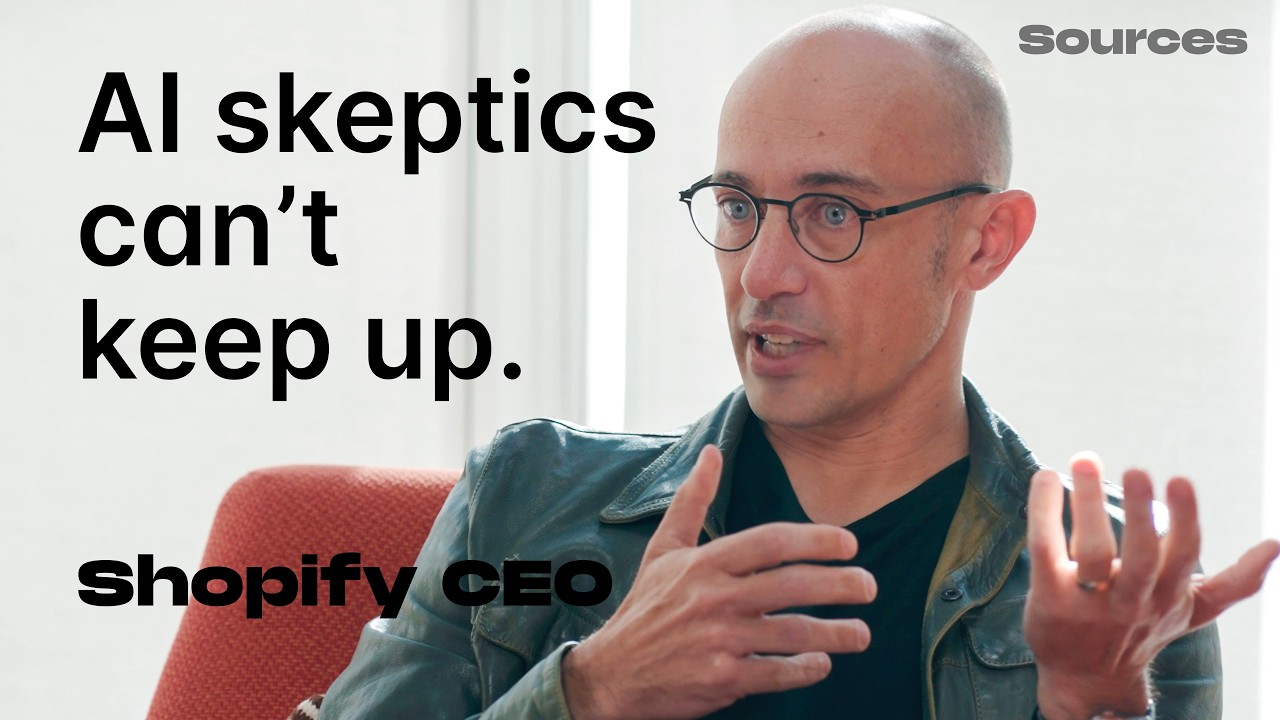
Toby Lütke, founder and CEO of Shopify, argues that AI agents are the latest chapter in a 20-year split between two commerce models: Amazon's everything store, with an ads business to protect, and Shopify's merchant-controlled storefronts. Prompted by Amazon blocking Meta's Muse agent, which Shopify is embracing, he says AI opens a positive-sum frontier in which zero-sum defense is a choice, not a necessity.
The tension is between conviction and evidence. Lütke is categorical on some points, including a p(doom) of zero, but candid on others: he says it is too early to tell whether the agentic world favors Shopify over the aggregators. He offers no concrete model for who pays for agents, only a thesis that value creates ways to monetize. The discussion tests how far founder optimism can stand in for a business model.
Two commerce philosophies — ▶ 0:52
Lütke frames the Amazon-Shopify split over Muse as a 20-year difference in philosophy, not a new rift: Amazon digitized the department store, with strength in inventory depth, while Shopify represents boutique independence and merchant storytelling. His structural explanation is that a marketplace has three parties, and the rational choice is always to optimize for buyers because their behavior is easy to observe. Shopify deliberately avoided building one and stays on the merchant's side. He declines to call either position right, and says it is too early to know whether agents favor his model.
Tolerating messy agents — ▶ 3:49
Lütke concedes that agents do alarming things, including impersonation, and that browser-based agent use works poorly but makes everything possible, which he considers more important right now. That explains, in his view, why agents take that route and why aggregators with more concrete control interests resist. Shopify's response is to build checkout APIs and systems that work well whether a person or an agent on their behalf is buying. The stance is operational rather than ideological: Shopify supports every channel, because the more places merchants sell, the more valuable the platform becomes.
Project-based agent purchases — ▶ 7:07
Agent-driven buying is rising from a low base, so Lütke says the percentages are absurd and not meaningful, and he offers no figures. The notable change is in purchase type: project-based orders such as everything needed for a home gym, or a weekend 3D-printing project with his kids, where the agent works out the parts and orders from local stores. These are deliberated, fairly high-order-value purchases preceded by a planning phase that merchants cannot see. The pattern suggests agents are creating demand for assembled outcomes rather than single products.
Better first, then new — ▶ 10:42
Lütke describes a two-phase pattern for agents. In the current phase they help people do things they already do, only better, such as an agent that can reorder 3D-printer filament when it runs empty. He expects a later phase in which people discover digitally native possibilities that were not previously feasible, and says glimmers are already visible. He calls this the point at which technology gets the most fun. It is a prediction supported by anecdotes from agent enthusiasts, not data, and he cautions that users must be comfortable giving agents access to devices.
Frontiers breed optimism — ▶ 12:25
Lütke argues that sci-fi tells you more about when it was written than about the future, and that for a period he puts at 20 to 50 years the genre turned dystopian because bleak books sold. He links that to tech pessimism. His game-theory claim is that without a perceived frontier, the correct strategy becomes competing for what already exists, a zero-sum mindset. Pessimism sounds sophisticated, optimism sounds naive, and so optimism survives mainly in winning startups. AI, he says, is a new frontier where path dependence is out of the window.
Value hiding in math — ▶ 18:22
Lütke argues that value is vastly under-converted. Floating-point math and matrix multiplication had been known for a very long time, yet the AI industry has, in his estimate, probably added trillions of dollars of new value from them. His analogy is uranium, whose energy value was locked behind knowing how to break the atom. By extension, many valuable products have yet to be discovered. Shopify's millions of merchants are his daily evidence, including a case where someone quit an accounting job and built a business after a lunch-break decision. Zero-sum thinking, he says, is therefore a choice.
Entrepreneurs gain most from AI — ▶ 22:14
Entrepreneurs must understand every job well enough to judge hires, which makes them heavy beneficiaries of AI, Lütke says. Almost 80% of Shopify merchants once said they had someone who would answer an entrepreneurial question within 24 hours, which he reads as survivorship bias: those who start businesses are those with access to advice. AI democratizes that access. He sees a Promethean myth shaping fears that every good carries proportional harm. He expects positive effects to far outweigh negative ones, puts his p(doom) at zero because it is floating points, and says dystopia is always about 40 years in the past.
Regional attitudes toward AI — ▶ 31:35
Lütke says business formation on Shopify is rising, with younger generations especially entrepreneurial, partly because of AI use and partly because of media like MrBeast, which he calls deeply entrepreneurial. On attitudes, he places the US ahead, Canada in between and closer to America, and Europe, where he is from, as more cynical rather than more negative. He thinks Europeans reason from a bad prior, such as having tried ChatGPT at launch and seen it hallucinate. He notes Muse is unavailable in Europe. Canada, he adds, takes pride in its contribution to AI foundations, including AlexNet and Geoffrey Hinton.
Outsider's edge on Silicon Valley — ▶ 34:18
Lütke says he has no wish to move Shopify to California, because staying outside lets him observe Silicon Valley and edit what he adopts rather than absorb the whole package. His criticism is that companies there converge: cultures are similar, and few escape the OKR system, so reinvention is difficult. The ability to build new businesses fast occasionally produces a company with a different enough culture to pull others toward it. He argues the aggregate industry needs diversity, with companies for different types of people, and that trying to be everything for everyone is bad.
Open source as competition — ▶ 37:13
Lütke credits Meta's open-sourcing of Llama with starting a norm that others followed, and says it would not have happened without a founder present. Without open-source models he would modify his optimism: still sky-high, he says, but less like cruise control, because a space needs competition. He treats Llama 4 as a null result of the kind every lab experiences, one that happened publicly, and praises how quickly Mark Zuckerberg reassembled a team. For Lütke, plural model suppliers are a condition of the optimistic scenario, not an afterthought.
Founder-led AI mandate — ▶ 45:00
Lütke says a founder can cut bureaucracy and make fast decisions a hired manager cannot, which is how his memo requiring reflexive AI use went out without committee review. It was controversial in the press but not inside Shopify, where more employees read it after the headlines. He has never had an annual plan, preferring everyone to run the same decision function over available inputs, loosely coupled. He says the AI rules now happen organically, and that a company should be explicit about who it is not for, since an AI skeptic will not be a top performer there.
Agents' take-rate fatalism — ▶ 52:19
Asked where the take rate for personal agents will come from, Lütke says he is fatalistic: agents deliver enough value that monetization, whether metering, transaction flows or finding users savings, will follow. He warns founders expecting 2% that they are entering the world of basis points, and notes most of Shopify's roughly 3% goes to card companies. He says about 2% of American households pay for AI, so it is early, and costs will fall. The interviewer counters that these startups carry compute costs earlier ones did not. Lütke offers no mechanism beyond value and falling costs.
Gross profit dollars, not percentages — ▶ 59:13
Lütke says he would prefer a lower percentage and more dollars: he cares about gross profit dollar growth, not margin, because the mission is making entrepreneurship plan A rather than plan B. The top time for business creation on Shopify is the local lunch break. He invokes Jevons paradox and wants no impediment to starting, including letting AIs sign merchants up and deferring payment until value flows. He says large, grown merchants let Shopify amortize its engineers and tokens across a wide base, which supports a beginner-friendly offering even though beginners are not the main revenue source.
Building a better Shopify — ▶ 1:03:30
Lütke says the real risk to Shopify is that someone builds a better one. Each year he starts by working out how he would build it from scratch, then spends the year moving Shopify toward that version. He calls himself an incumbent, notes the large installed base sometimes slows evolution, and says the goal is to reach new sources of value before two people in a garage plus a data center of agents. His method is to run the diff between the imagined ideal and the current product, avoiding the sunk cost fallacy. Shopify must serve both lunch-break signups and billion-dollar merchants.
Ads under agent trust — ▶ 1:11:27
Lütke is not pessimistic about advertising but expects it to change shape, perhaps losing the name. The challenge is trust: if an assistant acting on a user's behalf were paid to choose products, that would be a breach. He values ads for small merchants, calling Meta's ad engine the greatest boon to small businesses of all time and Google's slightly less so. Ads also act as rough proof of work for a growing business. He fears head concentration, as in the department-store era, and argues that a liquid discovery market is needed so products can reach a thousand true fans.
Lütke's central proposition is that the useful response to AI agents is to treat them as a new source of value rather than a threat to be walled off. That follows from a worldview he returns to repeatedly: the economic value latent in the world is vastly larger than what has been captured, so zero-sum defense is a choice, not a necessity. Amazon's decision to block Meta's Muse agent, and Shopify's decision to embrace it, is the live test case. Lütke does not frame this as virtue against vice. He describes it as the latest expression of a difference in commerce philosophy that has existed for 20 years, between a digitized department store and a platform for independent merchants.
The structural explanation he offers concerns whose side a company sits on. A marketplace has three parties: the corporate entity, buyers and sellers. Lütke argues the rational choice is always to optimize for buyers, whose behavior is easy to observe, and Shopify avoided building a marketplace for that reason. Its business is aligned with merchants, so it has no ads business to protect and no strong reason to control who or what does the buying. He is careful not to claim victory. It is too early to tell, he says, whether the agentic world favors Shopify's model over the aggregators, whose need to stay in control is more concrete. He also acknowledges that agents behave in alarming ways, including impersonation, and that browser-based agents work poorly yet make everything possible.
The evidence for agent commerce is qualitative. Lütke says agent-driven purchasing is rising from a fairly low base, so the percentages are absurd and carry little meaning, and he offers no figures. What interests him is the change in purchase type: project-based orders, such as everything needed to set up a home gym, or a weekend 3D-printing project with his kids, in which the agent works out the parts, places orders and sources from local stores. These are deliberated, higher-value purchases preceded by a planning phase merchants cannot see. His broader model has two phases. Agents first help people do existing things better. A later phase, he expects, brings digitally native possibilities that were not available before.
Underneath the commerce discussion sits an economic argument about abundance. Lütke contends that the AI industry has already created what he estimates as probably trillions of dollars of new value from floating-point math and matrix multiplication that had been known for a very long time. His analogy is uranium, whose value was locked behind the knowledge of how to break the atom. By extension, he says, many valuable products have yet to be discovered. Shopify gives him a daily view of this: millions of businesses, including one started by someone who quit an accounting job. He adds that the most common time for business creation on the platform is the local lunch break, which he reads as people trying a plan B.
Why, then, is sentiment toward AI so negative? Lütke offers a cultural explanation rather than a technical one. Pessimism sounds sophisticated and optimism sounds naive, so optimism survives mostly among high-status people, eccentrics, or inside startups where growth makes it obvious. When growth disappears, he argues, opportunities go unseen and zero-sum competition follows, a pattern he says played out in tech. Culture compounded it: sci-fi, in his telling, turned dystopian for a period he puts at somewhere between 20 and 50 years because bleak books sold. He invokes the Promethean myth as a hidden premise that every good carries equal harm. His own position is blunt. His p(doom) is zero, because it is floating points, and "dystopia is always just 40 years ago."
The weakest part of this case is that it leans on a vantage point the interviewer pushed on. Lütke concedes he is probably not the most representative person to ask, and the interviewer noted that some leaders describe AI as an entity we cannot control, a framing that feeds fear. Lütke disagrees but answers mainly with prediction: personal experience will spread, and the stories will wash the pessimism away. His evidence is anecdotal. The statistic he cites, that almost 80% of Shopify merchants had someone who would answer an entrepreneurial question within 24 hours, is offered as survivorship bias, which supports his claim that AI democratizes advice. But a founder who sees mainly people who chose to start businesses is looking at a self-selected sample. That inference is the editor's, not Lütke's.
One condition for his optimism is competition, and he ties it to open-source models. Lütke credits Meta's release of the Llama models with creating a norm that others followed, and says he would modify his optimism without open-source availability. It would still be sky-high, he says, but less like cruise control, because a space needs competition. He treats Llama 4 as a null result of the kind every lab experiences, one that happened publicly, and praises Mark Zuckerberg's speed in reassembling a team. He adds that Meta would not have open-sourced Llama without a founder present. The safeguard he names is not restraint but plural suppliers, a structural claim about the market rather than a technical one.
Lütke applies the same logic inside Shopify. A founder, he argues, can cut bureaucracy and make fast decisions a hired manager cannot, and he used that to send a memo requiring reflexive AI use. It was controversial in the press but not inside the company, where more employees read it after the headlines. He has never had an annual plan. He wants everyone to run the same decision function over the available inputs, loosely coupled. The consequence is deliberate selection: a company should be explicit about who it is not for, because an AI skeptic surrounded by colleagues using agents at scale will not be a top performer. He says the AI rules now happen organically rather than being enforced.
The same discipline applies to Shopify's competitive position. Lütke says he begins each year working out how he would build a better Shopify, then spends the year making Shopify more like it. He admits the company falls short of its own standards, and calls himself an incumbent whose large installed base sometimes makes evolution harder. The target is to reach each new source of value before two people in a garage with a data center of agents can. His method is to run the difference between the imagined ideal and the current product and to avoid the sunk cost fallacy. Large, grown merchants, he adds, let Shopify amortize its engineers and tokens across a wide base, which supports the beginner experience.
On how agents will be paid, Lütke offers a stance rather than a model. He calls himself fatalistic: agents deliver so much value that money will follow, whether through metering, transaction flows, or finding savings for users who overpay in areas like bank fees. Told that agent startups expect a cut of transactions, he answers that they are entering "the world of basis points," and notes that most of Shopify's roughly 3% goes to card companies. He cites about 2% of American households paying for AI and says costs will fall. The interviewer counters that these startups carry compute costs earlier ones did not, and that capital is flowing to GPUs. Lütke offers no mechanism beyond value and falling costs.
His own pricing instinct runs against extraction. He says he would prefer a lower percentage and more dollars, and that he cares about gross profit dollar growth rather than margin, because the mission is making entrepreneurship plan A rather than plan B. He cites Jevons paradox: as things get cheaper, people consume more. He wants friction near zero, including AIs that can sign merchants up to Shopify and defer payment until value is flowing. That is coherent for a company with a tail of billion-dollar merchants, a point he makes himself. It is, however, a statement about Shopify's position, not a template for agent startups that lack such a base.
Advertising is where the argument is most exposed. Lütke does not think ads will vanish. He thinks they will change shape and perhaps lose the name. His concern is trust: because an agent acts on behalf of a user, an assistant paid to choose products would be a breach, so socially acceptable forms are an active conversation. He values ads for small merchants, calling Meta's ad engine the greatest boon to small businesses of all time and Google's slightly less so. Ads also act as a rough proof of work, since a business that can advertise is probably growing. And he fears head concentration, as in the department-store era, when the biggest brand won the shelf space.
That leaves an unresolved structural problem. If aggregators wall off agents, and agents cannot accept payment for placement, the discovery engine that fed small merchants has no obvious successor. Lütke names blockchain primitives as possible tools for new matchmaking markets, but as opportunity, not design. His own agent use shows why the stakes are high. He runs a local agent at home, on a rack that includes a Dell GB300, feeding it his calendar, location and Fitbit data, and used heart-rate data to find which meetings stress him most. That intimacy is what makes an agent valuable, and it is why a hidden commercial incentive would corrode it. Lütke, whose company has no ads business to protect, can afford to leave that problem to others.
The open question. If aggregators wall off their platforms from agents, and agents cannot accept payment for product placement without breaching user trust, what replaces the ad-driven discovery engine that fed small merchants? Lütke calls this an active conversation and names blockchain primitives as raw material for new matchmaking markets, but offers no design. His broader answer, that value will find a way to be monetized, leaves open who pays, how much, and whether small merchants keep a growth channel in the meantime.
Watch the full video at https://www.youtube.com/watch?v=r9SHzCW9zxo.
Comments ()