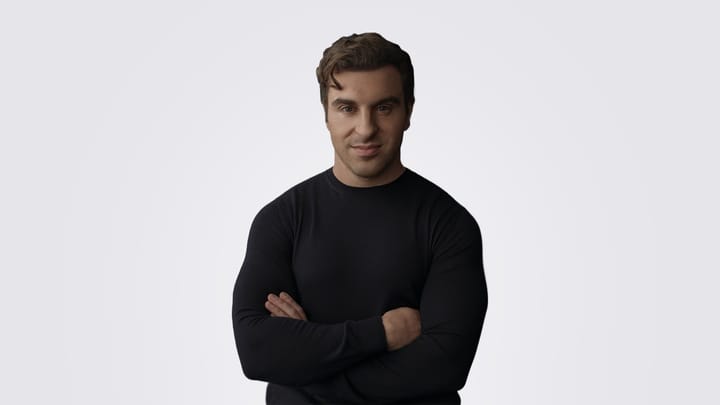

Recorded 22 October 2026 · 53 min
Brian Chesky, co-founder and CEO of Airbnb, thinks the biggest risk in AI is the gap between the people building it and everyone else. Silicon Valley is in a bubble, he says, and ordinary people feel AI is happening to them, not for them. His test: the only "normal" people most AI leaders talk to are the ones they pay, like a nanny or a chef.
The interview, recorded at Airbnb's headquarters for Semafor's CEO Signal, is mostly about his own company. Chesky is a trained industrial designer who started Airbnb at 26 and is now 45. He wants it to become a community and real-world social graph built on 200 million verified identities, with loneliness as the enemy. He also reverses old positions, on hotels and on housing, and frames that as curiosity over ideology.
The tension is that he is a self-described micromanager who edits everything before it ships, and a technologist who calls AI "social media times a thousand." He is also a self-appointed bridge-builder who will not say who should convene the bridge.
Pride as a ship gate — ▶ 5:18
Design is how something works, not how it looks. Airbnb ships nothing until the team is proud of it. Chesky calls that taste, and it cuts against the standard habit of "ship it and let the customer decide." Critics call it arrogance. He compares it to an artist signing their name. Simplifying, he argues, does not mean removing things. It means understanding something so deeply that you can strip out everything that is not its essence. He holds the company as a 3D lattice of shape and color in his head, and does not recommend that others copy it.
Loneliness is the mission — ▶ 8:15
Airbnb is the noun and verb for renting a home for under 30 days, and Chesky says that is what it was. It is becoming a global community where you can "travel anywhere and live anywhere," adding cars, massages, photographers and experiences. The stated purpose is fighting loneliness: social media is parasocial, and more screen time makes people lonelier. Airbnb will "use a device to get you off a device." Hosts join because "money is the hook," then stay because a first review or a child learning Italian words makes them feel connected.
Mayor of a distributed city — ▶ 11:50
Chesky rejects the booking-agent label, which he applies to Booking.com and Expedia. Quoting Charles Eames, he says the designer is a thoughtful host anticipating a guest's needs. Airbnb is a city of 5 million people a night, with him as mayor, fire department, police and sanitation. "We create the conditions for magic. We are not the magic." The invisible work is insurers underwriting $3 million of damage, 20 million customer service contacts, dispute mediation and host training. What Airbnb invented, he says, was a way for 3 billion people to trust one another.
A real-world social graph — ▶ 15:04
Chesky started at 26 and is now 45. If the mission were only mainstreaming home stays, he says, he could hand the keys to a professional CEO. Instead he wants a real-world social graph on top of 200 million verified identities. It would hold a profile, preferences and a trust credential, with Airbnb doing the matchmaking. That could mean roommates, long-term rentals or moving into a community. Launches are planned for next year, and he will not preview them. He concedes nobody says Airbnb has solved loneliness. He sees AI, "social media times a thousand," pulling the other way.
Swapping the enemy — ▶ 17:32
Airbnb's first tagline was "forget hotels." Chesky says great cultures need enemies, and hotels filled that role. Then he met boutique operators who cared about design and community. "It's hard to hate someone up close." Half the world's hotels are boutiques or independents, and 99% of Italy's are. He concluded he had built a caricature of an entire industry for 15 years, and that ideology is dangerous because beliefs become identity. The new enemy is loneliness, misunderstanding and mass production. Hotels are now one of Airbnb's fastest-growing businesses.
Last-dollar housing fund — ▶ 22:02
Airbnb has committed $250 million to fill the final funding gap on stalled projects that already have 90-95% of their money. In Austin, roughly $5-7 million unlocked 300 units, and Chesky expects the fund to unlock $5 billion of housing. He frames it as repayable investment, not philanthropy. His diagnosis is supply: America builds fewer units than in 1950 with twice the population. Austin built 140,000 units in 10 years and prices are down 18% since 2022, while New York prices are up 30%. He blames well-meant rules and NIMBYism.
Responsibility, not primary cause — ▶ 24:21
Chesky accepts Airbnb has a responsibility on housing but denies being the primary cause. He says it is typically about 0.5% of a city's housing, much of it someone's primary or secondary home. He says pied-à-terres and unoccupied homes outnumber listings, and the public imagines 20-30%. New York banned Airbnb and remains expensive. He will back restrictions where homes are genuinely taken off the market. He expects affordability to get worse as scarcity turns city living into a luxury. He predicts affordability and AI will be the two biggest topics of the next election, each compounding the other.
Recruiting is the job — ▶ 31:07
The number one thing a CEO does is recruit, Chesky says, and his first employee at a new company would be a recruiter. He spends 2-3 hours a day on it. His first and last calls of the day go to his recruiter. He co-hires the top 200 people so they are "my people," joining the dream of tomorrow rather than a short-term rental company. Better people need less management. He micromanages new executives, then lets go over time. Most leaders do the reverse, he says, and executives lose confidence. He is still fixing hiring mistakes from 10 years ago.
Editor-in-chief after the crash — ▶ 34:27
Airbnb lost 80% of its business in 8 weeks during the pandemic. In response Chesky dropped divisions for a functional structure with everything reporting to him, as he says most founders do to stay close to the customer. He made himself editor-in-chief, reviewing every launch before it shipped. The pushback was heavy and the move was unpopular. He compares it to a golf instructor fixing a swing before it hardens. Divisions create politics and a coordination tax, he argues, so slowing down for perfection is more efficient eventually. He reviews weekly, convenes the top 100 twice a year and runs a 2-year plan, not an annual one.
AI is happening to people — ▶ 37:38
Chesky calls AI a cognitive revolution, "a thousand times" the industrial one, and a Promethean moment society is "not at all prepared" for. He says Silicon Valley cannot regulate itself and Washington does not understand the technology well enough to do it. The deeper problem is the bubble: AI leaders talk to nannies and chefs they pay. He wants talk of a school teacher in Ohio, not "humanity." He does not expect AI itself to destroy humanity soon. He does say exponential technological progress could, if we are not careful, and that AI can bring either mass dislocation or a renaissance.
Start with cybersecurity — ▶ 42:12
Asked who should convene everyone, Chesky offers "people smarter than me." His practical advice is to skip saving humanity and solve one concrete problem per year, starting with cybersecurity, since AI could "take down the world economy." He argues the US and China share an interest in avoiding instability, while admitting he is not a China expert. He has funded an AI lab for regular people, not "all of humanity," with the product still unclear. AI cannot be stopped, he says. If Washington over-regulates it will do so wrongly, and if Silicon Valley refuses regulation, "a hammer" will come down.
Airbnb's real product is trust, not bookings. Chesky is flat about it. Staying in a stranger's home is thousands of years old, and Airbnb did not invent it. What the company built is a system that lets 3 billion people trust one another. Most of that system is invisible. Insurers underwrite $3 million of damage. Airbnb handles 20 million customer service contacts, mediates disputes and teaches hosts hospitality. That is why he bristles at the comparison with Booking.com and Expedia, which he calls booking agents. He describes a city of 5 million people a night, with himself as mayor, fire chief and sanitation department. "We create the conditions for magic. We are not the magic."
Trust is also an asset that can be reused. Airbnb has verified 200 million identities, and Chesky wants to turn them into a real-world social graph. Each person would have a profile, a library of preferences and a credential, and Airbnb would do the matchmaking. It could find a roommate, a long-term rental or a way into a new community. He says launches are coming next year and will not say more. This ambition explains why he is still CEO at 45. If the mission were only mainstreaming home stays, he says, he could hand the keys to a professional. The mechanism is modest. Hosts arrive for money and guests for space and savings. A first review, or a child picking up Italian words from a guest, does the rest. He is careful to add that nobody would say Airbnb has solved loneliness.
Loneliness is the target because the technology around him is pushing the other way. Chesky thinks AI is social media multiplied by a thousand, a force that glues people to devices. Airbnb's answer runs against the grain. It will use a device to get people off a device. The stakes, in his telling, are far larger than one company. He calls AI a cognitive revolution a thousand times the industrial one, closer to splitting the atom than to a new app, because it can change every job on the planet. He does not expect AI itself to destroy humanity anytime soon. He does think exponential technological progress could, if nobody is careful, and he sees two outcomes: mass dislocation or a renaissance.
Which outcome arrives depends, in his view, on a social failure rather than a technical one. Silicon Valley is in a bubble. The industry says "humanity" while ordinary people hear job automation. The train of progress used to be something you boarded. Now people feel they are standing on the tracks. Neither side can fix this alone. Silicon Valley cannot regulate itself credibly, and Washington does not understand the technology well enough to regulate it. Both extremes fail. Rules written from outside will be wrong, and a refusal of rules invites an over-correction, a hammer coming down after something bad happens.
Housing is the same dynamic at city scale. Residents feel something is being done to them, and Airbnb has been blamed for 15 years. Chesky's response is to separate responsibility from primary cause. He says Airbnb is typically about 0.5% of a city's housing, much of it someone's own primary or secondary home. He points to New York, which banned the company and remains expensive. The real driver, he argues, is supply. America builds fewer units than it did in 1950 with twice the population. Austin built 140,000 units in 10 years and prices there are down 18% since 2022, while New York prices rose 30%. So Airbnb is putting $250 million into last-dollar financing for stalled projects, expecting to unlock $5 billion of housing. He is not claiming this is charity. He expects the money back. He also expects the problem to worsen and predicts affordability and AI will be the two biggest topics of the next election, each aggravating the other.
What makes his prescription credible, to the extent it is, is that he describes himself changing his mind. Airbnb's first tagline was "forget hotels." Chesky says great cultures need enemies and hotels were a convenient one. Then he met boutique operators who cared about design and community. "It's hard to hate someone up close." Half the world's hotels are independents. He concluded he had invented a character for an entire industry. Hotels are now one of Airbnb's fastest-growing businesses. His lesson is that beliefs become identity and identity kills curiosity. That is the posture he wants from both Silicon Valley and Washington.
His own management is not consensus-driven. After the pandemic wiped out 80% of Airbnb's business in 8 weeks, he dissolved divisions and made himself editor-in-chief, reviewing everything before it shipped. The pushback was heavy. His defence is that divisions breed politics and a coordination tax, and that quality set early lets you let go later. He spends 2-3 hours a day recruiting, co-hires the top 200 people, and micromanages new executives before loosening his grip. It is a theory of control that eventually gives way to trust. It is not obviously a theory of cooperation among rivals.
That is where the argument is thinnest. Asked who should bring the AI industry and society together, Chesky says "people smarter than me." His practical advice is to stop trying to save humanity and take one real problem per year, starting with cybersecurity. He says AI could take down the world economy. He believes the US and China share an interest in avoiding instability, while admitting he is not a China expert. He has funded a lab to build AI for regular people, not all of humanity, and says plainly he does not know what the product is. He also says AI cannot be stopped and that there is no point trying.
The diagnosis is vivid. A billionaire's only regular contacts are his nanny and his chef. The remedy is a call for bridge-builders. Chesky volunteers as one, a designer who snuck past the bouncer into a room of engineers. Whether a bridge needs a convener, a deadline or a product is left open.
The open question. Chesky's case for US-China cooperation rests on one assertion: that China does not want the instability AI will cause. He admits he is not a China expert and offers no evidence. His whole prescription also hangs on a convener he cannot name, and on a lab whose product he cannot yet describe. The AI lab for regular people is the thing to watch. If it ships something concrete, "bridge-building" becomes a strategy. If it does not, it remains a slogan.
Watch the full video at https://www.youtube.com/watch?v=e7_eNEXBwhM.
Comments ()