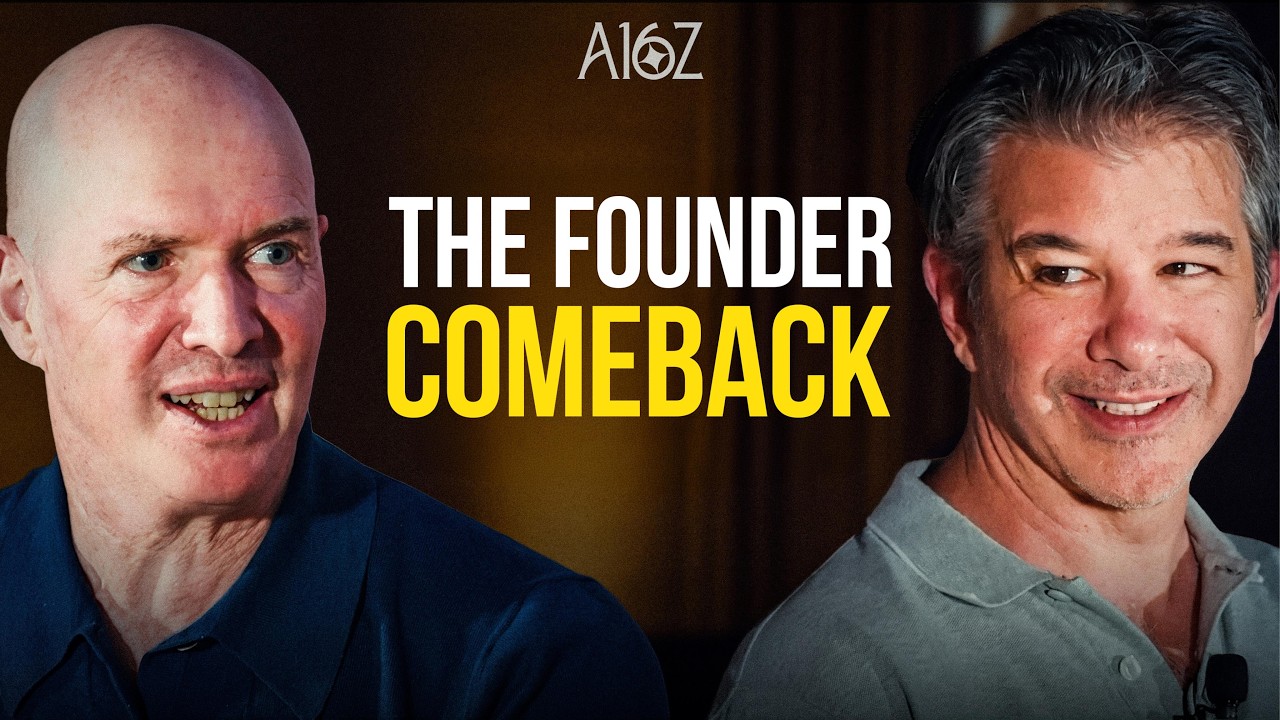
Recorded 14 August 2026 · 55 min
Travis Kalanick's new venture treats the physical world as a computer: manufacturing is the CPU, real estate is storage, and transport is the network. At a gathering of entrepreneurs, followed by a conversation with an investor named Ben and a moderator named Eric, he casts food, mining and autonomous vehicles as sectors about to be automated, with a combined value he puts in the multiple trillions.
The pitch rests on an untested bet: that robotics and autonomy can win on cost before social and competitive resistance blocks them. Kalanick offers few hard numbers, mainly a $6-8 per meal figure and a 20%-more-gold pitch to mine CEOs. The discussion also turns to culture, leadership at scale, and eight years of deliberate silence after leaving Uber.
Atoms as computing resources — ▶ 4:40
Kalanick maps the three core computing resources onto the physical world. CPU manipulates bits, so manufacturing manipulates atoms. Storage stores bits, so real estate stores atoms. Network moves bits, so transport and logistics move atoms. In this frame Uber was a network for the physical world, though he says the team did not think of it this way at the time. He argues digitized manufacturing and digitized real estate have far to go. His company is therefore an OEM building industrial, atoms-based computers that can sit behind any industry.
Food at grocery-store cost — ▶ 7:41
The food test is whether a prepared, delivered meal can approach the cost of going to the grocery store. Kalanick says that requires robotic production, for which he cites $6-8 per meal, robotic logistics inside facilities and outside them via what he calls "autonomous burritos", and industrial real estate to house both. Each layer corresponds to a component of his computer analogy. He later argues that if production and delivery both automate, a service cheaper than the grocery store follows. No delivery-cost data or timeline is offered.
Mining starts with the ground — ▶ 9:00
Kalanick's premise is that superintelligence needs chips and energy, and both trace back to mined material. He tells gold mine CEOs he can deliver 20% more gold per year; none has said no, but all say prove it. Lower opex and safer mines are secondary benefits. The computer mapping holds: land is storage, haul trucks are network (he describes one loaded at roughly 2 million pounds), flotation is processing, and orchestration software is the operating system. If every stage automates, he says, a mining company simply owns real estate.
Autonomy and the silver medals — ▶ 11:59
Kalanick argues industrial-scale work will be done by specialized wheeled machines, while humanoids suit low-scale tasks in human environments. Wheels require autonomy, and a company depending on only one or two outside suppliers will not get far, so it must build the platform itself. That platform then applies to what he calls silver medals beside ride-sharing's gold: food and parcel delivery, trucking, freight and off-road work. He says there are many multi-hundred-billion-dollar industries here, plus a "dark horse" angle if autonomy is built faster than Waymo's.
Resistance as final boss — ▶ 14:46
Kalanick defines progress as the compounding result of discovering valuable unknown truths, and names resistance to change its final boss. Because change is often bad, he argues, it must arrive with overwhelming progress. His historical analogies include the Homestead strike and the shooting of Henry Frick, Edison's public electrocutions of animals to discredit alternating current, European Uber strikes in 2014 where cars were burned, and Uber and Lyft drivers now protesting at Waymo's office. He expects renewed resistance and says founders must be hardcore.
Culture mismatch and toe-stepping — ▶ 22:43
Kalanick says he did not buy Lyft because the cultures differed, and he would change nothing despite the criticism. The investor Ben argues the culture Uber adopted after Kalanick left was a reaction to resistance and became milder, losing its core element: meritocracy and toe-stepping. Kalanick's company now calls this principle best idea wins. His logic is that if people will not fight for the best idea, they fight for a mediocre, politically expedient one. Ben likens it to Andy Grove's constructive confrontation.
Survival mode at scale — ▶ 28:30
Kalanick says that after early failure, including four years without a salary, he operated at Uber right up against the line even with extreme product-market fit. At scale, he argues, fast change outruns trust. Today he stays a few inches back, though he stands by every Uber decision. Ben adds a structural point: with 20,000 employees, a founder's survival-mode intensity can be interpreted by someone eight levels down as license to do something stupid. The lesson concerns calibrating intensity to organizational size, not repudiating past choices.
Ease signals danger — ▶ 34:22
Kalanick's rule is "when it gets easy it's time to push hard"; entrepreneurs who say it's easy are often about to be hit. His example is a founder bragging about hiring someone who turned down a $5 billion Anthropic offer for a $400,000 job. Ben separates two cases: faking success while not winning, and genuinely winning but easing off, which precedes losing. Kalanick adds that experience compresses work, such as a vision note taking 45 minutes instead of hundreds of hours, but familiarity with adversity dulls the anger he considers useful.
Merging businesses into one — ▶ 37:50
Kalanick ran separate companies with different investors and showed up to Andreessen Horowitz (A16) offering parts, but investors wanted the whole. The difficulty was setting merger ratios when some units are very early. Ben says his conviction came fast, resting on whether Kalanick was still the same scrappy operator. Kalanick's first Uber round was $4 million pre-money; this round is several orders of magnitude larger. Structurally, units run as separate businesses with shared finance, legal, HR and technology infrastructure, probably shared manufacturing, and only partly shared software. He admits he lacks all the answers.
Why revenge is dirty fuel — ▶ 46:11
Asked whether anger is a clean source of drive, Kalanick recalls an earlier peer-to-peer file-sharing company sued for a quarter of a trillion dollars by 33 of the largest media companies. His response was a spite business meant to turn them into customers. He argues revenge can succeed but falls short of potential, because it grows from fear of failure, producing long nights with little done. After Uber he moved to new work within eight months. His line: "when you fall in love again, you don't think about the ex very much."
Eight years of deliberate silence — ▶ 50:46
Kalanick says his company ran a detailed playbook for not getting attention, including barring thousands of employees from listing it on LinkedIn, and that he has worked for eight years without talking about it. He attributes his re-emergence to a changed media landscape. By his estimate, 90% of coverage a decade ago was negative as business became politics; now founders can speak directly through long-form podcasts. He credits Elon Musk's purchase of Twitter and compares his silence to a capitalist in Russia whose top KPI is staying quiet.
Travis Kalanick's central claim is that the physical economy can be treated as a computer, and that his new company builds those computers. The mapping is deliberate. A CPU manipulates bits; manufacturing manipulates atoms. Storage holds bits; real estate holds atoms. A network moves bits; transport and logistics move atoms. In this telling, Uber was the network layer, a partial digitization of transport. Manufacturing and real estate, he argues, have much further to go. The frame matters because it redefines the company. It is not a food business or a mining business but an OEM of industrial, atoms-based computers that could sit behind any industry.
He calls the category industrial AI: systems of software, sensors, robotics and AI used to automate the operations of entire industrial sectors. His scoping argument is simple. Everything in any room was grown or mined, manufactured and moved, so the addressable market is the material economy itself. He says this adds up to multiple industries worth hundreds of billions or trillions of dollars, large enough to stand apart from the enterprise story usually told about digital AI. These figures are Kalanick's framing, not sourced estimates. The pitch is breadth built on a common technical core, which is how a company that sounds like a conglomerate presents itself as one platform.
Two worked examples show how the logic is supposed to operate. For food, the test is whether a prepared, delivered meal can approach the cost of the grocery store. That requires automated production, for which he cites $6-8 per meal, robotic movement of food inside facilities and outside them through what he calls "autonomous burritos", and industrial real estate to house it all. For mining, the premise is that chips and energy both trace back to the ground. Mine CEOs, he says, never decline 20% more gold per year, but they reply "prove it". If every stage of mining automates, he adds, a mining company simply owns real estate.
Transport is the connective tissue. Kalanick argues that industrial-scale work will be done by specialized wheeled machines, not humanoids, which he assigns to low-scale tasks in human environments. Wheels require autonomy, and a company dependent on one or two outside suppliers, he says, will not get far. So the autonomy stack must come first and be built in-house. Its value then spills across what he calls silver medals: food and parcel delivery, trucking, freight, off-road work. Each is a potential multi-hundred-billion-dollar industry beside ride-sharing's gold. There is also, in his words, a dark horse angle if his autonomy arrives faster than Waymo's.
The main obstacle he names is social rather than technical. Resistance to change is his "final boss", and his reasoning is that because change is often bad, it must arrive with overwhelming progress. His evidence is historical analogy: the Homestead strike and the shooting of Henry Frick, Edison's staged electrocutions of animals to discredit alternating current, European strikes against Uber in 2014 in which cars were burned, and drivers now protesting at Waymo's office. The analogies cast him alongside the industrialists. They also treat all opposition as resistance, without distinguishing objections that might be legitimate. The transcript does not test that distinction.
Culture is the second instrument. Kalanick says he declined to buy Lyft because the cultures did not mix and would change nothing. Ben, the investor, argues that Uber's post-Kalanick culture was a reaction to the resistance and turned milder, losing its core element: meritocracy and toe-stepping. Kalanick's company now calls the principle best idea wins. The logic is that when people avoid upsetting colleagues, they end up fighting for a mediocre, politically expedient idea. Ben compares it to Andy Grove's constructive confrontation. This is an outsider's view of Uber, and Kalanick does not dispute it, though neither man offers evidence beyond observation.
The leadership lessons concern calibrating intensity to scale. Kalanick says he once operated right up against the line, in survival mode despite extraordinary product-market fit. At scale, he argues, change moves faster than trust. Ben sharpens the danger: with 20,000 employees, someone eight levels down may read a founder's urgency as permission to do something stupid. Kalanick stands by every Uber decision but now stays a few inches back. A related rule is "when it gets easy it's time to push hard". Ben separates founders faking success from founders genuinely winning and coasting. Experience cuts both ways, Kalanick adds. A vision note that once took hundreds of hours took 45 minutes, but familiarity with adversity dulls the anger he finds useful.
He also distinguishes between kinds of anger. After being sued for a quarter of a trillion dollars by 33 media companies, he built what he calls a spite business, and he now describes revenge as a dirty fuel. It can succeed, he says, but it comes from fear of failure and produces long nights with little done. His eight-year silence after leaving Uber was a choice of the same kind. He says he ran a playbook for not getting attention and returned because the media landscape changed, which by his estimate was 90% negative a decade ago. That estimate is unsourced.
The weakest part of the case is evidence. The food argument has a production cost figure but no delivery economics or timeline. The mining claim is, by his own account, still awaiting proof. The autonomy edge depends on outpacing Waymo, which is stated as a conditional. Kalanick himself says the thesis holds only if his team is correct and executes well, and adds that now it has to deliver. The organizational model is also unsettled. He merged separate companies with different investors, struggled to set ratios when some units were very early, and says he lacks all the answers on what is shared.
That last gap may be the decisive one. Kalanick describes the units as separate businesses with real autonomy, yet shared back-office functions, technology infrastructure, probably manufacturing, and mostly but not completely locked-in software. Manufacturing for mining resembles transport but not food. If the shared layer is thin, the company is a portfolio with a unified brand. If it is thick, the unit leaders lose the control he says they need. He points to Elon Musk's effort to reassemble separate companies under one roof as a precedent, but the transcript does not show how he will find the balance.
The open question. Kalanick says the businesses will run as separate units with real autonomy, while sharing back-office functions, technology infrastructure, probably manufacturing, and most but not all software. He admits he lacks all the answers. Whether the shared layer is thick enough to justify one company, yet thin enough to let each unit move at its own speed, is the question that decides if this is a platform or a portfolio. The cost claims still await the proof mine CEOs have asked for.
Watch the full video at https://www.youtube.com/watch?v=r8qKNFeBPXE.
Comments ()