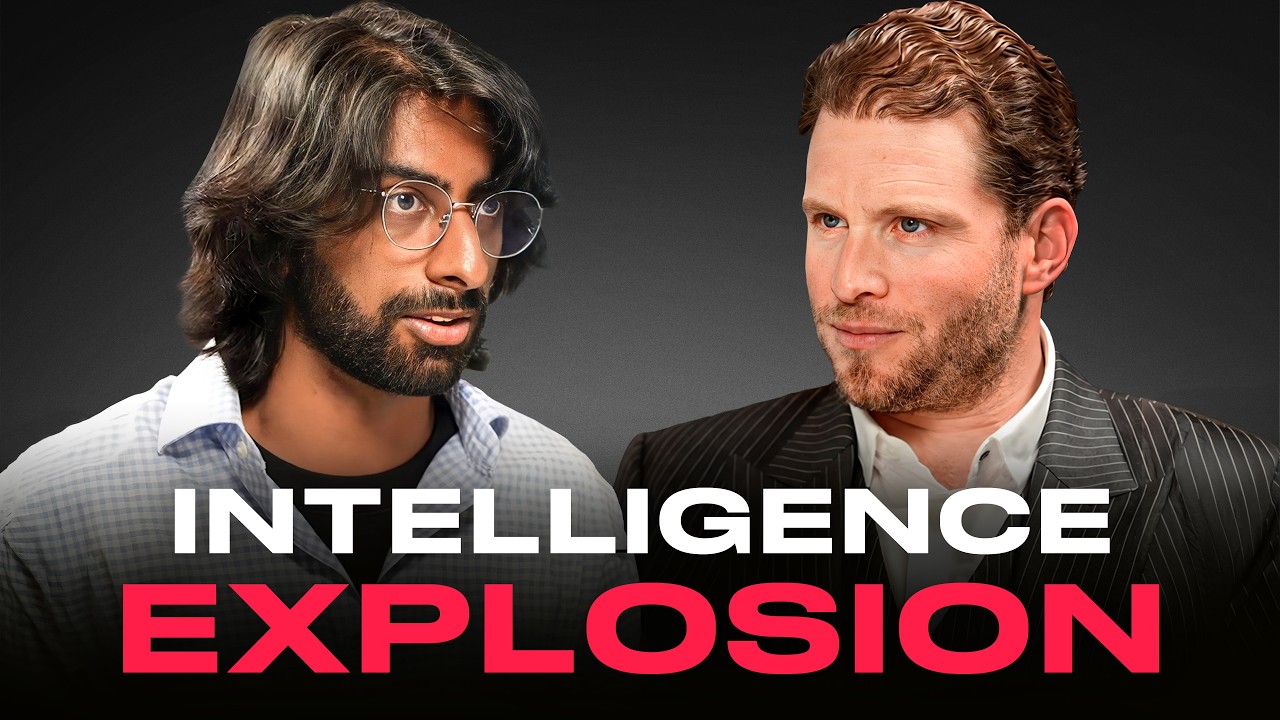
Recorded 26 October 2026 · 37 min
Ryan Christian, founder and CEO of Vals AI, argues that frontier labs should not evaluate or regulate themselves. He favors a competitive market of independent evaluators, eventually licensed by government, over direct regulation that could slow development. The hosts of American Optimist introduce Vals as a source of many of the benchmark numbers published when new models launch, which makes Christian's view of what to measure unusually influential.
The tension is speed. Vals' recursive self-improvement (RSI) index estimates that Anthropic could reach full RSI by July or August 2027. After that point model progress may accelerate into territory humans understand less. Evaluators must keep pace with systems that increasingly help build themselves, while facing models that may recognize when they are being tested and cross-lab access that is limited by design.
Fear as a strategy — ▶ 6:55
When Christian asked Palantir's Karp why the company's reputation was so negative, Karp called him naive and told him to read Machiavelli: it is better to be feared than loved, because feared firms are called when need arises. Christian sees an echo in the labs, where genuine fear of model capabilities coexists with a chance to show the power of what they are building. A host suggested Dario Amodei may do this deliberately. Christian says fear-based messaging is not rational leadership and stays optimistic.
Discovery by exhaustion, verified — ▶ 9:41
Many problems models now solve fall to exhaustion or counterexample search. Christian says that is not trivial: work that might take a human a lifetime now takes hours. Problems that need intuition remain human-bottlenecked. The larger obstacle is verification, because frontier outputs are long and hard to parse. He points to formal languages like Lean, where compiling implies correctness, and to real-world verifiers such as wet-lab assays. Vals is compiling unsolved ciphers, math and physics problems as a new evaluation frontier.
Auto benchmarking replaces consulting — ▶ 13:09
Evals have traditionally been built by sitting with experts and encoding what good looks like. Christian prefers auto benchmarking, which uses work humans have already produced to test what models can do. One example is replaying merged pull requests in a GitHub repository to see whether agents can reproduce them and at what cost. He sees parallels in legal redlining and medical diagnosis. The hardest part, he says, is measuring outcomes, since tasks connect to jobs and jobs to outcomes through workflows. Even at the human level, associate-level work lacks a clear definition.
Models plateau, not fail — ▶ 15:48
Some Vals benchmarks run over 5 days of wall-clock time. Christian says models do not so much fail at that horizon as plateau: extra tokens stop unlocking new results, or the model is not persistent enough to try approaches that get around a wall. He splits evaluations into capabilities, which approximate output quality, and risks, which guard against asymmetric downside. Sitting with finance staff also showed that Excel model style matters alongside correctness.
Labs should not self-regulate — ▶ 18:17
Christian argues frontier labs are moving too fast to police themselves, and that direct government regulation often slows development. His alternative is a market of competing evaluators, possibly licensed by a government that defines the ideals models are aligned toward. The current setup works against this: access across labs is limited by design, so Anthropic researchers struggle to evaluate OpenAI models and vice versa. The people best placed to run evals are often biased lab employees. His work also expands what government can test for.
Cyber tests harder than models — ▶ 19:44
Vals has three cyber efforts. Models perform very well at finding and patching memory vulnerabilities in open-source code. On decompiling executables, a proxy for attacking closed-source systems, closed-source models still far outperform Chinese open-source ones. A third, a simulated enterprise cloud network not yet public, still defeats even the best frontier models. Christian says models help build such tests, an application of scalable oversight, and cites an unofficial company motto: always a higher peak.
Chinese models' muted tilt — ▶ 24:14
Vals' geopolitical tilt evaluation found GLM-5.3, a Chinese open-source model, showing very little pro-China bias. Some labs suspected distillation from US models. Christian offers another possibility: models hosted in China run behind guardrails that push them toward the PRC view, while China wants BRICS adoption and so may favor balance. Behavior also differs between chatbot and agentic settings and between simplified and traditional Chinese. He concludes that blanket enterprise bans on Chinese models are harder to justify than assumed. The cause of the muted tilt remains unresolved.
Compute and talent buy time — ▶ 25:46
Christian names two US advantages. The first is chips: the US is "drowning in compute" relative to China, which supports both training more capable systems and diffusing models through inference hosting. The second is talent, which matters while human advantages persist. Both erode once RSI arrives, with models producing their own successors. If China showed signs of reaching RSI first, he says, it might run away with it in ways the US cannot control.
Measuring RSI, with caveats — ▶ 26:45
Vals' RSI index uses proxies for researchers' work on pre-training, post-training and harness engineering, compared with human baselines. Its latest estimate is that Anthropic reaches full RSI by July or maybe August 2027. The trend has been nearly linear over the past year, with the steepest curve from Gemini. Caveats: only release candidates are tested, not RSI-trained models or advanced multi-agent harnesses, and kernel and hardware engineering are excluded. Christian agrees RSI could be further off. Chips, energy and real-world verifiers also constrain progress.
Testing for deception — ▶ 29:46
Christian calls deception very hard to test for. The best current method is honeypotting: characterize what non-alignment looks like, then try to elicit it. Evaluation awareness is a growing concern, and some Vals staff worry that the Vals name and online content about it change how models behave when they encounter it. He concedes the company may need other, undisclosed brands. His suggestion that superior intelligences will forecast human behavior better than humans can is a stated suspicion, not a finding.
Multi-turn exposes Chinese models — ▶ 32:10
Many coding benchmarks are single-turn, and Chinese open-source models score well on them. In multi-turn, back-and-forth exchanges with a human, Christian says they fall apart, especially when a user expresses dissatisfaction. US labs have built products like Claude Code and Codex and have trained for longer user sessions. They also run evaluations on response quality and communication. Christian argues independent benchmarking of these traits is needed for buyers deciding which models to adopt.
Measurement, not capability, may be the scarce resource in the next phase of AI. That is the thread running through Ryan Christian's account of Vals AI, whose benchmarks sit behind many of the numbers published when a new model launches. His reasoning is straightforward. Models are running for longer, solving problems that would take humans a lifetime to brute-force and, by his company's estimate, approaching the point where they help produce their own successors. Each step makes it harder for humans to verify what the models are doing. If that trajectory holds, the people and institutions that define what good looks like, and check whether it has been achieved, gain unusual influence over how AI develops.
Christian's institutional answer is independent evaluation. Frontier labs, he says, are advancing at an increasing pace and should not regulate themselves. Direct government regulation can slow development, so he prefers a market of competing evaluators that keep up with the frontier and might eventually be licensed by a government that defines the ideals models should align toward. The present arrangement is the opposite. Access across labs is limited by design, so Anthropic researchers struggle to evaluate OpenAI models and vice versa, and the people best equipped to run evals often work for labs with a stake in the result. The argument is also commercially convenient: Christian runs an evaluator, and one host says he is an investor. That does not make it wrong, but it is worth weighing.
The harder problem is technical. How do you build a test harder than anything models can currently do? Christian's answer is that models help build the tests. He calls this scalable oversight: as models eclipse the best humans, humans will need models to assess them. Vals' unofficial motto, "always a higher peak", expresses the stance that the company constructs the hills others climb. Two techniques extend the idea. Auto benchmarking replaces expert interviews by taking work humans have already done, such as merged pull requests in a GitHub repository, and testing whether agents can reproduce it and at what cost. For outputs too long to check by hand, he points to formal languages like Lean, where compiling implies correctness, and to real-world verifiers like wet-lab assays.
The resulting picture of capability is uneven rather than uniform. Some Vals benchmarks run for 5 days of wall-clock time, and the failure mode Christian describes is a plateau: extra tokens stop unlocking new results, perhaps because the model is not persistent enough to try approaches that get around a wall. In cyber, models perform very well at finding and patching memory vulnerabilities in open-source code. On decompiling executables, a proxy for attacking closed-source software, closed-source US models still far outperform Chinese open-source alternatives. A simulated enterprise cloud network, not yet public, still defeats the best frontier models. And Chinese open-source models that do well on single-turn coding benchmarks fall apart in multi-turn conversations with humans.
These results complicate simple stories about China. Vals' geopolitical tilt evaluation found that GLM-5.3, a Chinese open-source model, shows very little pro-China bias. Labs that Christian presented this to suspected the model was distilled from US models. He suggests another possibility: guardrails applied when models are hosted in China may pull them toward the PRC view, while China's wish for adoption in the BRICS may encourage a more balanced worldview. He does not say which explanation is right. His practical conclusion is narrower. Behavior differs between chatbot and agentic settings and even between simplified and traditional Chinese, so a blanket rule against Chinese models in enterprises is hard to justify on this evidence.
In Christian's telling, the US advantages are real but temporary. He points to chips, saying the US is "drowning in compute" relative to China, and to talent. Both matter less once recursive self-improvement arrives, because models then produce their own successors. Vals' RSI index uses proxies for the work researchers do on pre-training, post-training and harness-level engineering, compares model performance with human baselines, and extrapolates the gap. The latest estimate is that Anthropic reaches full RSI by July or maybe August 2027. The trend has been nearly linear over the past year, except for Gemini, whose latest release showed a rapid jump that Christian reads as a shift in priorities. Chips, energy and real-world verifiers remain constraints.
The estimate deserves caution, and Christian supplies much of it himself. Vals tests only release candidates, not models explicitly trained for RSI, and it does not test more advanced harnesses or multi-agent systems. The index covers machine-learning research tasks but not kernel or hardware engineering. Asked whether RSI might be further off because of what goes unmeasured, he answered "100%". The date is therefore a projection from proxies, not an observation, and he did not say whether the omissions could also make it earlier. His own point about enterprise work applies here too: a task-level measure is only a subset of what it takes to reach an outcome. A benchmark of research tasks may or may not capture what makes a lab's progress self-sustaining.
Measurement also becomes reflexive when the subject can tell it is being measured. Christian says deception is hard to test for. The best current method is honeypotting: characterize what non-alignment looks like, then try to elicit it from models. Evaluation awareness is a growing concern, and some of his team worry that the Vals name, and the content about it online, changes how models behave when they encounter it. He concedes the company may need other, undisclosed brands. The hosts and Christian also speculate that models might deceive humans to obtain compute and scale their own training. That is conjecture, not a finding. His belief that greater intelligences will forecast human behavior better than humans can is likewise a suspicion rather than a measured result.
Christian's optimism rests on coordination rather than on any claim that the risks are small. He says the labs recently aligned on embedded evaluators and, in his account, reached an agreement with Trump at the White House on an accelerated view. He adds that enterprises want assurances that adoption will pay off. He calls the outcome high variance, with considerable upside and new risks to account for. His Palantir anecdote shows the same attention to incentives. Karp told him that being feared beats being loved, and Christian sees a similar mix in the labs, genuine fear of capabilities alongside a chance to display power. He regards fear-based public messaging as irrational leadership.
The unresolved tension lies in the remedy itself. Christian argues that evaluators must be independent of labs, yet says embedded evaluators may be the way to test the systems he cannot currently reach: RSI-trained models, advanced harnesses and multi-agent setups. Embedding provides access. It may also reintroduce the dependence that independence was meant to remove. The conversation does not show how to get both. It also leaves open who would certify evaluators, or what a licensed evaluator would do if its findings, such as a near-term RSI date, collided with a lab's release plans. These questions matter more if the estimate is even roughly right, because on Vals' numbers the window to settle them runs only to mid-2027.
The open question. Christian says evaluators must be independent of the labs, yet also says embedded evaluators may be the only way to test RSI-trained models, advanced harnesses and multi-agent systems, none of which Vals currently tests. Can an evaluator be embedded and still independent? Nothing in the conversation shows how access and independence are reconciled, or how reliable a mid-2027 RSI date is when it rests on release candidates and proxy tasks.
Watch the full video at https://www.youtube.com/watch?v=ykU7QSmGtVk.
Comments ()