
Recorded 21 Oct 2026 · 94 min
Jensen Huang's pitch is that the scarce resource in AI is time to first token, not chips. A one-gigawatt AI factory costs about $50 billion. On his assumption of $40 billion a year in revenue, a three-month delay burns $10 billion.
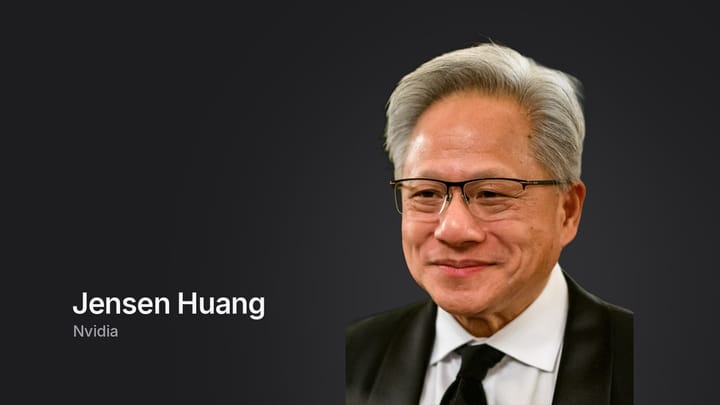
This is Huang's GTC keynote in Berlin, aimed at European companies. Nvidia is pushing integration upstream into the supply chain with DSX Pod and redefining the workload from models to whole agents: model, harness, sandbox, knowledge and tools. Around that sit security for autonomous agents, open models customised on company data, robotaxis, humanoids and a new PC line.
The tension is between a vendor selling a full stack as the only sensible route and a message that every company should produce its own intelligence. Huang wants customers to own the models, knowledge and tools while buying the factory, the runtime and much else from Nvidia.
Europe, 33 years in — ▶ 7:20
Nvidia invested nearly $10 billion across European startups and partnerships in the last year, announced 14 startup investments in a single week, and counts 12,000+ partnerships on the continent. The roots are local: NV1 through RIVA 128, the chip that "saved our company", was built in Europe, manufactured in Crolles, France and assembled in Malta. Elsa brought Nvidia into workstations in 2000, Audi took it into the car in 2005, and Mercedes autonomous work began in 2020. The framing is a new industrial revolution, defined as a technology that changes how we build something and what we can build.
Intelligence is manufacturing — ▶ 9:52
AI is "a manufacturing industry", not just software. It is a five-layer cake: energy, computing, AI factory infrastructure, models, and applications. The model layer spans language, biology, chemicals, physics and robotic actions, at every size. The advice to Europe is to produce AI, not merely consume it. Infrastructure has to exist before models, just as networking preceded the internet. One prediction is stated outright: every telco, with 100,000 sites and some 100 gigawatts of base stations and data centers, will evolve into a distributed AI network.
An algorithm company — ▶ 15:06
A one-gigawatt AI factory costs about $50 billion, covering land, power, shell, compute, networking, storage and cooling. Nvidia calls itself "an algorithm company that designed silicon to accelerate them". cuDNN is to AI what SQL is to databases, and 350 other CUDA-X libraries, from computational lithography to sparse solvers, are the "crown jewels". The libraries are how Nvidia opens new markets. Beyond GPUs, the company also claims to be the largest networking company in the world through Spectrum-X, and it ships Groq 3 as a decode accelerator for token generation.
1 million times in 10 years — ▶ 18:33
Since the DGX-1, delivered to OpenAI 10 years ago, AI performance is up 1 million times across six architecture generations. Moore's law would have given about 100x: 10x per five years. The difference is "extreme co-design", with chips, systems, system software, algorithms and the whole factory optimised together. Moore's law has "largely ended", so this is the only route. Each generation also widened the unit of compute: GPUs through Hopper, rack-scale one-giant-GPU with Blackwell, and now the entire agent with Vera Rubin.
Rubin is built for agents — ▶ 20:27
An agent needs four machines: the model that thinks, a harness holding working and long-term memory, a computer for data processing, and one running CUDA-X tools. Vera Rubin targets all of it. An NVL72 links 72 GPUs at 20 petaflops each. Nodes are 100% liquid cooled with no cables and assemble in under five minutes, against two hours for Grace Blackwell at 80% liquid cooling. Rubin is 30x Blackwell in two years, after Blackwell's 30x over Hopper. Spectrum-X co-packaged optics, 512 ports at 200 Gbit/s, is in volume production.
DSX Pod ships the factory — ▶ 29:14
DSX starts in a digital twin, validating power, water and scale before construction. A control loop steering power to workload demand yields the same output on 30% less power. Closed-loop cooling at coolant up to 45° uses dry coolers, saving 54 million litres of water a day at 2 gigawatts, the daily use of 180,000 households. DSX Pod is seven liquid-cooled racks with 17 km of Spectrum-X cabling, fully cabled and factory tested, shipped in containers on 800V DC. On-site deployment drops from several months to days.
Idle capex math — ▶ 34:22
Each gigawatt costs $50 billion. Assume $40 billion a year in revenue and a three-month delay costs $10 billion, enough to "make anybody anxious". Moving assembly into the supply chain cuts arrival-to-tokens from four to five months to about one. The precedent is NVLink 72, where whole racks were assembled in the supply chain. That is why several hundred data center buildouts run at once and every computer maker builds it. The stated aim is less wasted idle compute and idle capex, so everybody "becomes more profitable".
Two sources of advantage — ▶ 36:04
First, the only accelerated architecture that is general purpose: fluids, particles, quantum chemistry, data processing, not just transformers, consistent for two and a half decades. Second, a full-stack factory, because most companies want to deploy AI infrastructure, not design chips and write all the software. Customers span cloud providers, neoclouds such as Mistral in France, AI labs, and end industries like automotive, healthcare and finance. The system is fungible, usable for data processing, training, post-training, inference and agents, and durable because software keeps updating across a huge installed base.
Agents drive token demand — ▶ 41:48
The shift this year is that AI became productive. OpenClaw introduced the open-source agent, and agents think, reason, iterate and use tools, so they consume enormous numbers of tokens. Token consumption and GPU demand have "gone through the roof". An agent has five elements: the model, the harness (the "exoskeleton"), the sandbox the harness runs in, knowledge, and tools. The harness can be OpenClaw, Hermes, OpenHands, LangChain Deep Agents, or plain Python. Before usefulness comes security, because the agent is autonomous with access to files, networks and tools.
Security outside the agent — ▶ 43:54
Today the only thing stopping an agent misusing access is asking nicely, and "hope isn't security". OpenShell enforces policy at the level of system calls, file access and network connections, outside the agent rather than in LLM guardrails. Keys stay with the supervisor, so a compromised agent can't leak one it never had. Sentry on BlueField 4 monitors from a hardware-isolated domain and can quarantine an agent in milliseconds. It is Apache 2.0 and takes two commands to adopt. Anthropic is partnering on OpenShell agents, and privileges must be set dynamically per task and per person.
Open models, then customise — ▶ 49:34
No single model will run everything. Companies will use the best closed, open and custom models, closed for generic work and customised open models where proprietary knowledge matters. Nvidia releases open families, Nemotron, Cosmos, GR00T, Alpamayo and Earth-2, with weights, data and training scripts. The concession is explicit: these are "not necessarily the frontier of frontiers" for language. Post-training on company data is claimed to reach frontier capability, with Baseten and CodeRabbit, and Harvey, cited as examples. The goal is to turn proprietary data into "sovereign intelligence".
Software is not dying — ▶ 53:47
Agents become useful through company knowledge and tools. Nemotron Parse reads PDFs, Embed and Rerank retrieve, and Kumo predicts from SQL data. A supplier-delay notice, an order database and a replacement-part search chain into one workflow. The claim that AI ends software and tools companies is answered flatly: "It's exactly the opposite." There will be more users of tools than ever, and Cadence, CrowdStrike and Dassault are building agents. In a Dassault demo, agents adapt a Volkswagen Golf door for the Tiguan and a simulation agent catches a vibration problem. The knowledge and tools "belong to you".
Telecom and robotaxi standards — ▶ 1:06:58
Cell towers sense with radio waves and act through beamforming, which makes them natural AI machines. Nvidia made the first commercial phone call on T-Mobile's network with Nokia after nearly eight years of work, with AI to be layered on next. For robotaxis, Hyperion is one standard sensor and compute architecture, 14 cameras, nine radars and three lidars on dual Nvidia GPUs, aimed at a fragmented market. The world travels about 1 trillion miles a year at perhaps $1-2 a mile. VW van, JLR, Volvo and next-generation Mercedes join as Hyperion-compatible.
Standardise the humanoid — ▶ 1:12:38
Robotics is hard because diverse work fragments into custom configurations, which blocks the volume flywheel that phones, PCs and NVLink 72 enjoyed. A humanoid is "probably" not perfect for everything, but it is likely the highest-volume configuration, and small businesses could simply show it a task. Physical AI needs three computers: one to train, an Omniverse digital twin to learn skills, and an on-robot computer. Nvidia is building a reference robot, Agile One, with Agile Robotics, pre-assembled and available in the first quarter of next year. Europe's mechatronics craft is called the opening.
A petaflop in your hand — ▶ 1:17:18
RTX Spark, built with Microsoft over four years around the N1X chip, delivers 1 petaflop and 128 GB of memory. That is what the 2016 DGX-1 gave OpenAI, a machine that took two people to carry upstairs. A Windows DGX Station reaches 20 petaflops and 754 GB at the end of the year. The PC is reframed as a personal agent with all five components. The demo makes it concrete: an agent on RTX Spark designs, trains in the cloud and validates a Pollen Robotics Micro Duck, and the way to build an agent is "you ask an agent to build it for you".
The binding constraint on AI is no longer the chip. It is the stretch of months between a rack arriving at a site and the first token leaving it. Nvidia has spent a decade compressing everything upstream of that stretch. Now it is attacking the stretch itself.
The mechanism is to move integration out of the data center and into the supply chain. The Blackwell generation did this once. Nvidia stopped shipping parts and started shipping whole 72-GPU racks, assembled before delivery. That is why several hundred data center buildouts can run at the same time, and why every computer maker now builds the same rack. Even so, customers faced months of cabling and assembly on site. The Spectrum-X network for a single pod needs 17 km of cable. DSX Pod takes the next step. Seven liquid-cooled Vera Rubin racks arrive fully cabled, factory tested and burnt in, inside transportable containers. They run on 800-volt DC and shed heat through dry coolers that evaporate no water. Huang puts the on-site timeline at several months falling to days. He puts arrival-to-production-tokens at four to five months falling to about one.
The economics explain the urgency. A one-gigawatt factory covers land, power, shell, compute, networking, storage and cooling for about $50 billion. Assume it earns $40 billion a year. Three idle months then cost $10 billion in revenue that never exists. On that logic, idle compute is the most expensive thing in the building, and what Nvidia sells is the removal of idle time. That is the sense in which Huang calls AI a manufacturing industry. Energy, computing, infrastructure, models and applications stack into a five-layer cake. His advice to Europe is to produce intelligence rather than merely consume it.
The pitch only holds if the hardware keeps improving faster than the buildings around it. Huang claims AI performance is up 1 million times in 10 years. Moore's law would have delivered roughly 100x, and he says it has largely ended. The gap comes from what he calls extreme co-design. Chips, systems, system software, algorithms and the whole factory are tuned together. Vera Rubin is billed at 30 times Blackwell, which was itself about 30 times Hopper. The small numbers carry the same logic. A Rubin node is 100% liquid cooled with no cables and assembles in under five minutes. A Grace Blackwell node, 80% liquid cooled, took two hours. A control loop that steers power to match workload demand is said to deliver the same output on 30% less power.
What the factory runs has changed. It no longer just runs models. It runs agents. Agents think, iterate and call tools, so they burn tokens, and Huang says token consumption and GPU demand have gone through the roof. An agent has five parts: a model, a harness, a sandbox, knowledge and tools. Rubin is designed around the whole assembly. One machine does the thinking. The Vera CPU handles the harness's memory and data processing. A separate computer runs CUDA-X tools, which he says speed up fluid dynamics, quantum chemistry or ray tracing by 10x, 50x or 100x over a CPU.
The tools are the part Huang cares about most. The 350 CUDA-X libraries are the "crown jewels". cuDNN is to AI what SQL is to databases. Nvidia, he says, is "an algorithm company that designed silicon to accelerate them". That reading underpins his answer to the idea that AI ends software. "It's exactly the opposite." More users will come to the tools, and Cadence, CrowdStrike and Dassault are building agents to use their own. In a Dassault demo, agents adapt a Volkswagen Golf door to the Tiguan, and a simulation agent catches a vibration problem before an engineer picks the final design.
An agent is only as useful as the access it has, and that is the risk. Huang describes the current state of agent safety as asking nicely: please don't delete anything, please don't touch my SSH keys. "Hope isn't security." OpenShell moves enforcement outside the agent. Policy applies at the level of system calls, file access and network connections. Keys stay with a supervisor, so a compromised agent can't leak a key it never held. Sentry, running on BlueField 4, watches from a hardware-isolated domain and can cut an agent off from its model in milliseconds. The code is Apache 2.0 and takes two commands to adopt. Privileges also have to change per task and per user, every time an agent launches.
Knowledge is the other half of usefulness, and here the message is ownership. Companies should use closed models for generic work and customised open models where their expertise lives. Nvidia ships open weights with the data and training scripts, so provenance can be checked. The recipes are meant to let a company turn proprietary data into what Huang calls sovereign intelligence. The knowledge foundation handles the plumbing. Nemotron Parse reads PDFs. Embed and Rerank retrieve. Kumo predicts from SQL tables. A supplier-delay notice, an order database and a search for a replacement part chain into one workflow. The knowledge and the tools, he says, belong to you.
Physical AI follows the same pattern: standardise to create volume, then let volume drive the flywheel. Robotaxis are a fragmented market, and Hyperion is the answer. It is one sensor and compute architecture of 14 cameras, nine radars and three lidars on dual Nvidia GPUs. Volkswagen, JLR, Volvo and the next Mercedes now join, against a world that travels about 1 trillion miles a year at roughly $1-2 a mile. Humanoids get the same argument. Huang concedes the form is "probably" not perfect for everything, but says it is likely the highest-volume configuration. A reference robot, Agile One, ships pre-assembled in the first quarter of next year. Telecom gets a quieter version. After nearly eight years, CUDA made a commercial call on T-Mobile's network with Nokia, the traditional way, before any AI sits on top.
The obvious objection is that the whole structure leans on assumptions Huang supplies himself. The $40 billion a year per gigawatt is an illustration, introduced with "if we just said". Halve it and the cost of a three-month delay halves too. The case for fungibility and durability is also made by the party selling the fungible, durable system. He concedes the open models are "not necessarily the frontier of frontiers" for language. His proof that post-training closes the gap is a run of partner examples, Harvey, CodeRabbit and others, with no benchmarks and no cost comparison. The ownership message sits awkwardly beside the offer. A company is told to keep its knowledge and tools while buying the factory, the runtime, the security monitor, the open models, the retrieval stack and the PC from one vendor. Even the sovereignty framing for Europe runs through a single architecture.
None of that makes the logic wrong. If agents keep consuming tokens at this rate, delay is expensive, and shipping a finished factory beats assembling one on site. What stays unresolved is whether demand grows into a buildout this size, and whether the revenue per gigawatt Huang assumes is a number customers will ever see.
The open question. The urgency rests on one assumption. Huang says a gigawatt factory earns "tens of billion dollars per year" and then settles on $40 billion with "if we just said". Every figure about idle capex scales with that number, and he does not defend it. The examples of open models turned frontier-grade are also partner-selected, and he concedes the base models are not frontier for language. Watch for independent data on revenue per gigawatt and on how far post-trained open models actually close the gap.
Watch the full video at https://www.youtube.com/watch?v=PvFjbPYEOZI.
Comments ()