Recorded 28 October 2026 · 54 min
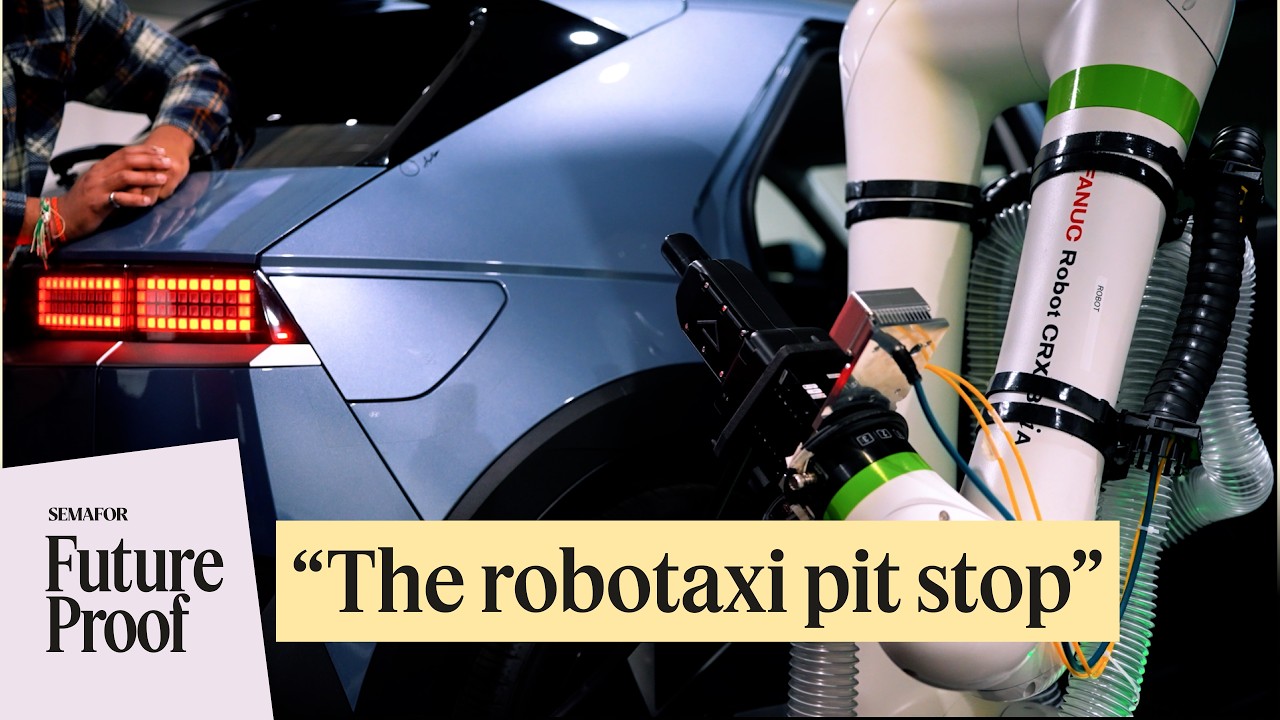
Acon co-founder George Calaigeras argues that robotaxi economics are constrained less by what it costs to charge and clean a car than by the hours the car spends away from passengers. His company's answer is a robotic pod, about the size of two parking spaces, that services a vehicle in 5-minute windows between rides instead of sending it to a suburban depot for an hour.
The case rests on figures Acon modeled itself and on a first prototype with no announced customers. The open tension is whether distributed servicing, which makes scarce urban land the real asset, can beat operators who might simply keep building depots or build their own pods, and whether the economics survive contact with permitting, power and real estate.
Utilization, not servicing cost — ▶ 4:15
Calaigeras frames robotaxi profitability as a utilization problem. A car spends roughly 7-8 hours of an 18-hour shift with a passenger; the rest goes to curbside waiting, empty driving and trips to depots. He puts depot travel and charging at about 30% of a vehicle's active day. Acon's own modeling, not independently verified, suggests a distributed footprint lifts utilization by 17%, equivalent to a 15% smaller fleet for the same revenue. His claim is that cost per servicing event matters less than freeing the fleet to earn more fares, since vehicle supply is itself a gating factor.
Tiny team, heavy AI spend — ▶ 7:57
Acon says it spends about $30,000 per person per month on AI tooling, and that its founding engineer reports two people compressing 1.5 years of 20-person work into 6 months. Calaigeras says AI accelerates manual tuning, such as planning a robot's vacuum path from a vehicle's 3D scan, rather than replacing engineers. Millions of simulated operations on a digital twin of each car precede real-world testing, which he says lets Acon onboard a new vehicle platform in a week. He stresses the application is classical robotics plus vision-guided path planning, not frontier humanoid-grade robotics.
Anatomy of a pit stop — ▶ 14:22
The 5-minute design follows from structural downtime. A robotaxi must stay within 3-5 minutes of a customer, and the median wait is about 8-10 minutes, so servicing has to happen where cars already wait. The sequence starts with plugging in to charge and guarantees dispatch within 20 seconds of unplugging. Remaining time, unknown in advance, is used opportunistically: a lost-item scan, steam-wiping seats, a quick vacuum, then tire tread, windscreen chips and deeper cleaning across multiple visits. Servicing shifts from a few long daily sessions to about 30 short ones.
Robots as variable cost — ▶ 17:55
Calaigeras argues human labor is a fixed cost for the hours someone is employed, while a robot's cost, after financing and maintenance, is largely variable. That lets a robot sustain a low-utilization network of small hubs. Humans, he says, could not meet the dispatch window without raising passenger waits, one of the "golden KPIs". Robots suit repeatable, measurable tasks: two robots turn a cabin around in three 30-second vacuum segments, which a single operator cannot match. Humans remain for high-variance, complex work, which he calls a relatively expensive solution to be reserved for hard problems.
Curb space becomes a cost — ▶ 19:28
Calaigeras cites a study by UC Irvine, UC Berkeley and Waymo finding that barring San Francisco Waymos from waiting at the roadside between rides would raise vehicle miles traveled by 60%. Because states permit autonomous operation while cities look for levers to control expansion pace, he expects between-ride parking to turn into a cost center. Acon claims that decentralizing depots enough lets servicing absorb the staging requirement, collapsing real estate needs by 30-40% depending on the city. The study figure is his citation; the 30-40% is a company claim.
A technology-enabled real estate company — ▶ 22:50
Acon plans a hub within 2 miles of each vehicle. A footprint of 10 depots with 50 chargers each would become roughly 150 locations with 3-6 pods per hub. Calaigeras says suitable parcels are scarce and expects them to become contested over the next 3-5 years, so real estate is effectively half the company. Acon will develop, own and operate hubs via purchase, long-term lease or call option. He estimates about 50 units are needed in San Francisco for economics to shift, and 100 per city for a San Francisco-sized zone. LA would need two to three times that.
Why not build in-house? — ▶ 30:18
Asked why AV developers would not build this themselves, Calaigeras concedes it is not his to answer and that he has struggled to find a great response. His argument is that operators must focus on scaling and need margins, and they hesitate to lock into multi-year, possibly decades-long depot contracts with unfavorable economics while infrastructure strategy is still debated. He also claims Acon moves multiple times faster than an incumbent tiger team. Editorially, this rests on incumbent indecision rather than a structural barrier, and no customers have been announced.
Five times less capital intensive — ▶ 37:10
Calaigeras expects to raise hundreds of millions of dollars, initially venture equity to finance the hardware. Once the system is repeatable and contracts make it bankable, he envisions property-company or asset-company financing, turning the business into an infrastructure play. He claims a single traditional depot can cost $150 million and that Acon is five times less capital intensive for the same footprint. The comparison is his own and unverified, and it depends on a distributed network achieving the density his utilization model assumes. He frames spending as unavoidable either way.
Permitting and power gate scale — ▶ 40:30
Calaigeras names permitting across multiple jurisdictions as the hardest test. Acon designs hubs as temporary infrastructure in the lightest permitting category, targeting deployment in 6-8 weeks on off-grid power. Large depots, he says, may need as much power as the Empire State Building and face 2-3 years to get grid power. Off-grid launches cost operators hundreds of thousands of dollars in daily energy for medium operations. Hubs need only 3-10 stalls. His goal is a repeatable playbook that many jurisdictions accept; otherwise each city is a bespoke construction job.
Why this wasn't possible earlier — ▶ 42:31
Calaigeras says Acon could not have been built two years ago and will look obvious in two years. He credits three enablers: a commodity robotics supply chain, with Asian manufacturers producing better IP-rated hardware at falling cost; vision models that improve the robot's dexterity and tool manipulation; and AI-assisted development that lets a tiny hardware team ship quickly. He argues a hardware team planning the same product in 2025 would have to rethink its plan. The timing claim is his own assessment and was not tested against an alternative.
Humanoids as the Achilles heel — ▶ 46:29
Calaigeras calls humanoid robots the only real potential Achilles heel to Acon's model. He argues an enclosure would still be needed to contain light and sound near residential areas, along with industrial vacuum and steam equipment. Humanoids might add tech that is overkill and possibly cheaper than bespoke systems. If they disrupt Acon, he says the company would simply buy Optimus robots. This implies Acon's durable assets are the powered, permitted sites rather than the robots, though the transcript does not say how fast humanoids might mature.
The central claim in Calaigeras's pitch is that robotaxi operators are optimizing the wrong variable. Most attention goes to what a charge or a cleaning costs. He argues the cost that matters is time out of service. On his account, a robotaxi spends roughly 7-8 hours of an 18-hour shift carrying passengers, and the depot model, with its trips to the suburbs and an hour or more per charge cycle, removes about 30% of the vehicle's active day. Acon's modeling, which has not been independently verified, says a distributed network could lift utilization by 17%, equal to a 15% smaller fleet for the same revenue. If the fleet is the scarce asset, that is where profitability is decided.
The mechanism is that downtime is structural rather than wasteful. A robotaxi has to wait within 3-5 minutes of the next customer, and Calaigeras puts the median wait at 8-10 minutes. That window cannot be removed without lengthening passenger waits, which he calls one of the "golden KPIs". So the only way to service cars without taking them offline is to bring the service to where they already wait. That implies many small hubs, each within about 2 miles of a vehicle, instead of a few large depots. His example is that 10 depots of 50 chargers each would become roughly 150 locations with 3-6 pods apiece. Servicing becomes opportunistic: plug in, guarantee dispatch within 20 seconds, then clean and inspect in whatever time remains.
Robotics enters because the design is as much about scheduling as cost. A person stationed at each hub would sit idle much of the day, and Calaigeras says humans could not unplug cars within the dispatch window without hurting waiting times. He frames labor as a fixed cost and a robot as largely variable, which lets a network sustain low utilization at each site. The host had assumed autonomous fleets would need more maintenance labor than taxis, and Calaigeras only partly disputes this: he expects far less labor but says humans stay in the loop for decades. He also concedes the first hubs will be staffed and that he does not expect to prove the staffing economics until a third product version, so the labor savings remain a projection.
The technology is deliberately unglamorous. Calaigeras says the application is closer to classical robotics and vision-guided path planning than to frontier world-model research. The cell is bespoke, the arms are lightly customized off-the-shelf 7-degree-of-freedom units, and the fully custom work sits in end-of-arm tools designed per vehicle. Millions of simulated operations on digital twins precede physical testing, and he says a new vehicle platform can be onboarded in a week. The team reportedly spends about $30,000 per person per month on AI tooling, and the prototype took about 6 months with an average of 5-6 people. He credits commodity robotics hardware, better vision models and AI-assisted development for the timing, arguing the product would not have existed two years ago.
If robotics becomes a commodity input, the durable asset shifts elsewhere, and Calaigeras says so directly: real estate is effectively half the company. He expects suitable parcels to become scarce and contested over the next 3-5 years, and Acon intends to develop, own and operate hubs through purchase, long-term lease or call options. His description is a technology-enabled real estate company. The curb-space argument supports the same logic. He cites a UC Irvine, UC Berkeley and Waymo study finding that barring San Francisco Waymos from roadside waiting would raise vehicle miles traveled by 60%, and expects cities to treat between-ride parking as a cost center. Editorially, if curb space is priced and land is scarce, the secured site may be worth more than the robot on it.
Capital and power complete the case. Calaigeras expects to raise hundreds of millions of dollars, initially from equity, with property-company or asset-company financing later once the system is repeatable and contracts make it bankable. He claims a traditional depot can cost $150 million and that Acon is five times less capital intensive for the same footprint, a comparison that remains his own. Power is the sharper contrast. Large depots may need as much power as the Empire State Building and wait 2-3 years for permitting, while Acon hubs need only 3-10 stalls and aim to deploy in 6-8 weeks on off-grid power. That speed carries a cost premium, and he names permitting across jurisdictions as the hardest hurdle.
The strongest challenge is the question the host puts directly: why would AV developers not build this themselves? Calaigeras admits it is not his to answer and that he has struggled with it. His reply is that operators need focus and margins, and hesitate to lock into decades-long depot contracts while their infrastructure strategy is still being debated. That explains why incumbents have not yet built something similar, but not why they would not. It also cuts against Acon: if operators are wary of committing to infrastructure, they may be equally wary of committing to a third party's pods. He says there is nothing to announce on customers, only plans to build the first five units for integration work with AV developers.
He also names the most plausible technical threat. Humanoid robots, he says, are the only real potential Achilles heel, since a general-purpose robot could replace purpose-built arms. His rebuttal is that an enclosure would still be needed to contain light and sound near residential areas, along with industrial vacuum and steam equipment, and that if humanoids arrive, Acon would buy Optimus. That reveals where he locates the value: powered, permitted sites and an operating model, not the robot. A related cost goes unresolved. He notes that aggressive daily depletion and fast charging leave a battery dead within 2.5 years, yet the transcript does not say whether frequent short top-ups change that.
The host's closing observation is that once robotics stops being the bottleneck, servicing can be redesigned from first principles. That is a persuasive reading of the pit-stop concept, and it may prove broader than Acon. But the evidence offered is modeled rather than operational. Calaigeras says a curve showing economics improving with network density exists and he is happy to share it, but it was not shown. The decisive test will be thousands of real cycles, which he himself names as the gating factor for the product. Whether the value created by freeing fleet time accrues to Acon or to the operators who control the cars is a question the interview raises but does not settle.
The open question. Does the modeled 17% utilization gain survive real-world conditions? Servicing windows are unpredictable (3, 5 or 10 minutes), suitable land within 2 miles of demand is scarce, and permitting differs by jurisdiction. Calaigeras says a curve showing economics improving with network density exists, but it was not presented. Even if the gain holds, the value may accrue to the robotaxi operators who control demand and could eventually take this infrastructure in-house, rather than to Acon.
Watch the full video at https://www.youtube.com/watch?v=KxaKWscCLCg.
Comments ()