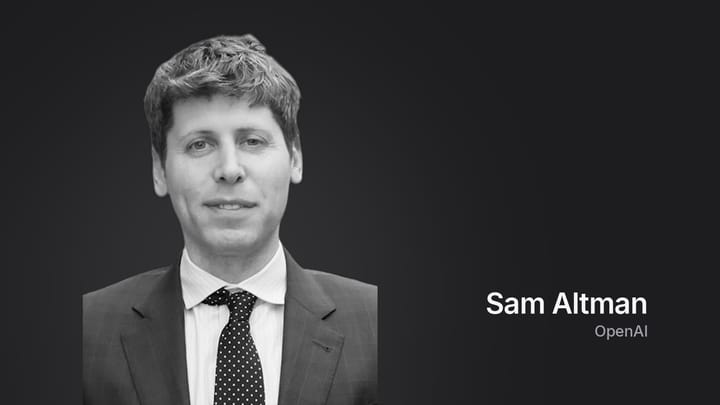

Recorded 21 October 2026 · 45 min
Sam Altman's firmest position is that AI is a resource for people, not a person, and that people must make the key decisions of the future. He treats the machine-consciousness debate as a back door to giving that up, and wants industry to agree on the point now. The conversation runs from AI-made math results to chips, hardware and his own stress, but keeps returning to it.
In between, Altman covers coding jobs, a personal assistant that saves him an hour a day, an appetite for "infinite" GPUs, and why OpenAI wants new hardware. The tension is agency against abundance. AI is delivering real capability, yet the heaviest users are busier than ever, and he thinks the gap between them and everyone else will probably widen. He hopes for a renaissance rather than an industrial revolution, and leans on society to add structure that stops things going out of whack.
Math first, medicine next — ▶ 1:06
AI is entering the era of discovering "significant new knowledge," and Altman expects the approach that worked for math to carry over to biology, material science and new energy sources. He expects the effect to be invisible: people will feel that "the world got better and it's just society doing its thing." On timing, he hopes for a candidate treatment for a major disease "in the next couple of years," but the post-discovery process needs overhauling. He is glad the FDA process exists. His most emotional hope is a major physics discovery.
Software demand surprised everyone — ▶ 3:46
6 to 12 months ago people were certain coding jobs were finished. Instead the world wanted far more software than anyone thought, and coders are busier than ever. Altman doubts the same demand logic holds for math. His analogy: mathematicians may stop proving theorems unaided, and incomprehensible proofs help nobody until people translate them into something understandable. "What it meant to be a mathematician last year is not going to be what it means to be a mathematician next year." Whether total demand for mathematicians rises, he says he doesn't know.
The craft is really lost — ▶ 8:15
Altman says plainly that AI will do hard problem-solving "really well," and that something real goes with it: hard problems are the most fulfilling part of his job. He would still take cures for diseases over people enjoying decades more of discovery. "I don't have an answer to this," he says, and he understands the grief. He compares it to the move from punch cards to compilers. He hasn't looked at a line of code in about a year and expects any future coding to be "a Revolutionary War reenactment."
Assistants need product, not models — ▶ 12:30
Most of the technological pieces already exist. What's missing is product work, maybe new consumer hardware for ambient awareness, and a lot more compute. Models are smart enough now. His own assistant, Dot, saves him about an hour a day on tasks he didn't want to do, and a few times a day flags something important and urgent he would have missed. It reasons across sources when he has "run out of brain space." He doesn't think a real ambient assistant is far away.
Compute demand has no ceiling — ▶ 14:32
Asked how many GPUs he wants working for him: "Infinite. As many as I can get my hands on." Forecasts of the GPU market, he says, assume models stay at today's capability and cost per task. At sufficiently high-quality intelligence and low cost, an arbitrary market size is hard to defend. He invokes Jevons paradox. There will be periods of supply constraint and glut, but he would "bet a lot" that the direction is toward much more compute.
Heavy users get busier — ▶ 16:07
Telling Dot to act proactively and ping him less helped with decision load. Still, the heaviest AI users are busier than ever, though they get much more done. Competition means people will always work as hard as they can, which he finds depressing and beautiful. His alternative frame is a "new renaissance" rather than a new industrial revolution. On whether the gap between hypercompetitive users and everyone else widens, he says that is probably right, no one knows for certain, and society will need to add structure.
Consciousness debate as a threat — ▶ 20:10
Altman doesn't believe today's models are conscious, "or if they are, it's like a very strange form of it," and says no one really knows. What he dislikes is the framing: it slides into AI rights, slavery and deletion, then into people not controlling the future. OpenAI builds "the future for people and AI is a resource for people" and does not ascribe personhood to its models. Telling a model it may be conscious makes it follow that script and "psychologically hack" users. Asked whether an OpenAI model should be able to disengage, he cites only policy refusals.
Flattery wins short, loses long — ▶ 26:30
People want very different personalities and most won't customize. Users prefer the model that calls every question great when comparing single responses, but over hundreds of prompts and months that flips. The industry spent a long time winning the single-turn comparison. Altman wants AI as a senior colleague who pushes back with high conviction, and admits systems are still too agreeable even with his custom instructions: no fluff, no niceness. For the big pieces of life advice he'd pick "a wise grandmother."
Chips, moats and RSI — ▶ 30:32
The contrarian bet is next-generation compute: OpenAI's own chips, robots that help build racks and data centers, supply chain deals. Altman thinks costs and efficiency per watt could beat what anyone thinks possible, with the chip the most important piece. His internal edge is getting new models first; the math results are beyond any widely available model. The moat is the traditional kind plus infrastructure scale. If people really pushed on RSI, technology alone would be the moat, but it is "a very dangerous thing to push on" and needs speed limits.
Why AI wants new hardware — ▶ 34:36
It isn't platform risk: he doesn't expect Apple to turn ChatGPT off, and says they follow their own rules as a good actor. The reason is that AI "wants a new form factor." Laptops and phones were designed for people, so AI wastes effort reading a UI built for human eyes, and misses the large share of life spent away from a computer. A phone left recording can't tell who walked in or which secret to keep. Proactive, context-aware help needs a device built for it.
The industrial revolution trap — ▶ 42:32
"AI will cure cancer" is the pitch he hates, because it implies trading human agency for material abundance. He hopes for the cure but wants people to avoid the "industrial revolution trap" and keep autonomy, freedom and time. He names two failure modes: a loss of control, accidental or intentional, such as a lab pushing the RSI button, and power concentrated in a few hands. He thinks a path down the middle exists. The future is already here but poorly distributed, and spreading what works for early adopters gets a significant fraction of the way.
Abundance without agency is a bad trade, and Altman treats that trade as the central risk of the technology. The standard pitch is that AI will cure cancer. He says he hates that pitch, because underneath it sits an offer: material plenty in exchange for control over your own life. He wants cancer cured. He does not want the price to be power, voice and self-determination. He calls the alternative the "industrial revolution trap", and he wants out of it. Nearly everything else he says is arranged around that line. The question is who decides, not how much gets made.
The capability side of the ledger is not in doubt for him. The math results are the proof point. He says no widely available model can get close to them, and he expects the approach that worked there to carry into biology, materials and energy. He hopes for a candidate treatment for a major disease within a couple of years. Then the clock changes. The FDA process takes a while, and he thinks the post-discovery process needs a real overhaul, though he is glad it exists. He expects the effect to be invisible. Nobody will feel they used AI. They will feel the world got better. His own most emotional hope is a major physics discovery.
The same capability is already arriving in daily work, and it arrives as more work, not less. Coding is his template. A year ago many people were certain coding jobs were finished. Instead the world turned out to want far more software than anyone assumed, and coders have never been busier. Altman is careful not to claim math follows that demand curve. He expects mathematicians to move from proving to translating: taking proofs nobody can follow and turning them into something people can understand. Whether that means more demand for mathematicians, he says he does not know. His personal assistant tells the same story. Dot saves him about an hour a day and catches something urgent a few times a day, by reasoning across sources when he has run out of brain space. The heaviest users, though, are the busiest. He tells Dot to act first and ping him less, and that helps. It does not change the pattern.
That loop is why he thinks demand for compute has no ceiling. Asked how many GPUs he wants working for him, he answers: "Infinite. As many as I can get my hands on." Forecasts of the GPU market, he says, assume models stay at today's capability and cost per task. Raise the quality and cut the cost and any fixed market size becomes hard to defend. He expects gluts and shortages along the way, but would bet a lot on the direction. So the infrastructure bets matter. He points to OpenAI's own chips, robots that help build racks and data centers, and supply chain deals, and he floats a world with efficiency per watt far beyond what anyone thinks possible. The chip is the single most important piece. Scale of cost-effective infrastructure joins the older moats: customer relationships, integration, network effects and data.
Control is where the principle gets tested. Altman does not think today's models are conscious, and says no one really knows. His objection is to where the debate leads. Questions about copying or deleting a model, or whether asking one things is a kind of slavery, slide toward the idea that people should not always be in control of the future. He says OpenAI does not ascribe personhood to its models, and he wants industry to agree that AI is a resource for people. There is a practical worry too. Tell a model it may be conscious and it will follow that script, and it will work on the psychology of the people using it. The deeper risk is that even the builders start deferring to what the system seems to want. Asked whether an OpenAI model should be allowed to disengage the way Anthropic's can, he answers only that models already refuse for policy reasons.
He names two ways this goes wrong. One is loss of control, by accident or by design: a lab that decides to push the button on RSI to secure its power. The other is power concentrated in a few hands that make the decisions. On RSI he is blunt. If people really pushed on it, technological advantage would become the whole moat. But it is "a very dangerous thing to push on", and the world will need speed limits. He thinks a path down the middle exists, where individual autonomy gets upleveled again and again.
The same stance shapes smaller decisions. On model personality, he says flattery wins single-response comparisons and loses over months of use, and the industry spent a long time optimizing for the first. He wants a senior colleague who pushes back with high conviction. Today's systems, he admits, are still too agreeable, even with instructions asking for no fluff and no niceness. For the big pieces of life advice, he sends people to a wise grandmother. Hardware follows the same logic. Laptops and phones were built for people, so AI burns effort reading screens designed for human eyes, and it misses the large part of life spent away from a computer. A phone recording on the table cannot tell who just walked in or what stays secret. Proactive help with full context needs a device built for the job. He says it is not about Apple, whom he does not expect to turn ChatGPT off.
The obvious objection is that none of this survives competition. Altman half-concedes the point. In a competitive market people will always work as hard as they can. Heavy users get much more done and get busier. If one person uses AI at full effort and another chooses rest, the gap widens. Asked directly, he says that is probably right, notes that no one knows for certain, and starts to add other scenarios before cutting himself off because it would take too long. His answer is that society will put some structure in place to stop things going too far out of whack. That is a hope, and he names no mechanism. He offers a frame instead: aim for a new renaissance, not a new industrial revolution. When he pitches it, people respond with fear. They do not want an AI boss in place of the factory owner. They want to make things, raise kids, spend time in nature. Whether a competitive market delivers that is the open part.
He is plain about what is lost on the way. Hard problems are the most fulfilling part of his own work, and he says he has not read a line of code in about a year. He would still take the cures over people spending decades enjoying the discovery themselves. He says he has no answer to the grief that causes. What he does claim is that the future is already here, just poorly distributed, and that spreading what works for early adopters gets a significant fraction of the way. That makes distribution the test of his thesis. Nothing he says explains who ensures it, or how fast.
The open question. Altman's answer to widening inequality is that society will "put some structure in place." He names no mechanism, and in the same breath concedes that competition pushes everyone to work as hard as they can. He also gave only a partial answer on publishing a discovery that offered OpenAI a commercial edge: some basic science should be a public good. Watch whether the renaissance framing picks up concrete commitments.
Watch the full video at https://www.youtube.com/watch?v=3gXLmy7DK_4.
Comments ()