Recorded 28 October 2026 · 69 min
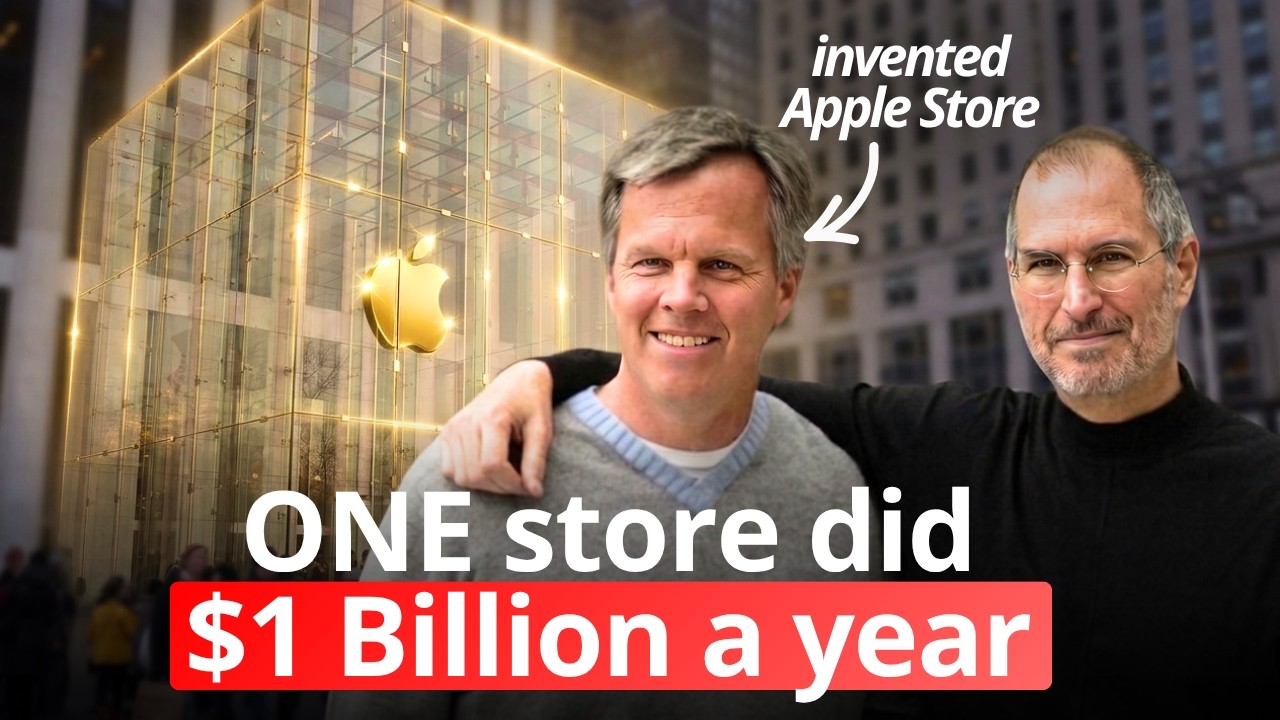
Ron Johnson, who ran Apple's retail expansion under Steve Jobs, argues that the Apple Store succeeded because it was designed to dissolve customers' fear of technology rather than to sell to them. He traces that idea from his Target work with Michael Graves through the Genius Bar, no-commission staffing and Jobs's unusual way of delegating.
The tension is that the same conviction did not travel. At J.C. Penney, Johnson says he moved too fast, lost employee support and saw sales fall 22% in his year, and he lost $50 million of his own money. What separates the two outcomes: the product, the speed of change, or a patron like Jobs?
Hiring subject-matter experts — ▶ 1:32
Jobs hired Johnson after a 3-hour conversation in which the two effectively designed the store. Johnson's explanation is that Jobs sought the best expert in each industry, naming Jony Ive in design and Tim Cook in operations, and saw Johnson's Target design partnership with Michael Graves as proof. Johnson says his own skill was bringing exceptionally interesting products to the masses, with an 80-90% hit rate on Target ideas by his estimate. What he took from Jobs was presence: an intensely curious listener with no objective in a conversation.
Interrupting shopper expectations — ▶ 4:48
Seeing a $150 Graves tea kettle, Johnson asked why good design has to be expensive. Target's sourcing brought the same quality to $25, and Williams Sonoma-type utensils from $15 to $5.99. Target's CEO suggested 3 items on an end cap; Johnson launched 140 SKUs. His mechanism is that shoppers form a visual imprint of a store and expect it again, so a change must be big enough to interrupt that expectation. Customers were already in the building for essentials, so the task was attention inside the store, not drawing them in.
Aim at the other half — ▶ 13:55
Jobs believed Apple's strength was creative professionals and that stores could double market share from 5% to 10%. Johnson refused to join for that goal, arguing half of America had not yet bought a computer. Jobs objected that Apple had spent 25 years competing with Microsoft, which held 95% share. Johnson's counter was that Microsoft had not won that other half either. The stores were therefore built for everybody. The logic favors serving non-consumers over fighting an incumbent for share, though Johnson offers no data beyond these figures.
Delegating through shared judgment — ▶ 18:20
Johnson told Jobs the store would be customers' first impression of Apple, not the product. Jobs called back that night: he touched every other part of Apple in Cupertino, but Johnson would pick locations and hire people. His rule was to come to him only when Johnson did not know how he thought. The mechanism was heavy: 4-hour Monday executive meetings, 3-4 hour Tuesday design sessions, and nightly calls that tapered after about a year and a half. In effect, Jobs transferred his judgment first and then stepped back.
Interesting people, no commissions — ▶ 19:55
Jobs's top hiring criterion was interesting people, because they think differently and are remembered. Johnson convinced him to skip commissions, saying he doesn't believe in selling to customers whose main obstacle is fear of technology. Staff were paid fairly in advance so they would look in their hearts, not their wallets. Johnson later qualified this: Nordstrom and Zegna use commissions successfully, he finds them harder to make work at lower prices, and the approach may have been unique to Apple, where buyers visit 4 or 5 times before purchasing a big-ticket product.
Stores as destinations — ▶ 21:49
Stores went into malls because people won't drive 10 miles but will go 10 ft out of their way. Johnson says Bloomingdale's window designers created interactive displays, and free high-speed internet on every computer made stores a meeting point, even where people created their first Facebook accounts. In 2002 a SoHo employee let a woman whose PC had died use a store computer to finish a book. Staff were empowered to do whatever it took to solve a customer's problem. Johnson says Jobs defined solving someone's problem as an act of love.
Why stores lost money — ▶ 26:33
Stores needed $15 million each to break even and opened at about $10 million. Apple shrank the store format slightly but kept to 25 openings a year. Johnson blames the early losses on Apple's product road map: in 2002 sales fell 38% as the Mac moved to Intel, and stores took off once the iPod went to Windows. He also says Apple needed stores to succeed, after 25 years with the worst go-to-market of any company. He cites a Hong Kong store doing half a billion dollars in its first year; his Fifth Avenue figure is hearsay.
Genius Bar naming — ▶ 31:22
Customers' biggest fear was that technology would be too complicated, so Johnson proposed a bar rather than a service desk. Jobs liked the bar but objected to the name, arguing technical people are geeks who can't talk to customers and suggesting a Geek Bar. Johnson argued the title worked as recruiting: it had to attract the smartest person in each city who also loved people, someone a Ritz-Carlton would hire. By the next morning Jobs had asked the general counsel to trademark it. Johnson says Jobs wanted the smartest idea in the room, not the smartest person.
Penney's moved too fast — ▶ 46:26
Johnson took J.C. Penney to reinvent the US department store, an industry he says fell from 150 nameplates to 10, with 4 that mattered. He assumed his reputation would earn employee support. Instead, employees felt they had survived and saw no reason to change. His own diagnosis is speed: the board wanted him to move fast, and he went way too fast, without time to explain the plan or let people add their fingerprints. At Apple he had hired everyone himself; at Penney's he felt alone, with no support from the board, press or employees.
Penney's discount trap — ▶ 48:54
Johnson says Penney's sold nothing at regular price: 100% of merchandise went at an average of 66% off, to customers who came for a sale and a coupon. Sales fell 22% in his year against a plan he recalls as 15%, compared with Apple's 38% decline. He argues the lost customers were the least profitable. After months of discussing a return to the old model, he resigned. He says he invested $50 million of his own money, lost it all, and earned $1.5 million a year. His verdict: better, but not great, against Amazon, Walmart and Target.
Metrics without commissions — ▶ 57:50
Johnson's first metric was daily store traffic, since it shows opportunity. Next was conversion, which need not be high but must be rising; he says rising conversion signaled traction even while volumes were down. Then came average dollar sale and attach rates such as AppleCare, which he says about 60% of customers now buy. He argues selling AppleCare without commissions works because it is the right thing for the customer, and that data compared across stores forms intuition. He says he felt no stress presenting these figures at Apple.
Ron Johnson's account of Apple's stores reduces to a single design decision: treat the customer's fear of technology as the problem, then build everything else around dissolving it. Johnson says the biggest fear a customer had was that technology would be too complicated. Persuasion does not overcome that fear, which is why he told Steve Jobs, "I don't believe in selling." The stores had no commissions, staff were hired for being interesting, and employees were told to do whatever it took to solve a customer's problem. Johnson frames the logic as a bet on repeat visits. A buyer who might make 4 or 5 trips before a large purchase needs a reason to return, not a pitch.
The same instinct appears earlier at Target, applied to a different problem. By Johnson's telling, Target's 1990s strategy of differentiation made it different but not better. The Michael Graves collaboration was his answer: a $150 tea kettle manufactured through Target's sourcing and sold for $25. The more transferable lesson concerns scale and attention. Shoppers form a visual imprint of a store and expect it on the next visit, Johnson argues, so a change must be large enough to interrupt that expectation. Hence 140 SKUs and what he calls 72 ft of interruption, rather than the 3 items on an end cap that Target's CEO suggested.
His second move at Apple was to refuse a smaller ambition. Jobs believed Apple's strength lay with creative professionals and that stores could double market share from 5% to 10%. Johnson objected that half of America had yet to buy a computer. Jobs countered that Apple had spent 25 years competing with Microsoft, which held 95% share. The stores were then built for everybody. Location followed the same reasoning. Stores went into malls because customers will not drive 10 miles but will go 10 ft out of their way, and free high-speed internet turned the computers into a reason to meet there. Johnson recalls people opening their first Facebook accounts in them.
What made this possible, in Johnson's account, was the way Jobs delegated. After Johnson pointed out that the store would be customers' first impression of Apple, Jobs called back that night. He explained that he touched every other part of Apple in Cupertino, and that Johnson would be choosing locations and hiring people. His rule was to come to him only if Johnson did not know how he thought. The structure behind it was heavy: 4-hour Monday executive meetings, 3-4 hour Tuesday design sessions, and nightly calls for roughly a year and a half. In effect, Jobs transferred his judgment first, then stepped back.
The Genius Bar shows that process at work. Johnson proposed a bar as the opposite of a service desk. Jobs liked the bar but not the name, arguing that people who know technology are geeks who cannot talk to customers, and suggested recruiting at a Geek Bar. Johnson returned with a recruiting argument. The title had to attract the smartest person in each city who also loved people, someone a Ritz-Carlton would hire, and the way to do that was to offer the honor of being an Apple Genius. By the next morning Jobs had asked the general counsel to trademark the name. Johnson's lesson is that Jobs wanted the smartest idea in the room, and needed it to appeal to both head and heart.
The economics were less tidy than the stories. Stores needed $15 million each to break even and opened at about $10 million. Apple made small tweaks, including a slightly smaller store, but kept opening, having agreed on 25 a year. Johnson's diagnosis is that the stores lost money because Apple lacked the right product road map: in 2002, he says, sales fell 38% during the Mac's move to Intel, and the stores took off once the iPod went to Windows. That reads as an argument that stores amplify products. Yet he also says Apple could not succeed without stores, having had the worst go-to-market of any company. The two claims are hard to separate.
J.C. Penney is where the same conviction met different conditions. Johnson took the job to reinvent the US department store, an industry he says fell from 150 nameplates to 10, with 4 that mattered. He expected his reputation to carry the organization. Instead, employees felt they had survived and saw no reason to change. His own diagnosis is speed: the board wanted him to move fast, and he moved too fast, without getting to know employees, investors or customers, and without letting people put their fingerprints on the plan. At Apple he had hired everyone himself. At Penney's he inherited them. The contrast he draws is between conviction and consent.
The customer problem compounded the organizational one. Johnson says Penney's sold nothing at regular price: all merchandise went at an average of 66% off, to customers who came for a sale and a coupon. Sales fell 22% in his year against a plan he recalls as 15%, a drop he sets beside Apple's 38%. He argues the customers lost were the least profitable. After months of discussing a return to the old model, he resigned. He says he invested $50 million of his own money and lost all of it, and was paid $1.5 million a year, not the $100 million of rumor. His own verdict is sober: the vision could have been better, but not great, against Amazon, Walmart and Target.
Johnson's self-assessment deserves more scrutiny than he invites. The Apple evidence is largely his recollection, and some figures are shaky. He says he has heard that the Fifth Avenue store has done $1 billion in a year, and the figure he follows with is garbled in the transcript. The Hong Kong claim of half a billion dollars in its first year is also his own. More importantly, his account of what carried over is mixed. He says he felt no stress at Apple because Steve's got his back, and describes being alone at Penney's. That implies the Apple model leaned on conditions Penney's lacked. He also concedes the no-commission approach may have been unique to Apple, noting that Nordstrom and Zegna use commissions successfully.
The metrics he names suggest how he judged experiments without commissions. He watched traffic daily, then conversion, which needed to be rising rather than high, then average dollar sale and attach rates such as AppleCare, which he says about 60% of customers now buy. These measure whether people return and trust the store. They also explain how he tolerated early losses: rising conversion while volumes lagged counted as traction. The unresolved issue is what a leader without Jobs's cover can use as that evidence. At Penney's he had a falling sales number and a board inclined to go back, and his account does not say whether any early indicator would have bought him the time.
The open question. Johnson says Apple's stores lost money until the product road map caught up, and also that Apple could not succeed without them. Which was the cause and which the amplifier? The answer decides whether the model is portable. If the stores amplified strong products, a retailer with weak products cannot copy the playbook. Johnson also offers no early indicator that would have bought him time at J.C. Penney, where traffic or conversion might have competed with a falling sales number and a board inclined to return to coupons.
Watch the full video at https://www.youtube.com/watch?v=NHBQwAZZ3KI.
Comments ()